It’s no joke: starting April 1st, the Dutch are asked to suggest topics for
scientific and scholarly research via a national website, launched by a coalition of the
national Confederation of Industry and Employers VNO-NCW, the Association of Universities
in the Netherlands, the Royal Academy of Sciences, and the national research council NWO. According to its website, the
Science Agenda ‘consolidates the themes that science
will focus on in the coming years.’
Under the
guise of a democratising measure, the autonomy of academia is being curtailed.
When the overarching science policy of which this agenda is part was launched
several months ago, newspapers received dozens of letters to the editor by scholars denouncing the
measures as inappropriate and threatening to the quality of Dutch research.
While it is too late to stop the agenda, the launching of the crowdsourcing
website helps us to understand what is really happening.
In all
western nations, the arts and sciences have been treated as related domains
throughout the long nineteenth century. Even though the gap has widened since
World War II, their position vis a vis politics and government remains largely
the same. Yet, while in the arts this relationship has been defined in clear
frames, known in Britain as the ‘Arm’s Lenght Principle’, there is no official
position regarding the influence of politics on the academic agenda. Still,
what is happening to universities today, only mirrors what has happend to the
arts over the pas few decades.
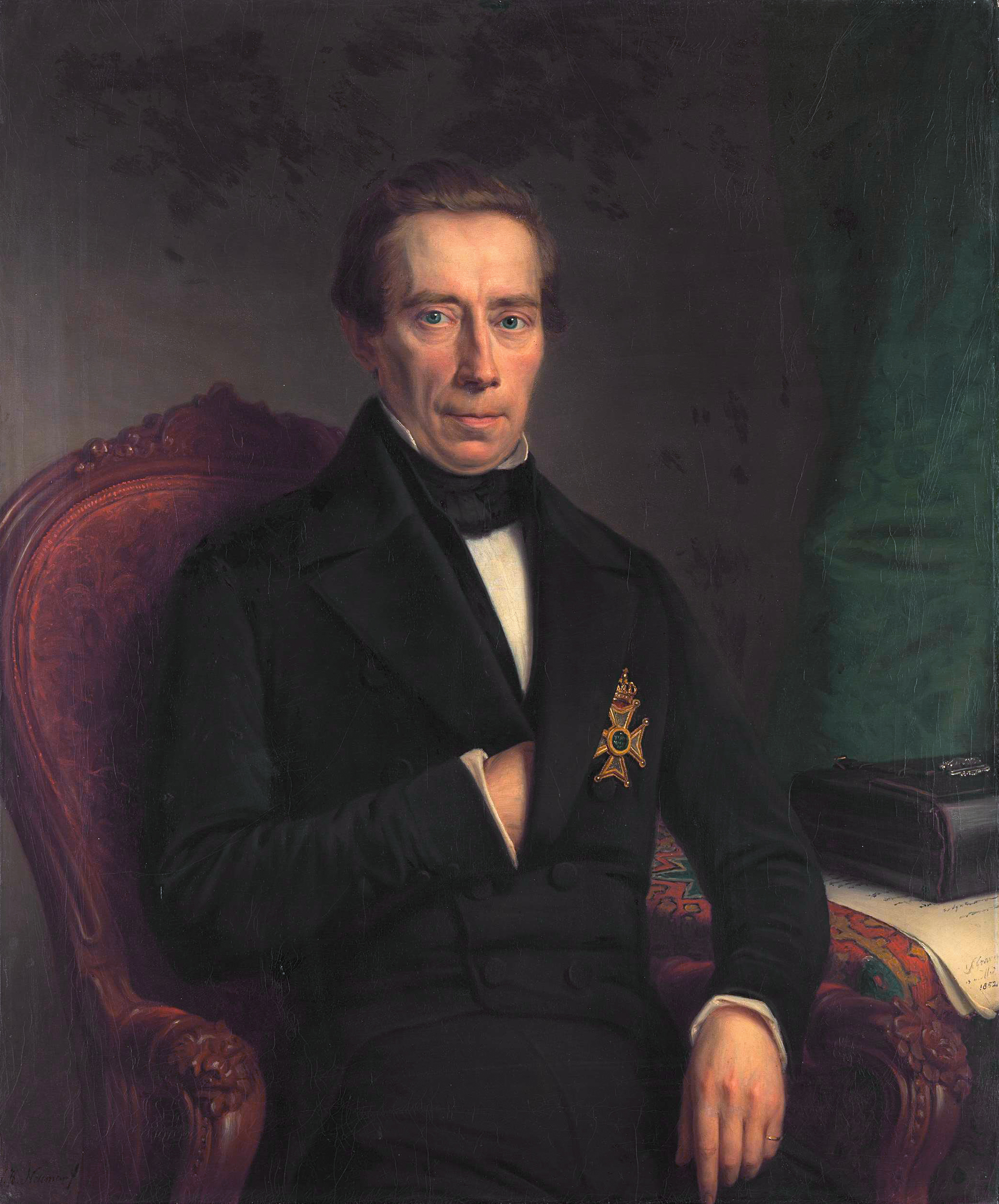
Nineteenth-century
Dutch prime minister Johan Rudolf Thorbecke famously stated that “De regering
is geen oordeelaar van wetenschap en kunst” – the government does not judge
science or art. This phrase, generally referred to as the Thorbecke Adage, has
been used to prevent the government from making artistic decisions, while at
the same time legitimising the construction of a large bureaucratic apparatus
aimed at indirect control over the arts. With the Science Agenda, politics is
looking for the same kind of back door into academia.
We’ve put together a fancy new video to promote our ground-breaking MA Programme in Creative Industries! Critical and Creative, Realist and Imaginative, this programme offers a thorough exploration of the changing landscape of cultural production. Whether it’s Fashion you’re interested in or Media, Trend Forecasting or Contemporary Art, the ins and outs of Tourism or a philosophical inquiry into Creativity; it’s all here, waiting for you to be discovered!
The Guardian presenteerde een paar weken terug‘
the 10 best art patrons’ aller tijden: tien opvallende mecenassen (vijf uit
het verleden, vijf hedendaagse), die de kunsten ieder op hun eigen wijze hebben
ondersteund. Een internationaal gezelschap van gulle gevers, soms bescheiden,
vaak veeleisend, meestal excentriek, dat een al even opvallende verzameling
kunstenaars om zich heen verzamelde.
Het lijstje zet aan het denken. Het
kabinet-Rutte ijvert al
tijden voor een nieuwe bloei van het Nederlandse mecenaat. Gulle gevers
zouden meer uit de schaduw moeten stappen, ter inspiratie van een nieuwe
generatie weldoeners. Zou een top tien van markante Nederlandse mecenassen
daarbij kunnen helpen? Vast wel. Daarom: anderhalve eeuw vaderlands mecenaat in
tien kleurrijke namen.
1 Johannes
Kneppelhout (rond 1860; muziek, literatuur,beeldende
kunst). Fanatieke weldoener
met licht neurotische trekjes die graag kunst én levenswandel van zijn protégés
bepaalde; had een voorkeur voor zeer jonge en maximaal kneedbare ‘artisten’. Hoopte
dat zijn protégés zijn naam als weldoener zouden vestigen tot aan het Parijse
hof aan toe. Werd daarin teleurgesteld.
2 Abraham
Wertheim (rond 1890; theater, muziek, beeldende kunst).
Armlastige kunstenaars die bij deze bankier
binnenliepen gingen zelden met lege handen de deur uit. Wertheim wilde trots
kunnen zijn op cultuurstad Amsterdam en speelde daarom een hoofdrol in de bouw
en financiering van cultuurtempels als de Stadsschouwburg; gewiekste zakenman met groot hart.
3 Hélène
Kröller-Müller (rond 1920; beeldende kunst). Kunstminnende dame
met ijzeren wil die tonnen uitgaf aan haar kunstcollectie en de bouw van
haar eigen museum, maar wier hoge verwachtingen en onmogelijke eisen haar architect
Van de Velde horendol maakten. Verzekerde hem desondanks dat ze ‘(…) geen
opdrachtgeefster [was]ter wille van mijzelf, maar ter wille van de kunst’.
4 René Radermacher
Schorer (rond 1930; literatuur, beeldende kunst). Mecenaat
op grote schaal door bescheiden, empathische en wat onzekere aristocraat;
ondersteunde een kring van tientallen schrijvers en kunstenaars; onder hen veel
experimentele avantgardisten. Plus ook nu nog aansprekende namen als Hendrik
Marsman, Jacques Bloem en Charley Toorop.
5 Joop
Colson (rond 1960; beeldende kunst, literatuur,
muziek). Rijke fotograaf die Kasteel
Groeneveld in Baarn kocht en daarna tevreden toekeek hoe ‘langharige artiesten
in vieze truien (…) fotografen, (…) proletarische dichters uit Het Gooi…’ zijn
kasteel overspoelden. Hielp ondertussen tientallen kunstenaars aan werk, schoof
hen van tijd tot tijd geld toe en betaalde hun studies.
6 Ludo
Pieters (rond 1970; literatuur). Havenbaron en ‘Vriend en Beschermer’
van Gerard Reve die heel blij met hem was (‘Mijn halve lichaam jeukt al van
woede bij de gedachte alleen – (…) dat
hij Bescherming, Goederen of Geld zou geven aan anderen dan aan mij’). Begon
als ‘Zeer geachte Heer P.’; werd al snel ‘Lieve Ludo’. Was vooral goed in het
schrijven van bemoedigende brieven: zijn financiële steun was bescheiden.
7 Pieter
Geelen (huidige tijd; beeldende kunst, literatuur, muziek).
Deze oprichter van TomTom (en zoon van kunstenaarsduo Imme Dros en Harry
Geelen) schonk in 2005 het immense bedrag van 100 miljoen euro aan de door hem
opgerichte Turing
Foundation. Niet al dat geld gaat naar de kunsten, maar het lijstje
ondersteunde kunstprojecten is desondanks indrukwekkend. Houdt vooral van kunst
die een brug naar het publiek weet te slaan.
8 Robert
Korstanje (huidige tijd; popmuziek). Energieke ondernemer
die rijk werd in de verpakkingsindustrie; exotisch vanwege zijn liefde voor
metalmuziek en zijn voornemen om de stad Nijmegen met het door hem ondersteunde
(en geleide) festival Fortarock als
metalstad op de kaart te zetten. Financiert ook metal-avonden in poppodium
Doornroosje. Is vanwege zijn ondernemersgeest en stadstrots in feite een
directe nazaat van Wertheim (nr 2).
9 Han Nefkens (huidige tijd; beeldende kunst, mode). Wil ‘erbij zijn wanneer een kunstwerk geboren
wordt’ en reist de wereld af om opdrachten te verlenen aan cutting edge beeldend kunstenaars. Stelt daarna hun werk
beschikbaar aan gerenommeerde musea,
wat niet alleen de kunstenaars en de musea helpt, maar ook hemzelf een vleugje
onsterfelijkheid verleent. Publiceerde in 2011 een lijvig boek
over zijn goede daden (net als nr 10 overigens, ook
in 2011).
10 Joop
van den Ende (huidige tijd; vooral podiumkunsten). De
onbetwiste koning van
het Nederlandse mecenaat, alleen al omdat hij zo vaak op die rol wordt
aangesproken. Schenkt jaarlijks miljoenen euro aan zijn VandenEnde Foundation, maar
selecteert de kunstenaars die ondersteuning krijgen liever niet zelf. Is
desondanks blij weldoener te zijn, want ‘een gevoel van gêne speelt ook mee,
als je achter je naam enige miljarden ziet staan’.
(Volgende keer, op verzoek: een lijstje van de
tien opvallendste Nederlandse ontvangers
van steun sinds 1850. En ja, Reve staat daarop, net als Willem Kloos. En Halina
Reijn.)
Thelast 15 years has seen a surge in speculative popular fiction focusing on theexistence of gods and mythical creatures trough a kind of thoughtform: If a
great enough number of people believe in the actuality of certain higher beings
deeply, passionately and for a prolonged amount of time, these beings are
enabled to ‘exist’, to intrude onto the physical plane of mankind and work
their not always so benign magic. In American
Gods(2001), – soon to be transformed into another major fantasy
tv-production – Neil Gaiman explores numerous pantheon’s in this way, from the
ancient Egyptians’ to modern day media-goddesses; In his incredibly
entertaining urban fantasy series The Iron
Druid Chronicles(2011- ongoing), Kevin Hearne makes the last remaining
Druid on earth battle witches, cooperate with vampires, and deal with Norse
gods and Native American tricksters; And traces of thoughtform motives can be
seen in the universes of such bestselling series as Jims Butcher’s The Dresden Files (2000 – ongoing) and
Seanan McGuire’s InCryptid series
(2012 – ongoing).
The
power of thoughtform as a literary theme, however, is not restricted to novels.
Last January, at the 2015 Image Expo in San Francisco, it was announced that a
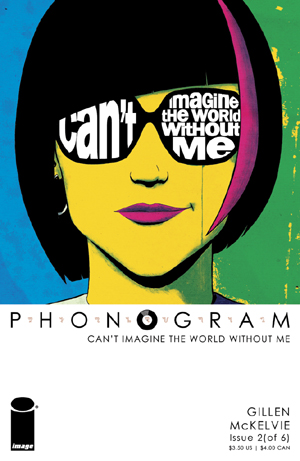
third series of the comic book (or graphic novel, whatever suits your fancy) Phonogram by Kieron Gillen and Jamie
McKelvie is to be published in August of this year. Its first volume Rue Britannia (2006-2007) tells the
story of the highly unlikeable chauvinist David Kohl, who is a phonomancer, a
rare kind of magician who feeds on people’s love for a certain type of music
and who can channel that love for magical use. Kohl is facing a dilemma: His
specific drug is Britpop, but suddenly the world appears to be slowly
forgetting its existence, and therewith Kohl’s, since he is kept alive by their
remembering. Kohl then starts on a literal trip down memory lane to save
Britpop, ensuring that not only he himself does not disappear, but, more
importantly in his eyes, people will still remember Kenickie as being the ultimate
goddesses of Britpop, that the mysterious disappearance of Manic Street
Preachers’ Richey Edwards will makes sure he will always be remembered… and
that (praise the good Lord!) people will not start thinking of those
proto-hipsters of Kula Shaker as actual Britpop. Phonogram is a mixed read: Kohl is one of the most unsympathetic
characters I have ever come across, but he is redeemed by his love for music.
Every reader of Phonogram, Britpop
fan or no,will be able to connect
with Kohl’s nostalgic longing for those days when you were being immersed into
a certain music scene for the first time in your life and your personal gods
came into existence – an experience that will form you, and maybe even haunt
you, for the rest of your days.
Our
current time in history, we might say, is an especially grim one, with
ideological wars raging all over the world, people becoming more and more connected
through electronics but less and less connected as human beings, and
differences are often more important than similarities. The gods we believe in,
if we do at all, are gods of hate and anguish – at least, those are the gods
that haunt our news bulletins. ISIS fighters destroy Muslim art in the world’s
museums, while Feyenoord supporters trash ancient Rome’s relics in Italy’s
capital. Their gods of religion and sports are ‘thoughtformed’ by annihilation,
hate and oppression, created through acts of barbarism rather than art.
Phonogram’s gods, on the other hand,
are thought into existence by love, admiration and creativity; and above all by
people’s passion for music. And that is why I am glad the Phonogram’s saga continues, while, as an avid reader of speculative
fiction, I believe the theme of thoughtform is becoming rather a cliché. Phonogram shows precisely what it is to
be human, to truly have faith in something outside of ourselves, and most
importantly, it shows that art, in this case music, is a symbol of hope in a
time when the world is so off-balance. Maybe, if the people of this world could
believe just a little harder, a little more passionately, in the gods we hear
on our radio’s, those we see expressed on canvases in our museums, those we see
on the stages of our theaters and encounter in the words of stories, the world
could be just that bit more of a
hopeful place. So if you stumble upon Phonogram’s
next installment ‘The Immaterial Girl’ somewhere this summer, don’t hesitate to
give a go; it might just change the world.
Last January the Belgian curator Frie Leysen was invited to give the closing keynoteaddress/speech of the Australian Theater Forum. She did not mince her words: ‘We have built theatres and arts centers, and we created festivals to produceand present art works and to welcome audiences in the best possible conditions.
But, during the years, most of these structures and organizations have become
rusted and sclerosized. They have become dinosaurs. (…) Originally meant to
support the artists, they got organized very well, often too well, and so lost
the needed flexibility to respond to the specific needs of specific works. The
artists now have to follow the policy and the rules of the houses instead of
the other way around.’ (The full lecture can be accessed here).
If we take a look at our Dutch playhouses, it is not too
difficult to see what Leysen is getting at: all plays seem to be made to fit
either the big or the small frontal stage; new, let alone experimental, theatre
is hard to find whereas there are plenty of adaptations, mostly of canonical
plays, which fit the classical structure of the play house like a glove.
Leysen knows the Dutch
situation all too well, as she made clear in her acceptance speech for the Dutch
Erasmus Price awarded to her last year. She rebelliously addressed King
Alexander sitting in front of her: ‘Your Majesty, your country has become a
place where the arts can barely breath.’ ‘How is it possible’, she continues, ‘that
one of the richest countries of the world no longer allows artists to
experiment and to think outside of the box?’ She is obviously referring to the
budget cuts of the previous government, effectively discouraging the creation
of new and temporary companies, and to the decision to stop supporting
‘artistic workshops, labs and research centers’. But the cuts go deeper, even
to the production level of the surviving companies. Whereas in the past few
decades theatre makers have had the tendency to look beyond the traditional playhouse
for new and different performance spaces (e.g. Dogtroep or Lotte van den Berg),
the current organization of city theatres no longer seems to embrace this
opportunity and for festivals it ironically almost seems a must to do so, rather
out of lack of performance space than because of it. They stick to the
habitual, fearing the risk more than the dinosaur.
A few months ago, the Arnhem-based theatre company Toneelgroep Oostpool performed ‘The Immortals’ in art house Lux in Nijmegen. At first sight this company seems to have adapted to the dinosaur type: in the past years they have been able to draw large audiences to their well-made adaptations of Shakespeare and modern novels like Virginia Woolf’s Orlando for either the small art house stage or the big playhouse stage. However, since the arrival of the new artistic team led by Marcus Azzini in 2012, its profile has been slightly adjusted. Oostpool still produces crafty adaptations of old and new classics, like ‘Reigen’ (Arthur Schnitzler) and ‘Angels in America’ (Tony Kushner), but it does so in combination with experimental plays mostly made by Suzan Boogaerdt and Bianca van der Schoot. The duo has established its own series called ‘Visual Statements’ which questions the contemporary obsession with visual culture, the spectacular and the self. Their performances, especially Hideous (Wo)men (2013) and The Immortals (2014), have troubled both the press and the usual Oostpool audience with their lack of plot and speech, as well as their ritualist hang-ups, involving many repetitive, gender-focused and abject scenes that disturb our view on television soaps (Hideous (Wo)men) and Youtube (The Immortals).
Interestingly, they also
have made an attempt to adapt and restructure the classical theater stage of
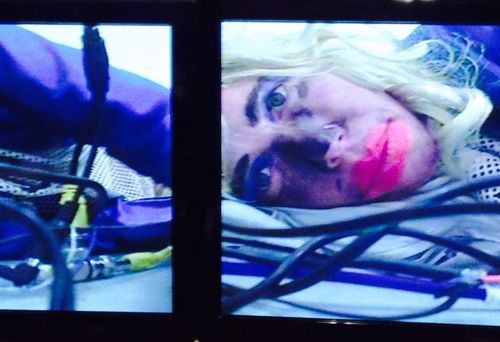
the playhouse to fit the concept of their performances. In Hideous (Wo)men, for instance, the audience has to watch a rotating
platform on which a television set is shown. The main structure remains
frontal, as the audience sits in the auditorium and the actors perform on
stage. Yet, in The Immortals the
auditorium is no longer used and the audience has to sit on stage trying to
peek into one of four rooms or to watch the flat screens showing what is
happening in the rooms: people broadcasting themselves endlessly. Once the
audience sits in its on-stage auditorium, the classical auditorium is no longer
visible and the classical stage loses its function as a stage. It turns into a
space very similar to what art houses and contemporary museums already have: a
performance room in which the dividing line between the audience and the performers
is less rigid. In other words, the production was performed in a space that was
not made for it. It is an inventive way of bringing their ‘visual statement’ to
the theatrical stage, no matter what that stage looks like, but it is also a
telling example of what Frie Leysen denounced in her keynote to the Australian
Theater Forum: the existing structures no longer adapt to the artists, the
artists have to adapt to the structures. They are obliged to dig around in the intestines
of the dinosaur. One never knows what can be found there, if one looks more
closely, but one does wonder what would be possible if the Dutch playhouses were
more keen on rethinking their structures and on inviting artists to do so as
well.
Plaster archeology is
a perversion. But a truly scientific one at that. It entails the deep mapping
of architectural facades, that is, observing buildings’ walls for information
that passersby normally wouldn’t notice. An inscription of someone’s
initials, a graffiti that’s barely visible, a fading advertisement of a cosmetic
product that no longer exists.
The plaster
archeologist spends a lot of time walking and staring at walls. The plaster
archeologist prefers walls that are layered, walls with plaster peeling off and
laying bare colors, or texts even that have been plastered over. The plaster
archeologist stops and observes where people normally keep walking, looking
ahead. Consequently, the plaster archeologist runs the risk of being perceived
as a weirdo.
Plaster archeology
also entails the noble quality of self restraint. For instance, decades of
neglect allow a chunk of the outer layer of plaster to fall off from a façade.
Part of the name of a store that used to be there in the late 19th
century is revealed. The plaster archeologist would instantly feel the urgency
to reveal the full name by removing more plaster. But this is to be avoided.
The plaster archeologist may not damage façades. Instead, the plaster
archeologist goes to the archives and goes through vintage photo collections to
decode what remains hidden behind plaster. And if there is no image, it’s all
well and good.
The city of Budapest,
where I grew up, is the ideal place to become a weirdo—and a plaster
archeologist. The bulk of the building stock of the city was built from mid to
late-19th century, when plaster abounded as a means of covering
buildings. Bullet holes from the war and the lack of means to renovate have
supplied me with ample material for years.
What about Nijmegen?
What about a city where walls are covered with brick and plaster is so rare?
Well, up until now I thought it would be a problem for the plaster
archeologist. But it is not so. The city bares the marks of World War II not
only in the absence of its old architecture in the city center but also in the
presence of scars on buildings’ walls, though one might not notice them at
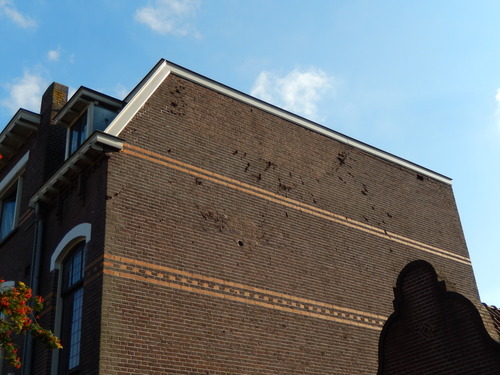
first sight. The side façade of 4 Prins Hendrikstraat is a case in point. Signs
of a massive impact close to the roof, perhaps housing a machine gun position.
Already walled in, but the scars bear witness. Brick is no impediment to
plaster archeology. Quite the contrary, it may open no horizons to dig.
Is meer minder?Deze vraag werd gesteld tijdens een lezing van Barry Schwartz aan de Radboud
universiteit over wat hij noemt de
keuzeparadox. In zijn boek The Paradox of Choice. Why more is less. How the Culture
of Abundance robs us of satisfaction, stelt Schwartz dat, hoewel een zekere mate van keuzemogelijkheid
bijdraagt aan het gevoel van autonomie, controle en vrijheid, juist een teveel
aan mogelijkheden kan leiden tot verlamming, verwarring en ontevredenheid.
In een aflevering
van “24 uur met”, werd de stelling van Schwartz mooi geïllustreerd. In de
uitzending van 9 januari was Frans Bauer te gast bij Theo Maassen (vanaf 2m52). Hij vertelde over het
enorme aanbod van aardbeienjam in zijn supermarkt en hoe dat groeiende aanbod
hem vooral veel tijd kost om zijn eigen vertrouwde pot jam te vinden.
Het staat buiten
kijf dat de mogelijkheid om zelf te kunnen kiezen voor een groot gevoel van
vrijheid zorgt en dat deze keuzevrijheid bijdraagt aan ons welzijn. We bepalen zelf welk model spijkerbroek bij
ons past en of we skinnyof bootcut willen dragen. We kiezen
welke aardbeienjam we op ons brood willen smeren en aan welk eisen onze
muziekspeler moet voldoen. Maar er is een dunne grens tussen een prettige
hoeveelheid opties en een onoverzichtelijk aantal mogelijkheden dat verlamt. We
worden ons steeds bewuster van onze keuzemogelijkheden en de consequenties van
de keuzes die we maken. Hoe meer alternatieven, des te hoger de
verwachtingen. Daarbij zijn we zelf
verantwoordelijk, ook als we achteraf niet zo tevreden blijken te zijn met het
resultaat. Hoe belangrijker het onderwerp is waarover we moeten beslissen, het
groter de stress wordt. Welke bacheloropleiding ga je doen? Voldoet die aan al mijn
wensen en vind ik daarmee een gave baan? Verkeerde studie gekozen? Dan draai je
zelf op voor de kosten. Verkeerde keuzevakken? Dan ben je zelf verantwoordelijk
voor je studievertraging. Welke master kies je vervolgens? Alleen al het kiezen
van een scriptieonderwerp kan enorm stressvol zijn.
Schwartz onderscheidt in zijn boek twee soorten mensen; maximizers en satisfiers.
De maximizer zoekt de allerbeste
optie. Hij bestudeert al zijn mogelijkheden, en steekt veel tijd (geld) en
energie in zijn zoektocht naar de perfecte keus. Omdat hij een duidelijk doel
voor ogen heeft (‘ik wil de beste auto’), zijn de verwachtingen enorm hoog en is
hij er uiteindelijk minder tevreden mee in vergelijking tot de satisfier. Die zoekt namelijk naar “goed
genoeg”, maakt zich geen zorgen over de mogelijk misgelopen betere alternatieven.
Een satisfier is dus altijd meer
tevreden met zijn besluit dan een maximiser.
De keuzestress
die we in onze Westerse maatschappij ervaren, wordt meer en meer erkend en daar
wordt heel handig op in gespeeld. Coaches bieden voor goed geld workshops aan over keuzestress
en Barry Schwartz geeft druk bezochte lezingen. Allemaal springen ze in op de behoefte om te
leren omgaan met die keuzestress in de hoop dat we duidelijk krijgen wat we nou
precies willen zodat we daar heel gericht voor kunnen kiezen. Tot voor kort behoorde de keuzeparadox exclusief tot het werkterrein van
psychologen, maar inmiddels is het ook opgepakt door verschillende creatieven; in maart is in
Nijmegen het eerste, spannende Choice Makers Festival.
Bij onze opleiding Kunst en
Cultuurwetenschappen is het aantal scriptie-onderwerpen beperkt tot de grenzen
van het domein van de cultuurwetenschappen; voor studenten biedt dat een enorme
hoeveelheid mogelijke scriptieonderwerpen. Misschien moeten we, omwille van het
reduceren van keuzestress en het helpen van de maximizers, het aantal scriptie-onderwerpen toch gaan beperken?
Deze maand een visuele primeur in het Amsterdamse Concertgebouw: Stravinsky’s _Vuurvogel_gespeeld door het Nederlands Philharmonisch Orkest, met geprojecteerde beeldenop een scherm van ruim vijftien meter breed. ‘Symphonic Cinema’ doopte regisseur Lucas van Woerkum dit nieuwe filmgenre. Geen bioscoopfilm met live muziek, maar het omgekeerde:
orkestmuziek met filmbegeleiding. Bij Symphonic Cinema staat de muziek voorop.
Het is veelzeggend dat dit fenomeen juist nu voet
aan de grond krijgt. Grof geschut wordt ingezet om het tij van de leegstromende
zalen te keren (hier: bekende acteurs, Gijs Scholten van Aschat en Hannah
Hoekstra). Meer zintuigen prikkelen, dat is het credo. En dus zal het vast niet
lang meer duren of ook de vroegere geurexperimenten uit bioscopen (Odorama, Smell-O-Vision) gaan de concertzalen veroveren.
Mensen die voor het eerst een klassiek concert
bezoeken noemen het een nadeel dat er op het toneel helemaal niets te zien is.
Je zit een avond lang te kijken naar mensen in saaie zwarte pakken die knullig heen
en weer bewegen op hun stoel en steeds op hun bladmuziek turen zonder contact
maken met hun publiek. Dat geeft een akelig gevoel (‘Ik word als toeschouwer
genegeerd’). Waren ze tussendoor maar opgestaan om een dansje voor ons te doen
of desnoods twee bemoedigende zinnen door een microfoon te roepen. Maar nee, dat
gebeurde niet. Overigens wordt datzelfde nadeel, het statische toneelbeeld, door
andere bezoekers juist als een groot voordeel gezien (‘Ik maak zelf wel uit welke
beelden ik wil zien, misschien wil ik wel helemaal niets zien. Ik kom hier om
te luisteren’).
Deze discussie, tussen voorstanders van ‘muziek-met
‘en die van ‘muziek-zonder’, wordt nu al twee eeuwen gevoerd. Componist/musicoloog
Elmer Schönberger hield in 2007 ‒ in navolging van
zijn Amerikaanse collega Peter Kivy (‘Music Alone’) ‒ nog een krachtig pleidooi voor het laatste, door hem ‘Het Grote
Luisteren’ genoemd, maar dit lijkt inmiddels een kreet uit een verloren tijdperk.
Zulke ‘pure muziek’ is voorgoed ouderwets geworden.
We willen alles begrijpen wat we horen.
Tegelijkertijd zijn we niet gewend om onze verbeelding te gebruiken. Dat valt
niet met elkaar te rijmen. Daarom zijn we zo blij met mensen die ons haarfijn kunnen
uitleggen dat op dat beroemde abstracte kunstwerk de bloederige klodders tegen
een achtergrond van groene lijnen niet alleen het diepste emotionele dal van de
kunstenaar verbeelden maar ook een impressie geven van het schamele onderkomen
uit diens jeugd, ver weg in een verlaten dorpje vol magere geiten in het
hooggebergte van de Sierra Nevada. En daarom zijn we ook zo dolgelukkig met
Lucas van Woerkum, die ons tijdens dat ontiegelijk saaie klassieke concert heel
precies in beelden uitlegt wat we moeten horen. Wat een opluchting!
“Smart clothes are hot,” stated the Een Vandaag news item last October. According to the television programme, a revolution is taking place in the fashion industry. However, as Anneke Smelik noted in a previous post on this blog, wearable technology is not something that many of us are actually wearing. The question is: why would we?
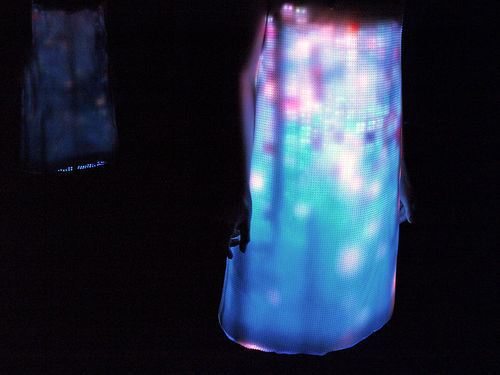
Currently on show at the Boijmans van Beuningen museum in Rotterdam is the exhibition ‘The Future of Fashion is Now’ (until January 18, 2015), which includes several designs that can be described as wearable technology: the famous laser-beam hat by Hussein Chalayan, the cell phone charging ‘Solar Dress’ by Pauline van Dongen and sound-activated clothing by Ying Gao. These projects are displayed in the museum for a reason: they are visually stunning, technically complex, highly artistic and all raise question as to what fashion is and could be. Yet, although fascinating in its own right, this is not the kind of fashion that you and me would be able to buy and wear. The one-off pieces are but prototypes of a future yet to come and designed to be looked at, rather than worn. Recent developments, however, indicate that wearable tech is on the verge of a breakthrough in a more mundane context as well.
Last December, the collaborative project ‘Zorgzame Bedrijfskleding’ (‘Careful Corporate Clothing’) was presented during a health care conference in Rotterdam. The projected resulted in a collection of sustainable and supportive garments for nurses, including some designs with a posture sensor, gas sensor and antibacterial coating. The posture sensor helps healthcare employees – who often perform physically heavy work – to be more aware of how they use their bodies and prevent any overburden, while the gas sensor can warn them of any harmful gases. Another inspiring example is the ‘Mesopic / Light Jacket’ that Pauline van Dongen developed in collaboration with Philips Research. The jacket contains several LED ribbons that increase the wearer’s visibility and safety in a dark environment. The light strips have been integrated in such a subtle way, that the jacket has a desirable and fashionable look during the day, as well as an aesthetically pleasing functionality during night-time.
Projects like ‘Zorgzame Bedrijfskleding’ and ‘Mesopic’ indicate that the field of wearable technology is rapidly maturing. These examples imagine a time at which technology and fashion have will truly have become one: a time at which clothing will protect, support and care for us, in addition to being a form of expression and adornment. Yet, even if technology will help fashion to become a form of intimate caretaking rather than conspicuous consumption, the key to a proper revolution in the fashion industry is the wearer. Ultimately, if our future clothes will actively nurture, support and soothe us, how shall we treat them in return?



 Culture Weekly