Plaster archeology is
a perversion. But a truly scientific one at that. It entails the deep mapping
of architectural facades, that is, observing buildings’ walls for information
that passersby normally wouldn’t notice. An inscription of someone’s
initials, a graffiti that’s barely visible, a fading advertisement of a cosmetic
product that no longer exists.
The plaster
archeologist spends a lot of time walking and staring at walls. The plaster
archeologist prefers walls that are layered, walls with plaster peeling off and
laying bare colors, or texts even that have been plastered over. The plaster
archeologist stops and observes where people normally keep walking, looking
ahead. Consequently, the plaster archeologist runs the risk of being perceived
as a weirdo.
Plaster archeology
also entails the noble quality of self restraint. For instance, decades of
neglect allow a chunk of the outer layer of plaster to fall off from a façade.
Part of the name of a store that used to be there in the late 19th
century is revealed. The plaster archeologist would instantly feel the urgency
to reveal the full name by removing more plaster. But this is to be avoided.
The plaster archeologist may not damage façades. Instead, the plaster
archeologist goes to the archives and goes through vintage photo collections to
decode what remains hidden behind plaster. And if there is no image, it’s all
well and good.
The city of Budapest,
where I grew up, is the ideal place to become a weirdo—and a plaster
archeologist. The bulk of the building stock of the city was built from mid to
late-19th century, when plaster abounded as a means of covering
buildings. Bullet holes from the war and the lack of means to renovate have
supplied me with ample material for years.
What about Nijmegen?
What about a city where walls are covered with brick and plaster is so rare?
Well, up until now I thought it would be a problem for the plaster
archeologist. But it is not so. The city bares the marks of World War II not
only in the absence of its old architecture in the city center but also in the
presence of scars on buildings’ walls, though one might not notice them at
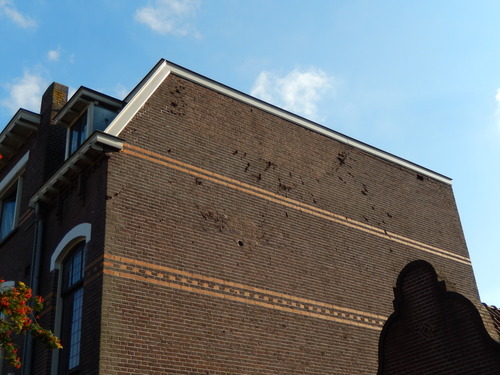
first sight. The side façade of 4 Prins Hendrikstraat is a case in point. Signs
of a massive impact close to the roof, perhaps housing a machine gun position.
Already walled in, but the scars bear witness. Brick is no impediment to
plaster archeology. Quite the contrary, it may open no horizons to dig.
“Smart clothes are hot,” stated the Een Vandaag news item last October. According to the television programme, a revolution is taking place in the fashion industry. However, as Anneke Smelik noted in a previous post on this blog, wearable technology is not something that many of us are actually wearing. The question is: why would we?
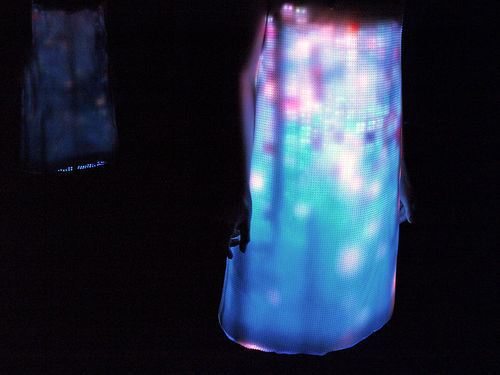
Currently on show at the Boijmans van Beuningen museum in Rotterdam is the exhibition ‘The Future of Fashion is Now’ (until January 18, 2015), which includes several designs that can be described as wearable technology: the famous laser-beam hat by Hussein Chalayan, the cell phone charging ‘Solar Dress’ by Pauline van Dongen and sound-activated clothing by Ying Gao. These projects are displayed in the museum for a reason: they are visually stunning, technically complex, highly artistic and all raise question as to what fashion is and could be. Yet, although fascinating in its own right, this is not the kind of fashion that you and me would be able to buy and wear. The one-off pieces are but prototypes of a future yet to come and designed to be looked at, rather than worn. Recent developments, however, indicate that wearable tech is on the verge of a breakthrough in a more mundane context as well.
Last December, the collaborative project ‘Zorgzame Bedrijfskleding’ (‘Careful Corporate Clothing’) was presented during a health care conference in Rotterdam. The projected resulted in a collection of sustainable and supportive garments for nurses, including some designs with a posture sensor, gas sensor and antibacterial coating. The posture sensor helps healthcare employees – who often perform physically heavy work – to be more aware of how they use their bodies and prevent any overburden, while the gas sensor can warn them of any harmful gases. Another inspiring example is the ‘Mesopic / Light Jacket’ that Pauline van Dongen developed in collaboration with Philips Research. The jacket contains several LED ribbons that increase the wearer’s visibility and safety in a dark environment. The light strips have been integrated in such a subtle way, that the jacket has a desirable and fashionable look during the day, as well as an aesthetically pleasing functionality during night-time.
Projects like ‘Zorgzame Bedrijfskleding’ and ‘Mesopic’ indicate that the field of wearable technology is rapidly maturing. These examples imagine a time at which technology and fashion have will truly have become one: a time at which clothing will protect, support and care for us, in addition to being a form of expression and adornment. Yet, even if technology will help fashion to become a form of intimate caretaking rather than conspicuous consumption, the key to a proper revolution in the fashion industry is the wearer. Ultimately, if our future clothes will actively nurture, support and soothe us, how shall we treat them in return?
Money, or more specifically, capital, is a hot and controversial issue in the art world. As Jan Baetens noted recently on this blog, commerce in and commercialization of the art world are debated subjects. Magazines and newspapers report record after record in sales: just recently, nine New York auctions of art from the 1950s to today raised (combined) $ 2.230.800.000, with Christies alone raising 853 mil. dollar (682 mil. euro). These sales led to, for instance, the Dutch newspaper the NRC, and international art news outlets such as the Art Newspaper and Art News proclaiming it the greatest auction record in history, and noting that ‘never before has so much money been spent on art in such a short period’.
The fact that for instance Triple Elvis by Andy Warhol was auctioned for $81.9m makes people upset, to say the least. There are complaints about the art market being a bubble. Auctions houses, gallery owners, and buyers are accused of speculating. New billionaire buyers on the art market buy art only as an investment; or, at best, they buy art to increase their social standing. All of this is clearly considered deplorable. As Matthew Slotover, co-founder of influential art platform Frieze stated recently at a panel discussion, ‘Money should follow art. Art should not follow money’.
The panel discussion in question was ‘Art, Capital & Avantgarde’, hosted at Amsterdam discussion venue De Balie as part of the Amsterdam Art Weekend programme (28-11-2014). Other speakers included the new director of the Stedelijk Museum, Beatrix Ruf, artist Zachary Formwalt, and sociology professor Olav Velthuis. The discussion’s description asked whether there still even is ‘critical potential to a painting that has become a market-fetish, a toy for speculative investors and a glaring symbol of the global inequality of wealth?’ Indeed, can one even avoid the ‘pitfall, power and influence of big money’?[1] A similar spirit of fear, distrust and even disgust towards money pervaded the panel. Traces of a moral panic were undeniably tangible. Artists, institutions, galleries and also, collectors and buyers should above all be motivated by the quality of art; or such was the consensus. The presence of capital in the art market—and its related associations of speculation and investment—was clearly considered a horrible development. Young rich buyers acquire art works of Hirst, Koons, Warhol or Richter only to store them; in other words, they don’t even have visual access to their art, let alone any aesthetic enjoyment if it. What horror!
The one really valuable contribution to the panel, in my view, was provided by the one scientist on the panel: sociologist Velthuis from the University of Amsterdam. Using data and statistics, Velthuis made clear that the money-discussion is indeed a moral panic, perpetrated by the media, which has nothing to do with actual developments in the art market. Indeed, corrected for inflation, the total amounts made at art auctions have over the past 30 years hardly kept any pace with the growing number of billionaires worldwide. Whatever those new billionaires are doing with their money, they’re certainly not buying art. Velthuis’s book Talking Prices. Symbolic Meanings of Prices on the Market for Contemporary Art (Princeton University Press, 2005) clearly outlines how the panicky art discourse operates, and subsequently demonstrates why it is based on untruths and distortions by using historical data and insightful statistic analysis.[2] Besides for students of art markets, art sociology, patronage and the arts in general, it should be obligatory reading for members of the art world as well.
In the end, the most important question, which touches upon the roots of this debate, remained unanswered. Why, in fact, are money and capital such “dirty” concepts in the art world? Why should art not follow money? Indeed, already in the art market of the Dutch Golden Age collectors were buying art as an investment, or to raise their social status, besides out of appreciation of its aesthetic qualities. In Renaissance times the Florentine Medici family were great patrons of the arts, and they used their patronage to gain further wealth, influence and power. Art has never stood apart from society and that society’s concerns. Obviously throughout the history of the arts aesthetic quality has been talked about as the major qualifier for discussing, collecting and acquiring art, but in the end, money, social standing and other concerns have always played their part in the real transactions of art. Only a cursory study of contracts between artists and patrons will reveal this. This, clearly, is why cultural historians are such a welcome presence in these debates. If only to point out that the notion that art should remain free of any social or financial worth, but be pure, authentic and original and only judged on its aesthetic worth, goes right back to 19th century art discourses. Thus this ‘moral panic’ about art prices is nothing new—and not even true, at that.
[2] Read the introduction here: press.princeton.edu/chapters/i8035.pdf.
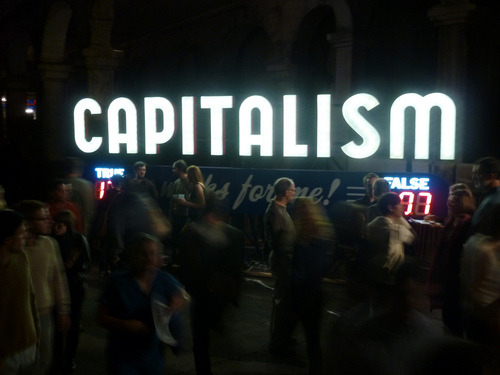
Image credits: Steve Lambert, ‘Capitalism Works for me’ at Spaces Gallery, https://www.flickr.com/photos/spacesgallery/6173517984/in/photostream/ shared under creative commons
With all the fuss about the creative industries and 21st-century skills, it seems to have escaped our attention that the real revolution In the arts is taking place elsewhere: in the world of healthcare. The arts have subtly, to some even unconsciously, changed their slogan. Arts are good for you: they make you happy and healthy, they stimulate your social life and keep you sober, help you overcome your fears and keep you focused. The arts are therapy. And all of this keeps the arts funded – which is more than just a side effect.
Art Therapy was at its peak in the seventies. Theatre groups, like the Dutch Werkteater, staged plays in hospitals and penitentiary institutions with the aim to reform both theatre and society. The belief in the transforming power of the arts seemed unlimited. The dream did not last and from the late 1980s onwards, quality and management became the new standards in the arts world. Recently, however, the tide has changed. This paradigm shift was heralded by philosopher Alain de Botton in his exhibition ‘Art is Therapy’ at the Rijksmuseum (April-September 2014) and the accompanying book Art as Therapy, co-written by art historian John Armstrong – note the difference (is/as) in the titles.
While de Botton is unable to escape the 1970’s Freudian frame of the arts as the expression of the unconscious, a growing number of arts organisations have re-discovered the arts as a hard core medicine, for instance in the treatment of Alzheimer’s disease, or in the treatment of autistic children. Starting from the development of community arts and the proof of the effects of music on intelligence in primary education, the arts are now embracing their effects on social, cognitive, as well as physical health as their principal proof of their relevance to society.
While cuts to art subsidies seem to threaten specialised disability arts organisations the ‘able’ arts organisations are more than anxious to enter the domain of (mental) health care in reaction to the same budget cuts. In a desperate leap forward, arts organisations are claiming the therapeutic effects of the arts (art as therapy), just to keep the money coming. In reality, healthcare is itself the treatment for art’s own disease: poverty. Meanwhile, arts organisations risk changing the very nature of the essence of the arts from distant critic of politics to practical tool for society (art is therapy).
—
Image credits: ‘Unlimited Traineeship’, Ian Johnston -Dancer, Unlimited Festival 2014. Photographer: Niall Walker.
Wouldn’t it be great if you could generate electricity with your jacket? Or load your mobile in the pocket of your jeans? Or wear a sweater that can send a tweet?
‘Wearable technology’ is the new trend in fashion. To create ‘wearables’ (as they are called), fashion designers and scientists wire complex systems of microprocessors, motors, sensors, solar panels, (O)LEDs or interactive interfaces into the fabric, textile or clothes. Designers experiment with these ‘smart materials’ to create thrilling examples such as a dress that connects you to twitter, a catsuit that visualises your emotions, jeans that change colour or measure your vital functions. This is what I call ‘cybercouture’. Interestingly, Dutch artists and designers like Pauline Van Dongen, Iris Van Herpen, Bart Hess, Daan Roosegaarde, Marina Toeters, and Anouk Wipprecht form the vanguard in the international field of cybercouture. It may all sound like the far future, but it is actually already happening – that is, in the lab or on the catwalk. But wearables hardly appear on the streets or in the shops. While the future of wearable technology has been announced time and again, the praxis lags behind.
The question then is how can we get beyond the stage of mere gadgets and gimmicks. At the Radboud University Nijmegen, together with the Technical University of Eindhoven, and the fashion academy ArtEZ in Arnhem, and six private partners, we have started an interdisciplinary research project, Crafting Wearables, to advance wearable technology to the next stage. The research project is funded by The Netherlands Organization for Scientific Research and brings together people from fashion design, technology, industry, museums and universities. The goal is to develop ‘wearables’ that are robust, fashionable and commercially viable. A nerdy outfit may be technologically cool, but it should also make you look pretty, be easy to wash or comfortable to wear. Moreover, it should add something fundamental and functional to your full wardrobe and the many technological devices that you already own.
As the body of the wearer becomes some kind of interface, there are also some philosophical implications of cybercouture. We have now entered an age in which we use technology with the idea that we can control, improve and enhance both our lives and our own bodies. Technology is one of the major factors in affecting our identity and changing the relation to our own body, and wearable technology even more so because of its closeness to the body. By wearing it directly on our bodies we relate intimately to technical objects and materials, further blurring the boundaries between body and technology. Integrating technology into our clothes will therefore have an impact on how we experience our bodies and our selves. For example, will the t-shirt that monitors my blood pressure make me more aware – or even self-conscious – of my body? How will it affect my friendships if my dress reflects my emotions without me having to express them? It is certain that cybercouture offers an encounter between fashion and technology, opening up to a future world where garments are merged with human skin, body and identity. The research program Crafting Wearables allows the Department of Cultural Studies to explore how wearable technology creates a web of new, complex and dynamic relations between the human being and her body, technology, and society.
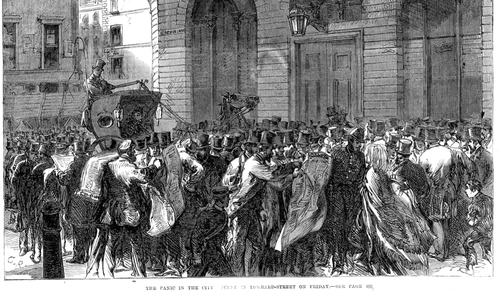
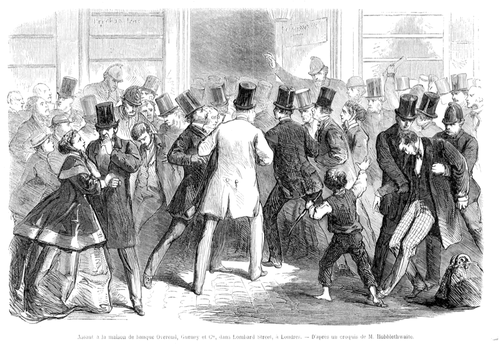
On May 19th 1866 curious images appear on the covers of the Illustrated London News and the French L’Illustration, the most famous illustrated newspapers of the nineteenth century. On the cover of the Illustrated News we see a crowd of top-hat-wearing men looking anxiously in large format newspapers, presumably the Times. The capitation reads: ‘The panic in the city. Scene in Lombard street on Friday’. The caption of the front page of L’Illustration is set to a different tune: ‘Siege of the office of the bank Overend, Gurney and Cie, Lombard street, in London’. Here we see a real panic: a crowd storming a bank, police trying to control the situation and a fainting man on the foreground. The cause of the ‘panic in Lombard Street’ is maybe already clear. Investors rushed to Lombard Street to get their money from the defaulting banking house of Overend, Gurney and Company.
It is not hard to compare the crisis of 1866 to the one that we are experiencing today. Overend and Gurney is often described as ‘the bankers bank’. The company dealt in bills of exchange: documents that guaranteed the payment of a specific amount at a specific date. Therefore, the bank can be compared to the financial institutions that caused the collapse of 2008. They were not involved in traditional products, like loans, but in the trade of financial derivatives. Overend and Gurney rose to prominence during the ‘Panic of 1825’, the first economic crisis that is not attributable to an external event, like a war, but mainly to speculative investment in Latin America including the imaginary country of Poyais (read more about it here and here). In 1825 the bank was able to extend loans to other banks that were bound to collapse and hereby started the so-called ‘interbank lending market’, an important component of our current financial system.
Were did it all go wrong? In the late 1850s the bank invested heavily in railway companies and other long-term loans. Ten years later the owners found that their short-term cash reserve amounted to only one million pounds while their liabilities were estimated at roughly four million (note that financial institutions in our time have far lower cash reserves). The directors of the bank reacted to this problem by turning their business into a limited company. In other words: they gave out stocks.
The newly acquired capital was invested in a rather irresponsible manner, as the early Marxist Henry Hyndman describes it, the directors of the bank “(…) were encouraging and embarking in enterprises of a character which were so unsound in themselves, and so dangerous from the class of people connected with them, that the veriest tyro [an absolute beginner] in finance would have instinctively shrunk from them (…)." Although the directors of Overend and Gurney were put on trial for fraud connected to these high-risk investments, the judge only found them guilty of ‘great error’ rather than criminal behaviour. This, of course, reminds us of the risks that employees in the financial sector are encouraged to take in our time (read the blog of Joris Luyendijk) and the lack of (legal) responsibility ascribed to them after the collapse of 2008.
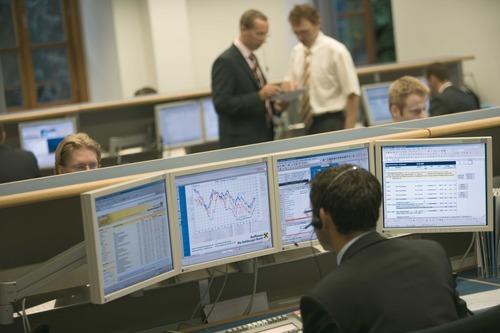
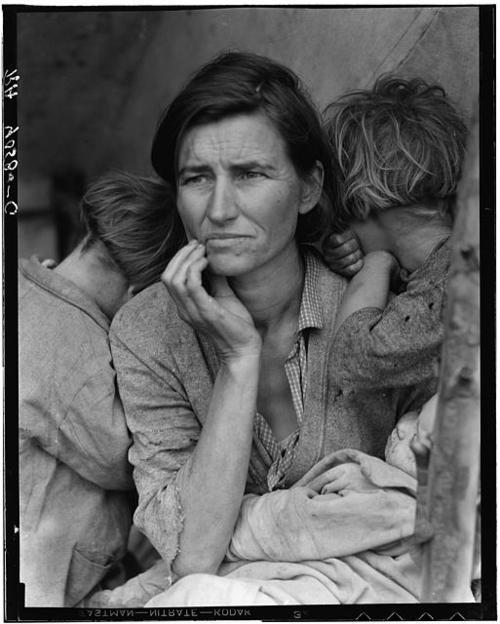
Because of major losses on the risky investments, the bank had to suspend payment on the 10th of May 1866. Shareholders rushed to the office of Overend and Gurney in Lombard Street to get their money and this lead to the chaotic scenes on the covers of the illustrated newspapers. Lets return to these images. How can we compare the visual coverage of the crisis of 1866 in the two illustrated newspapers to our ‘own crisis’? What and who do we see if we think about the current situation? Which images come to mind? What groups are seen as the victims of financial collapse? Type in ‘Great depression 1930’ on Google Images and you will find Dorothea Lange’s iconic Migrant Mother or a man holding up a sign ‘Work is what I want, not charity’. Personally, when I think of our crisis I see a young man, wearing an expensive suit, sitting behind his desk. He is staring at four, or maybe five, computer screens which all show the same descending red line. In other words: I see a poor investor, just like the ones on the covers of the illustrated newspapers in 1866. How is it that I don’t see an image of a family leaving their foreclosed home? A modern equivalent of Lange’s Migrant Mother? Why is it so hard for us – or at least for me – to imagine these victims of the crisis?
2: Detail of: ‘The panic in the city: scene in Lombard street on Friday’, Illustrated London News (19 May 1866).
3: ‘Assaut a la maison de banque Overend, Gurney et Cie, dans Lombard Street, à Londres’, L’Illustration (19 May 1866).
4: D. Lange, ‘Destitute pea pickers in California. Mother of seven children. Age thirty-two. Nipomo, California [Migrant Mother] (1936). Via Library of Congress.
See the original pages of the illustrated newspapers here and here.
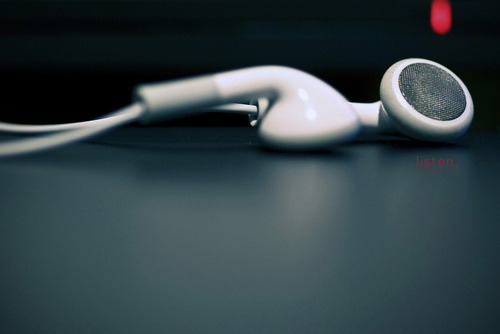
Hardly anyone could have missed the news regarding the new iPhone. In a well-orchestrated keynote presentation, held last month, Apple introduced the most recent iteration of its immensely successful product, again claiming that it is “the best iPhone ever.” Be it as it may, this wonderful device has caused the demise of another, former, hit product created by Apple: the iPod. Along with the introduction of the iPhone 6 the iPod Classic was quietly discontinued.
Of course, the iPod Touch, basically an iPhone without a phone, still exists, but this is a completely different device. An iPod Classic was a device devoted exclusively to music listening. Your entire music collection could be stored on its 160 Gb hard drive. The iPod Touch, on the other hand, does not have that storage capacity. Moreover, it is not meant as a music player, but as an interactive media device.
Perhaps at first sight this might not seem as a big deal, but the fact that Apple, one of the pioneers regarding the digital distribution of music, no longer offers a dedicated music player, may be indicative of a more general trend: a change in the way people appreciate music. In a rather nostalgic article, Wired’s Mat Honan links the disappearance of the iPod Classic to the fact that we are no longer defined by our music, music that we bought, owned, and collected. And I believe he is correct. Even though services such as Spotify and Rdio make most (but definitely not all) recorded music available to their users, creating a playlist in these services is not the same as collecting LPs, CDs, or even iTunes tracks. We no longer need to invest time and money in our music collection, and therefore the value we ascribe to music has changed.
Peter Kirn has a different take on these developments and discusses another recent phenomenon: releasing music as apps. Apps are particularly suited to devices such as the iPhone and iPod Touch, for they use both images and sound and invite interaction. Therefore, releasing music as apps turns music into something more than mere sounds, but at the same time transforms the way we define music. Take Björk’s Biophilia, for instance, one of the first examples of music as app. This app is almost a work of art, with excellent graphics that ask to be touched and manipulated. I have the app myself, but I still haven’t actually listened to the songs themselves. I’ve heard snippets of music while playing with the app, but I cannot really recall any of the songs. So, is music as app the future of music, or will it turn music into something else, a game perhaps?
High fashion and nerdy technology? Tourism and literature? Perhaps not the likeliest combinations, but nowadays they turn out to be highly complementary. If you want to know how and why, Creative Industries might just be the right Master’s programme for you.
The creative sector has grown into a proper industry: companies and social institutions borrow ideas from artists and designers, the tourist industry happily uses literary concepts in their marketing, and classical music, art and museums play a large role in city branding. The fashion industry has already proven that creativity and commerce fit together effortlessly, but this development needs to be evaluated critically from a historical and theoretical perspective. The Creative Industries Master’s degree, which is unique to the Netherlands, provides you with the tools to do just that.
Theory and practice
During the programme you will study the (post)industrial society as a cultural phenomenon. The case studies you will work with include the fashion-industry, new media and the role of images, and the tourist industry. You will also analyse themes such as creativity and the so-called ‘21st Century Skills’ in policy-making and education, the relationships between subjects and material culture, and how cultural heritage can be effectively incorporated in today’s ‘participation society’.
If you want to make a career in the area where art meets commerce, where highbrow meets lowbrow, and where elite meets public, Creative Industries will definitely suit your interests. This degree will help you develop the reflective, inquisitive and critical attitude you need to succeed in this field, while closely looking at research methods and discussions currently surrounding these topics. After completing the programme, you will have the skills you need to contribute to the development of the young and dynamic creative sector.

 Culture Weekly

