Professor Anneke Smelik en modeontwerper/promovenda Pauline van Dongen praten met NPO Docs over hun samenwerking.
Category Archives: Geen categorie
Shaping Ships
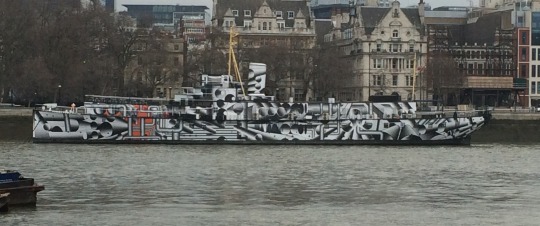
Walking along London’s Victoria Embankment one cannot help
but notice a UFO, in this case an unidentified floating object. Upon closer
inspection (and use of reason) the object reveals itself as a ship featuring a
variety of forms and colors painted all over its hull and superstructure. The
ship is the HMS President, built in
1918, and covered with “dazzle painting” by German artist Tobias Rehberger in
July last year.
Besides the HMS
President two other ships have received similar treatment by renowned artists
Peter Blake and Carlos Cruz-Diez as part of the commemorations of the 100th
anniversary of World War I. For dazzle painting is a type of camouflage used
primarily by the British and the American navy during the Great War.
If camouflage is meant to conceal an object, how can
something so spectacular serve this purpose? Indeed, dazzle painting is the
opposite of camouflage that allows an object to blend into its environment. With
the growing threat of submarine attacks navy officials soon realized the
impossibility of concealing any vessel at the high seas. What seems like a
counterproductive attempt at camouflage, the role of dazzle painting was
nothing else but to disrupt the shape of a ship so as to make it difficult to
identify its size, speed, and course.
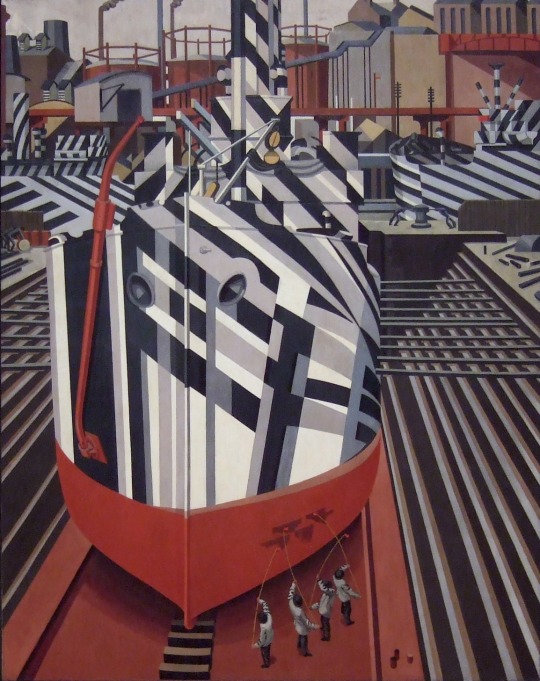
By no means a surprise, many Cubist artists soon found
themselves in the ranks of the navy, the army. Paul Klee, for instance, painted
camouflage on German airplanes, while the English vorticist Edward Wadsworth produced
a series of paintings depicting dazzle painted ships in harbor, drawing on his
wartime experience as a camoufleur.
Whether the patterns that they designed had ever
managed to dazzle the eyes of the enemy is debatable. By World War II, with the
advance of aerial warfare, the heyday of dazzle painting was already over. For
an in-depth study of the subject consult the works of professor of graphic
design Roy Behrens, who has written extensively on the intersections of art and
camouflage. The trend known as “Razzle Dazzle,” however, rolled on into the
roaring ‘20s in the form of fashion. The June 15, 1919 issue of the New York Tribune, for instance, features
a photograph of three women wearing dazzle-patterned swimsuits as “the newest
things”.
With Rehberger’s re-shaping of the HMS President dazzle painting has
acquired a commemorative function. His design is, however, more intricate than the
ones suggested by photographs of the same ship in 1918. What appears as a maze
of pipes and ducts seems to expose the ship’s interior from multiple
perspectives. David Kew’s short film Dazzle
Ship London uses Rehberger’s project as a platform to delve into the
interrelation of art and camouflage. In its dazzling appearance the ship can be
visited until 31 July 2015.
Image credits: via http://en.wikipedia.org/wiki/HMS_President_(1918)#/media/File:HMS_President_Dazzle_2.jpg and http://en.wikipedia.org/wiki/Edward_Wadsworth#/media/File:Dazzle-ships_in_Drydock_at_Liverpool.jpg
A Hollow Victory for the arts
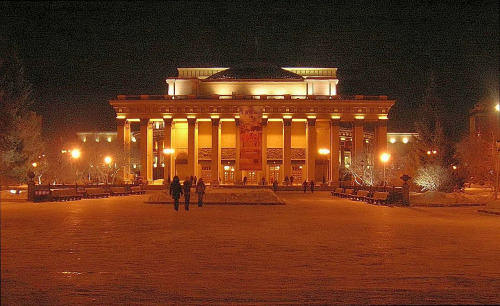
I don’t know how many of you follow
operatic life in Novosibirsk, Russia, but I know I have been, lately. This February,
a local production of Wagner’s Tannhäuser
in Russia’s third largest city became the focal point of fierce debate when
promising young director Timofey Kulyabin and the manager of the Novosibirsk
Opera Boris Mezdrich were charged of ‘intentional public desecration of objects
of religious worship,’ following a law introduced in 2013 – shortly after the
Pussy Riot trials – intended to protect the ‘feelings of believers’. The case
appears symptomatic for the influence of the Orthodox Church in Russian state
policy in recent years, as well as the authorities’ tightening control over
various media, which now apparently also affects opera.
The law in question, which is not very
clear in its definitions, may have implications for many fields of culture and
society. I was confronted with it myself some time ago, when I requested
permission to use a nineteenth-century image from a Russian archive, and was required
to confirm that I would do so without any ‘slogans related to the realization
of extremist or terrorist activity’, without ‘any attributes or symbols similar
to Nazi attributes’, without employing ‘the state symbols of the Russian
Federation (the state coat of arms, flag, and hymn)’, and finally, ‘without
offending the feelings of the faithful.’ It was the last clause that worried me
the most: it was a promise that seemed almost impossible to keep given the
sheer number of people subscribing to one religion or another.
The feelings of believers, of course, have
been very much on our minds lately, since the horrible attack on Charlie Hebdo in Paris. And it seems the
contemporary debate about the freedom of expression is inextricably mixed up
with the notion of terrorism, as opponents of Kulyabin’s Tannhäuser invoked the Charlie
attacks to press their case. Duma member Yaroslav
Nilov, who heartily supported the prosecution of Kulyabin and Mezdrich,
argued that this would serve to deter others from following their example, and
insinuated that their behaviour might otherwise ‘foster the desire to seek
retribution and commit terrorist acts’ among the hurt believers.
Kulyabin’s production was of the kind often
decried as director’s theatre by conservative operagoers: Wagner’s opera was
given a contemporary setting in which the eponymous hero Tannhäuser was represented
as a film director shooting a movie called Venus’s
Grotto about the early life of Jesus, which involved both religious imagery
and nudity. The production, it appears, was well received by audiences and the
press, until the Novosibirsk metropolitan Tikhon filed a complaint, claiming he
had received many reports from shocked members of his congregation. Several
thousands of Orthodox activists took to the streets, demanding that the
authorities would respect their feelings, artists throughout Russia rallied for
support of Kulyabin and Mezdrich. The affair is reminiscent of recent
controversial productions elsewhere, like the Düsseldorf
Tannhäuser in 2013, which was rife with Holocaust-imagery, or the
Metropolitan Opera’s staging of John Adams’ The Death of Klinghoffer last October, which its opponents
denounce as anti-Semitic and pro-terrorist. But as far as I know, in neither of
these cases did the director risk a three-year jail sentence. Could it be, I
wondered, that an opera performance would acquire the same resonance as Pussy
Riot’s punk-rock provocations?
Eventually, on March 10th, the Novosibirsk
court decided to drop the case against Kulyabin and Mezdrich, and the affair
seemed to end well for the proponents of artistic freedom. It was a hollow
victory, however, as the Ministry of Culture responded by sacking Mezdrich. The
Ministry is struggling to maintain a neutral stance and called for the Orthodox
activists to cease their public protests; at the same time, however, Putin’s
press officer Dmitry Peskov
declared that the state had the right to expect that productions by subsidized
collectives ‘would not cause such an acute reaction from public opinion’.
The dust hasn’t settled just yet. This
week, a stand of the Novosibirsk Opera was found vandalized with the text ‘For
Tannhäuser’, and critics continue to question the government’s position: if the
Ministry of Culture is in fact opposed to censorship, they ask, why would they
continue to put the screws on the arts?
“Kansrijke uitdagingen” voor de wetenschap?
Door Martijn Stevens
Sinds
1 april 2015 zijn Nederlandse burgers in staat om mee te denken over de
toekomst van de wetenschap door zelf suggesties aan te dragen via een speciale
website. Het digitale platform vloeit voort uit een nieuwe wetenschapsvisie,
die in het najaar van 2014 is gepresenteerd door het ministerie van Onderwijs,
Cultuur en Wetenschap. Hierin wordt tevens de ambitie uitgesproken om
kennisdeling te bevorderen. Wetenschappers dienen daartoe aansluiting te vinden
bij bedrijven en maatschappelijke organisaties.
De overheid lijkt te denken dat wetenschappelijke kennis
simpelweg een praktisch ‘ding’ of hulpmiddel is om concrete vraagstukken in de
samenleving of het bedrijfsleven aan te pakken, maar ze gaat daarmee voorbij
aan het feit dat de waarde van kennis sterk afhangt van een specifieke context.
Daarom zijn meestal aanvullende handelingen nodig om kennis die is ontwikkeld binnen
universiteiten succesvol te vertalen naar toepassingen buiten het eigen
vakgebied. Wederzijds vertrouwen, de motivatie om daadwerkelijk samen te werken
en de bereidwilligheid om kennis te delen geven daarbij de doorslag. Hierdoor
rijst de vraag of de huidige maatregelen om kennisdeling te bevorderen niet een
averechts effect bereiken.
De overheid beoogt een
verregaande verandering teweeg te brengen in de aansturing van wetenschappelijk
onderzoek, die raakt aan diepgewortelde denk- en werkwijzen binnen de
academische gemeenschap en logischerwijs niet zonder slag of stoot wordt geaccepteerd.
Veranderingen binnen universiteiten en onderzoeksinstituten zijn immers taaie
processen, die worden bemoeilijkt door de conserverende krachten van zogeheten
‘instituties’ ofwel “de regels, normen en waarden die in iedere organisatie
terug te vinden zijn en als vanzelfsprekend worden gezien” (Vermeulen, 2011, p.
17). Deze vanzelfsprekendheid zorgt ervoor dat ze niet vaak openlijk ter
discussie worden gesteld, wat resulteert in een onvermogen “tot kritische
zelfreflectie” (p. 18).
De institutionele theorie
wijst op de beperkingen van een rationeel perspectief op veranderen en
vernieuwen, waarin organisaties worden voorgesteld als voorspelbare en maakbare
systemen. De nieuwe wetenschapsvisie vertoont echter precies de kenmerken van
een rationele zienswijze: met een verscheidenheid aan maatregelen wordt
geprobeerd om doelgericht sturen op de aard, de omvang en de richting van wetenschappelijk
onderzoek. De ideeën van de overheid komen echter niet noodzakelijk overeen met
normatieve denkkaders binnen de academische gemeenschap. Daartoe behoren ook verwachtingen
ten aanzien van gewenst gedrag. Beroeps- en gedragscodes voor wetenschappers benoemen bijvoorbeeld steevast
de morele of maatschappelijke plichten die behoren bij deze functie, maar ze
bevatten tevens bepalingen omtrent rechten en privileges die zijn voorbehouden
aan personen met een specifieke rol of positie binnen de universitaire wereld.
Normatieve instituties zijn nauwelijks geëxpliciteerd en worden doorgaans
niet gekoppeld aan formele sancties, maar ze hebben desondanks een prescriptief
karakter en zijn bovendien dwingend van aard. Universiteiten dienen immers te
handelen in overeenstemming met heersende normen en waarden om legitimiteit te
verkrijgen van politiek en samenleving. Regulatieve instituties zijn daarentegen
uitdrukkelijk verbonden met regelgeving en handhaving, zoals strikte
procedures, hiërarchische systemen en formele mechanismen voor beoordeling en
beloning. Deze maatregelen worden bijvoorbeeld opgelegd door de overheid
middels wet- en regelgeving. In de praktijk blijken normatieve en regulatieve
instituties soms krachten die elkaar tegenwerken en bijgevolg wederzijds
uitsluitend zijn.
De
doordringende en alomtegenwoordige aanwezigheid van institutionele krachten
zorgt ervoor dat de beoogde vernieuwing in de Nederlandse wetenschap denkelijk
op grote weerstand stuit en daarom moeizaam verloopt of zelfs in de kiem wordt
gesmoord. Universiteiten kampen daarnaast met institutionele complexiteit,
waarmee wordt bedoeld dat ze worden geconfronteerd met tegenstrijdige en
onverenigbare eisen van verschillende belanghebbenden. Bovendien vinden de
formele systemen binnen de universitaire wereld nog onvoldoende aansluiting bij
het gewijzigde stelsel van normen en waarden dat doorklinkt in de nieuwe
wetenschapsvisie van de overheid. De politiek dient daarom oog te hebben voor
de institutionele dimensies van de voorgenomen beleidswijziging. Institutionele
krachten zorgen namelijk niet alleen voor de instandhouding van beperkende of
beknellende structuren die veranderingen tegenhouden. Ze creëren ook zekerheid
en stabiliteit, waardoor veranderingen juist beklijven. Kortom: hier is duidelijk
sprake van ‘kansrijke uitdagingen voor de Nederlandse wetenschap’. Misschien
wil iemand daarom een onderzoeksvoorstel indienen via de bijbehorende website?
Bron: Vermeulen, P. (2011). De verankerde organisatie. Een
institutioneel perspectief op veranderen en vernieuwen. Den Haag: Boom
Lemma.
Democratic Scholarship?
It’s no joke: starting April 1st, the Dutch are asked to suggest topics for
scientific and scholarly research via a national website, launched by a coalition of the
national Confederation of Industry and Employers VNO-NCW, the Association of Universities
in the Netherlands, the Royal Academy of Sciences, and the national research council
NWO. According to its website, the
Science Agenda ‘consolidates the themes that science
will focus on in the coming years.’
Under the
guise of a democratising measure, the autonomy of academia is being curtailed.
When the overarching science policy of which this agenda is part was launched
several months ago, newspapers received dozens of letters to the editor by scholars denouncing the
measures as inappropriate and threatening to the quality of Dutch research.
While it is too late to stop the agenda, the launching of the crowdsourcing
website helps us to understand what is really happening.
In all
western nations, the arts and sciences have been treated as related domains
throughout the long nineteenth century. Even though the gap has widened since
World War II, their position vis a vis politics and government remains largely
the same. Yet, while in the arts this relationship has been defined in clear
frames, known in Britain as the ‘Arm’s Lenght Principle’, there is no official
position regarding the influence of politics on the academic agenda. Still,
what is happening to universities today, only mirrors what has happend to the
arts over the pas few decades.
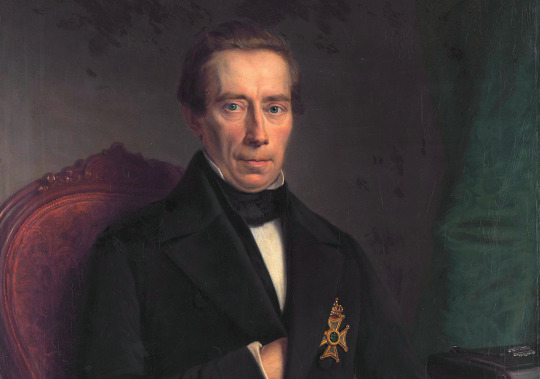
Nineteenth-century
Dutch prime minister Johan Rudolf Thorbecke famously stated that “De regering
is geen oordeelaar van wetenschap en kunst” – the government does not judge
science or art. This phrase, generally referred to as the Thorbecke Adage, has
been used to prevent the government from making artistic decisions, while at
the same time legitimising the construction of a large bureaucratic apparatus
aimed at indirect control over the arts. With the Science Agenda, politics is
looking for the same kind of back door into academia.
http://www.eenvandaag.nl/v/108031
Universitair docent Algemene Cultuurwetenschappen Helleke van den Braber bespreekt op televisieprogramma EenVandaag de rol van de Mecenas in het hedendaagse culturele landschap.
We’ve put together a fancy new video to promote our ground-breaking MA Programme in Creative Industries! Critical and Creative, Realist and Imaginative, this programme offers a thorough exploration of the changing landscape of cultural production. Whether it’s Fashion you’re interested in or Media, Trend Forecasting or Contemporary Art, the ins and outs of Tourism or a philosophical inquiry into Creativity; it’s all here, waiting for you to be discovered!
De tien beste Nederlandse mecenassen (van de laatste honderdvijftig jaar)

The Guardian presenteerde een paar weken terug‘
the 10 best art patrons’ aller tijden: tien opvallende mecenassen (vijf uit
het verleden, vijf hedendaagse), die de kunsten ieder op hun eigen wijze hebben
ondersteund. Een internationaal gezelschap van gulle gevers, soms bescheiden,
vaak veeleisend, meestal excentriek, dat een al even opvallende verzameling
kunstenaars om zich heen verzamelde.
Het lijstje zet aan het denken. Het
kabinet-Rutte ijvert al
tijden voor een nieuwe bloei van het Nederlandse mecenaat. Gulle gevers
zouden meer uit de schaduw moeten stappen, ter inspiratie van een nieuwe
generatie weldoeners. Zou een top tien van markante Nederlandse mecenassen
daarbij kunnen helpen? Vast wel. Daarom: anderhalve eeuw vaderlands mecenaat in
tien kleurrijke namen.
1 Johannes
Kneppelhout (rond 1860; muziek, literatuur,beeldende
kunst). Fanatieke weldoener
met licht neurotische trekjes die graag kunst én levenswandel van zijn protégés
bepaalde; had een voorkeur voor zeer jonge en maximaal kneedbare ‘artisten’. Hoopte
dat zijn protégés zijn naam als weldoener zouden vestigen tot aan het Parijse
hof aan toe. Werd daarin teleurgesteld.
2 Abraham
Wertheim (rond 1890; theater, muziek, beeldende kunst).
Armlastige kunstenaars die bij deze bankier
binnenliepen gingen zelden met lege handen de deur uit. Wertheim wilde trots
kunnen zijn op cultuurstad Amsterdam en speelde daarom een hoofdrol in de bouw
en financiering van cultuurtempels als de Stadsschouwburg; gewiekste zakenman met groot hart.
3 Hélène
Kröller-Müller (rond 1920; beeldende kunst). Kunstminnende
dame
met ijzeren wil die tonnen uitgaf aan haar kunstcollectie en de bouw van
haar eigen museum, maar wier hoge verwachtingen en onmogelijke eisen haar architect
Van de Velde horendol maakten. Verzekerde hem desondanks dat ze ‘(…) geen
opdrachtgeefster [was]ter wille van mijzelf, maar ter wille van de kunst’.
4 René Radermacher
Schorer (rond 1930; literatuur, beeldende kunst). Mecenaat
op grote schaal door bescheiden, empathische en wat onzekere aristocraat;
ondersteunde een kring van tientallen schrijvers en kunstenaars; onder hen veel
experimentele avantgardisten. Plus ook nu nog aansprekende namen als Hendrik
Marsman, Jacques Bloem en Charley Toorop.
5 Joop
Colson (rond 1960; beeldende kunst, literatuur,
muziek). Rijke fotograaf die Kasteel
Groeneveld in Baarn kocht en daarna tevreden toekeek hoe ‘langharige artiesten
in vieze truien (…) fotografen, (…) proletarische dichters uit Het Gooi…’ zijn
kasteel overspoelden. Hielp ondertussen tientallen kunstenaars aan werk, schoof
hen van tijd tot tijd geld toe en betaalde hun studies.
6 Ludo
Pieters (rond 1970; literatuur). Havenbaron en ‘Vriend en Beschermer’
van Gerard Reve die heel blij met hem was (‘Mijn halve lichaam jeukt al van
woede bij de gedachte alleen – (…) dat
hij Bescherming, Goederen of Geld zou geven aan anderen dan aan mij’). Begon
als ‘Zeer geachte Heer P.’; werd al snel ‘Lieve Ludo’. Was vooral goed in het
schrijven van bemoedigende brieven: zijn financiële steun was bescheiden.
7 Pieter
Geelen (huidige tijd; beeldende kunst, literatuur, muziek).
Deze oprichter van TomTom (en zoon van kunstenaarsduo Imme Dros en Harry
Geelen) schonk in 2005 het immense bedrag van 100 miljoen euro aan de door hem
opgerichte Turing
Foundation. Niet al dat geld gaat naar de kunsten, maar het lijstje
ondersteunde kunstprojecten is desondanks indrukwekkend. Houdt vooral van kunst
die een brug naar het publiek weet te slaan.
8 Robert
Korstanje (huidige tijd; popmuziek). Energieke ondernemer
die rijk werd in de verpakkingsindustrie; exotisch vanwege zijn liefde voor
metalmuziek en zijn voornemen om de stad Nijmegen met het door hem ondersteunde
(en geleide) festival Fortarock als
metalstad op de kaart te zetten. Financiert ook metal-avonden in poppodium
Doornroosje. Is vanwege zijn ondernemersgeest en stadstrots in feite een
directe nazaat van Wertheim (nr 2).
9 Han Nefkens (huidige tijd; beeldende kunst, mode). Wil ‘erbij zijn wanneer een kunstwerk geboren
wordt’ en reist de wereld af om opdrachten te verlenen aan cutting edge beeldend kunstenaars. Stelt daarna hun werk
beschikbaar aan gerenommeerde musea,
wat niet alleen de kunstenaars en de musea helpt, maar ook hemzelf een vleugje
onsterfelijkheid verleent. Publiceerde in 2011 een lijvig boek
over zijn goede daden (net als nr 10 overigens, ook
in 2011).
10 Joop
van den Ende (huidige tijd; vooral podiumkunsten). De
onbetwiste koning van
het Nederlandse mecenaat, alleen al omdat hij zo vaak op die rol wordt
aangesproken. Schenkt jaarlijks miljoenen euro aan zijn VandenEnde Foundation, maar
selecteert de kunstenaars die ondersteuning krijgen liever niet zelf. Is
desondanks blij weldoener te zijn, want ‘een gevoel van gêne speelt ook mee,
als je achter je naam enige miljarden ziet staan’.
(Volgende keer, op verzoek: een lijstje van de
tien opvallendste Nederlandse ontvangers
van steun sinds 1850. En ja, Reve staat daarop, net als Willem Kloos. En Halina
Reijn.)
Beeld via: http://pixabay.com/nl/geven-en-nemen-verkeersbord-556151/
Can’t imagine the world without music…
Thelast 15 years has seen a surge in speculative popular fiction focusing on theexistence of gods and mythical creatures trough a kind of thoughtform: If a
great enough number of people believe in the actuality of certain higher beings
deeply, passionately and for a prolonged amount of time, these beings are
enabled to ‘exist’, to intrude onto the physical plane of mankind and work
their not always so benign magic. In American
Gods (2001), – soon to be transformed into another major fantasy
tv-production – Neil Gaiman explores numerous pantheon’s in this way, from the
ancient Egyptians’ to modern day media-goddesses; In his incredibly
entertaining urban fantasy series The Iron
Druid Chronicles (2011- ongoing), Kevin Hearne makes the last remaining
Druid on earth battle witches, cooperate with vampires, and deal with Norse
gods and Native American tricksters; And traces of thoughtform motives can be
seen in the universes of such bestselling series as Jims Butcher’s The Dresden Files (2000 – ongoing) and
Seanan McGuire’s InCryptid series
(2012 – ongoing).
The
power of thoughtform as a literary theme, however, is not restricted to novels.
Last January, at the 2015 Image Expo in San Francisco, it was announced that a
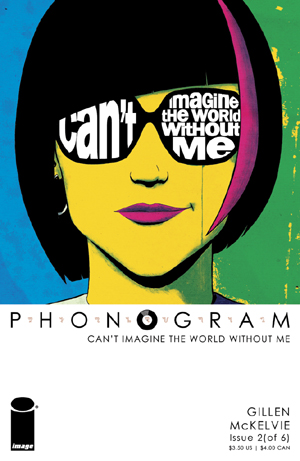
third series of the comic book (or graphic novel, whatever suits your fancy) Phonogram by Kieron Gillen and Jamie
McKelvie is to be published in August of this year. Its first volume Rue Britannia (2006-2007) tells the
story of the highly unlikeable chauvinist David Kohl, who is a phonomancer, a
rare kind of magician who feeds on people’s love for a certain type of music
and who can channel that love for magical use. Kohl is facing a dilemma: His
specific drug is Britpop, but suddenly the world appears to be slowly
forgetting its existence, and therewith Kohl’s, since he is kept alive by their
remembering. Kohl then starts on a literal trip down memory lane to save
Britpop, ensuring that not only he himself does not disappear, but, more
importantly in his eyes, people will still remember Kenickie as being the ultimate
goddesses of Britpop, that the mysterious disappearance of Manic Street
Preachers’ Richey Edwards will makes sure he will always be remembered… and
that (praise the good Lord!) people will not start thinking of those
proto-hipsters of Kula Shaker as actual Britpop. Phonogram is a mixed read: Kohl is one of the most unsympathetic
characters I have ever come across, but he is redeemed by his love for music.
Every reader of Phonogram, Britpop
fan or no, will be able to connect
with Kohl’s nostalgic longing for those days when you were being immersed into
a certain music scene for the first time in your life and your personal gods
came into existence – an experience that will form you, and maybe even haunt
you, for the rest of your days.
Our
current time in history, we might say, is an especially grim one, with
ideological wars raging all over the world, people becoming more and more connected
through electronics but less and less connected as human beings, and
differences are often more important than similarities. The gods we believe in,
if we do at all, are gods of hate and anguish – at least, those are the gods
that haunt our news bulletins. ISIS fighters destroy Muslim art in the world’s
museums, while Feyenoord supporters trash ancient Rome’s relics in Italy’s
capital. Their gods of religion and sports are ‘thoughtformed’ by annihilation,
hate and oppression, created through acts of barbarism rather than art.
Phonogram’s gods, on the other hand,
are thought into existence by love, admiration and creativity; and above all by
people’s passion for music. And that is why I am glad the Phonogram’s saga continues, while, as an avid reader of speculative
fiction, I believe the theme of thoughtform is becoming rather a cliché. Phonogram shows precisely what it is to
be human, to truly have faith in something outside of ourselves, and most
importantly, it shows that art, in this case music, is a symbol of hope in a
time when the world is so off-balance. Maybe, if the people of this world could
believe just a little harder, a little more passionately, in the gods we hear
on our radio’s, those we see expressed on canvases in our museums, those we see
on the stages of our theaters and encounter in the words of stories, the world
could be just that bit more of a
hopeful place. So if you stumble upon Phonogram’s
next installment ‘The Immaterial Girl’ somewhere this summer, don’t hesitate to
give a go; it might just change the world.
Image via: http://en.wikipedia.org/wiki/File:Phonogramcover2.png
The Survival of the Fittest: on Experimental Space in Dutch Theatre
Last January the Belgian curator Frie Leysen was invited to give the closing keynoteaddress/speech of the Australian Theater Forum. She did not mince her words: ‘We have built theatres and arts centers, and we created festivals to produceand present art works and to welcome audiences in the best possible conditions.
But, during the years, most of these structures and organizations have become
rusted and sclerosized. They have become dinosaurs. (…) Originally meant to
support the artists, they got organized very well, often too well, and so lost
the needed flexibility to respond to the specific needs of specific works. The
artists now have to follow the policy and the rules of the houses instead of
the other way around.’ (The full lecture can be accessed here).
If we take a look at our Dutch playhouses, it is not too
difficult to see what Leysen is getting at: all plays seem to be made to fit
either the big or the small frontal stage; new, let alone experimental, theatre
is hard to find whereas there are plenty of adaptations, mostly of canonical
plays, which fit the classical structure of the play house like a glove.
Leysen knows the Dutch
situation all too well, as she made clear in her acceptance speech for the Dutch
Erasmus Price awarded to her last year. She rebelliously addressed King
Alexander sitting in front of her: ‘Your Majesty, your country has become a
place where the arts can barely breath.’ ‘How is it possible’, she continues, ‘that
one of the richest countries of the world no longer allows artists to
experiment and to think outside of the box?’ She is obviously referring to the
budget cuts of the previous government, effectively discouraging the creation
of new and temporary companies, and to the decision to stop supporting
‘artistic workshops, labs and research centers’. But the cuts go deeper, even
to the production level of the surviving companies. Whereas in the past few
decades theatre makers have had the tendency to look beyond the traditional playhouse
for new and different performance spaces (e.g. Dogtroep or Lotte van den Berg),
the current organization of city theatres no longer seems to embrace this
opportunity and for festivals it ironically almost seems a must to do so, rather
out of lack of performance space than because of it. They stick to the
habitual, fearing the risk more than the dinosaur.
A few months ago, the Arnhem-based theatre company Toneelgroep Oostpool performed ‘The Immortals’ in art house Lux in Nijmegen. At first sight this company seems to have adapted to the dinosaur type: in the past years they have been able to draw large audiences to their well-made adaptations of Shakespeare and modern novels like Virginia Woolf’s Orlando for either the small art house stage or the big playhouse stage. However, since the arrival of the new artistic team led by Marcus Azzini in 2012, its profile has been slightly adjusted. Oostpool still produces crafty adaptations of old and new classics, like ‘Reigen’ (Arthur Schnitzler) and ‘Angels in America’ (Tony Kushner), but it does so in combination with experimental plays mostly made by Suzan Boogaerdt and Bianca van der Schoot. The duo has established its own series called ‘Visual Statements’ which questions the contemporary obsession with visual culture, the spectacular and the self. Their performances, especially Hideous (Wo)men (2013) and The Immortals (2014), have troubled both the press and the usual Oostpool audience with their lack of plot and speech, as well as their ritualist hang-ups, involving many repetitive, gender-focused and abject scenes that disturb our view on television soaps (Hideous (Wo)men) and Youtube (The Immortals).
Interestingly, they also
have made an attempt to adapt and restructure the classical theater stage of
the playhouse to fit the concept of their performances. In Hideous (Wo)men, for instance, the audience has to watch a rotating
platform on which a television set is shown. The main structure remains
frontal, as the audience sits in the auditorium and the actors perform on
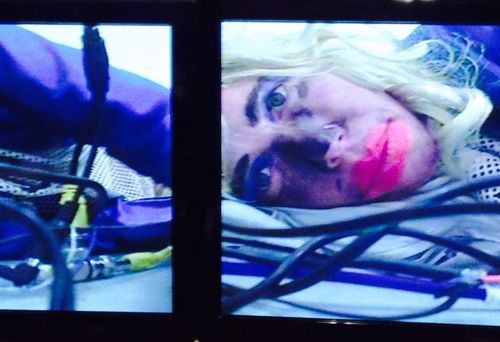
stage. Yet, in The Immortals the
auditorium is no longer used and the audience has to sit on stage trying to
peek into one of four rooms or to watch the flat screens showing what is
happening in the rooms: people broadcasting themselves endlessly. Once the
audience sits in its on-stage auditorium, the classical auditorium is no longer
visible and the classical stage loses its function as a stage. It turns into a
space very similar to what art houses and contemporary museums already have: a
performance room in which the dividing line between the audience and the performers
is less rigid. In other words, the production was performed in a space that was
not made for it. It is an inventive way of bringing their ‘visual statement’ to
the theatrical stage, no matter what that stage looks like, but it is also a
telling example of what Frie Leysen denounced in her keynote to the Australian
Theater Forum: the existing structures no longer adapt to the artists, the
artists have to adapt to the structures. They are obliged to dig around in the intestines
of the dinosaur. One never knows what can be found there, if one looks more
closely, but one does wonder what would be possible if the Dutch playhouses were
more keen on rethinking their structures and on inviting artists to do so as
well.
Image credits: The Immortals, Toneelgroep Oostpool, via http://www.toneelgroepoostpool.nl/nieuws/item/the-immortals-2
 Culture Weekly