Bling bling = armoe troef

De whoop whoop 35 miljoen dollar van Alma-Tadema

image

Op 30 september
2016 opende in het Fries Museum in Leeuwarden de
grootste retrospectieve ooit
in Nederland van het werk
van de negentiende-eeuwse schilder Lawrence Alma-Tadema. De tentoonstelling
werd overal met veel lof onthaald, met bijzondere aandacht voor hoe de werken
van Tadema, uiterst goed gedocumenteerde en technisch briljant uitgevoerde
taferelen van het dagelijks leven tijdens de Klassieke Oudheid, een belangrijke
inspiratiebron vormden voor Hollywoodfilms. Die aandacht is terecht. In de
tentoonstelling worden Tadema’s schilderijen op vernuftige gecombineerd met filmprojecties,
van scenes uit Ridley Scott’s Gladiator
tot Elizabeth Taylor als Cleopatra, die duidelijk maken dat velen van ons veel
bekender zijn met het werk van de negentiende-eeuwse schilder dan we eigenlijk
beseffen.

Minder toe te
juichen, maar eigenlijk niet minder verwacht, is de aandacht die bijna overal
in de media besteed werd aan de hoge prijzen die vandaag de dag voor Tadema’s
werk worden betaald. Het gros van de pers, van het NOS journaal tot The Guardian,
konden er niet aan weerstaan om uitgebreid in te gaan op de 35 miljoen dollar
die Tadema’s schilderij Mozes gevonden
enkele jaren geleden opbracht, het hoogste bedrag dat ooit voor een
negentiende-eeuws niet-impressionistisch werk werd neergeteld. Toegegeven,
Tadema’s rags to richess to rags to
richess
verhaal is aantrekkelijk: als zoon van een bescheiden Friese
dorpsnotaris werkte hij zich op tot zowat de duurst betaalde schilder van Victoriaans
Londen, maar enkele jaren na zijn overlijden in 1912 wilde niemand zijn
schilderijen nog en kon je ze voor een habbekrats op de kop tikken. Dan
opnieuw, postuum weliswaar, miljoenen scheppen met je schilderijen, is bepaald
een indrukwekkende comeback.

Die overdreven
aandacht voor die bling bling wijst
echter toch vooral op een dieperliggend probleem. Niet alleen dat kunst nog
maar louter en alleen interessant lijkt te zijn als een product op de markt,
waarin we als bankiers of speculanten onder de indruk zijn van de volatiele
koersen en van de reusachtige winsten die we hadden kunnen maken: ‘als we het
maar geweten hadden!’ Daarnaast is het blijkbaar ook moeilijk om gewoon, zonder
meer, geïnteresseerd te zijn in kunst uit een andere tijdvak, omdat die kunst
interessant is of dat tijdvak boeiend is. Het lijkt wel alsof we een externe
prikkel of motivatie nodig hebben, fascinatie voor kapitalistisch klatergoud in
dit geval, om die dingen interessant te gaan vinden. Misschien werkt dat wel:
verlaagt het de drempel of trekt het bezoekers over de streep. Alleen blijft de
vraag dan of die bezoekers ook met het juiste paar ogen gaan kijken.

Het is dan ironisch
dat sommige van Tadema’s eigen werken hier zelf iets over te zeggen hebben. De
classica Rosemary Barrow wees er op dat de kunstenaar ons, tamelijk tongue in cheek, in een aantal
schilderijen rijke Romeinse kunstliefhebbers toont die enkel oog hebben voor
dure, blinkende materialen en niet zien dat zich achter hun rug de echte kunst
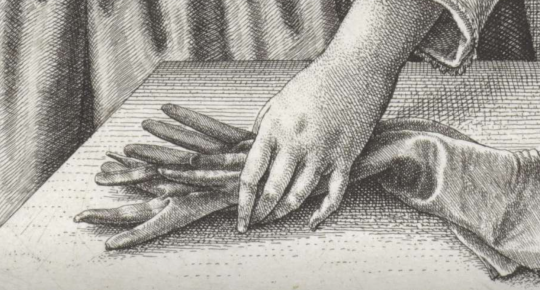
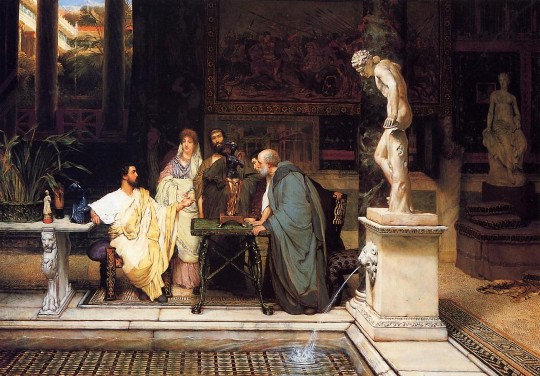
bevindt. In Een Romeins kunstliefhebber
uit 1868, bijvoorbeeld, zijn enkele mannen en een vrouw volstrekt verblind door
het dure goud en lapis lazuli van een voor het overige niet erg bijzonder
beeldje, zodat ze niet eens doorhebben dat ze omringd worden door enkele van de
bekendste werken uit de westerse kunsthistorische canon. Tadema zou, met andere
woorden, wellicht hartelijk gelachen hebben om alle aandacht voor de bling bling waarmee zijn werk vandaag de
dag opnieuw geassocieerd wordt. Hij wist het allemaal lang geleden al.

Afbeelding:

Lawrence Alma-Tadema, Een Romeins
kunstliefhebber
, 1868.

De wereld onder de diefstal: een affectieve lezing van Schuld (2016) door Walter van den Berg

Marrigje Paijmans

In de week dat op de campus van de Radboud Universiteit mijn
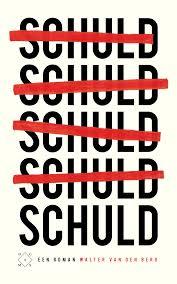
nieuwe Macbook werd gestolen, las ik Schuld (2016) van Walter van den Berg. In deze
roman draait het om een groepje jonge mannen in Amsterdam
Nieuw-West
die leven op de rand van – of eigenlijk net erover – de
criminaliteit. Kevin verdient geld met het formatteren van gestolen laptops:

image

Als Kevin aan een nieuwe laptop
begon, stopte hij zijn gouden schijfje in de bay, startte de laptop op en
kraakte het wachtwoord. Daarna deed hij een search op foto’s en video’s. Als er
niets bijzonders tussen zat, zette hij er een schone Windows op met zijn
zilveren schijfje, steeds dezelfde Windows met dezelfde product key. (26)

De volmaakte onverschilligheid waarmee Kevin de laptops
gereedmaakt voor de zwarte markt is schrijnend. Bij het idee dat mijn eigen
Macbook op vergelijkbare wijze van zijn (mijn) geheugen is ontdaan word ik
bijna onpasselijk. Tegelijkertijd is die verschilligheid, als ik Schuld lees, een luxe.

Van den Berg ontziet zijn hoofdpersonen niet, al plaatst hij
hun handelingen wel in hun snoeiharde context. De jonge mannen zijn stuk voor
stuk getekend door complexe familiesituaties en bovendien bij lange na niet in
staat om hun gevoelens daarover in een narratief te plaatsen. De volgende passage
uit een telefoongesprek tussen een van de mannen en zijn vriendin laat zien hoe
een gebrek aan taalvaardigheid en sociale omgangsvormen kan leiden tot morele
kaalslag:

Mis je mij?
Wat?
Mis je mij?
Natuurlijk mis ik jou.
Wat mis je het meest aan mij?
Je kut.
Nou, zei ze. Geef normaal
antwoord.
Ik geef je normaal antwoord. Je
vraagt wat ik het meest mis, ik mis je kut het meest.
Dat klinkt helemaal niet lief.
Ik mis je lach ook.
Dat is liever. Heb ik een mooie
lach?
Ja, je hebt een mooie lach.
Beschrijf mijn lach dan eens?
Jezus, gewoon een lach. (16-17)

De wederzijdse onverschilligheid, hoewel veroorzaakt door
onzekerheid en onvermogen, is opnieuw schrijnend, maar ook grappig. Dat is het
gevolg van de stereotypering, waar Van den Berg zich helaas wel mee inlaat, maar
ook van de focalisatie, die bij de personages zelf ligt. Als lezer kruip je in
de huid van twee dertigers met de uitdrukkingsmogelijkheden van een puber en
dat gevoel van onbeholpenheid werkt op de lachzenuwen.

Kevin, die als enige van deze randfiguren studeert, voelt
zich verheven boven zijn omgeving, maar ook boven zijn medestudenten, die niet
weten hoe je een laptop kraakt. Hij waant zich boven de wet, omdat hij van het
geld dat hij verdient met zijn criminele activiteiten de schulden van zijn
vader aflost. Ook zijn speurtocht naar seksfoto’s en -video’s op de laptops blijkt
een ‘hoger’ doel te dienen; hij zoekt naar bewijs dat zijn moeder niet de enige
slechte vrouw is.

De titel mede in aanmerking genomen, kan Kevin worden
beschouwd als een 21e-eeuwse Rodion
Raskolnikov
, de hoofdpersoon van Fjodor
Dostojevski’s
Misdaad en straf (1866), ook wel vertaald
als Schuld en boete. Rodion pleegt
een roofmoord op een oude woekeraarster, waarmee hij naar eigen zeggen de
wereld verlost van een stuk ongedierte, terwijl hij met de opbrengst goede
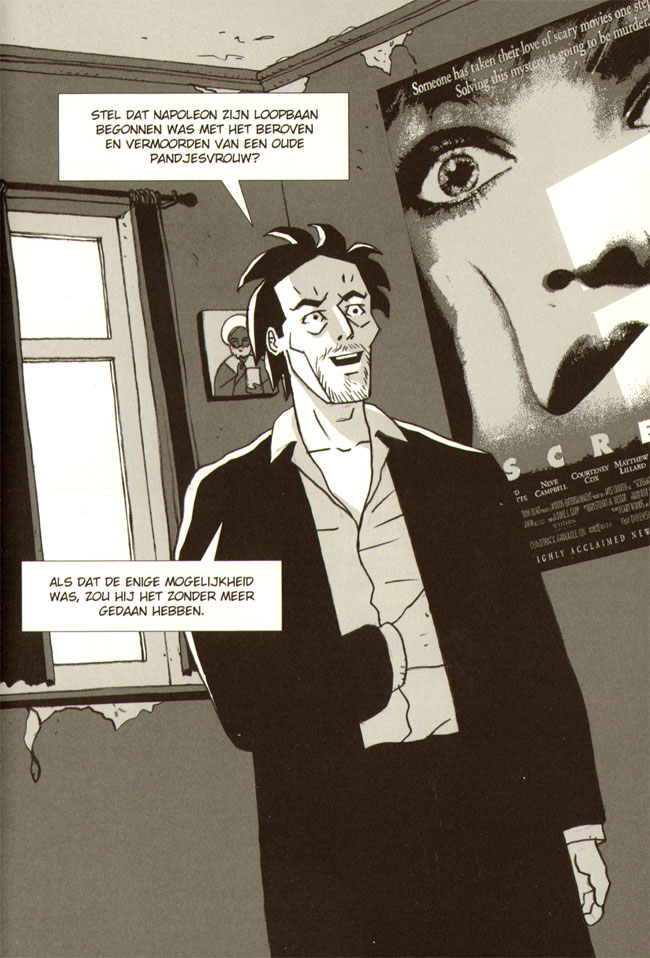
daden zal verrichten. Ook hij is ervan overtuigd dat sommige mensen, zoals Napoleon en
hijzelf
, door hun buitengewone inborst boven de wet staan. Dostojevski’s
roman is dan ook geïnterpreteerd als een aanklacht tegen het politieke en
culturele nihilisme
van de late negentiende eeuw.

Het Amsterdam Nieuw-West van Schuld wordt beheerst door een vergelijkbare wereldvisie; diefstal,
mishandeling, maar bovenal onverschilligheid zijn de norm. Ik wil geen
moralistisch punt maken, maar veeleer iets zeggen in termen van affect. De
grofheid die we ervaren na de ontvreemding van een dierbaar object, is misschien
wel de harde werkelijkheid van Kevin en kompanen die doorklinkt in de onze. Het
is alsof de diefstal ons tijdelijk in verband stelt met die wereld, waarin iedere
schuld wordt afgelost met een volgende. Van den Bergs roman maakte mij attent
op die verbeeldingswerkelijkheid.

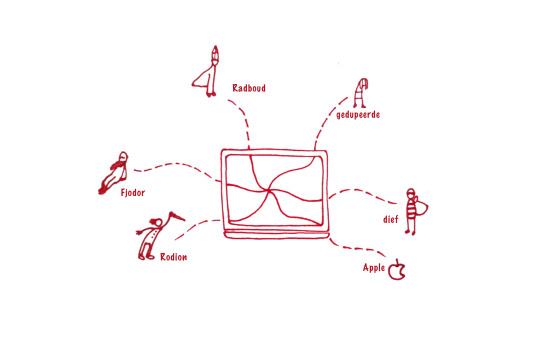
Apple biedt een functie die de locatie van je Macbook weergeeft
in Google Maps, mits die contact legt
met het Internet. Mijn Macbook is sinds de diefstal niet meer online geweest. De
functie toont een afbeelding van mijn Macbook met een zwart
scherm
, ten teken van zijn geripte innerlijk. Ik probeer er de humor van in
te zien: dat ik rouwig ben om een ‘ontzield’ apparaat, maar ook dat ik bij
mezelf een licht gevoel van trots bespeur als ik denk aan het moment dat de dief
in mijn tas de nieuwe Macbook aantrof en toen, in mijn verbeelding van dat
moment, even heel gelukkig was.

Talking racism; Or, Getting Under Someone’s Skin

by Tom Idema

If you really want to
get under someone’s skin, reduce everything he does or says to the color of his
skin. Being labeled “white” takes away the comforts of unmarked personhood: the
conditions that allow oneself to simply be a person, a human being, general and
unspecific. Furthermore, to many, whiteness conjures up histories of violence
that shatter the image of the West as the pinnacle of civilization. These
histories, in the plural, render the past uninhabitable—they problematize the cultural imaginary of a singular
national history as a solid ground for ethnic identity. At the other side of
the equation, being labeled “colored” can be interpreted as a reminder that the
privilege of abstract, unmarked personhood is ultimately unattainable, due to
the natural fact of one’s bodily color. And here too, history is evoked as a
site of struggle, a history that all too easily marks the subject in question
as victim. The widespread, common-sense response to racism, then, is not just
to avoid it, but to deny it. When it comes to talking racism, everybody loses. 

image

If you really want to
get under someone’s skin, reduce everything he does or says to the color of his
skin. Being labeled “white” takes away the comforts of unmarked personhood: the
conditions that allow oneself to simply be a person, a human being, general and
unspecific. Furthermore, to many, whiteness conjures up histories of violence
that shatter the image of the West as the pinnacle of civilization. These
histories, in the plural, render the past uninhabitable—they problematize the cultural imaginary of a singular
national history as a solid ground for ethnic identity. At the other side of
the equation, being labeled “colored” can be interpreted as a reminder that the
privilege of abstract, unmarked personhood is ultimately unattainable, due to
the natural fact of one’s bodily color. And here too, history is evoked as a
site of struggle, a history that all too easily marks the subject in question
as victim. The widespread, common-sense response to racism, then, is not just
to avoid it, but to deny it. When it comes to talking racism, everybody loses.

But getting under our skin is just what
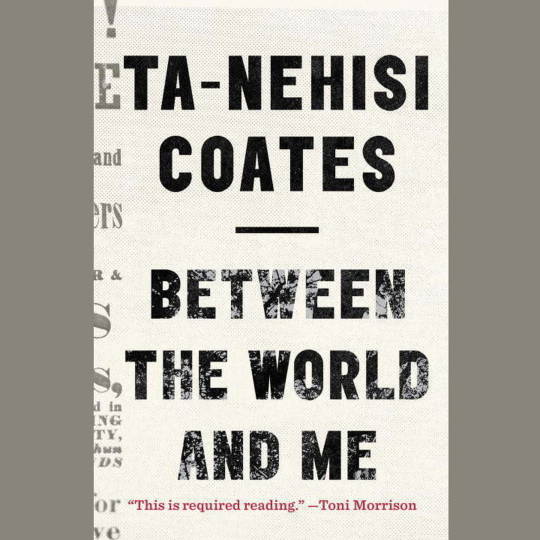
Ta-Nehisi Coates wants to achieve in his 2015 manifesto-cum-epistolary
non-fiction book Between the World and Me.
Coates, MacArthur Genius Award-winning
journalist of The Atlantic,
has found a way to turn his anger about racism in US society into a form that
is at times literary. Addressed to his 14 year-old son, and written in the
second person, the author awkwardly relates to the reader as a father. I would
argue that it is Coats’s ability to bring racism to life through a combination
of writing strategies—dramatic anecdotes, historical surveys, news facts, and
passionate appeals—that has led to the wide acclaim for his book, which won the
2015 National Book award
 and was a finalist for the 2016 Pullitzer
prize
.

Unavoidably, I think,
the mixing of history and autobiography, factual analysis and passionate critique,
gets under the skin of some commentators. Perhaps it is a common response to this
kind of text: who are you to tell me about my world, my society? Writing for
The Guardian, Sukhdev Sandhu complains that “his
prose seems increasingly ventriloquized and his insistence
on Afro-American exceptionalism a kind of parochialism
”.  In a review in the New York Times, Michiko Kakutani observes that “There is
a Manichaean tone to some of the passages in this book, and at times, a
hazardous tendency to generalize
”. Even if we acknowledge these criticisms, I think they
expose a practical impossibility of being African-American: one must vanish
into the melting pot (rather than promote racial exceptionalism and
parochialism), but one must also refrain from “generalizing”—laying claim on Americanness.

Critics are
right that Coates is unabashedly inward looking, culturally as well as
personally, and that the book is not without elements of self-aggrandizement. Coates
deliberately projects himself on the firmament of Afro-American cultural,
academic and political icons, quoting from W.E.B. Dubois, James Baldwin,
Richard Wright, Malcolm X, Toni Morrison, Nas, and KRS one. His happy
reminiscences of his time as a student at the predominantly black Howard
University are indeed parochial, celebrating his love and knowledge of
literature, philosophy, history, and other fields. Having learned about
Coates’s tough early life in the streets of Baltimore,  one can imagine the exhilaration of being
able to follow one’s curiosity while feeling safe, at home.

But besides
the many citations, Coates also invents aphorisms of his own. Here’s one: “Race is the child of racism, not the father” (7). Paraphrasing
virtually all the canonical Afro-American thinkers, Coates hammers home the
point that the color of one’s skin and the texture of one’s hair only come to
be connoted as negative because of racist ideology. He reminds us that if racism makes no sense from the vantage point of liberal
democracy. At the same time, however, Between
the World and Me
shows that racism literally makes sense: it is a key marker of difference that allows us to
create cultural, social, economic, and psychological meanings. Both capitalism
and the state were built on and through racism, and the strategy of racism denial
has been essential for these systems to keep functioning in the wake of the
abolition of slavery and the various emancipatory waves. The sorting mechanisms
of our societal systems (who gets to be, have, do, and say what) still work on
the software of racism (and sexism), disguised as the hardware of race (and
sex).

Coates has understood
well the necessity of writing a book on racism that is both rhetorically
appealing and palatable to a large audience. The aesthetic dimension is just as
important as the message: “poetry aims for an economy of truth—loose and
useless words must be discarded, and I found that these loose and useless words
were not separate from loose and useless thoughts” (510). The paradox is that
exactly by bringing in literary suppleness and subtlety, Coates has been able
to communicate the raw violence of racism in the US.

image

Even if not all ideas in
Between the World and Me are
refreshing, the creative weaving together of history and biography, literature
and manifesto, is compelling, and the appeal to talking about racism again is
urgent considering the continued devaluation of non-white lives in the US and
elsewhere. For Coates, the most pernicious idea is the belief in our own
innocence, the unquestioned, simple rationality of one’s own ideas, and
ultimately the idea of just being oneself.
If race is not of our own making, the same goes for our ideas about race: they are
the products of impersonal systems. And so an honest appreciation of the problem
of racism does not so much require moral introspection: “’Good intention’ is a
hall pass through history, a sleeping pill that ensures the Dream” (33). An
honest appreciation of the problem of racism, instead, means reading, writing, talking,
producing, buying, voting, governing, and so on, in full awareness of racial
inequality as constitutive of US society. Thus, the white American may
recognize that his father is, at least in part, black.

Sick Sounds: Hospitals as Acoustic Environments

by Vincent Meelberg

image

Designing and constructing a new building is a major undertaking. The building needs to meet the requirements of its future occupants, comply with government regulations, and at the same time look aesthetically pleasing. Increasingly, buildings are expected to look spectacular.

Builldings, however, not only have a look, but a sound – or rather, sounds – as well. All buildings have acoustic identities. These identities are shaped by the ways in which the rooms are shaped and decorated, which determines its acoustics. The fact that a room sound reverberant, shrill, hollow, dark, or dampened codetermines the atmosphere, or ambiance, of that room. This aural architecture, as Barry Blesser and Linda-Ruth Salter call it in their book Spaces Speak: Are You Listening? (MIT
Press 2007), can also have a social meaning: 

For example, the bare marble floors and walls of an office lobby loudly announce the arrival of visitors by the resounding echoes of their footsteps. In contrast, thick carpeting, upholstered furniture, and heavy draperies, all of which suppress incident or reflected sounds, would mute that announcement. The aural architecture of the lobby thus determines whether entering is a public or private event. (Blesser & Salter 2007: 3) 

Yet, the inhabitants of a space also contribute to the acoustic
identities of a building. In his TED Talk, sound consultant Julian Treasure
explains how the acoustic environments we live and work in influence the way we function:

Sound thus seems to be extremely important when designing a new building and proper attention needs to be given to the acoustic environments.

This is particularly true when that building is a hospital. Sounds are extremely important in a hospital, as they contain important information concerning the health of patients. The hospital staff needs to be able to properly listen to the auditory signals produced by the medical equipment. If they are not able to, this may lead to dangerous and sometimes even life-threatening situations for patients. It is all the more surprising, then, that only fairly recently hospitals and medical equipment manufacturers are paying attention to the manners in which medical devices sound alarms.

The acoustic environments in hospitals affect patients as well. In some cases, they may even be harmful to them. Therefore, the acoustic environment of a hospital needs to strike a balance between auditory signals that the staff needs to hear, without overwhelming them with sounds, and at the same time not being too stressful for the patients, perhaps even be soothing to them. In any case, the acoustic environment should not aggrevate the patient’s condition.The Japanese electronic musician Yoko K. wondered if the acoustic environment in hospitals could be improved:

The Future of Hospital Sound from Yoko K. on Vimeo.

One of the manners in which Yoko K. intends to improve the hospital’s acoustic environment by making sure the sounds produced by medical equipment are more or less consonant, in tune. And although that would perhaps improve the acoustic environment, the question is whether or not it would diminish the signal value of the sounds. In other words: will these sounds still be noticed by the medical staff, because the different sounds blend to well?

It is because of these conflicting sonic conditions that designing the sonic environment of a hospital is so complicated. At this moment a new children’s hospital is being built in Utrecht, and this time sound is a concern. Together with soundbranding agency Blckbrd and the Radboud University the hospital will investigate the manners in which the acoustic environment in the hospital can be optimised. This hospital will not only look spectacular, but sound the part as well.

Happy New Year

image

door Edwin van Meerkerk

Het nieuwe collegejaar is begonnen. In de collegebanken bij
cultuurwetenschappen mogen we daarbij deze maand een record aantal
internationale studenten verwelkomen. Dit jaar startte namelijk de Engelstalige
variant van onze bacheloropleiding, waarnaast we sinds twee jaar ook al een
internationale master aanbieden. ACW Nijmegen gaat dus mee met de trend van
verengelsing van het Hoger Onderwijs waar de laatste tijd zoveel discussie over
is. Door twee opleidingen in het Engels aan te bieden kiezen we positie in dit
debat. Het is goed die keuze hier toe te lichten.
*

Critici vrezen dat onderwijs in het Engels schadelijk zou
zijn voor de talige ontwikkeling van de studenten. In plaats van op academisch
niveau te leren communiceren in hun moedertaal zouden ze aan het eind van de
rit noch in het Nederlands, noch in het Engels veel beter zijn dan de
gemiddelde scholier. Bovendien, zo wordt gesteld, beheersen docenten en
studenten het Engels onvoldoende om ook inhoudelijk het beoogde niveau te
behalen. Beide argumenten verhullen in mijn ogen de meerwaarde van het
internationaliseren van het Hoger Onderwijs.

Maar eerst de geclaimde nadelen. De uitdrukkingsvaardigheid
van afgestudeerden in hun opleidingstaal moet natuurlijk van hoog niveau zijn.
Onderwijs in het Engels moet daar dan ook voldoende steun aan geven. Onderwijs
is groeien in kennis, houding en vaardigheden – inclusief de beheersing van de
taal. Dat is geen vanzelfsprekend of natuurlijk proces. Zoals we de studenten
van de Nederlandstalige specialisaties ondersteunen in de ontwikkeling van hun
uitdrukkingsvaardigheid en hen daar bij werkstukken, tentamens en scriptie op
afrekenen, zo doen we dat ook bij het Engels. Dat is de taak van een opleiding,
en daar verandert niets aan wanneer de taal van de opleiding anders is –
hooguit is het startniveau van de taalbeheersing lager. Dat maakt de opleiding
moeilijk voor de student, maar daar is het een universiteit voor.

Het tweede argument, dat het inhoudelijke niveau van de
opleiding zou leiden onder het gebruik van een andere taal kan ook positief
worden geformuleerd: docenten in een opleiding die in het Engels wordt
aangeboden, moeten die taal tot in de puntjes beheersen. Dat klopt, en ook daar
is niets nieuws onder de zon. Van onze docenten wordt C2-niveau (near native) geëist
en wie daarna nog verdere ondersteuning in het geven van colleges of het
corrigeren van teksten nodig heeft, krijgt die van de faculteit. Kortom, een
opleiding in het Engels aanbieden is niet iets om lichtvaardig af te doen. Dat maakt
doceren moeilijk voor de docent, maar daar is het een universiteit voor.

Deze discussie over taalbeheersing en opleidingsniveau leidt
af van de reden waarom opleidingen overstappen op het Engels. De afgelopen twee
jaar hebben wij ervaren wat de meerwaarde is van het werken met een
internationale groep studenten. De diversiteit in culturele achtergronden is,
zeker voor een opleiding cultuurwetenschappen, van niet te overschatten
meerwaarde. (Universitair) onderwijs is idealiter meer dan een opleiding op een
bepaald terrein, het is ook een vorm van kritische zelfreflectie en de
ontwikkeling van metacognitieve competenties. De confrontatie met leeftijdsgenoten
uit, om mijn groep van verleden jaar als voorbeeld te nemen, Nederland, Rusland,
Indonesië, Canada, Mexico en Brazilië is een katalysator voor juist dat proces.
Dat vormt de studenten als mens, maar vooral ook als academici. Dat is niet
zozeer harder werken, maar meer leren, en daar is het een universiteit voor.

*) Deze blog is op persoonlijke titel geschreven. In het
Nederlands, ook al gaat het over het Engels, want het is een Nederlandse
discussie.

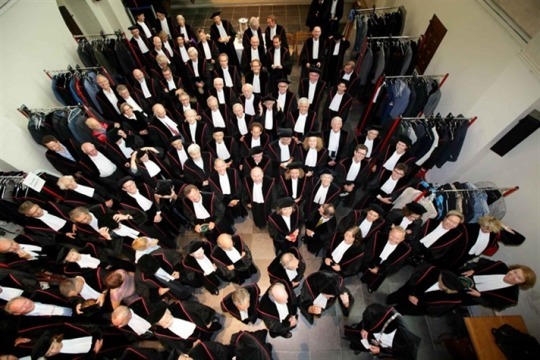
Afbeelding: de hoogleraren verzameld voor aanvang van de
opening van het academisch jaar 2016-2017. http://www.ru.nl/nieuws-agenda/nieuws/vm/2016/augustus/academisch-jaar-radboud-universiteit-start/

Have yourself a Meelberg summer

By Vincent Meelberg

– Groove: A Phenomenology of Rhythmic
Nuance
– Tiger C. Roholt (New York: Bloomsbury 214). A phenomenological study of
what I consider one of the most important aspects of music: groove.

– In the Blink of an Ear: Toward a
Non-Cochlear Sonic Art
– Seth
Kim-Cohen (New York: Bloomsbury 2009). And: 
The Tone of Our Times: Sound, Sense,
Economy, and Ecology
(Cambridge: MIT Press 2014). Two books on sound, but
discussed from different perspectives: art and ecology, respectively.

– Speaking Code: Coding as Aesthetic and
Political Expression
– Geoff Cox (Cambridge: MIT Press 2013). And: Code/Space: Software and Everyday Life – Rob
Kitchin and Martin Dodge (Cambridge: MIT Press 2011). 
Two books on another phenomenon
that I am fascinated with: software. These books approach software from a
cultural studies perspective.

Summertime!

By Timotheus Vermeulen

Alright, here’s
my summer reading list. It features books I imagine readers might actually
enjoy reading whilst lying on the beach or gazing across the mountain valleys
or – in case you are holidaying in the Netherlands – hiding from the rain in
your camper van or tent (as opposed to those books I personally always think,
or hope, rather, I might want to read but inevitably, and not without relief,
keep pushing to the bottom of my suitcase).

Changing my mind, Zadie Smith

What Judith
Naeff said
. Thoughtful in a mostly intuitive way; emotional in a contemplative
manner, meandering and measured, exploring the cosmically great and the intimately small. This is one
of the most talented authors of our moment at her best. (I would recommend
starting your holidays with this book; it will put your mind to a kind of
inspired, meditative serenity).


I am Zlatan Ibrahimovic, Zlatan Ibrahimovic & David
Lagercrantz

The, ahum,
autobiography of Zlatan Ibrahimovic, not just ghost paraphrased but “ghost imagined”,
if that’s a thing, by David Lagencrantz, is, simply put, splendid fun. There
really is no other way to describe it: it’s splendid fun: intentionally (there
are spot-on characterisations of other players and coaches in football) and
unintentionally (in its apparent lack of self-reflection) hilarious, gripping
(it’s a rags to riches story, after all), suspenseful (which fight will break
out next) and superbly written. I’ve read it two summers in a row and look
forward to getting into it again this august. (Best on the beach or next to the
pool, if you ask me).


10:04, Ben Lerner

I think
this may well be my favourite book of the past decade: moving seamlessly between
life-writing and (meta-)fiction, farce and melodrama, cultural philosophy and anecdotal
kitsch, in a prose that is lively and spot-on, the novel at once reflects on
the ills of contemporary society and contemplates the more and less effective cures.
(A good second holiday book).

Can’t and won’t, Lydia Davis

Everything Lydia
Davis writes, regardless of what it is or is about, is the best American
literature has to offer. Period. (Wonderful for reading out loud to your fellow
travellers on long journeys by car, train or plane)

Precision and Soul, by Robert Musil

Precision and Soul is a collection of essays written by Musil
between 1911 and 1937. The essays are, without exception, mind-blowing, each of them in and of themselves timeless intuitive philosophy. (Indeed, if you begin your holidays with
Smith, book-end it with this companion piece by Musil.) If the collection is
timeless however, it is also exceptionally pertinent to our current moment.
These essays read like they might have been written today, dealing with the
simultaneous bureaucratization and monetarization of thought, the perverse
obsession with measuring everything, and rising fascism. Scary stuff, but essential
stuff.

Edwin van Meerkerks zomerklassiekers

In de zomervakantie probeer ik altijd mijn achterstand in klassiekers in te halen en iets nuttigs te lezen en ook iets uit het land waar ik op vakantie ga, en verder vooral lekker laagdrempelige literatuur – zeg maar gerust pulp, maar dat is voor een science fiction-liefhebber niet zo’n kunst. In deze volgorde staan, deels digitaal, deels op papier nu vast paraat:

–       John Milton (1667) Paradise Lost.

Ik lees te weinig poëzie, te weinig religieuze literatuur, en te weinig oude boeken: drie vliegen in één klap.

–       Andy Field (2016) An Adventure in Statistics.

Ik ben niet zo van het harde rekenwerk, maar ik vind dat een alpha net zoveel bèta-literatuur moet lezen als bèta’s van ons soort volk ‘echte’ literatuur horen te kennen – bovendien is het door de vele illustraties bijna een graphic novel.

image


–       Peter Verhelst (2015) De kunst van het crashen.

Ik ga weliswaar naar Zeeuws Vlaanderen, maar er staan voldoende dagtripjes zuidwaarts op het programma om me te mogen laven aan het proza van Verhelst.

–       Lutz Seiler (2015) Kruso. 

Weer een herschrijving van Daniel Defoes klassieker, wat na o.a. literaire helden als Tournier (Vendredi) en Coetzee (Foe) van durf, zo niet overmoed getuigt, maar de recensies zijn veelbelovend.

–       Emily St. John Mandel (2014) Station Eleven.

Winnaar van de Clarke Award, dat is voor mij vaak al voldoende aanprijzing. En dan zou het ook nog eens lezen als poëzie, dat wordt smullen.

–       Robert J. Sawyer (2009) Wake.

Geen idee wat dit gaat worden, staat al een tijdje op de e-reader omdat het geshortlist was voor de Hugo Award. Spontane intelligentie ontwikkelt zich op het web, hmmm, we zullen zien.

–       Richard K. Morgan (2002) Altered Carbon.

Als iets als ‘hardboiled cyperpunk’ wordt geadverteerd dan ben ik er voor in!

Wat leest Roy Groen in zijn puptent deze zomer?

Door Roy Groen

Garth Risk Hallberg – City On Fire. Omdat je Netflix-account niet
overal werkt en je toch op de een of andere manier de avonden in je puptentje
op de camping moet doorkomen. Hallbergs roman lijkt met ruim 900 pagina’s wat
aan de lange kant, maar het geheel is gestructureerd als een moderne tv-serie,
en net als vijf seizoenen Breaking Bad of
Dexter is City on Fire voorbij voordat je er erg in hebt.

Marcel Proust – A la recherche du temps perdu. De zomervakantie is een goed
moment om dit monumentale werk dat zo’n 3000 pagina’s telt eindelijk eens te
lezen. Na de zomervakanties in je studententijd is de eerstvolgende gelegenheid
waarbij je genoeg tijd hebt om Prousts werk te lezen een periode van langdurige
werkeloosheid, of een aanstelling als literatuur professor.  

Richard Rorty – Contingency, Irony, and Solidarity. Al was het maar zodat je na
de vakantie is afgelopen net als Rorty op een overtuigende manier de namen van
Hegel, Kant, Darwin, Freud, Weber, Dewey, Heidegger, Putnam, Foucault en
Nietzsche zonder blikken of blozen in éen zin kunt gebruiken. En kunt uitleggen waarom ze
allemaal een beetje gelijk hadden, maar niet helemaal.

Hart Crane – The Bridge. The Bridge is een aaneenschakeling van
15 lyrische gedichten, die samen een ondoorgrondelijk epos vormen.  Alleen het openingsgedicht (Proem: To Brooklyn Bridge) bevat al meer
moeilijke woorden dan je prismawoordenboek telt, dus enig doorzettingsvermogen
is vereist.

Hannah Arendt – The Human Condition. Na het lezen van al die
boeken vraag je je misschien af hoe het eigenlijk met de menselijke soort
gesteld is. Hannah Arendt presenteerde bijna zestig jaar geleden een
spitsvondig antwoord dat nog steeds waardevol, verontrustend, en hoopgevend is.

Tom Idema’s reis door de literatuur

Door Tom Idema

John Steinbeck. East of Eden. Een geschiedenis van twee families in de Salinas
Valey in Californië die gedurende drie generaties met elkaar vervlochten raken
in de turbulente periode 1850-1950. Nobelprijs-winnaar Steinbeck weet als geen
ander het persoonlijke en het maatschappelijke met elkaar te verbinden.

Tom Lanoye. Gelukkige slaven. Razendsnelle roman van een van mijn favoriete
schrijvers in het Nederlandse taalgebied. Absurde gebeurtenissen en
ijzerstekere dialogen à la Tarantino.

Margaret Atwood. Maddaddam. Derde deel van de gelijknamige trilogie. Hoogstaande
post-apocalyptische fictie met veel vreemde wezens, waaronder mensen. Gewoon
science fiction dus, maar dat mogen we van Atwood niet zeggen. Taai maar fraai.

Jeff Vandermeer. The Southern Reach Trilogy. In ‘gebied X’ waar jarenlang van de overheid geen mens mocht komen,
schijnt de natuur terrein terug te winnen op de mens. Wat betekent dat precies?
Een frisse combinatie van science fiction, fantasy en horror.

Jonathan Franzen. Purity. De desintegratie van het gezin, de politiek van het
internet, en de vurige wens om meer te hebben dan de ander: Frantzen is een van
de scherpste observatoren van de hedendaagse Amerikaanse cultuur. De proza in
zijn meest recente werk is oppervlakkig en onorigineel, geheel in lijn met
vertwittering van de maatschappij. Dat leest dus lekker weg!