By Timotheus Vermeulen

I enjoy the Indiana Jones franchise as much as the next
person. I mean, I grew up watching Indiana Jones films. As a ten year old, Indy
used to be my role model – topped only, perhaps, by Leslie Nielsen (you know, the guy of Naked Gun fame). However, as Anna
Kendrick’s recent spoof has made clear, the films aren’t what you’d call
progressive – and that’s putting it mildly, I’m afraid. 

The franchise’s attitude to,
well, everyone who is not a white, male, heterosexual American, I guess, is at
best unfortunate, but probably just offensive – I’m not speaking about Indiana
Jones’s attitude towards the Nazis, here, obviously; exploding heads and
melting faces is what they had coming for a long time. If the films value Arabs (often of
unspecified origin), Chinese, Indians or women at all – which they rarely do,
since they are mostly portrayed to be too busy sneaking around, poisoning
people, eating gigantic beetles, monkey brains and eyeball soup, or being
hysterical  – it is as the white man’s lesser
versions: less brave, less clever, less civilized, less strong. Indeed, the
franchise’s entire premise is that Jones saves these crippled creatures, from their
enemies as much as from themselves. 

Of the bunch, Temple of Doom is certainly the most cringeworthy, but Raiders of the Lost Ark is not without
its moments of embarrassment either: the one assertive woman, yes, the single
female with agency, reads like Death of a
Salesman
; all her endeavors end miserably, the spirits lifted only by the
arrival of … well you can guess…. It’s called Indiana Jones, not Jane. 

It may be obvious that my ‘enjoyment’ of
Indiana Jones is troubled, to say the least. It relies on nostalgia, though one
that is waning; on an appreciation of how its well structured, suspenseful
narratives made me feel way back when, increasingly marred by what its representations make
me endure today. My aim here is not to take away anyone else’s enjoyment of the
film, let alone berate you. Everyone is free to derive pleasure from whatever
he or she fancies. But perhaps, the next time you see a promotional poster/DVD cover that
features a white man wearing a noble explorer’s top hat, an adventurer’s torn shirt,
a cowboy’s pants and a gun for a penis whipping exotic foreigners and women
into submission, try and be aware of what it is exactly, that your enjoyment
consists of.
What is art education’s answer to the refugee crisis?

By Edwin van Meerkerk

Over the pas few years the arts sector has found an answer to the austerity measures and the economist paradigms underlying the budget cuts, in the endorsement of the notion of value. Art and culture have, it is claimed, a value that goes beyond monetary output and economic growth. Its value lies on the social level, by the development and promotion of empathy and a sense of community, as well as on a cultural level, by fostering understanding for cultural differences, as well as strengthening cultural self-awareness.

In arts education, these claims have resounded strongly. What is more, they have joined forces with a third positive outcome of engaging in cultural activities: cognitive skills and multiple intelligences. These positive effects of the arts: social, cultural, and cognitive have met with little qualitative opposition, although true curriculum or policy change appears to be much slower than the endorsement of the notion of cultural value.

But now the arts in general, and arts education in particular, are facing a challenge that forces us to stand for our claims. The refugee crisis that holds the Near East, Northern Africa, and Europe in its grip, may well be the greatest challenge to western society since the end of colonialism (or maybe it shows that colonialism has not yet fully ended, but that is another discussion).

The refugee crisis may have deep economic and political causes, yet as a crisis it is predominantly social and cultural in nature. This is the crisis that takes the shape of people crossing borders, people living in camps, but also of angry people on the streets, volunteers distributing clothes, food, and toys. That part of the crisis is nothing but social and cultural. 

The arts, the cultural sector, arts education, has to stand up for its claim to have cultural and social value if this claim is worth anything. But what is it we are to do? How does one foster empathy through art in the middle of a crisis? How can cultural differences be celebrated when one party is hungry, tired, and homesick, and the other is scared, uncertain, even angry?

How can an arts teacher enter her or his class tomorrow and make a beginning in solving the social and cultural crisis that has entered the hearts and minds of the students in class? Where do we begin? I don’t know the answer. What I do know, is that it is a question that must be asked, and it must be asked now, from all of us.

This essay was first published on http://cultwise.tumblr.com/post/131576809544/what-is-arts-educations-answer-to-the-refugee

Blasted by sounds

by Vincent Meelberg

image

Music has the potentiality
to move us, sometimes quite literally so. It incites us to dance, triggers emotions,
or helps us remember. Music simply makes us feel something. Listening to music
is not only a mental activity, but a physical one as well. This is not only
noticeable when one listens to very loud
music
. Soft music can have
a similar impact as well. Yet, there are people who claim that music does
nothing to them. They believe to be insensitive to the moving powers of music. 

As of today, it might be more
difficult to sustain that claim. Salk Institute scientists have found a way to control the brain
cells of a tiny nematode worm through ultrasound.
No devices needed to be attached to the poor creature; it was all done by
simply blasting ultrasonic waves to the worm. Through these sound bursts the
scientist were able to change the worm’s direction. Neural activity thus was
triggered from a distance, by using sounds that penetrate the worm’s body. The
scientists expect that it will eventually also be possible to do this with
larger animals, including humans. 

The intrusive powers of
music and sound isn’t a recent discovery. Steve Goodman, also known as Kode9, for instance, wrote
an excellent book on sonic warfare. And one only needs
to stand in an elevator and listen to the
music played there
to realize how
intrusive, and nerve wrecking, sound and music can be. The fact, however, that
sound can literally change our physical constitution and manipulate and control
our movements does seem to make the claims regarding the influencing powers of
music on consumers, as articulated by companies such as Mood Media,
much more believable, and a bit scary as well…

Image by https://www.flickr.com/photos/76999192@N06/ via https://flic.kr/p/ezQdZm under creative commons.

Touching the surface

By Vincent Meelberg

Touch might be the most important sense we
human beings have. Touch puts us in direct, constant contact with the outside
world. And perhaps that might be the reason why this sense is so problematic.
Touch implies intimacy and closeness, and these are phenomena that the
(Western) world finds increasingly difficult to cope with. On the one hand, we
are no longer sure when it is appropriate to touch someone. On
the other hand, however, the temptation to touch is always present. This is one
of the reasons why New York City Assembly Speaker Carl Heastie and Chair of the Task
Force on Women’s Issues Aravella Simotas
recently announced the passage of
legislation
 to assure that a sentence of up to one year of
imprisonment may be imposed for a person “who makes inappropriate physical contact with
another person while traveling on a mode of public transportation.” Apparently people are so eager to touch others, even without consent, that they need a law to hold them back.

Yet, as many studies have shown, physical contact between human beings – provided it is mutually agreed upon – is vital. Physical contact and reassurance will make
people more secure and better able to form relationships. David J. Linden, a neuroscience professor at
Johns Hopkins University School of Medicine and the author of Touch: The
Science of Hand, Heart, and Mind
adds during an interview in The Atlantic: “More
than anything else, what touch conveys is ‘I’m an ally, I’m not a threat.
Touch puts the recipient in a trusting mental state, and anything you can do to
encourage the student to trust the teacher is going to make learning
better.“ And let’s face it: it is often simply very enjoyable to be
touched and to touch someone else.


Interestingly, the way we interact with
non-human entities is increasingly through direct touch as well. Until a few
years ago the way we interacted with phones and computers was by pushing
buttons. And while pushing implies touching too, this interaction remained very
indirect. One never really had the sensation of literally touching the
information that was being manipulated by the touching of buttons. All this
changed with the introduction of the iPhone. One of the reasons this device became such a huge
success was its user interface. Instead of trying to hit the correct tiny
physical buttons in order to write an email, for instance, suddenly the user
could type directly on the screen and had the possibility to literally touch
the Internet via multi-touch. It indeed was a magical experience, as Steve Jobs
liked to stress over and over again.


Nowadays, most phones use multi-touch, and
tablets such as the iPad could not have existed without this technology. So,
what does the fact that we have no problem touching the surface of our devices,
but are very reluctant to touch another person, say about Western society? Have
we arrived at a stage where we are more comfortable
being intimate with our phones than with human beings? When we take into
account that we use these devices to communicate with other people and that
direct personal contact is gradually being superseded by these mediated forms
of communication, the pessimistic conclusion might be that direct interpersonal
relations are indeed becoming increasingly rare, and therefore touching someone
may become the exception rather than the rule.


I think I need a hug…

Shaping Ships

By Laszlo Muntean 

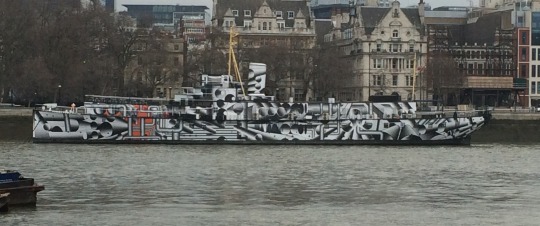
Walking along London’s Victoria Embankment one cannot help
but notice a UFO, in this case an unidentified floating object. Upon closer
inspection (and use of reason) the object reveals itself as a ship featuring a
variety of forms and colors painted all over its hull and superstructure. The
ship is the HMS President, built in
1918, and covered with “dazzle painting” by German artist Tobias Rehberger in
July last year.

image

Besides the HMS
President
two other ships have received similar treatment by renowned artists
Peter Blake and Carlos Cruz-Diez as part of the commemorations of the 100th
anniversary of World War I. For dazzle painting is a type of camouflage used
primarily by the British and the American navy during the Great War.

If camouflage is meant to conceal an object, how can
something so spectacular serve this purpose? Indeed, dazzle painting is the
opposite of camouflage that allows an object to blend into its environment. With
the growing threat of submarine attacks navy officials soon realized the
impossibility of concealing any vessel at the high seas. What seems like a
counterproductive attempt at camouflage, the role of dazzle painting was
nothing else but to disrupt the shape of a ship so as to make it difficult to
identify its size, speed, and course.

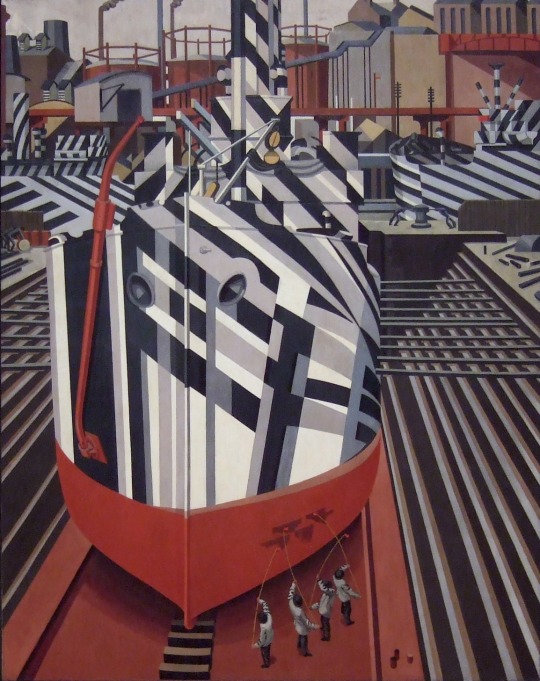
By no means a surprise, many Cubist artists soon found
themselves in the ranks of the navy, the army. Paul Klee, for instance, painted
camouflage on German airplanes, while the English vorticist Edward Wadsworth produced
a series of paintings depicting dazzle painted ships in harbor, drawing on his
wartime experience as a camoufleur.

image

Whether the patterns that they designed had ever
managed to dazzle the eyes of the enemy is debatable. By World War II, with the
advance of aerial warfare, the heyday of dazzle painting was already over. For
an in-depth study of the subject consult the works of professor of graphic
design Roy Behrens, who has written extensively on the intersections of art and
camouflage. The trend known as “Razzle Dazzle,” however, rolled on into the
roaring ‘20s in the form of fashion. The June 15, 1919 issue of the New York Tribune, for instance, features
a photograph of three women wearing dazzle-patterned swimsuits as “the newest
things”.

With Rehberger’s re-shaping of the HMS President dazzle painting has
acquired a commemorative function. His design is, however, more intricate than the
ones suggested by photographs of the same ship in 1918. What appears as a maze
of pipes and ducts seems to expose the ship’s interior from multiple
perspectives. David Kew’s short film Dazzle
Ship London
uses Rehberger’s project as a platform to delve into the
interrelation of art and camouflage. In its dazzling appearance the ship can be
visited until 31 July 2015.  

Image credits: via http://en.wikipedia.org/wiki/HMS_President_(1918)#/media/File:HMS_President_Dazzle_2.jpg and http://en.wikipedia.org/wiki/Edward_Wadsworth#/media/File:Dazzle-ships_in_Drydock_at_Liverpool.jpg

A Hollow Victory for the arts

By Rutger Helmers

image

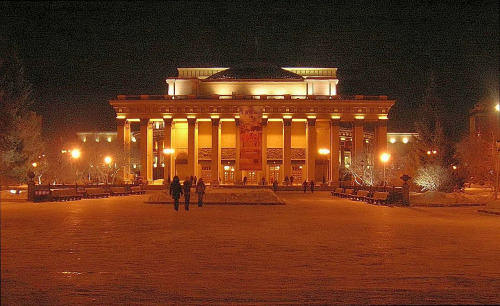
I don’t know how many of you follow
operatic life in Novosibirsk, Russia, but I know I have been, lately. This February,
a local production of Wagner’s Tannhäuser
in Russia’s third largest city became the focal point of fierce debate when
promising young director Timofey Kulyabin and the manager of the Novosibirsk
Opera Boris Mezdrich were charged of ‘intentional public desecration of objects
of religious worship,’ following a law introduced in 2013 – shortly after the
Pussy Riot trials – intended to protect the ‘feelings of believers’. The case
appears symptomatic for the influence of the Orthodox Church in Russian state
policy in recent years, as well as the authorities’ tightening control over
various media, which now apparently also affects opera.

The law in question, which is not very
clear in its definitions, may have implications for many fields of culture and
society. I was confronted with it myself some time ago, when I requested
permission to use a nineteenth-century image from a Russian archive, and was required
to confirm that I would do so without any ‘slogans related to the realization
of extremist or terrorist activity’, without ‘any attributes or symbols similar
to Nazi attributes’, without employing ‘the state symbols of the Russian
Federation (the state coat of arms, flag, and hymn)’, and finally, ‘without
offending the feelings of the faithful.’ It was the last clause that worried me
the most: it was a promise that seemed almost impossible to keep given the
sheer number of people subscribing to one religion or another.

The feelings of believers, of course, have
been very much on our minds lately, since the horrible attack on Charlie Hebdo in Paris. And it seems the
contemporary debate about the freedom of expression is inextricably mixed up
with the notion of terrorism, as opponents of Kulyabin’s Tannhäuser invoked the Charlie
attacks to press their case. Duma member Yaroslav
Nilov
, who heartily supported the prosecution of Kulyabin and Mezdrich,
argued that this would serve to deter others from following their example, and
insinuated that their behaviour might otherwise ‘foster the desire to seek
retribution and commit terrorist acts’ among the hurt believers.

Kulyabin’s production was of the kind often
decried as director’s theatre by conservative operagoers: Wagner’s opera was
given a contemporary setting in which the eponymous hero Tannhäuser was represented
as a film director shooting a movie called Venus’s
Grotto
about the early life of Jesus, which involved both religious imagery
and nudity. The production, it appears, was well received by audiences and the
press, until the Novosibirsk metropolitan Tikhon filed a complaint, claiming he
had received many reports from shocked members of his congregation. Several
thousands of Orthodox activists took to the streets, demanding that the
authorities would respect their feelings, artists throughout Russia rallied for
support of Kulyabin and Mezdrich. The affair is reminiscent of recent
controversial productions elsewhere, like the Düsseldorf
Tannhäuser
in 2013, which was rife with Holocaust-imagery, or the
Metropolitan Opera’s staging of John Adams’ The Death of Klinghoffer last October, which its opponents
denounce as anti-Semitic and pro-terrorist. But as far as I know, in neither of
these cases did the director risk a three-year jail sentence. Could it be, I
wondered, that an opera performance would acquire the same resonance as Pussy
Riot’s punk-rock provocations?

Eventually, on March 10th, the Novosibirsk
court decided to drop the case against Kulyabin and Mezdrich, and the affair
seemed to end well for the proponents of artistic freedom. It was a hollow
victory, however, as the Ministry of Culture responded by sacking Mezdrich. The
Ministry is struggling to maintain a neutral stance and called for the Orthodox
activists to cease their public protests; at the same time, however, Putin’s
press officer Dmitry Peskov
declared that the state had the right to expect that productions by subsidized
collectives ‘would not cause such an acute reaction from public opinion’.

The dust hasn’t settled just yet. This
week, a stand of the Novosibirsk Opera was found vandalized with the text ‘For
Tannhäuser’, and critics continue to question the government’s position: if the
Ministry of Culture is in fact opposed to censorship, they ask, why would they
continue to put the screws on the arts?

Democratic Scholarship?

By Edwin van Meerkerk

image

It’s no joke: starting April 1st, the Dutch are asked to suggest topics for
scientific and scholarly research via a national website, launched by a coalition of the
national Confederation of Industry and Employers VNO-NCW, the Association of Universities
in the Netherlands
the Royal Academy of Sciences, and the national research council
NWO. According to its website, the
Science Agenda ‘consolidates the themes that science
will focus on in the coming years.’

Under the
guise of a democratising measure, the autonomy of academia is being curtailed.
When the overarching science policy of which this agenda is part was launched
several months ago, newspapers received dozens of letters to the editor by scholars denouncing the
measures as inappropriate and threatening to the quality of Dutch research.
While it is too late to stop the agenda, the launching of the crowdsourcing
website helps us to understand what is really happening.

In all
western nations, the arts and sciences have been treated as related domains
throughout the long nineteenth century. Even though the gap has widened since
World War II, their position vis a vis politics and government remains largely
the same. Yet, while in the arts this relationship has been defined in clear
frames, known in Britain as the ‘Arm’s Lenght Principle’, there is no official
position regarding the influence of politics on the academic agenda. Still,
what is happening to universities today, only mirrors what has happend to the
arts over the pas few decades.

Nineteenth-century
Dutch prime minister Johan Rudolf Thorbecke famously stated that “De regering
is geen oordeelaar van wetenschap en kunst” – the government does not judge
science or art. This phrase, generally referred to as the Thorbecke Adage, has
been used to prevent the government from making artistic decisions, while at
the same time legitimising the construction of a large bureaucratic apparatus
aimed at indirect control over the arts. With the Science Agenda, politics is
looking for the same kind of back door into academia.

Image via http://upload.wikimedia.org/wikipedia/commons/7/7a/Johan_Heinrich_Neuman_-_Johan_Rudolf_Thorbecke.jpg

We’ve put together a fancy new video to promote our ground-breaking MA Programme in Creative Industries! Critical and Creative, Realist and Imaginative, this programme offers a thorough exploration of the changing landscape of cultural production. Whether it’s Fashion you’re interested in or Media, Trend Forecasting or Contemporary Art, the ins and outs of Tourism or a philosophical inquiry into Creativity; it’s all here, waiting for you to be discovered! 

Can’t imagine the world without music…

By Puck Wildschut

image

Thelast 15 years has seen a surge in speculative popular fiction focusing on theexistence of gods and mythical creatures trough a kind of thoughtform: If a
great enough number of people believe in the actuality of certain higher beings
deeply, passionately and for a prolonged amount of time, these beings are
enabled to ‘exist’, to intrude onto the physical plane of mankind and work
their not always so benign magic. In American
Gods
(2001), – soon to be transformed into another major fantasy
tv-production
 – Neil Gaiman explores numerous pantheon’s in this way, from the
ancient Egyptians’ to modern day media-goddesses; In his incredibly
entertaining urban fantasy series The Iron
Druid Chronicles
(2011- ongoing), Kevin Hearne makes the last remaining
Druid on earth battle witches, cooperate with vampires, and deal with Norse
gods and Native American tricksters; And traces of thoughtform motives can be
seen in the universes of such bestselling series as Jims Butcher’s The Dresden Files (2000 – ongoing) and
Seanan McGuire’s InCryptid series
(2012 – ongoing).

The
power of thoughtform as a literary theme, however, is not restricted to novels.
Last January, at the 2015 Image Expo in San Francisco, it was announced that a
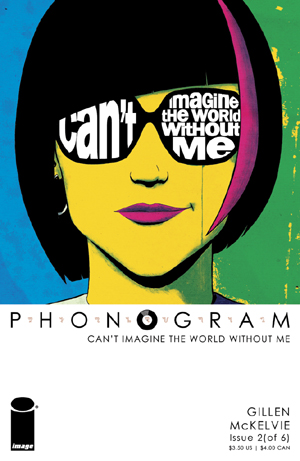
third series of the comic book (or graphic novel, whatever suits your fancy) Phonogram by Kieron Gillen and Jamie
McKelvie is to be published in August of this year. Its first volume Rue Britannia (2006-2007) tells the
story of the highly unlikeable chauvinist David Kohl, who is a phonomancer, a
rare kind of magician who feeds on people’s love for a certain type of music
and who can channel that love for magical use. Kohl is facing a dilemma: His
specific drug is Britpop, but suddenly the world appears to be slowly
forgetting its existence, and therewith Kohl’s, since he is kept alive by their
remembering. Kohl then starts on a literal trip down memory lane to save
Britpop, ensuring that not only he himself does not disappear, but, more
importantly in his eyes, people will still remember Kenickie as being the ultimate
goddesses of Britpop, that the mysterious disappearance of Manic Street
Preachers’ Richey Edwards
will makes sure he will always be remembered… and
that (praise the good Lord!) people will not start thinking of those
proto-hipsters of Kula Shaker as actual Britpop. Phonogram is a mixed read: Kohl is one of the most unsympathetic
characters I have ever come across, but he is redeemed by his love for music.
Every reader of Phonogram, Britpop
fan or no, will be able to connect
with Kohl’s nostalgic longing for those days when you were being immersed into
a certain music scene for the first time in your life and your personal gods
came into existence – an experience that will form you, and maybe even haunt
you, for the rest of your days.

Our
current time in history, we might say, is an especially grim one, with
ideological wars raging all over the world, people becoming more and more connected
through electronics but less and less connected as human beings, and
differences are often more important than similarities. The gods we believe in,
if we do at all, are gods of hate and anguish – at least, those are the gods
that haunt our news bulletins. ISIS fighters destroy Muslim art in the world’s
museums, while Feyenoord supporters trash ancient Rome’s relics in Italy’s
capital. Their gods of religion and sports are ‘thoughtformed’ by annihilation,
hate and oppression, created through acts of barbarism rather than art.

Phonogram’s gods, on the other hand,
are thought into existence by love, admiration and creativity; and above all by
people’s passion for music. And that is why I am glad the Phonogram’s saga continues, while, as an avid reader of speculative
fiction, I believe the theme of thoughtform is becoming rather a cliché. Phonogram shows precisely what it is to
be human, to truly have faith in something outside of ourselves, and most
importantly, it shows that art, in this case music, is a symbol of hope in a
time when the world is so off-balance. Maybe, if the people of this world could
believe just a little harder, a little more passionately, in the gods we hear
on our radio’s, those we see expressed on canvases in our museums, those we see
on the stages of our theaters and encounter in the words of stories, the world
could be just that bit more of a
hopeful place. So if you stumble upon Phonogram’s
next installment ‘The Immaterial Girl’ somewhere this summer, don’t hesitate to
give a go; it might just change the world.

Image via: http://en.wikipedia.org/wiki/File:Phonogramcover2.png

The Survival of the Fittest: on Experimental Space in Dutch Theatre

By Maarten de Pourcq

image

Last January the Belgian curator Frie Leysen was invited to give the closing keynoteaddress/speech of the Australian Theater Forum. She did not mince her words: ‘We have built theatres and arts centers, and we created festivals to produceand present art works and to welcome audiences in the best possible conditions.
But, during the years, most of these structures and organizations have become
rusted and sclerosized. They have become dinosaurs. (…) Originally meant to
support the artists, they got organized very well, often too well, and so lost
the needed flexibility to respond to the specific needs of specific works. The
artists now have to follow the policy and the rules of the houses instead of
the other way around.’ (The full lecture can be accessed here).

If we take a look at our Dutch playhouses, it is not too
difficult to see what Leysen is getting at: all plays seem to be made to fit
either the big or the small frontal stage; new, let alone experimental, theatre
is hard to find whereas there are plenty of adaptations, mostly of canonical
plays, which fit the classical structure of the play house like a glove.

Leysen knows the Dutch
situation all too well, as she made clear in her acceptance speech for the Dutch
Erasmus Price awarded to her last year. She rebelliously addressed King
Alexander sitting in front of her: ‘Your Majesty, your country has become a
place where the arts can barely breath.’ ‘How is it possible’, she continues, ‘that
one of the richest countries of the world no longer allows artists to
experiment and to think outside of the box?’ She is obviously referring to the
budget cuts of the previous government, effectively discouraging the creation
of new and temporary companies, and to the decision to stop supporting
‘artistic workshops, labs and research centers’. But the cuts go deeper, even
to the production level of the surviving companies. Whereas in the past few
decades theatre makers have had the tendency to look beyond the traditional playhouse
for new and different performance spaces (e.g. Dogtroep or Lotte van den Berg),
the current organization of city theatres no longer seems to embrace this
opportunity and for festivals it ironically almost seems a must to do so, rather
out of lack of performance space than because of it. They stick to the
habitual, fearing the risk more than the dinosaur.

A few months ago, the Arnhem-based theatre company Toneelgroep Oostpool performed ‘The Immortals’ in art house Lux in Nijmegen. At first sight this company seems to have adapted to the dinosaur type: in the past years they have been able to draw large audiences to their well-made adaptations of Shakespeare and modern novels like Virginia Woolf’s Orlando for either the small art house stage or the big playhouse stage. However, since the arrival of the new artistic team led by Marcus Azzini in 2012, its profile has been slightly adjusted. Oostpool still produces crafty adaptations of old and new classics, like ‘Reigen’ (Arthur Schnitzler) and ‘Angels in America’ (Tony Kushner), but it does so in combination with experimental plays mostly made by Suzan Boogaerdt and Bianca van der Schoot. The duo has established its own series called ‘Visual Statements’ which questions the contemporary obsession with visual culture, the spectacular and the self. Their performances, especially Hideous (Wo)men (2013) and The Immortals (2014), have troubled both the press and the usual Oostpool audience with their lack of plot and speech, as well as their ritualist hang-ups, involving many repetitive, gender-focused and abject scenes that disturb our view on television soaps (Hideous (Wo)men) and Youtube (The Immortals).

Interestingly, they also
have made an attempt to adapt and restructure the classical theater stage of
the playhouse to fit the concept of their performances. In Hideous (Wo)men, for instance, the audience has to watch a rotating
platform on which a television set is shown. The main structure remains
frontal, as the audience sits in the auditorium and the actors perform on
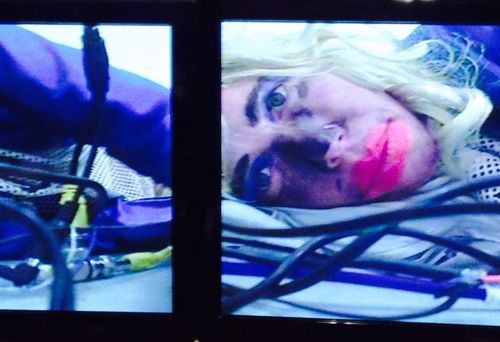
stage. Yet, in The Immortals the
auditorium is no longer used and the audience has to sit on stage trying to
peek into one of four rooms or to watch the flat screens showing what is
happening in the rooms: people broadcasting themselves endlessly. Once the
audience sits in its on-stage auditorium, the classical auditorium is no longer
visible and the classical stage loses its function as a stage. It turns into a
space very similar to what art houses and contemporary museums already have: a
performance room in which the dividing line between the audience and the performers
is less rigid. In other words, the production was performed in a space that was
not made for it. It is an inventive way of bringing their ‘visual statement’ to
the theatrical stage, no matter what that stage looks like, but it is also a
telling example of what Frie Leysen denounced in her keynote to the Australian
Theater Forum: the existing structures no longer adapt to the artists, the
artists have to adapt to the structures. They are obliged to dig around in the intestines
of the dinosaur. One never knows what can be found there, if one looks more
closely, but one does wonder what would be possible if the Dutch playhouses were
more keen on rethinking their structures and on inviting artists to do so as
well.

Image credits: The Immortals, Toneelgroep Oostpool, via http://www.toneelgroepoostpool.nl/nieuws/item/the-immortals-2