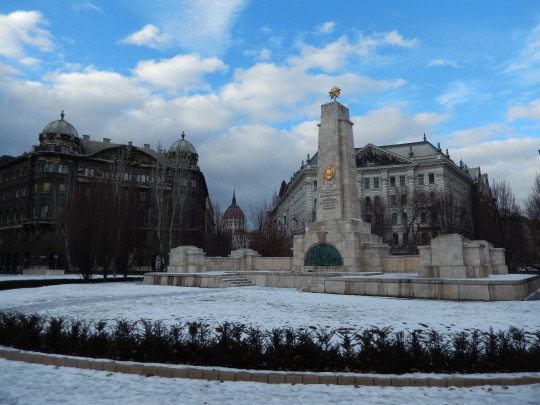
15 January 2017. My early-afternoon walk takes me to Freedom Square, located in the close vicinity of the Hungarian Parliament. The square has long been a battleground of contrasting visions of the nation’s past, present and future. At the spot where the national flag was flown at half-mast, commemorating the loss of two-thirds of the country’s territories after World War I, is now a Soviet war memorial built in 1945 and dedicated to the soldiers of the Red Army that died during the siege of Budapest. Commonly perceived by Hungarians as a monument to Communism, rather than a war memorial, it has been vandalized several times, most recently at a large-scale anti-government protest in 2006.
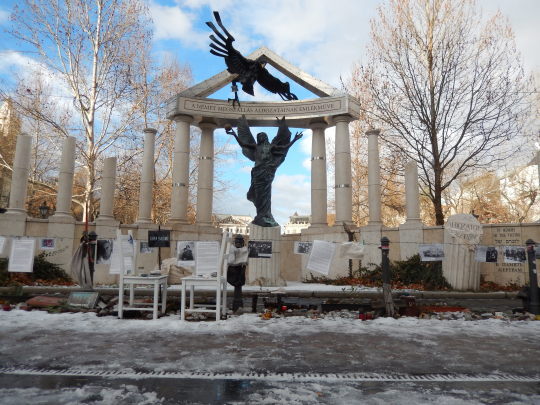
What interests me, however, is another memorial erected at the opposite end of the square in 2014. Initiated by the ruling government, this new memorial commemorates Hungary’s occupation by German forces on 19 March 1944. What looks like a classical colonnade topped by a tympanum frames archangel Gabriel attacked by an eagle stooping down. A row of broken columns—conventionally symbolizing lives cut short by violence—surrounds the tympanum on both sides. The text on the plinth reads, “in memory of the victims” in Hungarian, English, Hebrew, German, and Russian. The term victim, however, is highly problematic. While the memorial is dedicated to the victims of the occupation, the sculpture fashions Hungary as Gabriel, helplessly falling prey to the German eagle, thus obscuring Hungary’s allegiances with Germany and its complicity in the Holocaust.
Ever since its hasty construction, protesters have been adamantly demanding the memorial’s removal. The resulting counter-memorial, which faces the colonnaded tympanum on the opposite side of a narrow road, reveals the link missing from the composition. Photocopies of Hungarian
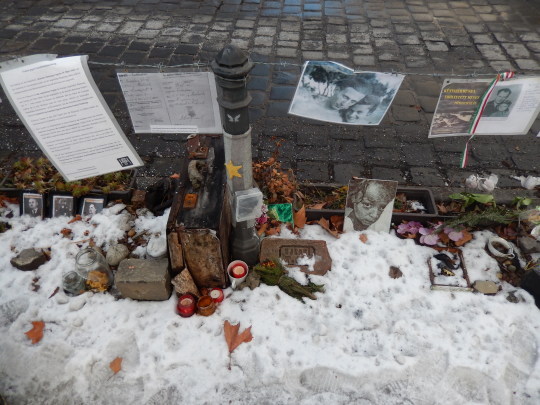
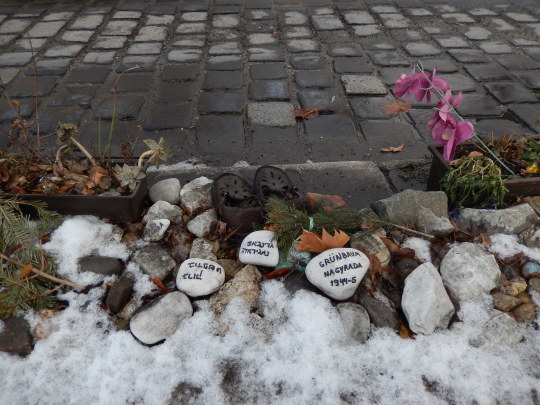
anti-Jewish laws preceding the German occupation, as well as images and stories of people perished in concentration camps have been placed along the curb. In addition, pebbles, tiny rocks with names and an assortment of objects, primarily candles, flowers, shoes and suitcases have been placed at the “living memorial,” as its creators call it. As a bottom-up initiative, it is indeed alive: it undergoes constant change exposed to heat, rain, and snow.
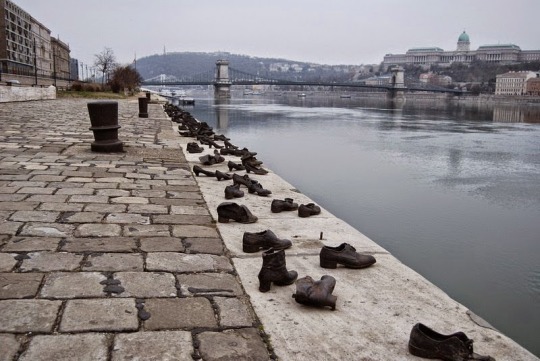
The rocks are integral to Jewish funereal culture, but what role do the shoes and suitcases play in this cacophony of new and disintegrating objects? Although they are obviously not relics from the 1940s, they still appear uncannily familiar. They are props that invoke (as intertextual references) other memorial sites. The shoes recall a nearby memorial dedicated to Jews who had been shot into the Danube by Hungarian Nazis in the closing months of the war. In that memorial the absence of murdered victims is conveyed by rows of bronze shoes along the river.
The living memorial at Freedom Square also recalls of the stacks of shoes, suitcases, and glasses and other objects confiscated from deported Jews as exhibited, for instance, in the Auschwitz concentration camp. If these personal belongings bear the imprint of their murdered owners, the props that mimic them at the living memorial at Freedom Square invoke them as intertexts, thus constituting a corrective to the “alternative facts” propagated by the official memorial to the German occupation of Hungary. The civil movement organized around the living memorial has morphed into an ongoing protest with a strong online presence. As the removal of the tympanum with Gabriel and the eagle is not on the government’s agenda, it is safe to say that the living memorial is there to stay for a while—something to seek out if you’re in Budapest.
French
philosopher Jean Baudrillard once described America as Europe’s ‘future
catastrophe’.
With the election of Donald Trump, this description aptly describes the feeling
of many Europeans, especially where new elections are due and populist
candidates appear strong in the polls. Baudrillard is known for his
introduction of the notion of the simulacrum,
the sign without reference, as emblematic for the postmodern society. In this
‘hyperreal’ world, there is no reality, only images. With a president elect who
oftentimes seems to exist mainly in and through his twitter account @realdonaldtrump,
the hyperreal seems to acquire a new momentum.
The slogan
that won Trump’s election more than anything was his assertion that he would
‘make America great again’. This expression is a direct, albeit most likely
unconscious, quotation from J.G. Ballard’s 1981 novel Hello America, in which a future president of the United States
uses the very same line. Ballard (1930-2009), whose work is
often typified as science fiction, but is better described in Margaret Atwood’s term
‘speculative fiction’, has had a love-hate relationship with America throughout
his life. His fascination with American technology (especially cars) and
celebrity cult, went hand in hand with his rejection of American politics and
media.
In Hello America, the protagonist, Wayne,
is on a quest to find his father. After a soul-searching journey through a
future America, which has turned into an uninhabitable desert due to climate
change, he ends up in Las Vegas, the only remaining city. The United States
have become the embodiment of the simulacrum: an artificial reality. Here, he
meets the new president, Charles Manson:
‘I was very
impressed by Manson. For all his weirdness, he has the old Yankee virtues. He
wants to see America great again, and becoming president is little more than
the decoration on the cake.’
Manson, an
obvious reference to the assassin and cult leader still serving a life time
sentence,
is a superstitious and narcissist man, who, in Wayne’s words ‘has every right
to call himself the forty-fifth President.’ (Hello America, p.140) – the number seems prophetic. Manson is
convinced that Europe is trying to break his ascent to power: ‘I see it waking
now like an old dog, smelling us here and trying to get its snout into this new
America I’ve built.’ As a response, Manson starts bombing cities on the eastern
coast of America, to create an impenetrable nuclear wasteland. Wayne naively believes
everything Manson says, despite the numerous warnings he is given.
Finally, Wayne meets
his father, the cliché mad scientist dr. Fleming, who spends most of his time building robot avatars of previous
presidents, as well as a fleet of solar power aircraft. Dr. Fleming, unlike his son Wayne,
does not believe in America any longer, wondering
‘what exactly we signify by
the term “America”. It’s an emotive symbol, Wayne, went out of
fashion in the 1980s and 1990s, somehow lost its appeal…’
America as an
emotive symbol, American power residing in Las Vegas, Charles Manson as its
president, all of whose predecessors are mere robots: it may seem a harmless joke, but
the stakes become real when Manson aims the last of the nuclear missiles at
himself, seeking to destroy his own capital. Making America ‘great again’ for him
means to utterly destroy it.
J.G.
Ballard’s view on American politics has always been quite unambiguous. This was
never as acutely expressed as in his pamphlet ‘Why I want to Fuck Ronald Reagan’
(1967, also included in The Atrocity
Exhibition, 1970),
the immediate cause for his American publisher to withdraw Ballard’s manuscripts from
distribution, and the reason why Hello
America wasn’t published in the US until years after its initial publication date.
The pamphlet is Ballard’s reaction to Reagan’s election campaign as governor of
California in 1967. In this campaign, Reagan widely used television
advertisements and other visual campaign strategies, all of which showed a
stark contrast between the image of a friendly and benevolent candidate and the
conservative programme with which Reagan ran for office.
It seems to
be more than ironical that the next political candidate to revolutionize the use of modern media, in
this case Twitter, in a campaign that overturns the order of fact and image, is
destined to become the real 45th
president of the United States. His name is not Charles Manson, even though he,
too, claims to want to ‘make America great again’.
Photo:
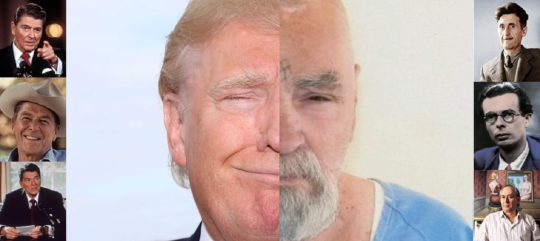
collage of portraits (Reagan, Trump, Manson, Orwell, Huxley, Ballard) by author from public domain. J.G.
Ballard ([1981] 1985) Hello America.
London: Triad/Panther.
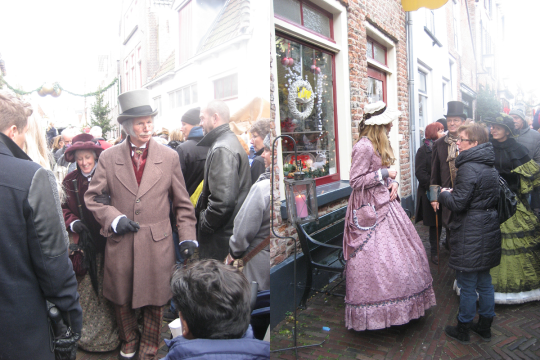
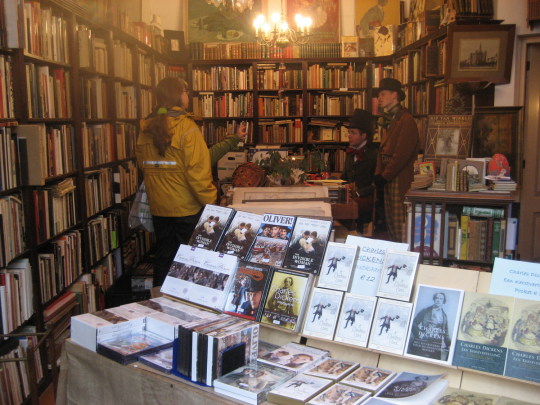
Komend weekend vindt voor de 26ste keer het Dickens Festijn in Deventer plaats.
Het festijn is een initiatief van enkele winkeleigenaren, die op deze manier
het winkelen in het historische gedeelte van Deventer een thema gaven. En met
succes! Het Dickens Festijn in Deventer trekt jaarlijks zo’n 135.000 bezoekers,
voor het merendeel afkomstig uit Nederland, maar ook uit Duitsland, België en
zelfs Engeland. Deze bezoekers trekken dan door de smalle konkelende straten
van het Bergkwartier volgens een uitgestippelde route, en komen onderweg
allerlei personages uit Dickens tegen, die her en der scenes uit zijn
verhalen—in het bijzonder, A Christmas
Carol—spelen. De winkels zijn open, er zijn allerlei versnaperingen, en
hoewel het een drukte van jewelste is, is de sfeer er uiterst gemoedelijk, niet
in de minste plaats doordat iedereen elkaar voortdurend vriendelijk
begroet!
Het Dickens Festijn lijkt zo een schoolvoorbeeld van wat
Joseph Pine en James Gilmore de beleveniseconomie noemden. In hun inmiddels
klassieker The Experience Economy met
de veelzeggende ondertitel Work is
Theater & Every Business a Stage (oorspronkelijk in 1999 gepubliceerd,
de Nederlandse vertaling verscheen in 2012), betogen zij dat belevenissen dé manier
is om klanten aan bedrijf en product te verbinden. Zo’n belevenis moet volgens
hen een thema hebben, die het bezoekers gevoel van werkelijkheid, van ruimte,
materie en tijd verandert. Verhalen vertellen is daar een belangrijk onderdeel
van. Door rechtstreeks van de negentiende schrijver zijn verhalenwereld te
lenen, haalt Deventer zijn thema welhaast van de bron.
Het fenomeen van mediatoerisme is inmiddels bekend: in zijn Plaatsen van verbeelding. Media, toerisme
& fancultuur gaat Stijn Reijnders in op het fenomeen van fans die na
het lezen van een boek of het zien van en film of TV-serie op zoek gaan naar de
locaties van hun geliefd verhaal. Denk aan de ‘Sex and the City Tour’ in New
York of fans van The Da Vinci Code in
Parijs. Of lezers die in de voetstappen van hun
favoriete auteurs treden, op zoek naar een gelaagde ervaring van plaats.
Maar wat betekent Dickens voor de bezoekers en inwoners van
Deventer? Dickens is nooit in Deventer geweest en ook zijn verhalen spelen zich
daar niet af. Het festijn bestaat al een kwart eeuw. Jongeren weten niet beter
dan dat dit een kerstraditie is—een traditie, bovendien, waarbij men zich niet
alleen verkleedt, maar ook verdiept in het werk van Dickens, zijn personages en
hun motivaties. De verhalen worden (voor)gelezen. Een paar jaar geleden
verscheen ’n
Mirreweentervertealsel, de eerste vertaling van A Christmas Carol in het Twents. Zo krijgt Dickens weer nieuwe
betekenissen en vindt zijn werk een nieuwe plaats in het culturele geheugen,
niet alleen als chroniqueur van de grootstad ten tijden van de industriële
revolutie, en ook niet alleen als thema voor een commerciële onderneming, maar
als inspiratie voor een gemeenschap om zich te organiseren en samen dingen te doen:
te ontdekken, te maken, en te spelen.
For the
occasion of the Prince Claus Award Ceremony on December 15, Lebanese born Egyptian
artist, scholar and activist Bahia Shehab visits the Netherlands. I have the
privilege to receive her with a group of students at Leiden University this
week.
Bahia
Shehab is specialized in Arabic calligraphy and typography, both historical and
contemporary, and has developed a Graphic Design major and the University of
Cairo. She currently heads this department and continues to teach there. In her
2010 art work A Thousand Times No she collected a large number of samples
of the word “no” – in Arabic “لا” – in Arabic calligraphy, which also
led to a publication that meticulously documented each sample with information
about the original context and the date of the inscription. In 2011, large
scale protests erupted in Cairo, following the uprising in Tunisia. Shehab took
to the streets and used stencils to spray the various NOs she had collected on
the city’s walls. “No to military rule.” “No to a new Pharaoh.” “No to beating
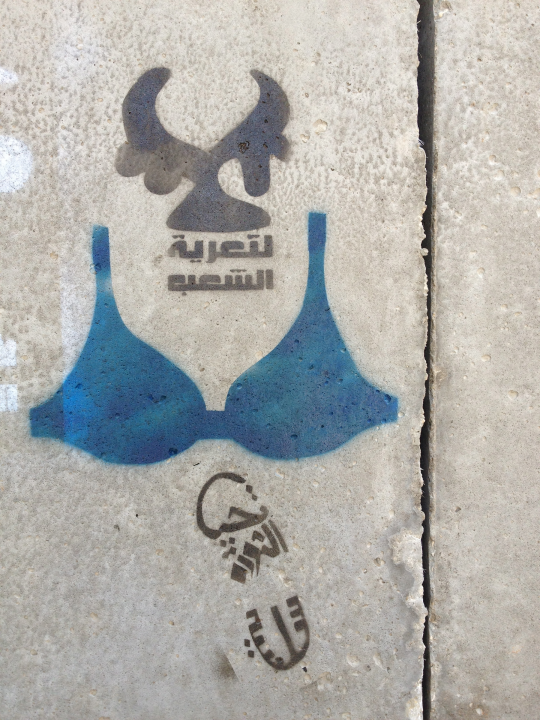
women.” One of her stencils shows a blue bra referring to the footage of a
woman who was ripped of her abaya (traditional black robe and veil) by
military police revealing her blue bra. The military police proceeded to drag the
woman along the street and stamped on her bare belly with their boots. The
footage went viral under the name “blue bra girl.” Shehab’s stencil reads “No
to stripping the people.” The footprint is itself a piece of calligraphy too, reading
“Long live the peaceful revolution.” You can watch her TED talk about these
projects here.
The
masterclass that I organize around her visit forms the incentive to reflect on
the role of artistic and creative practices in the context of political dissent.
To stick with the context of the Arab spring, there has been a tendency in both
academic and popular literature to understand revolutionary arts as “weapons”
in the struggle against repressive regimes and disenfranchisement. For example,
the BBC has decided to use for its item on the creator of a children’s magazine
the heading: “Syrian woman using ‘art as weapon’” (19 March 2016). Likewise, the
scholar, activist and journalist Donatella Della Ratta wrote in 2011: “It may
seem like a strange time to talk about music and films in Syria, but artists, armed
with a renewed creative mindset, are taking an active role in the struggle
against the Syrian regime and the violent crackdown it has launched” (“Creative resistance challenges
Syria’s regime”Aljazeera
25 December 2011, my emphasis).
If arts can
indeed function like a weapon, what is its target and how does it attack? Egypt
today suffers under a violently repressive and humiliating new dictatorship;
Libya, Yemen and Syria have spiralled down into full blown war; only Tunisia
managed to move into a new but highly precarious democratic order. Images and
texts cannot remove a regime nor can they protect bodies from bullets and
bombs. Yet, looking at Shehab’s blue bra stencil, I am still touched by the
revolutionary spirit of Egypt in 2011. When I watch the finger puppet show Top Goon, I still feel elevated by the wittiness with which it mocks Bashar
al-Assad. When I watch the videos of AbounaddaraI feel
enlightened by their portrayal of human dignity and compassion amidst the
unspeakable violence and suffering in contemporary Syria.These works
continue to radiate a powerful embrace of life against the odds and despite the
desperation and exasperation of the present. I want to argue that claiming a
voice against suffocating repression, and advocating life in the face of death
asks for a vocabulary that defies war and militarism.
There is a
long tradition of thinkers who have tried to give meaning to forms of
resistance that do not seek direct confrontation with the authorities. Michel
de Certeau, for example, pitted the concept of “strategies” against “tactics”
(1984: xix). If the former refer to administrative, policing and military
actions to control and discipline the population, the latter refer to everyday
practices with which individuals appropriate, reclaim and at times subvert the
paths laid out by a ruling system. Olifantenpaadjes constitute a benign but eloquent example of such everyday civil
disobedience. In the context of the Middle East, Asef Bayat long before the
Arab uprisings erupted, pointed towards what he called “the quiet encroachment
of the ordinary” (2010: 14-15) meaning the “non-collective but prolonged direct
action by individuals and families to acquire [the] basic necessities of their
lives (land for shelter, urban collective consumption, informal jobs, business
opportunities and public space) in a quiet and unassuming illegal fashion” (2010:
45). In other words, the prolonged survival tactics of large swathes of the
urban dispossessed has been transforming the urban environment, and society in
general, in sometimes subversive ways, without any concrete political agenda or
pivotal leadership.
De Certeau’s
“tactics” and Bayat’s “art of presence” hence both conceptualize creative forms
of resistance that do not seek direct confrontation. Yet, their
inauspiciousness does not allow for an inclusion of revolutionary graffiti,
banners and posters, or satire in theatre, television and cartoons, or rallying
music, rap or chanting in the streets. Are these not precisely meant to carve
out a presence that is to be heard, seen and felt; that disrupts the routines
of everyday life, rather than uses these routines as a cover? Helle Malmvig
when reviewing creative practices in the Syrian context, instead proposes the
Foucauldian concept of counter-conduct. Counter-conduct, she maintains, is
never directly targeting sovereignty. Rather, it is characterized by performing
behaviour and imagining ways of being that refuse to conform to hegemonic forms
of conduct. It is therefore also risky, in the sense that it disrupts the norms
and exposes the subject as “other”. For example, Abounaddara’s refusal
to clearly distinguish between victim and perpetrator, right side and wrong, is
a form of counter-conduct in the context of military sectarianism in
contemporary Syria.
Finally, in
order to understand how counter-conduct finds its place in larger patterns of
resistance, I would like to turn Marwan Kraidy. In his latest book, The
Naked Blogger of Cairo, he distinguishes between radical and gradual modes
of what he calls “creative insurgency.” The radical type occurs in outbursts,
violent and spectacular in their life-threatening open challenge to the
sovereignty of the ruler. The gradual mode “is distinctive in the incremental
and cumulative ways it chips away at power” and largely coincides with
Malmvig’s understanding of counter-conduct (2016: 18). Kraidy’s crucial insight
is that the two modes entwine. “They fuel and shape, prod and pull each other.
Gradual rebellion expands prerevolutionary dissent […] [and] sporadic radical
actions fuel waves of gradual infractions that reverberate widely, setting
grounds for the next radical gauntlet” (ibid.). Even if speaking about arts and
culture in terms of weaponry fails to do justice to the affirmation of life
they perform, they still function in tandem with violent forms of confrontation
in complex and unequal ways.
With these
insights, I look forward to hear Shehab discuss her work – then and now. I am
particularly curious to learn how she looks back on the exhilarating
revolutionary period from the perspective of a bleak present. What role does she
see for herself and others like her in the current situation in Egypt and the
Arab world at large? If you want to find out, check the
announcement and send in your motivation before Monday 12 December. The deadline has already, but if
there is still space, I am sure we can accommodate you.
Image
courtesy from the artist.
Bayat, Asef
(2010) Life as Politics: How Ordinary People Change the Middle East.
Amsterdam: Amsterdam University Press. De Certeau,
Michel (1984) The Practice of Everyday Life. Trans.
Steven Rendall. Berkeley: University of California Press. Kraidy,
Marwan (2016) The Naked Blogger of Cairo: Creative Insurgency in the Arab
World. Cambridge, MA: Harvard University Press. Malmvig, Helle
(2016) “Eyes Wide Shut: Power and Creative Visual Counter-Conducts in the
Battle for Syria, 2011–2014.” Global Society 30:2, 258-278.
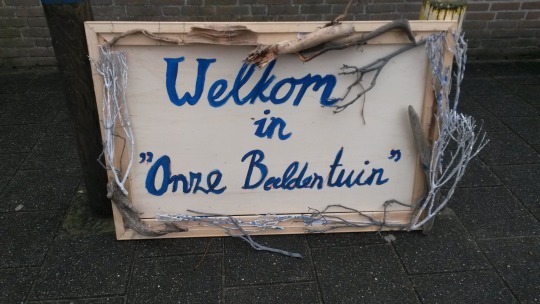
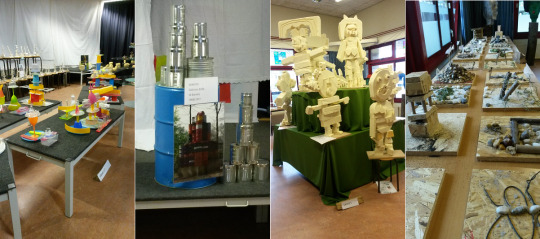
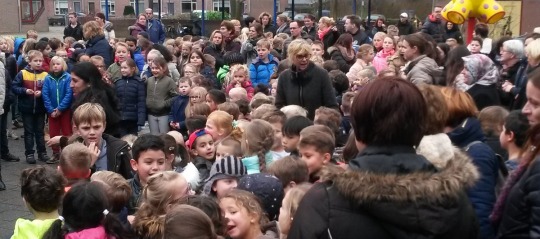
Op 2 december sloten twee Wijchense basisscholen hun CMK-project af met een beeldentuin. Alle klassen hadden onder begeleiding van kunstenaars beelden gemaakt,geïnspireerd op de werken in de beeldentuin van Kröller Müller Museum, waar de oudste kinderen zelf ook heen waren geweest. Op het schoolplein stond en lag land art, in de school diverse andere werken, onder meer geïnspireerd door werk van Jan Fabre en Christo.
De diversiteit van de werken was groot, niets was een kopie van het oorspronkelijke kunstwerk. De kinderen hadden de werken en het gedachtengoed van de kunstenaars gebruikt als inspiratiebron om nieuw, eigen werk te maken. Het resultaat is prachtig, maar dat is slechts een deel van de opbrengst. Het werken met de kunstenaars leerde hen denken als een kunstenaar. Vol trots presenteerden zij het resultaat aan de aanwezige ouders.
Het slotlied: Ik zeg: hé [hé], kijk eens om je heen, ik zeg: hé [hé], je ziet het niet meteen. Kunst is er voor iederen al ben je jong of oud. En alles wat je ziet is goed één, twee, drie, en niets is fout!
Waar gebeurd? Brussel, Antwerpen – de winter van
1926/1927. De Vlaamse dichter Paul van Ostaijen onderhoudt zijn toehoorders
over poëzie in een voordracht met de licht ironische titel Gebruiksaanwijzing der lyriek. Een van de mooiste zinnen uit die
lezing luidt: ‘de dichter is […] iemand die zeer moeilik spreekt’. Anders dan
de politieke redenaar, de strafpleiter of de welbespraakte sales manager zit de dichter steeds verlegen om het woord. Hij
houdt er bovendien een ingewikkelde relatie met de werkelijkheid op na. Met hun
woorden en voorstellingsvermogen wenden zij zich af van de dagdagelijkse wereld
en voeren zij hun lezers mee naar een tweede werkelijkheid, naar ‘the dark
places of psychology’ (Virginia Woolf), naar de diepten van het ‘moi profond’
(Proust) of naar de hoogvlakte van de verbeelding, waar verstilling en
verschrikking zich schuil houden – en misschien zoiets als waarheid.
Zo lang als er verzonnen verhalen worden verteld staat
fictie onder verdenking. Literatuur leidt niet naar de waarheid toe, maar voert
ons van de waarheid weg. Dichters verdraaien de waarheid en bederven de jeugd –
aldus Plato, die in zijn ideale staat de dichters aan een strenge pedagogische
controle wilde onderwerpen ten bate van het algemeen maatschappelijk belang.
Dichters zijn – in de woorden van Van Ostaijen – ‘staatsgevaarlijk’ en juist
daarin schuilt hun engagement. De traditie die met Plato begon is door de
Franse literatuurwetenschapper William Marx eloquent uit de doeken gedaan in
zijn onlangs verschenen boek La Haine de
la littérature (2015). In een wereld die wordt geregeerd door macht en geld
is literatuur volkomen onbruikbaar en het schrijven en lezen van literatuur
asociaal; een steriele bezigheid. In zo’n wereld is literatuur ‘le discours
illégitime par excellence’.
Liever dan verzonnen verhalen zoeken lezers hun toevlucht
tot boeken waarin bekende Nederlanders hun ‘echte leven’ (laten) vastleggen. De wereld volgens Gijp van Michel van
Egmond is een sprekend voorbeeld van een bestseller die profiteert van die
publieke werkelijkheidshonger. Talloze lezers vinden vertier en inspiratie in
de vertelde levensloop van de voetbalanalist. De knipoog naar John Irvings
roman The World According to Garp (1978)
is ogenschijnlijk de enige literaire kunstgreep die de auteur zich veroorlooft.
Wat zou er gebeuren wanneer we – uit baldadigheid bijvoorbeeld – zouden
besluiten dit boek te lezen als een roman, als een verzonnen geschiedenis over
een tragische held? Hoeveel fictie verdraagt de werkelijkheid?
Waarom lezen we romans? Waarom zou iemand zich wekenlang
intensief bezighouden met een ogenschijnlijk nutteloze bezigheid als de lectuur
van De verwondering van Hugo Claus –
een fantasmagorisch pandemonium van woorden en beelden? Hier kan ik alleen mijn
eigen antwoord geven. Lange tijd gaf ik in Nijmegen college over literaire
teksten die hun lezers confronteren met een voorstellingswereld die allerminst
geruststellend is, omdat zij niet kan worden verzoend met de eigen
ervaringswereld. Op de mooiste momenten leidden die colleges tot een gedeelde
intieme ervaring – tot momenten van gemeenschappelijk inzicht in een complexe
wereld van woorden. Al lezend en sprekend werd dan een voorstellingswereld
zichtbaar die groter en dieper is dan de dagdagelijkse werkelijkheid, maar die
werkelijkheid in een nieuw perspectief zette. Wie fictie wil verbannen –
bijvoorbeeld uit het facultaire introductieprogramma (niet uit haat tegen de
literatuur, maar uit – geloof het of niet – wetenschappelijk ongefundeerde angst
voor andermans imaginaire verveling) – kan hopelijk op fors weerwerk rekenen
van generaties letterenstudenten, het smaldeel Algemene Cultuurwetenschappen
voorop.
Behoud het verlangen, koester de verwondering.
Zeer verkorte
weergave van het ‘kroegcollege’ in Cali bij de opening van het
Wintertuinfestival, Nijmegen, 23 november 2016.
Welcome
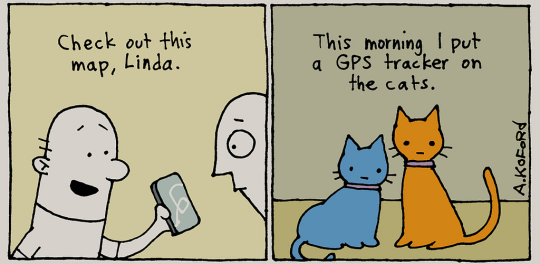
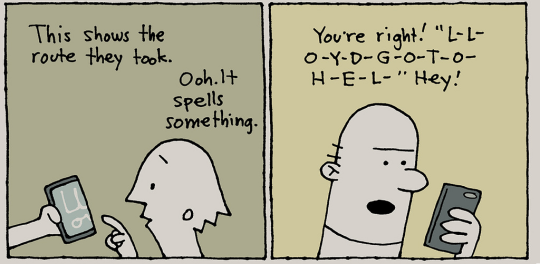
to the wonderful world of wearable surveillance! Thanks to the wearable GPS
tracker you will “never lose your pet
again”, and be able to track the location of your dementing relative or wandering child at any time.
No longer having to worry about the safety of our beloved pet, relative or
offspring us caregivers will finally have peace of mind, or so the
techno-utopian marketing story goes. But before you run off to the (web)store
to purchase this technological solution to all your ‘parental nerve’ you might
want to think again. And read this blog post, of course.
According to Belgian philosopher Kathleen
Gabriels, the “constant, remote, and often covert tracking of the other’s
data engenders a situation of what can be characterized as ‘quantified
otherness’”. In the specific case of
GPS trackers, this means that the geographic location of a physically distant
other can constantly, remotely, and unobtrusively be traced. Obviously, there
is little against the heartfeltwish
to care for, protect, and safeguard our beloved ones. The question, however, is
whether wearable GPS trackers are a desirable
and effective way to canalize and act upon this philanthropic inclination. Do
these wearables truly help prevent our vulnerable children, pets, and relatives
from getting lost or hurt, or is this the latest example of a surveillance
society gone mad?
A
few weeks ago, Dutch newspaper De
Volkskrant published an article entitled ‘Big Mother’, which connects the
parental urge to continuously supervise children to what sociologist Frank
Furedi terms ‘paranoid parenting’. “Today’s parenting style sees safety and
caution as intrinsic virtues”, Furedi
writes, “[p]aranoid parenting
involves more than exaggerating the dangers facing children. It is driven by
the constant expectation that something really bad is likely to happen to your
youngster”. There is no substantial empirical data suggesting that children wearing
a GPS tracker are indeed safer. After all, the technology will not prevent them
from falling or drowning, from being bullied or hit by a car. Kids trackers, in
other words, do not owe their appeal to their verifiable improvement of child
safety but to their capitalization of paranoid parenting fueled by a generally risk-averse
society. Depending on how they are
used, however, such wearables may nonetheless have a positive effect on the
parent-child relationship. Just the thought of being able to track a kid’s
location might turn the overprotective parent into a relaxed parent who is willing
to grant the child more autonomy and space for self-development.
Pet trackers relate to a similar phenomenon. On
the one hand, it seems like a win-win situation if these devices effectively
relieve the owner of the constant fear that something might happen to their
domestic companions and, hence, give the pet more freedom of movement. Considering
the omnipresence of heartbreaking “missing pet” posters in the contemporary
urban landscape, there is no doubt about the potential market for these
devices. On the other hand, however, pet owners (and parents/caregivers alike)
should be aware that GPS trackers decrease worries, rather than prevent any
identified danger or probable risk. The GPS technology will tell you where roughly
to look for your pet/child/relative, yet it is not fine-grained enough to identify
the exact location. Civilian GPS
trackers can track locations with a maximum accuracy
of about 8 meters, which means that
one will still have to search for the missing cat/dog/ferret/parakeet/guinea
pig/elderly/toddler/other within an area of approximately
200 meters. This is helpful
if that area is a mall or public park but becomes more complicated when it
concerns a crowded multistorey mall or dense forest.
Wearable GPS trackers are effective to the extent
that they can assist in keeping an eye on those we care for and help us to
track their location in precarious situations. In that sense, the technology
may effectively relieve some of the burden of care even if that relief rests on
the illusion of pseudo-safety. Whether their use is also desirable, however, depends on how users deal with the ethical
concerns around privacy, control, dignity, and autonomy that tracking devices
also unavoidably raise. Ultimately, the biggest issue is not if the trackers
work but how they affect the relation between ‘the tracker’ (i.e. parent,
owner, relative) and the tracked (i.e. child, pet, caregiver). The right to privacy
and self-determination is obviously less of an issue in the case of pet
trackers although some self-reflection on whether your paranoia is enough of an
excuse to make your dog “look
like a Silicon Valley asshole’s pet” seems fair. But if you are considering the option to equip your child
or dementing relative with a GPS tracker there are many other ethical concerns
to deliberate (Michael
et al 2006; Landau
2012; Estes
2014). Will you truly use the
wearable in the best interest of your beloved one, or are you simply being
tricked into buying yet another technological gadget that “resemble[s]
solutions in search of a problem” (Haggerty
and Ericson 2006: 14)?
Toegevoegde waarde In de
afgelopen jaren heeft de Nederlandse overheid aanzienlijk geïnvesteerd in
wetenschappelijk onderzoek naar de creatieve industrie, omdat zij – met een miljardenomzet en
een bovengemiddelde toename van de werkgelegenheid – wordt gezien als een belangrijk deel van de economie. Bovendien wordt ze beschouwd als een
belangrijke aanjager van innovatie en economische
groei in andere
sectoren. De creatieve industrie wordt zelfs cruciaal geacht voor de toekomstige
concurrentiepositie van westerse economieën. De traditionele maakindustrie is immers
grotendeels verplaatst naar lagelonenlanden en opkomende markten in voormalige
ontwikkelingslanden vormen inmiddels ook een bedreiging voor de kenniseconomie die daarvoor in de plaats is
gekomen. In reactie op deze sociaal-economische veranderingen werd reeds in
1997 een speciale commissie ingesteld door de Britse overheid met de opdracht om de toegevoegde
waarde van kunst en cultuur nauwkeurig in kaart te brengen. Bedrijvigheid in de
culturele sector werd kennelijk gezien als een belangrijk middel om de
leefbaarheid van voormalige industriegebieden te vergroten en tegelijkertijd
nieuwe vormen van werkgelegenheid te creëren in regio’s die kampten met een
toenemend verlies van arbeidsplaatsen.
Betekenisgeving Het eindrapport van de commissie schetste het
rooskleurige beeld van een sector die significant bijdroeg aan de economie van
het land. Deze conclusie was voornamelijk gebaseerd op de
statistische analyse van diverse bedrijfstakken die simpelweg waren
samengevoegd en voortaan werden aangeduid als creative industries. Uiteenlopende activiteiten op het gebied van kunst, vormgeving,
media en communicatie werden daartoe gepresenteerd als een coherent geheel, hoewel de onderlinge verschillen dikwijls
groter leken dan de vermeende overeenkomsten. Bovendien klonken methodologische bezwaren, want de gemeten effecten waren
moeilijk te isoleren van andere variabelen, causale verbanden bleken bij nader
inzien uitermate complex en de diversiteit in de sector was simpelweg te groot
om de uiteenlopende resultaten van verschillende tellingen te generaliseren.
Mede hierdoor ontstond vrijwel direct een grote onenigheid over de precieze aard en omvang van
de creatieve industrie. In de praktijk werden echter pragmatische keuzes
gemaakt om tot een bruikbare werkdefinitie met bijbehorende grootheden te
komen, waarbij de oorspronkelijke definitie uit het rapport meestal als
uitgangspunt werd genomen. Het document van de Britse overheid
speelde hierdoor ‘a critical formative role in establishing an international
policy discourse for what the creative industries are, how to define them, and
what their wider significance constitutes’ (Flew,
2012, p. 10). Hieruit blijkt dat theoretische concepten, analytische
modellen en andere vormen van taalgebruik niet simpelweg een afspiegeling van
de werkelijk zijn. Door middel van taal en communicatie proberen we daarnaast
ook betekenis toe te kennen aan de wereld om ons heen. We blijken zelfs in staat om een verandering in de wereld teweeg te brengen door erover te spreken. Dikwijls creëren we zodoende het
fenomeen dat we juist trachten te omschrijven.
Gezamenlijk referentiekader Feitelijk
werd de creatieve industrie in het leven geroepen door de verwoede pogingen om
haar te definiëren en nader in kaart te brengen. Ze is derhalve het concrete
resultaat van een talige interventie in de werkelijkheid, die sindsdien op een
andere manier wordt ‘waargenomen, beschreven, uitgedrukt, gekarakteriseerd,
geclassificeerd en gekend’ (Foucault, geciteerd in Merquior, 1988, p. 59). Ogenschijnlijk wordt hiermee een
conceptueel of linguïstisch reductionisme gesuggereerd, dat inhoudelijke
debatten onmiddellijk vernauwt tot semantisch geneuzel of een geraffineerde
woordspeling zonder duidelijke referent in de materiële werkelijkheid. Taal
vormt echter ook een gemeenschappelijk referentiekader, dat ons helpt om zin te geven aan
de complexe wereld om ons heen. De semantische interpretatie van
bepaalde woorden vormt daarbij een praktisch richtsnoer voor denken en
handelen. Politici, ambtenaren en managers gebruiken bijvoorbeeld specifieke
woorden om beleid te formuleren, de resulterende taken en
verantwoordelijkheden te benoemen, een bijbehorende infrastructuur te
omschrijven, enzovoort. Tot nog toe wordt het publieke debat over de
creatieve industrie evenwel gekenmerkt door onduidelijkheid, ambiguïteit en
nonchalance ten aanzien van de gebezigde definities en
theoretische concepten. Het onvermijdelijke gevolg daarvan is een grote
verscheidenheid van aannames, overtuigingen en verwachtingen oftewel een teveel – of wellicht juist een gebrek
– aan betekenissen. De constructie van een gedeeld
referentiekader is dan ook noodzakelijk om de creatieve industrie daadwerkelijk
verder te brengen. Wetenschappelijk onderzoek dient bijgevolg meer op te
leveren dan nieuwe feiten en harde cijfers, die immers alleen geloofwaardig
en betekenisvol zijn in relatie tot een specifieke context. We moeten tevens aandacht besteden aan het bredere raamwerk
dat wordt aangewend om deze gegevens op een zinvolle manier te interpreteren. Inzicht verschaffen in deze achterliggende systemen van
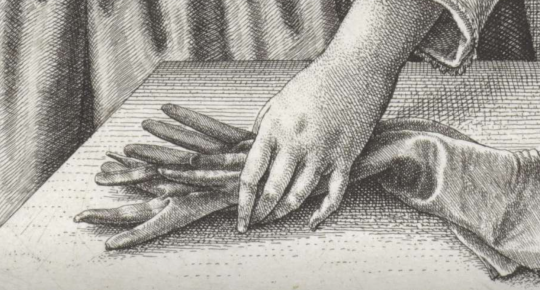
betekenisgeving is precies het domein van de cultuurwetenschappen. Wie neemt de
handschoen op?
Afbeeldingen: – Ludwig Gottlieb Portman, Twee Westfriese
vrouwen in klederdracht, 1803-1807, ets op papier, met de hand ingekleurd,
234 mm x 160 mm, Rijksmuseum te Amsterdam, schenking van G.J. (Vledder) Stoel, http://hdl.handle.net/10934/RM0001.COLLECT.32177 – Wenceslaus Hollar, Zomer, 1641, ets op papier, 245 mm x 175
mm, Rijksmuseum te Amsterdam, http://hdl.handle.net/10934/RM0001.COLLECT.32177
De Vlaamse auteur Bart Meuleman
(1965) en de Nederlandse auteur Rob van Essen (1963) groeiden op in een wereld
die niet meer bestaat. Daarover schreven ze elk onlangs een boek. Deze twee
boeken bevatten zoveel overeenkomsten dat de verschillen des te frappant zijn. Beide
schrijvers groeiden immers op in de jaren zeventig en tachtig in de provincie,
en kwamen terecht in de grootstad, waar hen een vage maar daarom niet minder dwingende
artistieke roeping wachtte. Beiden ondervonden ze aan den lijve de spanning
tussen hun leefwereld en het opkomende socialisme. Beiden onderzoeken ze mede
daarom in hun boek de moderne architectuur, waarbij nieuwe, sturende en niet
zelden utopische ideeën over samenleven de basis legden voor al dan niet
ambitieuze nieuwbouwwijken. Van Essen woonde in zo een wijk, Meuleman niet.
Misschien ligt daarin het fundamentele verschil tussen deze twee boeken verscholen.
Beide boeken worden verteld door
een ik, maar Meuleman doet dat in de tegenwoordige tijd, Van Essen in de
verleden tijd. Dat levert meteen een belangrijk contrast op: bij Meuleman beleven
we de frictie tussen het nu en het toen, bij Van Essen voelen we de afstand. De jongste zoon presenteert zichzelf als
een roman, Kind van de verzorgingsstaat
als een memoire. Het laatste boek is dan ook vooral een terugblik op een manier
van leven die in het huidige politieke bestel nagenoeg ondenkbaar is geworden,
of waarvan we stilaan in de eindtijd zijn geraakt: de verzorgingsstaat. Een
groot sociaal vangnet stond klaar voor al wie zich niet meteen thuis voelde in het
burgerleven. “Lummelen met een uitkering”,
zoals een vooraanstaande krant als NRC het verwoordt. Dit soort taalgebruik
speelt uiteraard in de kaart van de neoliberale politici die vandaag de touwtjes
in handen hebben en ons vooral met grote huiver willen doen terugdenken aan die
verzorgingsstaat. Van Essen doet daaraan, niet helemaal ongewild, mee en
plaatst daardoor, niet geheel onterecht, vraagtekens bij het wijdverbreide sociaaldemocratische
gedachtegoed van die tijd. Wel krijg je spontaan nóg meer sympathie voor de
huidige generatie jongeren die met een fikse studieschuld hun werkleven aanvatten.
Van Essens personage is een
participant, iemand die zich flexibel en bijna geruisloos laat meeslepen in de
vaart der dingen en het systeem van binnenuit beleeft. Als kind gaat hij
gewillig op in zijn religieuze opvoeding, als adolescent laat hij zich voor de
kar van de SP spannen, en later is hij een lummelaar met uitkering en
artistieke ambities in Amsterdam. Meulemans personage is een nurkse outsider,
een slimmerik die naar ‘het college’ in de stad mag maar daar toch het gevoel
heeft dat hij blijft ruiken naar platteland. Hij wordt een filmstudent met
pleinvrees die in een Brussels achterkamertje vol toewijding luistert naar de gezaghebbende
theatercriticus op de radio. Deze ik dompelt zich onder in de poëzie van Hans
Faverey, de films van Rainer Werner Fassbinder en de popmuziek van Nico. Waar veel
tieners zichzelf verliezen in kunst, zet hij bevlogen exposés op en probeert
hij zijn esthetische ervaringen in woorden te vangen. Hier ligt overigens wel de
kwetsbaarheid van deze roman: de balans tussen levensverhaal en kunstkritiek
helt voortdurend over. Maar dat maakt het ook spannend.
Opvallend is dat Meulemans ik
zichzelf verkent door te graven in leven en werk van artistieke streekgenoten,
zoals de andere schrijvers die op zijn college school hebben gelopen: Maurice
Gilliams en Leo Pleysier. Ook Pleysier was een dorpeling, een boerenzoon zelfs,
die de boerderij de rug toekeerde door te gaan wonen in een hypermodernistisch
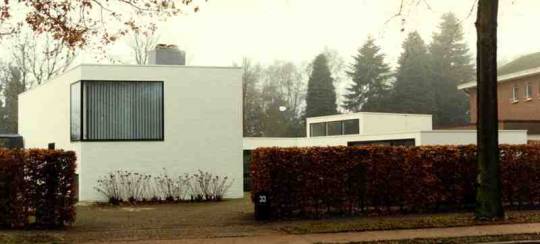
huis van de architect Paul Neefs [zie foto]. Deze Neefs is net als Pleysier en
Meuleman een zoon van de Kempen, het uitgestrekte zanderige gebied tussen
Antwerpen en Eindhoven. Wat zo bijzonder is aan zijn woningen is dat ze het
model van de boerderij lijken te repliceren: ze wenden zich af van de
buitenwereld en richten zich naar binnen als naar een erf. Het is geen toeval
dat Meuleman een uitspraak van Pleysier citeert die helemaal bij dat centripetale
concept past: “Soms zeg ik: ik woon niet in Rijkevorsel, niet in de
Noorderkempen, niet in de provincie Antwerpen, niet in Vlaanderen, niet in
België. Ik woon enkel en alleen maar in mijn huis. In ons huis.” (p.123)
Het contrast met de moderne
doorzonwoning waarin Van Essen opgroeit kan niet groter. Niet alleen de zon
maar ook de blik van de wijk doorschijnt hier het familiale leven. Helemaal
tegen de keer van de jaren zeventig beslisten zijn ouders, oud-hippies, om zich
aan te sluiten bij een strenge gereformeerde gemeenschap. Ze betrokken niettemin
een woning die het moderne functionalisme en de sociaaldemocratische
gelijkheidsgedachte moest belichamen: het rijtjeshuis met zijn uniforme
kamerindeling en het kenmerkende toiletraampje naast de voordeur. Dit
rijtjeshuis sloot naadloos aan bij het emancipatoire streven van de toenmalige Nederlandse
overheid die dit woonmodel massaal uitrolde over de Nederlandse dorpen en
wijken. En het werkte, zelfs voor hen die zich niet door de ideologie achter
die ruimte wilden laten inspireren: “Breed opgezette wijken met veel licht,
lucht en ruimte, dat was allemaal mooi, maar de ruimte waar het echt om ging
was het hiernamaals.” (p.54) Het huisorgel kon erin, de gemeenschap kon op
visite, dus no strings attached.
En dat merk je: de ik bij Van
Essen vertelt enigszins verwonderd over zijn gereformeerde opvoeding, maar de
bloedbanden zijn in zijn verhaal nooit zo strak aangesnoerd als bij Meuleman.
Die laatste blijft zichzelf zien in het licht van zijn familie (de ik is en
blijft ‘de jongste zoon’), terwijl Van Essen zichzelf ontwikkelt in het licht
van de samenleving en de gemengde Amsterdamse Diamantbuurt als zijn natuurlijke
habitat ziet (hij is een ‘kind van de verzorgingsstaat’). Beide schrijvers
laten zich wel kennen als romantische zielen, met een hang naar het leven in de
periferie van het centrum, vanwaar ze scherpzinnig het reilen en zeilen van hun
omgeving kunnen observeren, maar waarbij ze ook zichzelf in spel brengen. Het
is dan ook geen toeval dat architectuur een prominente plaats inneemt in deze
boeken: het is de plaats waar oud en nieuw, ik en wij, idee en gevoel, behagen
en onbehagen elkaar afwisselen; het is een vorm waarin persoon en politiek
samenkomen. Daar is het voor schrijvers en denkers, nurks of flexibel, meestal
goed toeven.
Bart Meuleman, De
jongste zoon. Amsterdam – Antwerpen: Querido, 2014. Rob van Essen, Kind
van de verzorgingsstaat. Opgroeien in een tijdloos paradijs. Amsterdam –
Antwerpen: Atlas Contact, 2016.
Rob van Essen is dit
jaar writer-in-residence aan de Radboud Universiteit. Bart Meuleman ensceneerde
enkele jaren geleden het vermaarde boek De Verwondering van
Hugo Claus.
In case you think that cultural
theory and academic thought are behind the times, think again. For a few years
we have been teaching theories and concepts within the framework of ‘new materialism’ at the Department of Cultural
Studies, and guess what? This autumn the famous trend forecaster Lidewij Edelkoort announced a new trend for the next
year, in fact for the next decade: NEW MATERIALISM.
In capital letters.
Her trend forecasting skills show that
we academics are quite trendy and ahead of times.
What does new
materialism entail? For Edelkoort it involves a return to the materiality of
fabrics and craftsmanship in fashion design: “We are in an age of new
materialism, the making of materials comes first before form, colour, function”.
However, as cultural theorists we think new materialism goes much further than that. At the
heart of it all is ‘matter’. New materialism takes seriously the notion that objects,
art, fashion, even people, are made out of matter. Materiality thus refers to
quite different ‘things’: the designer’s and the wearer’s body, the garment, as
well as the fiber and fabric.
Matter ‘matters’, because
it has a certain force and agency. In other words, matter is not inert but vibrant, as Jane Bennett claims. New materialism looks
at how material powers affect our daily lives. Such a
perspective is productive for the study of art, fashion and culture, because it helps understand
cultural objects as active and meaningful actors in the world.
This is even more
important because of the pivotal role of technology today. Take the phenomenon
of ‘wearable technology’, as in the designs of Pauline van Dongen and Iris van Herpen. Clothes usually hang on the body, moving
along with it. But technologies, like solar cells, LED lights, 3D printing, or
electronics, enable the garments to move autonomously irrespective of the
wearer. As Kaori O’Connor aptly remarks: ‘Man-made fibres are not inert, they
have been created to do’ (2005, p.
53). Clothes then take on a life of their own, acquiring non-human agency, entangled with the human body. The
notion of material agency highlights the fact that the technologies establish
interaction between the garments and
the body, between human and non-human entities. Material agency, in other
words, is not located exclusively in the technology, or in the human body, but
in an assemblage of wearer, fashion, and technology.
The body, clothes, and
technologies: all of these things are made up of vibrant matter that ‘act’ and
‘do’. They do so in interactive and interdependent ways; together they become ‘creative entanglements’, as Tim Ingold calls it. To fully
understand the complexity of new materialism means to take into account not
merely the materiality of fabrics, as Lidewij Edelkoort suggests, but equally
the materiality of the humans that design and wear them. New materialism thus points
to a dynamic notion of life in which human bodies, fabrics, objects and
technologies are inextricably entangled.




 Culture Weekly