
By Ketty Iannantuono, Postdoctoral researcher at Radboud Institute for Culture & History
After many years of absence, a man returns home, carrying with him the trauma of war. His wife has patiently waited for him, never losing hope but struggling to keep their home from falling apart. Their distraught son has lived in his father’s myth. Now, they must all come to terms with the less-than-heroic return of an old man: he has survived, but at an extremely high cost. This could easily be a story set in the present, yet it is based on a tale written over three thousand years ago. This is Homer’s Odyssey, as reimagined by Uberto Pasolini in his new film, Ithaca: The Return.
Rather than recounting the epic of Odysseus’ great journey – the kind of story previously adapted for the screen in Camerini’s and Bava’s Ulysses (1954), Rossi’s Odissea (1968), the Coen brothers’ O Brother, Where Art Thou? (2000), or the forthcoming Christopher Nolan blockbuster The Odyssey (set for release in summer 2026) – Pasolini’s Ithaca: The Return opts for an intimate retelling of the classic myth, focusing solely on the last books of the poem (Od. XIII-XXIII). The story is stripped of all the adventures, nymphs, monsters, and gods, and this absence feels strikingly deliberate.
The narrative centers on Odysseus’ (Ralph Fiennes) νόστος – his return to his homeland, where he arrives shipwrecked and naked, one ordinary day. More than a hero, he is a veteran, burdened with the guilt of having lost all his comrades in war. His many years of wandering are only hinted at, not as challenges to be overcome by craftiness and deception or as persecutions inflicted by envious gods, but as the result of his profound alienation and his inability to reclaim control over his life after the absurdity of the Trojan War, which, like every other war – then and now – upends the meaning of all things. For much of the film, Fiennes’ Odysseus is helpless: he barely speaks, hides in the shadows, and witnesses the devastation of his home and family. Meanwhile, his wife Penelope (Juliette Binoche) and son Telemachus (Charlie Plummer) are left with the burden of defending his throne from suitors who are pressuring the queen to remarry. As in the original text, Penelope stalls them by claiming she will choose a suitor only once she has completed the shroud she is knitting for her ailing father-in-law. In reality, she secretly spends her nights unraveling the shroud, buying Odysseus more time to return.
A fundamental theme of the film is the struggle to reconstruct one’s identity, a quintessential Odyssean topos: that of becoming “Nobody.” Returning home with clear signs of grappling with PTSD – at the premiere of the movie in Milan, Pasolini has mentioned reading Vietnam War veterans’ diaries while writing the script – Odysseus struggles to fit back into his old life. Yet, those closest to him recognize him almost immediately: Eumaeus (Claudio Santamaria), who soon understands who the old beggar is; the dog Argos, who has waited twenty years, only to die upon his master’s return; Euriclea (Angela Molina), who recognizes him by his scar; but above all, Penelope, who only needs a glance at the stranger to know that her husband has returned. She doesn’t need any further confirmation of his identity and devises the challenge of the bow not to test the stranger facing her but to push her husband to piece together the fragments of his existence and reclaim his role.
Seemingly in contrast to the Homeric poem (though I can’t help but think of the verses in Book 1, where Odysseus’ son expresses frustration and uncertainty about his identity, unsure of who his father really is despite what others say; cf. Od. I, 200-210), Telemachus refuses to accept that the veteran is his long-lost father. The man before him bears no resemblance to the hero he has heard about since childhood, evoking conflicting feelings of hatred, resentment, and humiliation. But when Telemachus finally sees Odysseus fighting mercilessly and resolutely in the palace hall, violently exterminating the suitors as per the script, he “finds” him again – and in doing so, finds himself and his place in the world.
The Absence of Gods and the Focus on Human Responsibility
In Ithaca: The Return, we are faced with a plausible story, set in a convincingly reconstructed Homeric society that parachutes us into believable Hellenistic Middle Ages, where the aristocracy is in turmoil and power struggles are violent. The film is marked by intense performances –especially from Fiennes and Binoche, who communicate deeply through their tormented yet powerful silences – and a visually striking atmosphere. The exterior shots, often set in rugged locations – shot in Corfu and in the Peloponnese – create a sense of isolation and mystery, contrasted with the claustrophobic palace scenes, which represent a prison-like environment for the protagonists. In almost every frame, both exterior and interior, the sea remains visible, reminding us of the island setting. This serves as a powerful metaphor for the deep isolation experienced by all the characters. Each man (and woman) is an island, bearing the consequences of their actions alone.
In Pasolini’s film, there are no gods swooping in to resolve conflicts. This decision transforms the film from a simple retelling of an ancient myth into a poignant commentary on the human cost of violence and war. With the gods entirely absent, the film places the full weight of Odysseus’ choices squarely on his shoulders. The consequences are real, personal, and deeply felt by everyone involved.
Penelope: More Than Just the Waiting Wife
In the original poem, Penelope is primarily a symbol of patience and fidelity, waiting for Odysseus’ return. While her devotion is admirable, it often reduces her to a secondary character defined solely by her relationship to him.
Feminist scholarship on the Odyssey emerged in the 1990s, shedding light on Penelope’s agency and intelligence. Scholars like Helene Foley (1978), John Winkler (1990), Nancy Felson (1994) and Barbara Clayton (2004), have pointed to Penelope’s role as a clever counterpart to Odysseus. After all, she manipulates the suitors, “weaves her shroud,” and subtly collaborates with her husband’s plot. On the other hand, other feminist scholars have examined the extent to which the Odyssey truly highlights, empowers, or praises women. Lillian Doherty (1995) argues that while the epic’s strong female characters may engage female audiences, they lack significant agency within a male-centered narrative. Sheila Murnaghan (1986; 1995) and Ingrid Holmberg (1995) have contended that Penelope is essentially powerless, her actions controlled by Odysseus and the goddess Athena, who is associated with male power. Other scholars, such as Marilyn Katz (1991), Victoria Wohl (1993), Seth Schein (1995), and Froma Zeitlin (1995), have noted that the Odyssey often challenges the concept of female virtue, particularly through Penelope’s potentially ambiguous actions toward both the suitors and Odysseus. Rachel Lesser (2017; 2018) argues that Penelope’s combination of disempowerment and subjectivity – autonomous yet devoted to her husband – reinforces the Odyssey’s patriarchal ideology.
Pasolini’s adaptation offers a fresh perspective. Penelope is presented as a central character in her own right, with her struggles, strengths, and complexities. She not only waits but also manages the household – handling finances, making key decisions, and defending her home from suitors. She controls her own destiny and even has a say in whether she will accept the veteran as her husband again. Such a take feels much needed, especially in the cinema, where, borrowing the words of Edith Hall (2013), until now “Penelope has still waited”. The situation is more diverse in contemporary literature: it suffices to mention Margaret Atwood’s The Penelopiad: The Myth of Penelope and Odysseus (2005) as an example of a counter-narrative to the traditional Odyssey’s patriarchal tone. Similarly, by giving Penelope more depth – and in this case even more agency in determinig Odysseus’ final destiny – Ithaca: The Return offers a powerful commentary on gender roles and the way history has traditionally sidelined female voices.
Presented at the 2024 Rome Film Festival and the 2025 Toronto Film Festival, Ithaca: The Return hit theaters in the Netherlands on March 27, 2025.
References
– Atwood, Margaret. 2005. The Penelopiad: The Myth of Penelope and Odysseus. Toronto: Village Canada.
– Clayton, Barbara. 2004. A Penelopean Poetics: Reweaving the Feminine in Homer’s Odyssey. Oxford: Lexington Books.
– Cohen, Beth. 1995. The Distaff Side: Representing the Female in Homer’s Odyssey. New York: Oxford University Press.
– Doherty, Lillian Eileen. 1995. Siren Songs: Gender, Audiences, and Narrators in the Odyssey. Ann Arbor: University of Michigan Press.
– Felson, Nancy. 1994. Regarding Penelope: From Character to Poetics. Princeton: Princeton University Press.
– Hall, Edith. 2013. “Why Penelope is Still Waiting? The Missing Feminist Reappraisal of the Odyssey in Cinema, 1963-2007”, in Ancient Greek Women in Film, edited by Konstantinos P. Nikolouzos: 163–185. Oxford: Oxford University Press.
– Foley, Helene. P. 1978. “‘Reverse Similes’ and Sex Roles in the Odyssey”, Arethusa 11: 7–26.
– Holmberg, Ingrid E. 1995. “The Odyssey and Female Subjectivity”, Helios 22 (2): 103–22.
– Katz, Marylin A. 1991. Penelope’s Renown: Meaning and Indeterminacy in the Odyssey. Princeton: Princeton University Press.
– Lesser, Rachel. 2017. “The Pandareids and Pandora: Dening Penelope’s Subjectivity in the Odyssey”, Helios 44 (2): 101–132.
– Id. 2019. “Female Ethics and Epic Rivalry: Helen in the Iliad and Penelope in the Odyssey”, The American Journal of Philology, 140, 2: 189–226.
– Murnaghan, Sheila. 1986. “Penelope’s Agnoia: Knowledge, Power, and Gender in the Odyssey”, Helios 13: 103–15.
– Id. 1995. “The Plan of Athena”, in Cohen 1995: 61–80.
– Schein, Seth L. 1995. “Female Representations and Interpreting the Odyssey”, in Cohen 1995: 17–27.
– Winkler, John. 1990. “Penelope’s Cunning and Homer’s.” In The Constraints of Desire, 129–61. New York: Routledge.
– Wohl, Victoria. 1993. “Standing by the Stathmos: The Creation of Sexual Ideology in the Odyssey”, Arethusa 26: 19–50.
– Zeitlin, Froma. 1995. “Figuring Fidelity in Homer’s Odyssey”, in Cohen 1995: 117–52.
*
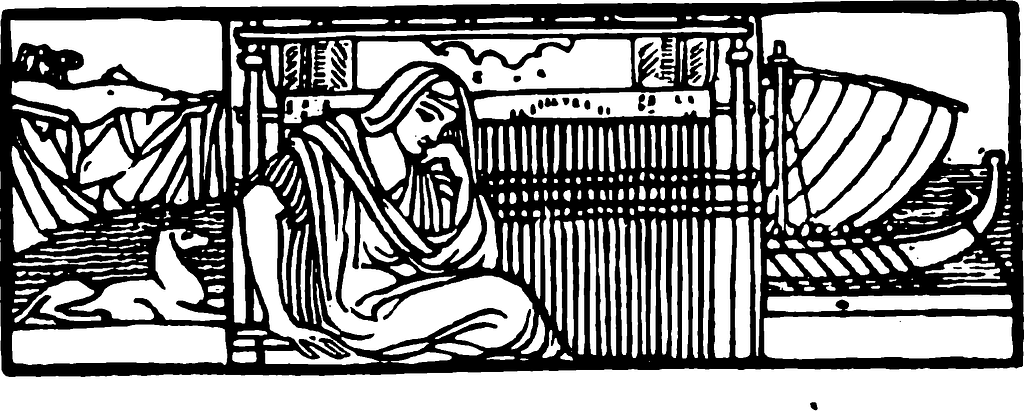
Header illustration by Adolfo de CarolisImmagini, from: Odissea, trad. Ettore Romagnoli, Bologna: Zanichelli, 1927.

 Culture Weekly