A review of social commitment in 20th century art and its commodification under Capitalism

By Zahra Abdi

Introduction
At the start of the 20th century, the impact of war, economic crises, colonial competition, and skepticism about progress led many artists to move away from content-driven art and embrace formalism, sparking the rise of modern art. By the 1920s, however, avant-garde artists renewed their interest in socially engaged art, which is essential in addressing the era’s socio-political challenges (Scheunemann, 2005; Clark, 1997). In the 1920s and 1930s, artists addressed issues like poverty, housing, war, executions, and workers’ strikes. However, as the economy improved and the art market grew, the question of art’s autonomy led to a divide between art and life (Roberts, 2014). Modern art, with its formalist focus, dominated the art world until the postmodern era. In postmodernism, art shifted back to social discourse. After 1960 in France, a rebellion against consumerism sparked critical art, and by the 1980s, figurative painting became a platform for addressing social issues. Social movements, feminism, and themes of gender, race, and identity then became central to cultural studies and artistic works (Smythe, 2015).


This research aims to answer the key question of how the discourse of socially committed art evolved within Western art during the 20th century, shaped by historical developments. It also seeks how this art is commodified in a capitalist society. The objective of this research is to examine how socially committed art—as a tool for resistance and social critique—has evolved in its expression and purpose, and to analyze how capitalist systems transform this critical art into consumable products, often stripping away its oppositional potential. To address this, the research adopts a descriptive-analytical method, beginning with a review of the trajectory of socially committed art during two first decades of the 20th century, extending through the rest of the century and into postmodernism, then applying Theodor Adorno and Horkheimer’s theory of the Culture Industry to explore how capitalism affects art and culture.


Socially committed art in the first two decades of the 20th century
To fully grasp 20th-century art and the development of modernism, it is essential to contextualize them within the broader political, social, and technological changes of the time1 (Berlin, 1997). At the beginning of the century, many Europeans and Americans were imbued with an optimistic belief in societal progress, driven by the expansion of democracy, capitalism, innovation, and technology (Marx & Mazlish, 1996). However, the competitive nature of colonialism and capitalism introduced deep instability within Europe and its political allies, ultimately leading to widespread skepticism regarding the notion of progress. The concept of progress posits that history unfolds as a continuous process of improvement, with all societies contributing to a collective evolutionary trajectory. According to this framework, if one perceives history as a definitive path toward advancement, Western civilization becomes positioned as the apex of this developmental pathway (Castoriadis & Murphy, 1985). Hegel, in his metaphysical narrative, proposed that the driving force of history lies in the birth and evolution of ideological maturity. He argued that this ideological shift occurs when a new idea emerges within the confines of an established one, eventually superseding it. In his philosophy of history, Hegel maintained that any reflective individual analyzing historical events must accept that suffering is an integral part of progress, thus embedding the concept of colonialism within the broader framework of historical advancement (McLangy, 2024).


In the latter half of the 19th century, the notion of an organic society diminished, and conflict came to be seen as the foundation of life in industrialized Western society. This view was reflected by Marx and Engels in the early Communist Manifesto, which can be seen as a seminal modernist statement advocating a radical break from the past. Modernist writers and artists were influenced by this perspective, striving to depict the alienation of urban life. The shift toward abstraction in avant-garde art is also interpreted as a reflection of this social alienation2 (Childs, 2017). The incorporation of Marxist ideas into 20th-century art, prior to the Russian Revolution, led to the creation of movements like Futurism and Constructivism, where machine played a central role. This often led to the development of abstract expressions. These artists created a significant break from traditional art forms, embracing avant-garde techniques to merge industry and production with art. By defamiliarizing common processes, they aimed to elevate critical cultural awareness (Versari, 2009). In addition to philosophical influences, the rise of avant-garde art movements was closely tied to the events surrounding World War I (Cárcel, 2023). The outbreak of the war in 1914 drastically altered global dynamics. Prior to the conflict, collaboration among European artists was widely accepted, but the war’s onset and divergent views on it caused these relationships to collapse, ushering in a new phase of European art. During this period, many artists, either voluntarily or due to obligation, joined the front lines, with some subsequently glorifying war while others strongly opposed it (Becker, 2020). It seems that the glorification of war by avant-garde artists stemmed more from their anti-bourgeois stance than from any commitment to patriotism. This avant-garde viewpoint aimed to destruction of all systems influenced by the bourgeoisie. Among European avant-garde groups, the Italian Futurists, led by Filippo Tommaso Marinetti, were the most captivated by war (Storchi, 2015).

The first Futurist manifesto, issued by Marinetti in 1908, declared that only by becoming free of the stinking gangrene of… “professors, archaeologists, touring guides, and antique dealers” only by burning libraries and flooding museums, could Italy save itself. The new world of speed and technology required a new language of forms derived not from the past but from the future. A second manifesto declared that by denying its past could art correspond to the intellectual needs of our time. Tradition was reactionary, Modernism alone was revolutionary and progressive (Gablik, 2004).


These artists displayed a fragmented chaos that represented the 20th century—a century that was increasingly and technologically undergoing transformation (Salter, 2010). For the Futurists, war was viewed as an inspiring, progressive, and even beautiful phenomenon. However, this fascination was not universally shared among artists; for some, enthusiasm was replaced by profound hatred. In France, André Breton, who would later lead the Surrealist movement, expressed his reluctance toward the glorification of war, while artists such as Marcel Duchamp distanced themselves by leaving their homeland (Re, 2004). By mid-1915, the violence, suffering, and perceived futility of the war compelled many pro-war artists to reevaluate their positions. They sought to use their art to denounce and critique the war. In post-World War I Europe, the anxiety stemming from the conflict prompted some artists to memorialize the victims, not to celebrate military heroism, but to condemn the political underpinnings of war and the prevailing culture of forgetting (Cork, 1995).


Amid World War I (1916), the Dada movement emerged with its revolutionary critique of war and bourgeois society, followed by Surrealism in 1924, which embraced an anti-war stance (Rubin, 1968). By the 1920s, the postwar generation of Dadaists had grown increasingly skeptical of society’s mercenary nature. The catastrophic consequences of the war had shattered any remaining faith in a rational and peaceful future. In their view, a civilization that tolerated such atrocities was unworthy of art’s consolations, having lost its legitimacy. Consequently, the public was confronted with meaningless, aggressively absurd object (Gablik, 2004). Avant-garde modernism emerged as an artistic movement protesting the existing social order while seeking individual freedom. The war’s catastrophic effects shattered faith in progress and disillusioned artists with past ideologies, leading them to embrace absurdity. Dadaist and Surrealist artists aimed to dismantle established patterns, yet the disharmony and fragmentation of their works mirrored individuals’ loss of control and societal harmony (Childs, 2017). This loss of centrality once again led artists to reconsider the relationship between art and society from a new perspective.


Socially committed art from 1920 to postmodernism
In the late 19th century and early 20th century, the presence of humans, either as a source of evil or as an oppressed and threatened identity, became increasingly prominent in artworks3 (Wosk, 1986).

Even though the social thought and function of art around the 1880s gradually gave way to a phase of avant-gardism, which remained influential until about 19204, but during that period, the intensification of art’s autonomy through the aesthetic movement facilitated the avant-garde’s recognition of the inherent lack of social impact in autonomous art. As a logical consequence, there emerged a concerted effort to reintegrate art into the domain of social action. The fundamental transformation that arose from the transition from aestheticism to the avant-garde movement was rooted in art’s awareness of its role within bourgeois society—or, more precisely, its comprehension of its own social standing. Avant-garde artists believed that the integration of art into life was possible, provided they created unfinished works that remained open to audience reactions. This approach began its activities in 1920s5, when streets replaced galleries as venues for artistic expression, emphasizing the connection between life and art more than ever before (Burger, 1984). Alongside radical movements, the resurgence of realism in post-war European painting cannot be overlooked. The psychological impact of the war fostered a revival of realism, as artists, driven by a heightened sense of responsibility, became more attuned to their social and human obligations, seeking to contribute to the betterment of society (Lucie-Smith, 2020).


The formation of social realism in the 1920s and 1930s was inspired by the belief that art could serve as a weapon to combat the exploitation of workers under capitalism and halt the rise of international fascism (Whitfield, 2022). The painful experience of war drove German artists such as Max Beckmann and Käthe Kollwitz to create works with themes of war, suffering, and grief. However, while Kollwitz’s work can be considered part of social realism, Max Beckmann is associated with Neue Sachlichkeit. The ‘New Objectivity’ movement, which emerged in the 1920s, was an artistic response to the war and the political and social upheaval of the Weimar Republic, often characterized by a critical, detached, and sometimes satirical portrayal of contemporary life and politics in Germany (Pound, 2018). In addition to European art, American art during this period exemplified the return of art to social action. The Harlem Renaissance, which unfolded between the end of World War I and the mid-1930s, marked significant cultural, social, and artistic transformations in Harlem. Although initially driven by a literary movement led by writers and poets, this period gradually attracted artists, photographers, and musicians, establishing Harlem as a cultural hub. The Harlem Renaissance revitalized Black pride and contributed to changing perceptions of African Americans and their roles within the cultural framework of the United States (Stephens, 2006). According to Art Hazelwood, citing Gorky6, despite the significant socio-political movement in the art world, the powerful political art of the 1930s was sidelined. During this time, elitism reemerged with the economic recovery and the decline of the Great Depression. Many curators, gallery owners, and artists participated in this pronounced shift away from political art, which had previously symbolized solidarity among artists in the 1930s. Economic improvement, evolving artistic practices, the revitalized commercial art market, fatigue from political engagement, and a sense of futility surrounding political art were all noted as reasons for the decline of political art (Hazelwood, 2017).


The return of art to social commitment: Postmodernism
Postmodernism presents both opportunities for the resurgence and expansion of cultural politics and the risk of its neutralization. A significant focus of postmodern aesthetic theory is the rejection of the modernist distinction between art and other social activities. It seeks to reclaim the suppressed political dimensions inherent in aesthetic and cultural practices. As culture permeates all areas of life, there is a growing aestheticization of social, political, and economic spheres (Connor , 1989). The resurgence of political and social consciousness, along with the re-engagement of art in political discourse, was most prominently visible in France. In 1960s France, a rebellion against consumerist society emerged at a time when art was often seen merely as entertainment. This upheaval provided a renewed platform for critical art. Although abstract painting dominated the artistic landscape and gained significant traction in educational institutions, the resistance to mainstream art forms led artists to incorporate everyday objects, including discarded materials, into their work. This shift positioned them as commentators on social movements, reflecting broader critiques of contemporary culture (Foster, et al., 2005).


With the ongoing production of socially themed artworks, a new vitality emerged in painting from the early 1980s. This revival followed the marked isolation and unprecedented withdrawal that the medium had experienced during the 1960s and 1970s in response to innovative experiments beyond the traditional canvas framework. Notably, this renewed energy in painting was expressed not through abstraction, but primarily through figurative art (Cork, 2002). During this period, it is noteworthy that Marxist and socialist interpretations of art, which gained significant influence after World War I, contributed to the emergence of a movement known as the social history of art by the mid-20th century. This movement emphasized the reciprocal relationship between society and art. Over time, Marxist art history evolved into social art history, integrating with competing methodologies such as feminism, psychoanalysis, and studies of gender and race. This shift resulted in a diverse and interdisciplinary body of work, often referred to as “modern art history. Simultaneously, approaches associated with “cultural studies” increasingly gained prominence within the realm of sociological art studies (Doy, 1998). Alongside the expansion of social art studies, a wave of global artistic events emerged, spotlighting artists of diverse nationalities, ethnicities, and cultures who had been overlooked for years. Moreover, the rise of multiculturalism coincided with the end of the Cold War, exemplified by two exhibitions that challenged the institutional dominance of white artists in Paris and London (Stallabrass , 2006).


One of these two exhibitions was “Magicians of the Earth7” at the Georges Pompidou Center. This event was pivotal in decentralizing the main cultural and artistic hubs of the world and distributing art across international centers. Selecting half of the works from Asian and African countries, aimed to present a more global discourse on art, integrating local characteristics while fostering dialogue within a broader international context. During this time, new artistic movements with social objectives emerged. Conceptual and thematic art, which gained prominence in the late 20th century, transformed aesthetic perceptions and accompanied art with a form of aggressive ethics. However, the radical advancement of new artistic expressions faced significant resistance both within and beyond the art world, prompting many artists to redefine art in a figurative space. During this period, there was a widespread effort to address social issues, focusing on inequalities related to class, race, gender, and ethnicity, especially for those facing discrimination, violence, exploitation, or invisibility. What was once a marginal issue in the modern era became central in postmodernism. The emphasis shifted towards exposing both overt and hidden forms of discrimination, reshaping social images becoming a dominant approach in contemporary art.


Commodification of socially committed art
Adorno and Horkheimer’s theory of the Culture Industry indicates how cultural products, initially created for expression and intellectual development, are commodified and mass-produced for capitalist markets (Horkheimer & Adorno, 2012). Culture and capitalism have been deeply intertwined since the Industrial Revolution, leading to the separation of culture from everyday life. This separation resulted in an undemocratic culture, where art and culture became commodities (Childs, 2017). Commodification refers to the process through which symbolic forms—cultural products with significant intellectual, aesthetic, or emotional content—are produced, distributed, and consumed as commodities within capitalist systems (Scott, 2011). These products, which may serve as tools for entertainment, communication, or social positioning, are transformed into goods for profit within market exchanges which is one of the main concerns of culture industry theory (Scott, 2011; Horkheimer & Adorno, 2012). In the context of art, commodification refers to the process by which creativity, or any form of expression is transformed into a marketable product, valued primarily for its potential to generate profit, rather than for its intrinsic or affective qualities (Anonymous, 2017). The profit derived from exclusive control over unique, non-replicable resources—such as a work of art— is referred to as monopoly rent, which can extract value from it by capitalizing on its uniqueness as discussed by Harvey (2001). Capitalism seeks to appropriate local differences, cultural variations, and aesthetic meanings to generate monopoly rents leading to the commodification of cultural products, often at the expense of their original authenticity and political meaning. Walter Benjamin and Theodor Adorno argue that art has the power to disrupt capitalist ideologies as it serves as a bearer of truth by revealing hidden social and historical truths often obscured by dominant power structures. However, they stress that art’s autonomy—its ability to remain independent of market or political pressures—is fragile. Autonomous art retains its critical edge, but when absorbed by the creative industries and commodified, it risks losing this independence and its capacity for critique (Lijster, 2017). Art can also criticize capitalism and its effects, offering a platform for resistance. Malik (2008) argues that the art market uses critique as a moral justification to appear distinct from overtly commercial practices, yet both primary and secondary markets ultimately reinforce capitalist accumulation. The values of “artist critique”—creativity, autonomy, and resistance to commodification—have been co-opted by neoliberal management. These values, once used to challenge capitalism, are now integrated into its operations, making critique part of the system and weakening its oppositional power (Chiapello, 2004).


The paradox of socially committed art lies in the fact that, while it seeks to challenge and critique the very systems of oppression and commodification inherent in capitalism, it is not immune to the forces of commodification itself. Activist art, a form of socially and politically engaged art that aims to provoke change by raising awareness about injustices, encouraging dialogue, and mobilizing communities for social action (Gupta, 2021; Himada, 2014), is the prime example of this contradiction. This form of art transcends mere aesthetic appeal, using emotion (affect) and strategy (effect) to foster a deeper understanding of systemic issues and catalyze social transformation (Gupta, 2021; Sholette, 1998). Although activist art challenge societal norms, criticize power structures, and address issues such as racism, gender inequality, environmental degradation, and human rights violations (Hackney, 2016), yet, like much creative productions, it often finds itself co-opted by the same market forces it critiques. As Lippard (1984) notes activist art can act as a Trojan horse, appearing within the structures of the art world but containing subversive messages aimed at disrupting power structures. However, when this form of art is commodified, its critical edge can be dulled, turning a tool for resistance into a marketable product for public consumption. The commodification of art, especially within the context of public spaces or cultural institutions, raises questions about the authenticity of its message and the ability of such works to maintain their political impact. Street art as a type of activist art, once a form of urban resistance and critique, has also been co-opted into the very capitalist frameworks. This transformation of public art into a tool for urban branding reflects the idea of co-optation in a broader trend of “creative city” paradigms (Pavoni, 2019), where this aesthetics are incorporated into mainstream advertising, tourist attraction, and increasing property values. What began as a form of cultural opposition to the urban decay and marginalization has been turned into a commercial product that facilitates gentrification processes while maintaining structural inequalities by excluding residents from decision-making and alienating them(Raposo, 2023; Ian Ross, et al., 2020).


On the other hand, the sense of alienation felt by people or communities in this system, resulting from commodification, can lead to resentment and opposition toward the capitalist system. This aligns with Adorno’s concept of negative dialectics, where alienation creates the possibility for resistance, even within systems of oppression (Sherman, 2016). Besides, considering capitalism needs cultural differences and their uniqueness to generate monopoly rents and maintain the illusion of authenticity, this can create openings for resistance. Alternative forms of cultural production and political organization are another form of resistance to commodification. Socialist movements and other radical political forces can use culture as a tool for opposition, reclaiming creativity and authenticity from capitalist exploitation. By focusing on collective empowerment and redirecting cultural production toward social and communal values rather than profit, these movements can challenge the dominance of capitalism while preserving cultural uniqueness (Harvey, 2001). Serafini believes community-centered art practices as resistance for this commodification. She draws on Herbert Read’s essay “To Hell with Culture” (1941), where Read critiques how capitalist systems commodify art and hinder the democratization of culture. She argues by engaging people in radical politics and social change rather than institutions through community centered art we can maintain art’s autonomy and preserve its critical potential outside the constraints of institutionalization and market pressures (Serafini, 2015). Adorno’s concept of autonomy in art, which emphasizes its separation from market logic, can be also seen here as another model for preserving the integrity of socially committed art. Read advocates for a radical shift towards a democratic model of cultural production. He argues that under capitalism, art is produced primarily for profit, leading to an elitist and undemocratic culture that is disconnected from the everyday lives of people. To counter this, it should be a system where all production is for use, not for profit, with an emphasis on function and fulfillment as the defining qualities of art, rather than its marketability. He calls for the collective ownership and control of the means of production, including artistic industries, ensuring that cultural output serves the common good rather than capitalist interests. Furthermore, Read envisions a society where art is fully integrated into everyday life, breaking down the separation between culture and work that was caused by the Industrial Revolution. In this model, artists are no longer isolated as unique geniuses but are part of a collective workforce, contributing to the democratic and functional culture that serves society as a whole (Child, 2015).


In conclusion, the commodification of socially committed art under capitalism poses a paradox: while this art form seeks to challenge and critique oppressive systems, it often becomes absorbed into the very market forces it opposes. As critical art is transformed into consumable products, its oppositional potential is frequently diluted, turning acts of resistance into marketable commodities. However, opportunities for resistance remain, as artists and communities continue to explore alternative models of cultural production that preserve the integrity of socially engaged art and challenge its commodification within capitalist frameworks.

References:

  • Anonymous, A. A., 2017. Political art without words: Art’s threat of emergence, and its capture within signification and commodification. Ephemera, 17(4), pp. 877-894.
  • Becker, A., 2020. 1913, between peace and war. In: . E. Rentzou & A. Benhaïm, eds. 1913: The year of French modernism. Manchester: Manchester University Press , pp. 174-192, https://doi.org/10.7765/9781526145031.00019.
  • Berlin, I., 1997. The proper study of mankind : an anthology of essays. 1st ed. London: Pimlico.
  • Berlin, I., 2018. The Pursuit of the Ideal. [Online] Available at: https://isaiah-berlin.wolfson.ox.ac.uk/sites/default/files/2018-09/Bib.196%20-%20Pursuit%20of%20the%20Ideal%20by%20Isaiah%20Berlin_1.pdf [Accessed 1 October 2024].
  • Burger, P., 1984. Theory of the avant-garde, Translation from the German by Michael Shaw. 1st ed. Manchester: Manchester University Press.
  • Cárcel, J. a. r., 2023. World War I as a Cause of Ephemeral Hope in the Artistic Avant-Gardes. Society, 61(1), pp. 1-11.
  • Castoriadis, C. & Murphy, J., 1985. Reflections on ‘rationality’ and ‘development’. Basil Blackwell, 4(4).
  • Chiapello, E., 2004. Evolution and Co-optation The ‘Artist Critique’ of Management and Capitalism. Third Text, 18(6), pp. 585-594.
  • Child, D., 2015. To Hell with (the contemporary commodification of) Culture!. Anarchist Studies, 23(2).
  • Childs, P., 2017. Modernism. 3rd ed. London: Routledge.
  • Clark, T., 1997. Art and Propaganda in the twentieth century, the political image in the age of mass culture. 1st ed. London: The Everyman Art Library.
  • Connor , S., 1989. Postmodernist Culture: An Introduction to Theories of the Contemporary. 2nd ed. Oxford: Basil Blackwell.
  • Cork, R., 1995. A Bitter Truth: Avant-Garde Art and the Great War. Art Journal, 54(3), pp. 98-101.
  • Cork, R., 2002. New spirit, new sculpture, new money : art in the 1980s. 1st ed. London: Yale University Press.
  • Doy, G., 1998. Materializing Art History. 1st ed. Oxford: Berg.
  • Foster, H., Krauss, R., Bois, Y.-A. & Buchloh, B. H. D., 2005. Art Since 1900 Modernism · Antimodernism · Postmodernism. 1st ed. London: Thames & Hudson.
  • Gablik, S., 2004. Has Modernism Failed. 2nd ed. London: Thames & Hudson.
  • GAIE, Ș., 2021. The Radical Avant- Garde and the Obsession for a New Beginning. Papers in art and humanities, 1(1), pp. 44-55, https://doi.org/10.52885/pah.v1i1.44.
  • Gupta, J., 2021. ART ACTIVISM: NOT JUST VISUAL APPEAL BUT A CATALYST FOR SOCIAL CHANGE. International Journal of Advanced Research(IJAR), 9(08), pp. 1021-1046, DOI: 10.21474/IJAR01/13356.
  • Hackney, L. D., 2016. ACTIVIST ART VS. PUBLIC PERFORMANCES AS SOURCES OF ACTIVISM FOR BLACK. Johannesburg: Wits University.
  • Harvey, D., 2001. The Art of Rent: Globalization, Monopoly and the Commodification of Culture. In: D. Harvey, ed. Spaces of Capital: Towards a Critical Geography . Oxford: Routledge, pp. 394-411.
  • Hazelwood, A., 2017. Art, Artists and Activism– 1930s to Today. [Online] Available at: https://www.artbusiness.com/art-artist-activism-protest-history-demonstration.html [Accessed 30 September 2024].
  • Himada, N., 2014. Activist Passion: Art, Philosophy, and the Political. Quebec: Concordia University.
  • Horkheimer, M. & Adorno, T. W., 2012. The Culture Industry: Enlightenment as Mass Deception. In: K. B. Anderson, ed. Karl Marx. London: Routledge, p. Chapter 22.
  • Ian Ross, J., Lennon, J. F. & Kramer, R., 2020. Moving beyond Banksy and Fairey: Interrogating the co-optation and commodification of modern graffiti and street art. Visual Inquiry: Learning & Teaching Art, 9(1&2), pp. 5-23, https://doi.org/10.1386/vi_00007_2.
  • Lijster, T., 2017. Benjamin and Adorno on Art and Art Criticism. 1st ed. Amsterdam: Amsterdam University Press.
  • Lippard, L. R., 1984. Trojan Horses: Activist Art and Power. In: B. Wallis, ed. Art after modernism : rethinking representation. Boston: New Museum of Contemporary Art, pp. 341-358.
  • Lucie-Smith, E., 2020. Movements in Art Since 1945. 2nd ed. London: Thames & Hudson.
  • Lynton, N., 1980. The story of modern art. 1st ed. Oxford : Phaidon.
  • Malik, S., 2008. Critique as alibi: moral differentiation in the art market. Journal of Visual Art Practice, 7(3), pp. 283-295, DOI: 10.1386/jvap.7.3.283_1.
  • Marx , L. & Mazlish, B., 1996. Progress: Fact or Illusion. 1st ed. Michigan: The University of Michigan Press.
  • McLangy, M., 2024. Stanford Encyclopedia of Philosophy. [Online] Available at: https://plato.stanford.edu/entries/progress/ [Accessed 30 September 2024].
  • Pavoni, A., 2019. Speculating on (the) urban (of) art: (un)siting street art in the age of neoliberal urbanisation. Horizontes Antropológicos, Volume 55, pp. 51-88, https://journals.openedition.org/horizontes/3692.
  • Pound, C., 2018. Artsy. [Online] Available at: https://www.artsy.net/article/artsy-editorial-new-objectivity-artists-
  • exposed-decadence-hypocrisy-german-society [Accessed 1 October 2024].
  • Raposo, O. R., 2023. Street Art Commodification and (An)aesthetic Policies on the Outskirts of Lisbon. Contemporary Ethnography, 52(2), pp. 163-191, ps://doi.org/10.1177/08912416221079863.
  • Roberts, J., 2014. Revolutionary Pathos, Negation & the Suspensive Avant Garde. In: M. J. Léger, ed. The Idea of the Avant Garde And What It Means Today. 1st ed. Manchester: Manchester University Press, pp. 138-145.
  • Rubin, W. S., 1968. Dada, Surrealism, and their heritage. 1st ed. New York: The Museum of Modern Art.
  • Salter, C., 2010. Entangled: Technology and the Transformation. 1st ed. Massachusetts: MIT Press.
  • Scheunemann, D., 2005. Theorising the Avant-Garde. In: K. Beekman, ed. AVANT GARDE CRITICAL STUDIES. Amsterdam: Rodopi, pp. 15-48.
  • Scott, A. J., 2011. Capitalism, cities, and the production of symbolic forms. Wiley, 26(1), pp. 11-23.
  • Serafini, P., 2015. Beyond the Institution: Community-Centred Art Activism Against the Commodification of Culture. Anarchist Studies, 23(2), pp. 68-88.
  • Sherman, D., 2016. Adorno’s Negative Dialectics: Adorno’s Negative Dialectics. Philosophy Compass, 11(7), pp. 353-363, DOI:10.1111/phc3.12328.
  • Sholette, G., 1998. News from nowhere: Activist art and after. Third Text, 13(45), pp. 45-62, DOI: 10.1080/09528829808576764.
  • Singsen, D., 2020. The Historical Avant-Garde from 1830 to 1939: l’art pour l’art, blague, and Gesamtkunstwerk. [Online] Available at: https://doi.org/10.26597/mod.0154 [Accessed 1 October 2024].
  • Smythe, L., 2015. Modernism Post-postmodernism: Art in the Era of Light Modernity. Modernism/Modernity, 22(2), pp. 365-379, DOI:10.1353/mod.2015.0033.
  • Stallabrass , J., 2006. Contemporary Art: A Very Short Introduction. 1st ed. Oxford: Oxford University Press.
  • Stephens, J. L., 2006. The Harlem Renaissance and the New Negro Movement. In: B. Murphy, ed. The Cambridge Companion to American Women Playwrights. Cambridge: Cambridge University Press, pp. 98-117.
  • Storchi, S., 2015. Ardengo Soffici’s “Rete mediterranea”: The Aesthetics and Politics of Post-war Modernism. Annali d’Italianistica, Volume 33, pp. 321-340 , https://www.jstor.org/stable/43894808.
  • Versari, M. E., 2009. Futurist Machine Art, Constructivism and the Modernity of Mechanization. In: G. Brghaus, ed. Cover Futurism and the Technological Imagination. Netherlands: Avant-Garde Critical Studies, Volume: 24, pp. 149-175.
  • Whitfield, T., 2022. whitfieldcollection. [Online] Available at: https://whitfieldcollection.com.au/blogs/bulletin/social-realism-new-masses-diego-rivera?srsltid=AfmBOori1Tltu9j3FM_qPvTn_jpR31OdUzGjN_hLir2OoxvTbyRP2lab [Accessed 1 October 2024].
  • Wosk, J. H., 1986. The Impact of Technology on the Human Image in Art. Leonardo, 19(2), pp. 145-152, https://doi.org/10.2307/1578279

Footnotes
  1. In his article The Pursuit of the Ideal, Berlin identifies two significant factors in shaping the history of humanity in the 20th century: the active influence of science and technology, and the profound ideological upheavals that emerged. Events such as the Russian Revolution and its aftermath, totalitarian regimes (both left and right), surges of nationalism, racism, religious fanaticism, etc (Berlin, 2018) ↩︎
  2. Lynton describes modern art as if “there was no design, no composition, and no way for the viewer to know what to admire, let alone what to think about. It seemingly lacked any content (Lynton, 1980). ↩︎
  3. At the end of the 19th century, in the works of artists such as James Ensor (1860–1949), Edvard Munch (1863–1944), and Toulouse-Lautrec (1864–1901), there was no longer any trace of the tranquility and brightness found in classical works or the vibrancy of life depicted in realism. Instead, there are faces of distorted humanity, beings devoid of identity, and purely anguished visages; these faces symbolize the sickly and pessimistic spirit of suffering and corrupted humanity. ↩︎
  4. The avant-garde timeline should extend back to the 1830s, tracing its roots to l’art pour l’art. This shift highlights that the avant-garde was not only a rejection but also a continuation of l’art pour l’art (Singsen, 2020). ↩︎
  5. It is also known as radical avant-garde (GAIE, 2021). ↩︎
  6. Arshile Gorky, poor art for poor people ↩︎
  7. Magiciens de la Terre, a contemporary art exhibit from 18 May to 14 August 1989. ↩︎

As the Crowd Was Chanting More!

What popular concert culture can learn from Punk DIY Ethos in an age of consumption, social media, and sustainability.

By Sybe Kemmere, Cynthia van Mourik, Julie Nijburg, Fleur ter Horst and Caroline Couch

Concerts have always been about more than just listening to music. They serve as the intersection of artist and listener, becoming a nexus of self-expression, fan connection, and honestly – plain fun. In a post-pandemic age, mainstream pop giants have redefined the cultural zeitgeist surrounding concerts. Artists and their fans alike, through the power of social media like TikTok, have developed concerts into a cultural phenomenon at the intersection of consuming music and fashion. From the bedazzled cowboy hats of Chappell Roan’s Midwest Princess Tour to the indie-sleaze revival of Charli XCX’s Sweat Tour, pop concerts have become full-fledged fashion events. For many fans, it is no longer enough to enjoy a concert. What you wear (and post about it) matters almost as much as the show itself.

This expression alone is not a problem, rather it is that these fans turn to fast-fashion as a cheap and convenient solution to meet the expectations of this new concert culture. While at first it might just seem like “it’s just one outfit,” the numbers these pop crowds draw and the amount of social media impressions are massive, and the implications for consumption are frightening.

Taylor Swift’s tour has sold 11 million concert tickets and amassed over 105 million impressions on TikTok for The Eras Tour Outfit alone.1 Amongst these millions of attendees come millions of individual garments produced, purchased, and disposed of. These mass events of single use consumption fuel the growing issue of fast fashion’s global environmental impact, and this connection is one that we just can’t afford to ignore.

The fashion industry is one of the largest global contributors to pollution and climate change, with production alone constituting 10% of global carbon emissions.2 Quantity too has replaced quality: 60% of new clothing is created with cheap synthetic materials, leading to poor quality and limited re-wearability.  Globally we produce 92 billion tonnes of textile waste yearly and the massive influx of non-biodegradable synthetic fast fashion waste clothing builds up.3

Pop concert fans are influencing fast fashion production through their consumption, as the outfits they buy often externalize their connection to the artist or maybe even gain some social media fame. However, after the tour hype is over, many of these items will end up forgotten in closets or, worse, in landfills. The solution to this issue is not telling fans to cease their fan expression through fashion, rather it is to adopt more sustainable understandings of their consumption and adopt mitigating practices.

This is where we believe the mainstream pop fans can learn a few lessons from something completely opposite from them, Punk. Particularly, how the subculture’s DIY ethos informs their consumptive habits regarding expressive acts of “fandom” identification.

While the media might sometimes frame “fandom” as only for teenage girls or geeks, it is everywhere. From sports to music, and cars to fashion brands, fans are found anywhere and anytime. Before delving into what this mainstream pop concert culture can do to reshape their fan expression, it’s important to take a moment and just see how fans not only drive consumption, but act as producers themselves.

Fans are the audience members that form lasting relationships with a phenomenon like a book or artist, and for many this emotional attachment causes fans to express their connection to the product creatively.4 The devotion crystallizes into fan projects, such as the current trend of hyper-specific concert outfits.

Social media only drives this production too, as there is now a low barrier of entry to recognition within fandom spaces for the uniqueness of the work you create or the strength of your identity as a fan. As a result, we have seen more fan output and expression than ever.

Through this creative expression, fans can connect to other fans and develop their own personal connection with their media of choice. Fandom becomes a marker of identity, howeve, even though it is an intrinsic part of the self, one’s fan identity can’t always be expressed in offline daily life. Therefore, events like these large pop concerts become sites where fans can converge, bringing a sense of belonging and safe space for fandom expression, but also a place to see and be seen.

This expression of identity often takes shape in fashion, where one’s clothing says something about one’s status: from punk concerts where everybody is wearing at least one safety pin, to classical concerts where nobody is wearing jeans.

In the mainstream pop-concert world, we have additionally seen how these outfits become aesthetic expressions of one’s fan identity, but also symbolic representations of the original media. Social media has fanned the flames of this, with the aforementioned TikTok videos surrounding the flaunting of one’s concert outfit and discussion of references visually baked into the outfit obtaining hundreds of millions of views. During The Eras Tour, fans went all-out: home-made red carpet looks, cloning Swift’s outfits, or even clothes referencing lyrics and inside jokes. During Beyoncé’s Renaissance Tour, fans wore silver, black and cowboy attire emulating the retro futuristic sonics and aesthetics of her most recent albums.

You don’t show you’re a devoted fan by knowing every lyric, you show you’re a devoted fan by wearing your devotion.

Through the intersection of fashion and concerts, pop fans express their own fan identity, find community belonging, and open the door to obtaining social capital in the quest to be seen as a “real” or “the best” fan. In the quest to obtain this social capital, outfits have become more complex. More garments are consumed and eventually disposed of, exacerbating the previously discussed issues of environmental sustainability.

So now that the issues surrounding sustainability and fan motivations have been explored, what can be done to target issues of over-consumption, while also still retaining the spirit of creative fan expression through fashion? Well, enter the Punk subculture, who adopt ‘Do It Yourself’ or DIY as an aesthetic and practiced values within their communities.

In many Punk subcultures, fashion becomes a reflection of the social realities and independent lifestyle of their movement with a strong focus on celebrating music and criticizing societal establishments. Fashion choices from haircuts to shoelaces become expressions of self-identity: visually signifying one’s identification as a member of a music scene, a punk, and even political affiliations. However, a punk doesn’t go to Shein or Temu to develop their fashion expression or purchase signifiers that will visually display themselves as “more punk.”

Rather the often anti-establishment (if not openly anti-capitalist) nature of Punk centers DIY as a rejection of mainstream expectations regarding consumption. Additionally, this DIY ethos has existed long before the modern understanding of the environmental crisis; nowadays it’s hard to ignore the political implications that pollution and climate change play in the adoption of DIY.

Specifically, The DIY culture in punk focuses strongly on independence, for example producing and distributing music without the interference of a record label. Band members as well as fans even make their own clothing, and bands also travel and perform at DIY events where they connect with their community. By being independent like this, Punks create a social network that enables Punk music and ideologies to spread.5

As for fashion, Punks will DIY their own clothing, remaking objects from waste or second-hand materials. If you want something new, you make it – paint and bleach make any piece of fabric homemade “merchandise” for your favorite band, while safety pins and dental floss stitch garments into new life. This DIY is not only about limiting consumption, but also about production outside of the present system, as Punks push reduce, reuse, repair, recycle to new creative heights.

In contrast, the mainstream pop-cultural space has its own trend of “DIY.” On social media, videos surrounding how fans “DIY’d” their outfits, by styling newly purchased pieces together, gain a following on social media. Punk DIY is not about obtaining social capital. Rather, it is a direct political challenge against mass production and consumption, promoting the creation of one’s fan identity outside of capitalism.6

Now more than ever, in the age of one and done fast fashion concert outfits, mainstream culture needs to learn from the subcultural ethos of Punk DIY.

Trickle up theory in fashion suggests that there is an avenue for the methods and aesthetics of Punk fashion into the mainstream, implying that new trends arise in subcultures on the streets subsequently “trickle up” into adoption by upper and middle classes. This can include adoption of aesthetic styles but also trends surrounding consumption. For example, “thrifting” which once was a way of low-cost clothing consumption for lower classes, has now been adopted by higher classes as an activity for leisure.

Unlike the Punks, Pop-music concert culture is more focused on expression of fandom than on expression of ideals. Absorbing the model of Punk style can provide insight in the implementation of sustainable DIY culture, not only as a method to create fan expression– but to live by. If styles relating to repurposing and identity rather than new consumption would become popular within the big concert cultures, perhaps the same symbolic dimension could make meaning for this group.

Therefore, with the right messaging, if not romanticization, the DIY ethos as both a fashion aesthetic and politicized expression can lead to a greater awareness of the  fashion industry’s environmental damage and the role these fans play in driving this damage.7 The trickle up theory can thus serve as an important starting point in addressing fashion issues because the broader adoption of Punk styles can result in conversations and reflections on these issues.8

What does this messaging look like? True, intentional DIY in mainstream concert spaces needs to become trendy. Organization amongst fans need to center sustainability and DIY in the conversations, while social media can be used to redefine what social capital is gained in effort. While negative, how can social media be used to shame those who post haul after haul of cheap fast fashion?

The burden doesn’t fall on the fans alone. Mainstream pop artists too have an important role in defining the values and practices of their fans, especially as it regards DIY ethics and sustainability practice. If an artist doesn’t value or center the environment, fans likely are not going to care. While artists like Taylor Swift are famously silent about the role themselves, their music, and their fandom play on the environment, other artists, like Billie Eilish, who is currently on her global Hit Me Hard and Soft Tour, is an example of how an artist can carry out the Punk-esque sentiments of DIY ethos and politics in a more mainstream context.

At her concerts, Eilish has partnered with Reverb, a research non-profit that explores the connection between fast fashion and music through consulting, case studies, and on the ground interventions. Reverb attends each show, collecting data about fan consumption and encouraging political actions related to sustainability by connecting fans with local organizing groups, registering to vote, and taking a pledge to eat plant-based meals.

Eilish does not discourage creative fan expression, yet implores her fans to be aware of their consumption, while providing more sustainable alternatives.9 For example, she has organized clothing swaps for ticket holders of her tour, dedicated portions of ticket proceeds to climate issues, and ensured her concert merchandise is limited in scope and made from recycled materials.10 Through someone with as wide a reach as Billie Eilish, underlying messages of sustainable fashion and fan practices ideals can spread.

Fandoms are unique entities, possessing untapped power for connection and expression through music – but also a potential for environmental harm as the effects of consumptive concert culture becomes undeniable on a global scale. Now more than ever it seems the main-stream Popgirlies and their fans can learn from Punks.

Sources:

  1. TikTok. n.d. “The Eras Tour Outfits.” Accessed October 28, 2024. https://www.tiktok.com/discover/the-eras-tour-outfits. ↩︎
  2. World Economic Forum. 2020. “These Facts Show How Unsustainable the Fashion Industry Is.” World Economic Forum. https://www.weforum.org/fashion-sustainability. ↩︎
  3. Resnick, Brian. 2019. “More Than Ever, Our Clothes Are Made of Plastic. Just Washing Them Can Pollute the Oceans.” Vox, January 11, 2019. https://www.vox.com/the-goods/2018/9/19/17800654/clothes-plastic-pollution-polyester-washing-machine. ↩︎
  4. Leksmono, Desideria., & Maharani, Tarisya P. (2022). “K-Pop Fans, Climate Activism, and Participatory Culture in the New Media Era.” Unitas, 95(3): 114-135. https://doi.org/10.31944/20229503.05 ↩︎
  5. Moran, Ian. 2010. “Punk: The Do-It-Yourself Subculture.” Social Science Journal. https://www.semanticscholar.org/paper/Punk%3A-The-Do-It-Yourself-Subculture-Moran bf18c0f5ea7f51d9c6b975994d77b01bac82a474. ↩︎
  6. Triggs, Teal. 2006. “Scissors and Glue: Punk Fanzines and the Creation of a DIY Aesthetic.” Journal of Design History 19 (1): 69–83. https://doi.org/10.1093/jdh/epk006
    Affuso, Elizabeth, and Suzanne Scott, eds. 2023. Sartorial Fashion: Fashion, Beauty Culture and Identity. University of Michigan Press. https://doi.org/10.3998/mpub.12315327.
    Osgerby, William. 2014. “Subcultures, Popular Music, and Social Change: Theories, Issues, and Debates.” In Subcultures, Popular Music and Social Change, edited by William Osgerby. Cambridge Scholars Publishing. http://ebookcentral.proquest.com/lib/rug/detail.action?docID=1790933.. ↩︎
  7. Sklar, Monica, Sharon Autry, and Lauren Klas. 2021. “Fashion Cycles of Punks and the Mainstream: A US-Based Study of Symbols and Silhouettes.” Fashion Practice 13 (2): 253–74. https://doi.org/10.1080/17569370.2020.1794314. ↩︎
  8. Mohr, Iris, Leonora Fuxman, and Ali B. Mahmoud. 2022. “A Triple-Trickle Theory for Sustainable Fashion Adoption: The Rise of a Luxury Trend.” Journal of Fashion Marketing and Management: An International Journal 26 (4): 640–60. https://doi.org/10.1108/JFMM-03-2021-0060. ↩︎
  9. Havens, Lyndsey. 2024. “Why Billie Eilish Insists on Sustainability In Her Career: ‘It’s a Never-Ending F-king Fight.’” Billboard, March 28, 2024. https://www.billboard.com/music/pop/billie-eilish-sustainability-eco-friendly-initiatives-mom-1235642455/. ↩︎
  10. Shoaib, Maliha. 2022. “Can Billie Eilish Convince Fans to Shop More Sustainably?” Vogue Business, June 10, 2022. https://www.voguebusiness.com/sustainability/can-billie-eilish-convince-fans-to-shop-more-sustainably.
    Leksmono, D., & Maharani, T. P. (2022). K-Pop Fans, Climate Activism, and Participatory Culture in the New Media Era. Unitas, 95(3), 114-135. ↩︎

The Sound of Resistance: How Music and Acoustemology Can Amplify the Impact of Student Protests

By R.L. Benjamins · S. Gahramanlı · M.M. Ho · K. Perjési · S.G. Pol

Following the assassination of Martin Luther King Jr, James Brown’s Say It Outloud (I’m Black and I’m Proud) became a hit. Peter Gabriel’s Biko brought the story of Steve Biko (an anti-apartheid activist from South Africa) to millions in the West. Shervin Hajipour’s Baraye became the song of Iranian women’s struggle against the Iranian regime. These are three examples of instances in which music brought communities together and delivered unnoticed stories to millions. As Rosenthal explains in his work, Playing for Change: Music and Musicians in the Service of Social Movements, “songs are democratic” since almost anyone can create a melody and songs are uniquely portable. He explains that we carry a database of songs associated with memories and emotions. It is hard to say the same thing for other art forms. While not everyone is a fervent reader, and not everyone might like paintings, everybody engages with music in one way or another.

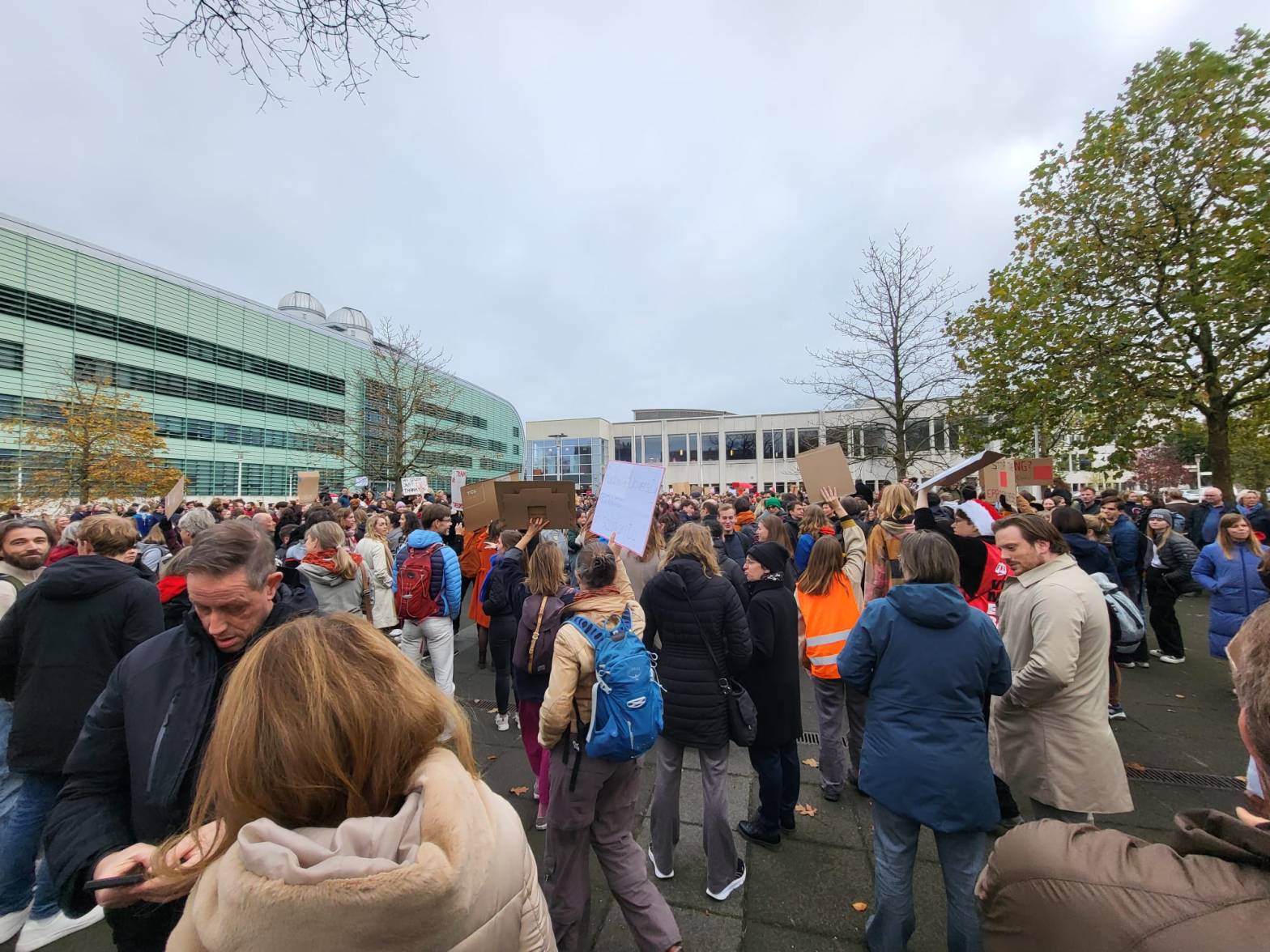
Listening to music is arguably the most accessible form of engaging with art, more accessible than reading. Thus, it is no wonder that social movements end up adopting songs. Music defies language barriers and resonates with diverse audiences, allowing people on one side of the world to sympathise with the struggles of those in other parts of the world. With the help of music, emotions behind the motives of a social movement become apparent, and the message is delivered in a more accessible format. Moreover, the integration of music into social movements serves branding purposes. Once a song becomes associated with a purpose, people will reminisce about this movement once this song plays. For instance, in the Netherlands, student protests usually involve loud music and chanting to disrupt the peace in public spaces and express their message in this way. However, with acoustemology and a planned form of the use of music, the goals of student protests may be more effectively realised. By employing the language of music as a tool, these protests can achieve a more significant following and appeal to more people. In light of the recent protests against budget cuts in higher education, we want to explain why.

A way to look at this is through acoustemology, a term created by anthropologist Steven Feld, which combines “acoustics” (the study of sound) with “epistemology” (the study of knowledge). This concept suggests that sound is more than just something we hear; it’s a powerful way to “know” and experience the world. Feld’s work, particularly with the Kaluli people of Papua New Guinea, showed that sounds held deep meanings for them. Bird calls, for example, were thought of as the voices of ancestors, weaving family, memory, and identity directly into the environment. In this way, sounds became a way to feel connected to both place and community, making sound a way of understanding the world.

In the context of protests, acoustemology offers a unique lens to understand how sounds—such as chants, music, and even the rhythm of footsteps—shape the atmosphere, participation, and overall purpose of an event. In protests, sound is a powerful tool to forge unity, assert identity, and build a sense of presence and solidarity. For instance, when groups chant, sing, or clap in rhythm, they express themselves individually and create a collective voice. This shared sonic environment amplifies the protest’s impact, making it feel more substantial, unified, and bold than if participants were to stand in silence.

The three critical components of acoustemology that we can actively examine for its insights and effectiveness are the space, the participants, where the protest activities occur, and the sounds generated during them. The usage of spaces can depend on a specific meaning held by that place concerning the protest, allow sounds to amplify better, or allow participants to interact with it.

A recent study by Hei Ting Wong on the acoustemology of Hong Kong in protest highlights how specific sounds can evoke shared histories and cultural understanding within the same cultural system. In Wong’s analysis, she suggests that understanding protestors’ demographics and cultural backgrounds can help identify which sounds will resonate most effectively. The sounds within a protest’s acoustemology carry significance, regardless of individual preferences, because they are accessible, circulated, and—most importantly—widely understood within that context. According to Wong, sound can reveal an “unseen space” of human experience, offering an alternative way to experience and interpret spaces. Acoustemology thus helps us explore how sound can alter or even challenge spatial order. It allows us to see how spaces are reclaimed through music and sound and how these elements establish meaningful connections between people and the space around them.

By focusing on the interaction between sound, space, and participants, acoustemology enables us to analyse protests through their soundscapes—the collection of sounds in places. This approach reveals how different sounds—chants, drums, or intentional silences—transform a location into a symbolic space of resistance. For example, in Hong Kong’s Anti-Extradition Law protests, the song “Glory to Hong Kong” was sung in public places, turning everyday spaces like shopping malls into sites of solidarity and defiance. As this song filled public squares, transportation hubs, and streets, these spaces became part of the movement, resonating with participants’ shared purpose and identity.

Using acoustemology to study student protests, we gain insight into how sound creates a sense of belonging and presence. For example, a protest where students chant in unison strengthens the participants’ understanding of unity and communicates a message to anyone listening. This effect can draw in bystanders, attract media attention, and make the message of the protest resonate more deeply with people who might not otherwise engage. In this way, sounds create a ripple effect, where those who hear it feel connected to the movement, even if they aren’t physically present. By carefully selecting sounds representing their goals or emotions, protesters can create a more memorable and impactful event. This makes acoustemology a valuable framework for understanding and enhancing the effectiveness of protests.

Drawing on Bill Osgerby’s subcultural theory, which suggests that music shapes group identity and reclaims spaces for marginalised voices, music can help protesters, including students and faculty of higher education, turn familiar spaces—streets, squares, and university entrances—into resonant sites of protest. By choosing acoustically favourable areas that carry sound further, students can create high-impact moments where chants and music take on a new, amplified quality. This performative reclaiming of public space isn’t just about volume; it’s about turning these spaces into meaningful places of solidarity.

Acoustemology can also be used to recognise the impact of music and sounds on the people participating. Analysing acoustemology can give us more insight into the practical relationship of sound and music with society. This is what Christian Spencer-Espinosa describes in Music and Social Change: Reflections on the Relationship between Sound and Society. He believes that because of music, a shared value and participative ethos can be communicated, and every individual’s contribution is part of the performance’s success. Therefore, understanding the participatory aspect of acoustemology is crucial for a protest or political movement to succeed. Acoustemology sees sounds as obtaining knowledge. It conveys a form of knowledge that leans toward a particular way of living, its embodied nature offering a powerful tool for increasing protest impact by shaping participants’ collective identity.

Music as a performance can invigorate a protest, making it feel dynamic and alive, capturing the attention of participants and onlookers alike. Coordinated chants, live music, and rhythmic elements like clapping and drumming transform the protest into an immersive experience that feels like a collective act of resistance. As Spencer-Espinosa explains, music naturally fosters inclusivity, allowing each individual to contribute equally, which is essential for building a unified front. Students can use synchronised chants and rhythms at the education funds protest in Utrecht to create a cohesive, powerful sound that embodies their shared stance against funding cuts. This collective sonic identity does more than amplify the protest’s message – it visually and audibly conveys solidarity, creating a powerful display that engages bystanders and draws them into the movement. When a crowd unites in rhythm, their message of solidarity becomes nearly impossible to ignore, sending a clear, resounding call for change.

In addition to this collective experience, the creative process of crafting music for the protest brings a DIY spirit that enhances a sense of ownership and individual expression within the movement. By encouraging students to contribute to chants, rhythms, or even anthems, the protest takes on a collaborative, grassroots quality where every participant’s input shapes the unique soundscape. Using accessible instruments like drums, tambourines, or even everyday objects, participants can join in without needing formal musical training. This DIY approach empowers students to contribute to the protest’s auditory identity actively, turning their voices and sounds into a communal force that is distinct, organic, and memorable. Together, these elements—the shared experience of rhythm and the personalised DIY contributions—create an inclusive, resonant protest environment, reinforcing the students’ unified call for accessible, well-funded education.

Rosenthal explains that songs are unique in how they attach to our memories and emotions, becoming almost like mental shortcuts that instantly bring back specific feelings or experiences when we hear them. Taking this, we can argue that a big speech might not be the most effective method in reminiscing a cause when attending a protest, but a chant or protest song will be more easily remembered. Creating an original anthem, specifically for the protest, is an approach that builds unity while tapping into Rosenthal’s concept of music as a “database of linked emotions.” This concept suggests that music connects us to memories and emotions, making it a lasting symbol of a cause. By crafting a song that reflects the frustration or aspirations of students facing funding cuts, the protest can create an emotional anchor for participants. A custom anthem with meaningful lyrics becomes something students carry with them emotionally, resonating long after the protest ends. Sharing the song beforehand so students can learn it reinforces a sense of shared purpose and solidarity when sung together at the protest.

To conclude, acoustemology can be essential in organising and contributing to protests. The sonic experience can be powerful to the participants and people outside the movement and create a sense of belonging. Chanting in an open or closed space could make a significant difference in the effects of the protest. In addition, it can act as an inclusive and accessible tool, maximising participation opportunities, which is crucial within social movements and the achievement of change.

The proposed bill that protested by students and faculty affects the quality of education and has long-term consequences for every individual in the Netherlands. Innovation and creativity, which the same government wants to encourage, may be in danger. We urge you, students, colleagues and readers, to stand up for what you think is right and go against what you believe is unjust. To realise every voice matters and can bring change. To instrumentalise your voice and body to make sounds, create melodies and sing out loud to achieve positive social change. 

Music is an art form that reflects reality and affects the listener. But in music and acoustemology also resides power, and this power is in our hands, in our voice, and in our body. As more people muster their courage, more hands and bodies come together to stand together. The louder our presence, the more space we can reclaim.  So, the individual chooses to participate and contribute to the greater movement. The individual’s power is to unify and engage with others to guarantee success. Above all, every individual has the right to express and protect their voice; through music, we make that voice resonate.                                   

The budget cut protest discussed in this blogpost, which was to take place on November 14, 2024, was cancelled due to security concerns. An alternate protest was organised in The Hague on November 25th. Additionally, unions are currently discussing the possibility of a strike.

Sources:

Osgerby, Bill. “Subcultures, Popular Music and Social Change: Theories, Issues, and Debates.” In Subcultures, Popular Music and Social Change, edited by The Subcultures Network, 1-48.Newcastle: Cambridge Scholars Publishing, 2014.

Rosenthal, Rob and Richard Flacks. “An Introduction to the Music-Movement Link.” Playing for Change: Music and Musicians in the Service of Social Movements, 1-36. London: Routledge, 2011.

Rice, Tom. “Acoustemology.” In The International Encyclopedia of Anthropology 1, no. 1, 2018: 1-7. https://doi.org/10.1002/9781118924396.wbiea2000

Spencer-Espinosa, Christian. “Music and Social Change. Reflections on the Relationship between Sound and Society.” International Review of the Aesthetics and Sociology of Music 53, no. 1, 2022: 57–76. https://www.jstor.org/stable/48689101.

Wong, Hei Ting. “The Acoustemology of Hong Kong in Protest: A Sonic Understanding of the Anti-Extradition Law Amendment Bill Movement.” Continuum, September, 2024: 1–18. doi:10.1080/10304312.2024.2401832.

Protests:

Student protest against high study costs in 2018: https://www.aob.nl/actueel/artikelen/driehonderd-demonstranten-tegen-hoge-studiekosten/

2024 protest against budget cuts in higher education: https://www.aob.nl/actueel/campagne/kabinetsloopthogeronderwijs/

How Can Popular Music Change the World?

In this post, Prof. Dr. Melanie Schiller introduces Culture Weekly’s special section on Popular Music and Social Change

Music is more than just entertainment—it’s a powerful way to reflect and shape society. From civil rights anthems to protest songs against wars, music has carried the struggles, dreams, and demands of generations. It can amplify the voices of marginalized communities and bring people together to fight for causes like gender equality and environmental justice.

Over the years, songs like “We Shall Overcome” became symbols of the Civil Rights Movement, while punk rock pushed back against authority in the 1970s. Today, hip-hop tackles issues like systemic racism, and artists use their platforms to address urgent challenges like climate change. Music connects people through shared emotions and inspires them to act, leaving a lasting impact on culture and society.

Understanding this connection means looking at not just the songs but also their historical and cultural backgrounds. By exploring the role of music in social movements, we see how melodies and lyrics become tools for resistance, unity, and hope—proof that the right song at the right time can drive real change.

As part of the course Popular Music and Social Change in the master’s program Creative Industries, students took this idea further by creating real-world projects linking popular music to the United Nations’ Sustainable Development Goals (SDGs). Each group chose an SDG—like reducing inequality or promoting education—and designed a musical intervention for their local community. Projects included social media campaigns about the environmental impact of fast fashion inspired by Taylor Swift fandom, interactive playlists to discourage smoking, and educational leaflets highlighting gender inequality in the music industry.

Through these creative efforts, the students explored a big question: How can music save the world? Their projects showed how music can inspire progress, spark conversation, and bring us closer to solving global challenges.

Vrouw Slaat Hond

Door Saskia Kroonenberg

Woensdagochtend. Treinreis richting Nijmegen. Bij Utrecht stappen ze op. Een vrouw van middelbare leeftijd, een jongen, een hond. “Geen aandacht geven!” maant ze de jongen. “Anders denkt hij dat hij belangrijk is.” Dat is hij blijkbaar niet. “Hou op! Niet zo vervelend zijn,” roept ze naar het arme dier dat er allemaal ook niks aan kan doen. Ongemakkelijk zit de hond tussen haar benen. Hij mag niet naar links kijken, niet naar rechts kijken, als hij opkijkt krijgt hij een mep, als hij omlaag kijkt een ruk aan zijn halsband. En maar schelden. Hij is ook maar een hond.

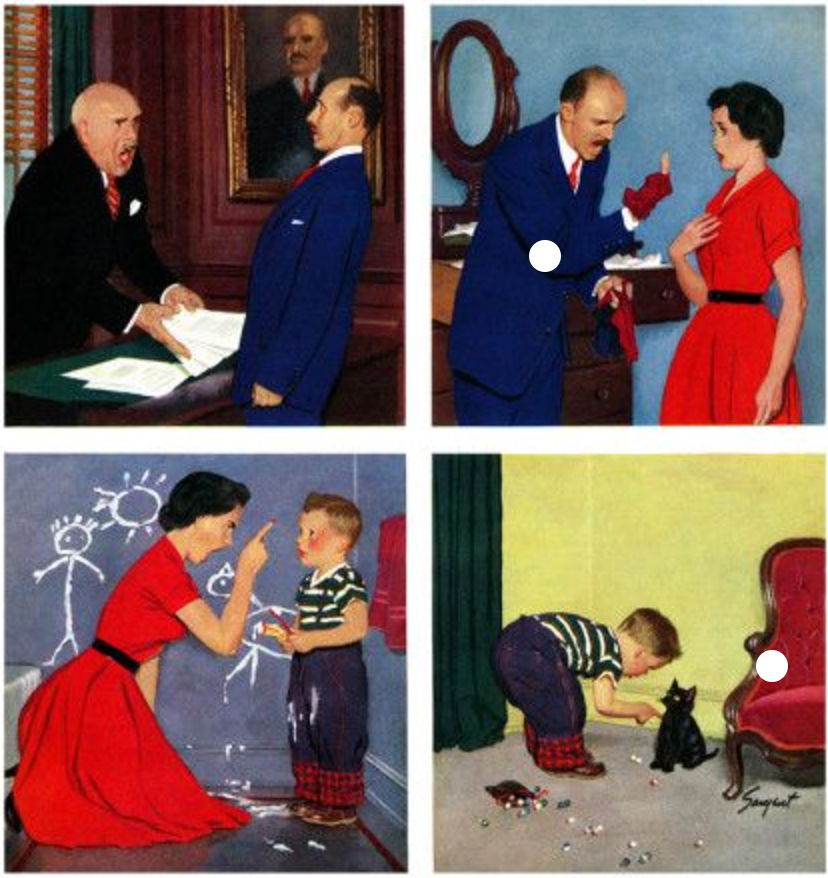
Het doet me denken aan een plaatje dat ik tijdens mijn studie psychologie tegenkwam, van een man die wordt uitgescholden door zijn werkgever. Thuisgekomen scheldt hij daarop zijn vrouw uit, die tegen het kind uitvalt, die tegen de kat begint te krijsen. Zo reageren we agressie op de volgende (onderliggende) trede in de sociale hiërarchie af. Wie onderaan staat krijgt de meeste klappen, in dit geval een (kat of) hond. En waar moet die het laten? Zou die vals geworden zijn en ook enkel weten hoe van zich af te bijten? Of zou die maar depressief in zijn mandje gaan liggen tot het ophoudt? En hoeveel agressie heeft die vrouw te verduren gehad? Van wie? Waar begint het en waar houdt het op?

Ik kijk naar buiten. Een drinkwaterbedrijf prijst sterke dijken en schoon water aan. O ja, ons drinkwater. Daar blijkt steeds meer PFAS en andere rommel in te zitten, lees ik in het nieuws. We drinken continu forever chemicals en andere troep, de hele dag, een creditcard per week, zeggen ze. Het is overal, in ons voedsel, in de lucht die we inademen, in onze ongeboren baby’s. We kunnen niet ontkomen. Dit ís niet houdbaar, dit kán niet goed gaan, het gaat niet zo. Ik sluit mijn ogen. De wereld voelt de laatste tijd zwaar, gebukt onder ontelbare vormen van geweld. Plastic, genocide, een vrouw, een hond. Ik voel me machteloos en huil naar het landschap. Ik weet niet waar het ophoudt.

Wat is mijn rol in dit alles? Wat doe ik?

Ik ben onderweg naar een werkgroep Academische Vaardigheden. Het vormt de basis van het academische werk van de studenten. Het is een belangrijk vak, waarin we nadenken over wat een tekst wetenschappelijk maakt, hoe we weten of een bron betrouwbaar is of niet, en hoe we een academische stijl kunnen toepassen in schrift en woord. Het is belangrijk, ja, maar het voelt tegelijkertijd nogal futiel. Wat maken punten en komma’s eigenlijk uit? Enkele of dubbele aanhalingstekens, schuingedrukt of Hoofdletter, punt, puntkomma, who cares? Ik vermoed dat mijn studenten wel grotere zorgen hebben dan de uitlijning van een word-document. Zoveel problemen in de wereld en wij zetten een punt op een i.  

En toch, het maakt uit. We lijken steeds meer in een cultuur te leven waarin we er maar gewoon op los mogen slaan als ons iets niet zint. Een grote bek en niet zo moeilijk doen, is het motto. Gewoon afreageren op de volgende in de hiërarchie. Lekker beuken op een hond. Misschien is nauwkeurigheid en accuraat werken met taal juist extra belangrijk, als geweldloos tegenwicht.

De vrouw stapt uit, en met haar de jongen en de hond. Ik kom aan in Nijmegen en bereid me voor op mijn les. Wat kan ik mijn studenten meegeven? Hoe beleven zij dit alles?

Wat ik hoop is dat we er op de universiteit in slagen om niet onze eigen frustraties en pijn op anderen uit te leven. Dat wij ze, zoals Freud het noemde, kunnen sublimeren; dus ze om kunnen zetten in kunst(-analyses), in het collectief organiseren van bijvoorbeeld een protest, en in andere vormen die bijdragen in plaats van afbreuk doen. Dat we agressie kunnen gebruiken voor iets anders, in ons eigen kleine kunnen, gewapend met vaardigheid in komma’s, punten, puntkomma’s, en i’s. Onze macht als geesteswetenschappers is beperkt, maar wat we doen, kunnen we goed doen, zo volledig mogelijk en volgens de academische standaarden die we in de loop der jaren hebben ontwikkeld. Omdat het zo hoort, zo hebben we het afgesproken, het is iets. Het geweld houdt niet op, maar wij zetten door.

Afbeelding: “Anger Transference” Richard Sargent 1954

The Lost Generation: a Board Game Based on Hemingway

By Amber van Driel, student in Arts and Culture Studies

As an Arts and Culture Studies student, it is impossible to avoid the city of Paris. One of the ways we encounter it is through the words of Ernest Hemingway in his memoir A Moveable Feast. In one of our courses, we watched Woody Allen’s Midnight in Paris, which was based on the book. This interplay between the works inspired me to read the memoir, and I fell in love with it. When Frederik van Dam gave us the opportunity to create our own transmedial work in the new course Intertextuality and Intermediality, I had my eyes set on this story from the beginning. The result became the board game The Lost Generation.

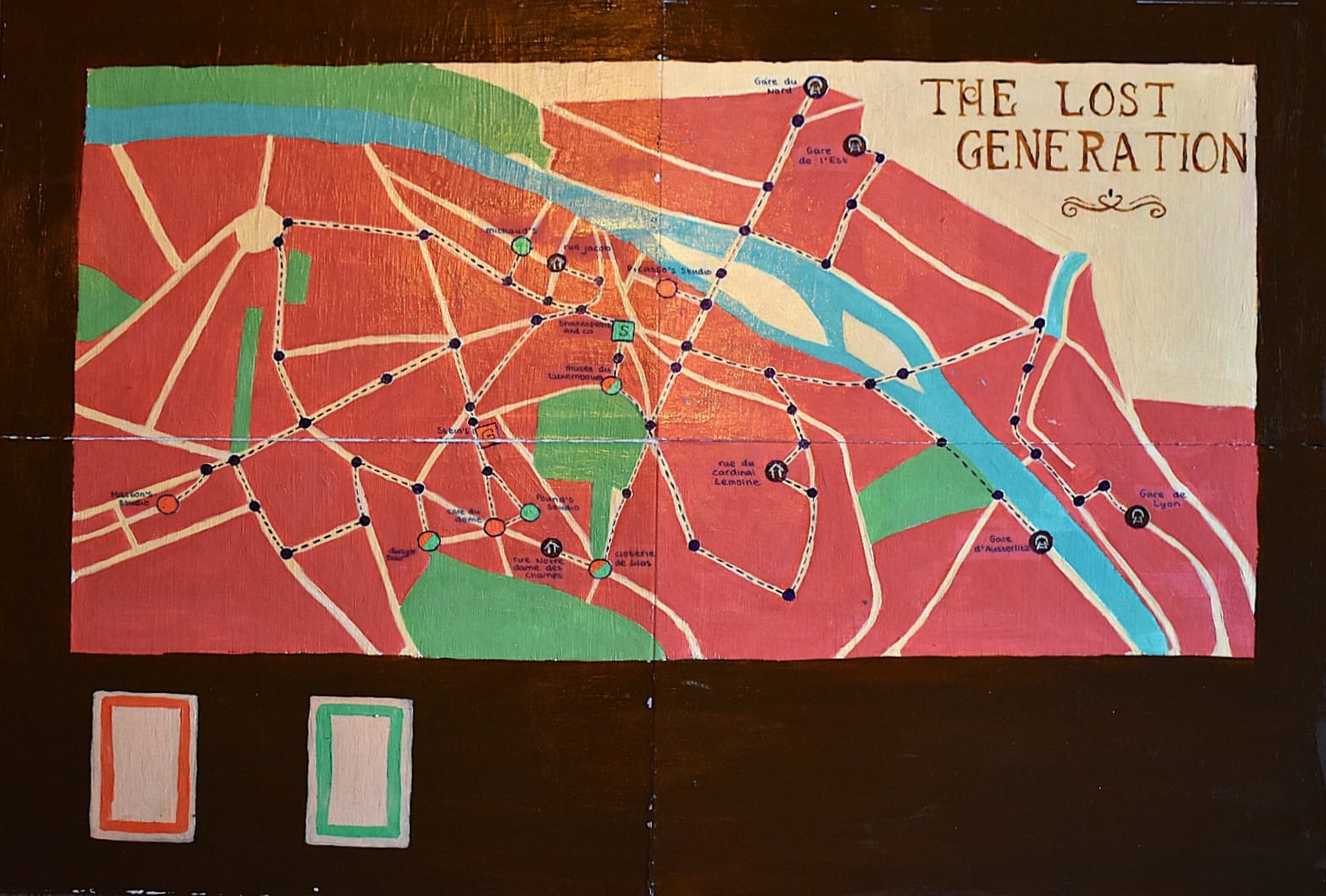
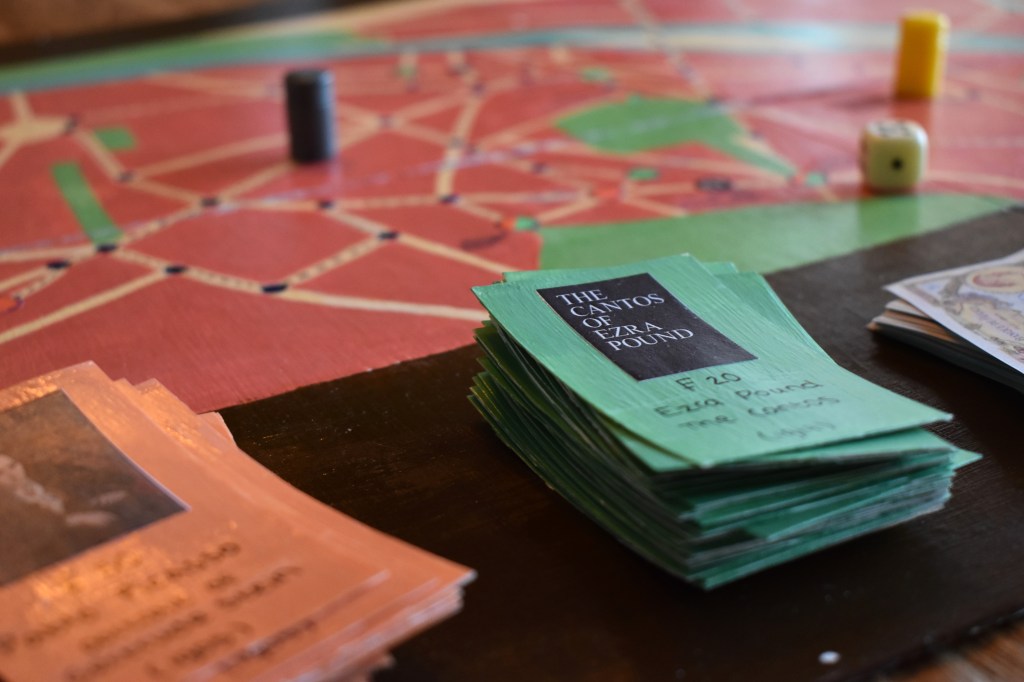
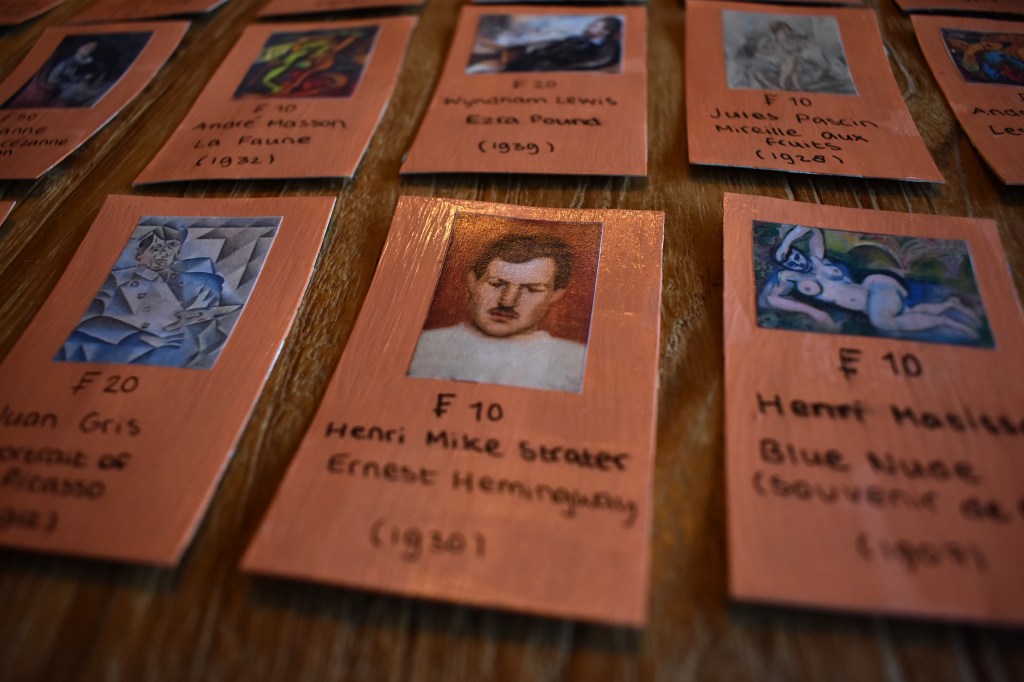
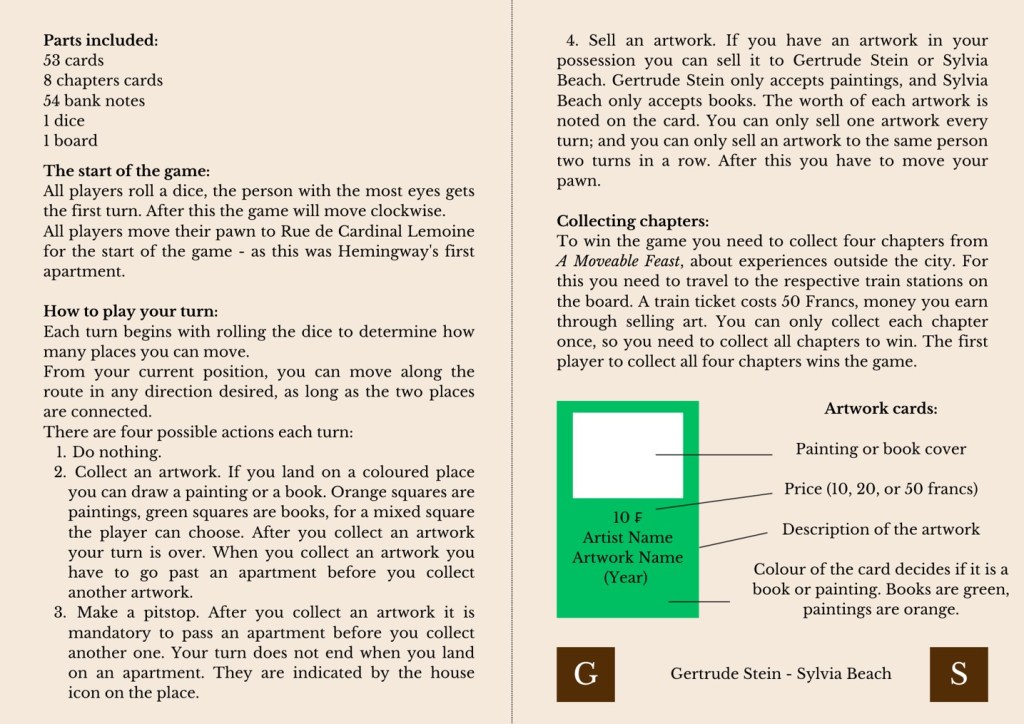
Essentially, the board game is an adaptation of Hemingway’s A Moveable Feast. The board game is an interdisciplinary work that engages with the source-text. To guide me in the process of adaptation, Linda Hutcheon’s theory proved very useful. The main theme, persistent in both the book and the game, is of course the characters – all real-life artists. The game is centred around interactions with these artists: the goal of The Lost Generation is to ‘write’ chapters of Hemingway’s memoir, while collecting the art of his friends. When landing on specific places on the board, players receive cards with artworks on them – either literature or paintings. The players can sell these artworks to Gertrude Stein and Sylvia Beach, to earn enough Francs to buy train tickets. Each train station corresponds with a chapter from A Moveable Feast. These connections are historically and geographically accurate.

Both Gertrude Stein and Sylvia Beach are often mentioned by Hemingway, and are perhaps some of the most influential ‘characters’ in the book. Because of this, and because I needed some feminine power in this male-dominated book, I centred most of the game around them.

Gertrude Stein was an American author and art collector who moved to Paris in the twentieth century. She is known for the famous salon she hosted in the city, which Hemingway frequently visited. This salon functioned as a meeting space, where many of the important modernist artist’s met each other. Players can thus sell all of their paintings to her, which differ in value.

Sylvia Beach, also an American, was a publisher who lived in Paris. Her bookstore Shakespeare and Company is quite famous, and was described by Hemingway in A Moveable Feast. He also wrote about Sylvia Beach’s publication of James Joyce’s Ulysses, which was a significant moment for the modernist literature field. It comes to no surprise, then, that players can sell works of literature to Sylvia Beach in the game.

I developed the process of the gameplay according to Roger Caillois’ game theory. He distinguishes four different types of games: Agôn, Alea, Mimicry, and Ilinx. These four types each describe a quality that a game can have, and naturally I wanted to incorporate as many as possible, to create ‘the ultimate game.’ Caillois describes Agôn as competition. It is important that there is a complete equality of opportunity for everyone, so the players’ talent becomes the deciding factor. In the case of board games, this talent is usually the strategy they choose. Alea is the element of chance. In board games this is often incorporated as dice rolling, with The Lost Generation being no exception. Additionally, the artwork-cards have different values and are drawn blindly, increasing the role of chance in the game. Caillois defines Mimicry as imitation. Essentially, Mimicry is a form of roleplaying: the player becomes a fictional character and behaves like them.  I associate this with a sense of escapism. Woody Allen captured that escapism perfectly in Midnight in Paris: every generation longs for a different time (or even a different place). The entire board game is based around this desire, with some additional creative liberty. Ilinx refers to a feeling of vertigo. Interpreted literally, this is quite impossible to achieve within a board game. Though one could argue that a radically different perspective on a familiar work from history – A Moveable Feast – can cause disorientation as well. Three – possibly four – out of the four checkboxes ticked off should be the recipe to a perfect board game, right?

To me, the most important and most enjoyable part of the process was designing the board. Because of A Moveable Feast’s strong geographical quality, it felt obvious that the board should be some variation of a map. In the course we encountered narrative cartography through Marie-Laure-Ryan, who categorizes different kinds of intertextual maps. In the case of The Lost Generation, the map is an annotation of a real-world map, as an interpretation of the original text by Hemingway. In this part of the process I took some creative liberty – after some frustrating dead-ends – and used a map provided by Google Maps, of which I altered the scale slightly. Throughout the research, it surfaced that the majority of the book takes places in the Montparnasse neighbourhood, while all the train stations are located much farther away. So I altered the scale, and then ‘annotated’ this map with routes and locations.

Eventually, all this research resulted in a hand painted board game: The Lost Generation. The game is far from perfect, but that was not the point of this research. I learned so much about the process of creating a board game, and a lot about transmedial storytelling. It was fun to actively engage with the theory we encountered in the course, and to expand this fictional ‘franchise’ that I have come to love a little further.  

Cultural Studies Protest Slogans

By Erik Hovenga, Holly van Zoggel and Talin de Jeu, with the help of Saskia Kroonenberg and Doro Wiese

On November 25th, amongst the thousands of protesters, a small group of students and teachers in the streets of The Hague. Brought together by the protest against the budget cuts in higher education, they sought ways to combat the impending changes in creative ways. This amalgamation of frustration towards the government and love for their field, resulted in protest slogans inspired by iconic cultural scholars. During the march through The Hague, what started as a simple joke grew to a shared mission — resulting in a spitfire of protest slogans quicker than we could write down. This project did not stop after the protest was over, instead it followed us back to Nijmegen and stayed the topic of our conversations in the days following. Rather than keeping this to ourselves, we would like to present to you the fruits of this labour.

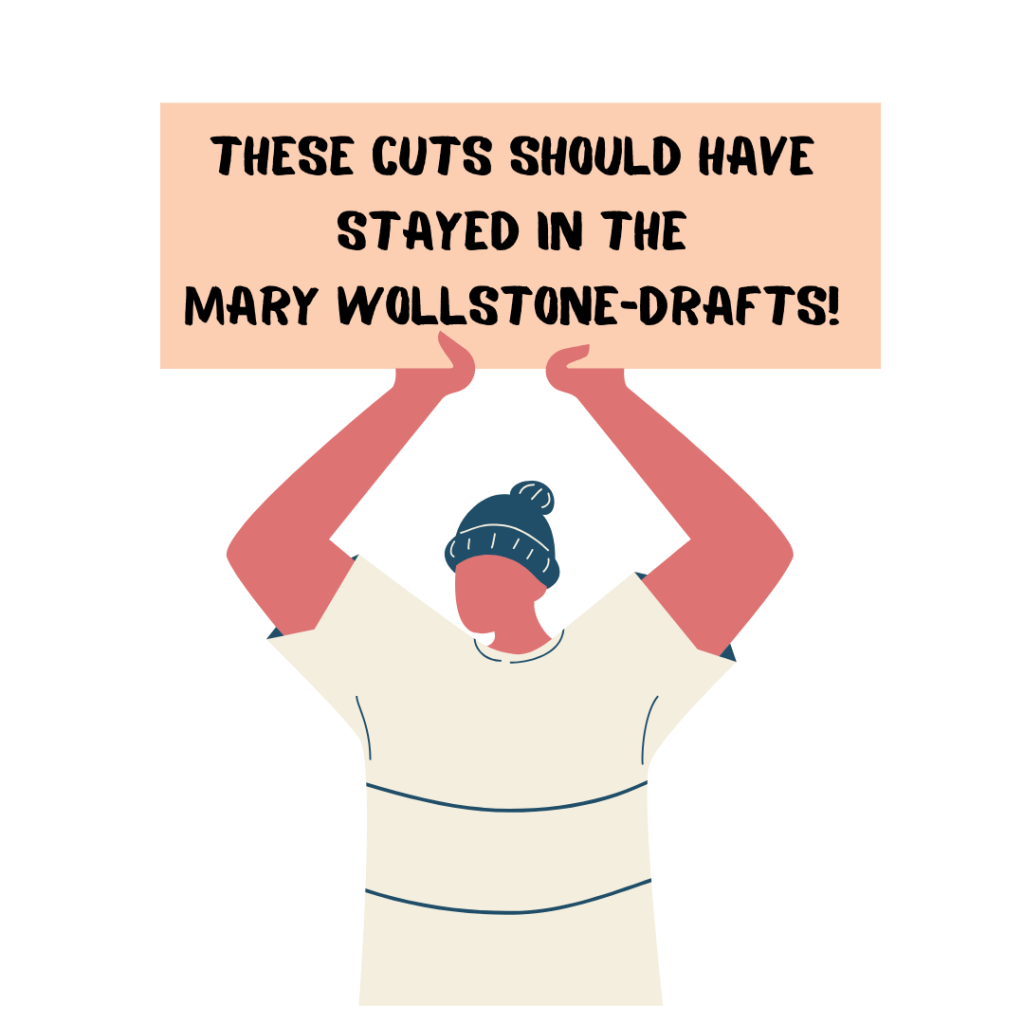
  • These cuts should have stayed in the Mary Wollstone-drafts!
  • Budget cuts? Camust you do this?
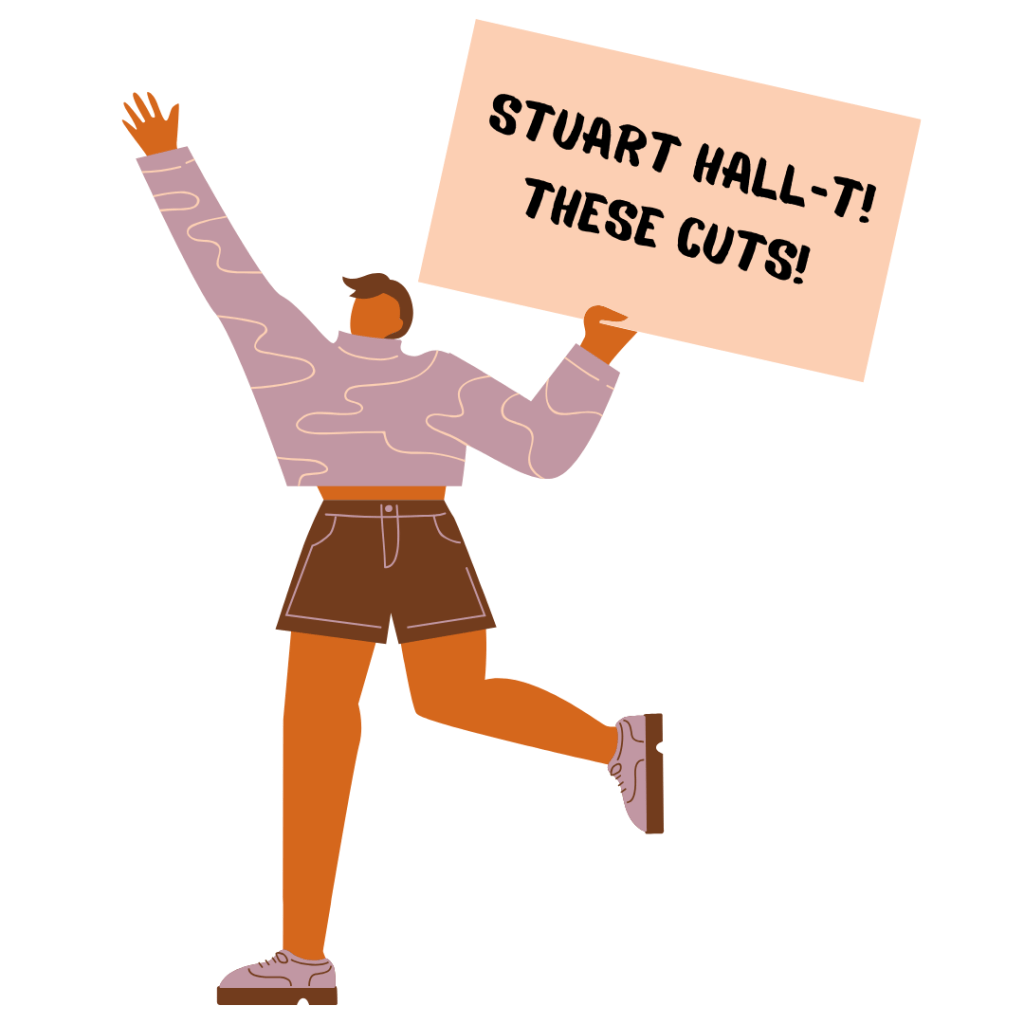
  • Stuart Hall-t! These Cuts!
  • Budget cuts are Rolando Vaz-questionable!
  • This is a Kriste-fucking bad idea!
  • Make education Adrienne Rich again!
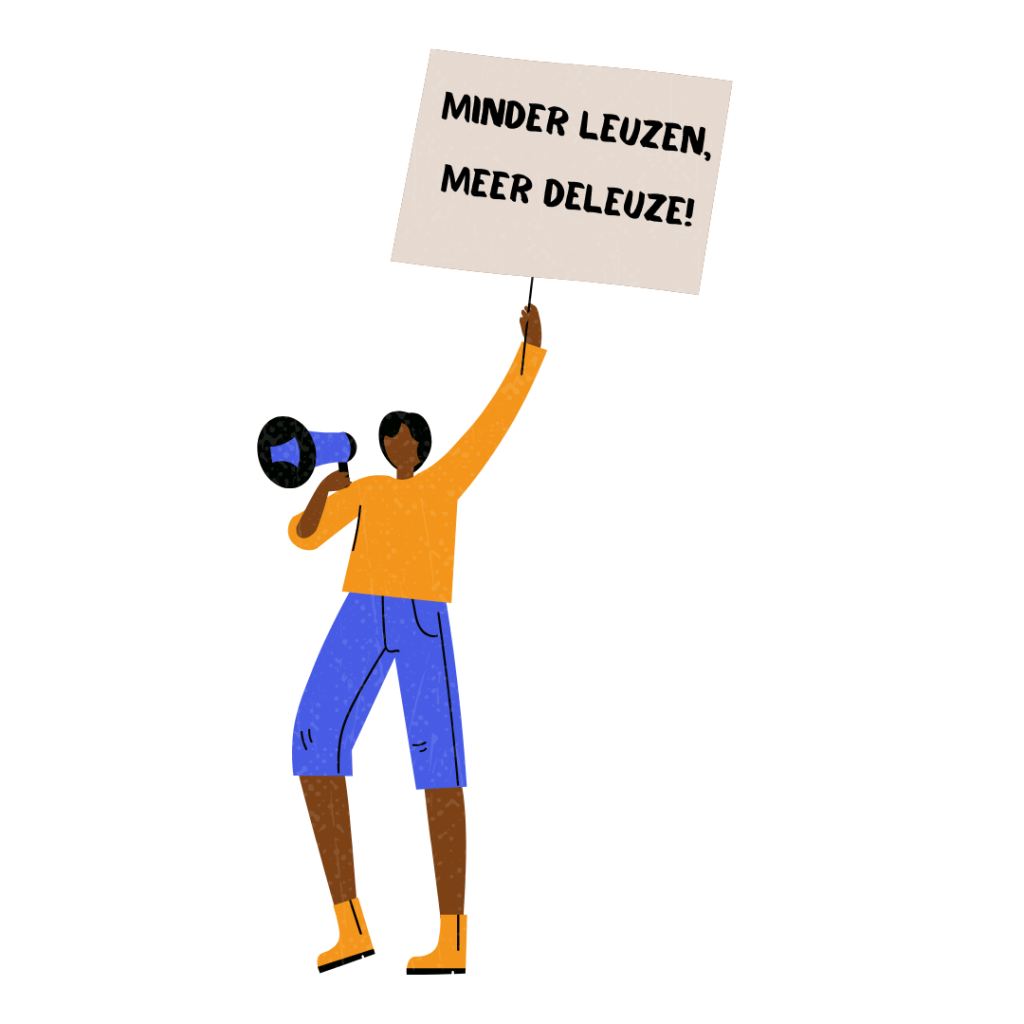
  • Minder leuzen, meer Deleuze!
  • Ik zeg Donna Hara-nee tegen de bezuinigingen!
  • Wij willen Judith But-leren!
  • Dit gaat de verkeerde Immanuel Kant op!
  • Zo haal je alle Freud-e uit het onderwijs!
  • Onderwijs? Het kabinet heeft er Lac An!
  • Doe het Edward Sa-niet!
  • Ik heb hier een Hegel aan!
  • Zeg maar “au De Beauvoir” tegen kennis!
  • Het hele onderwijs gaat op zijn Plaat-o!
  • Ik wil nog een Gayatri Spi-vak kunnen leren!
  • Bezuinigingen? Derri-dat is een slecht idee!
  • Ik word hier Virginia Woo-dend van!
  • Maak de goede Herbert Mar-keuze!
  • Dit is zo Ferdinand de Sau-zuur!
  • Wij willen geld voor Aristote-les!
  • Bezuinigingen? Roland BAH-rthes!
  • We willen nog Beaudri-jaren educatie genieten!
  • Het onderwijs Bruno Lat-hoort erbij!
  • Leren over Braidotti maakt je een hotty!
  • Ik word hier Grams-ziek van!
  • Er zitten veel bell hooks en ogen aan dit beleid!
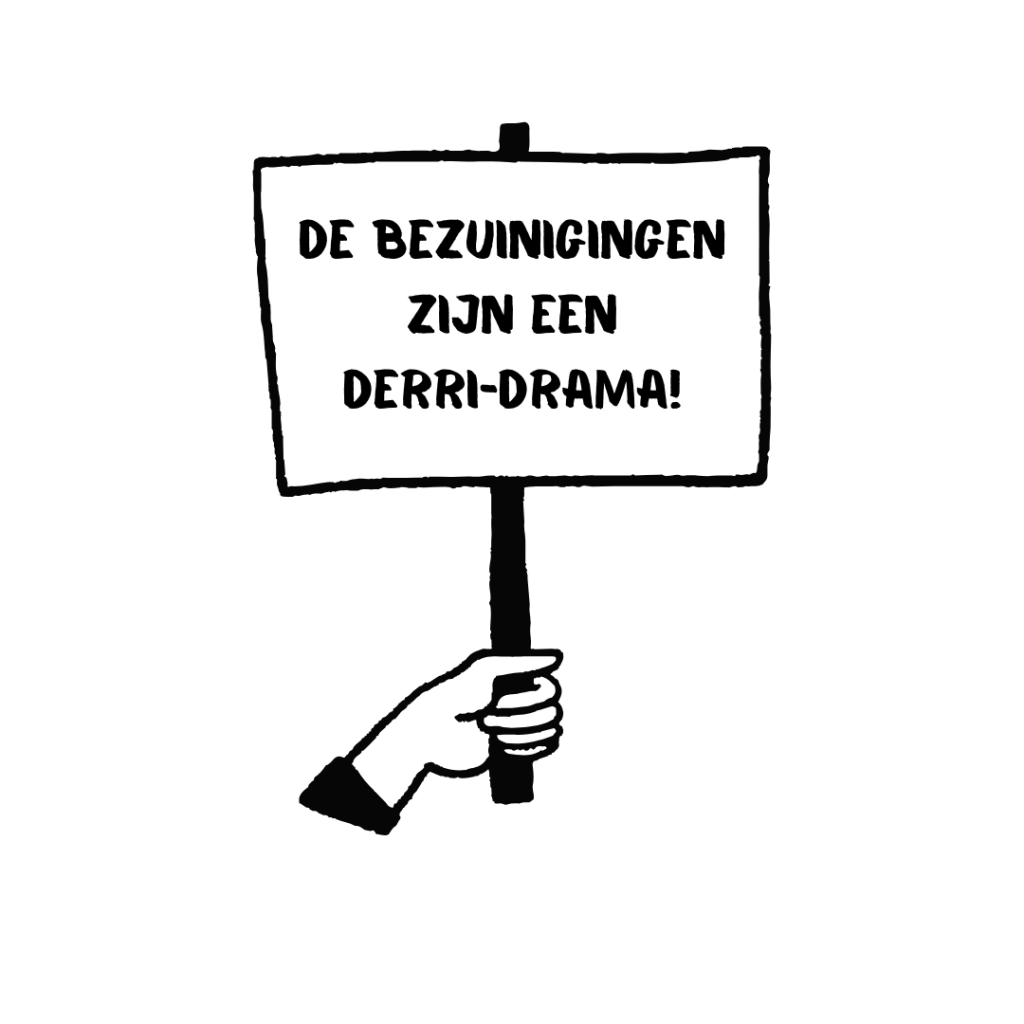
  • De bezuinigingen zijn een Derri-drama!
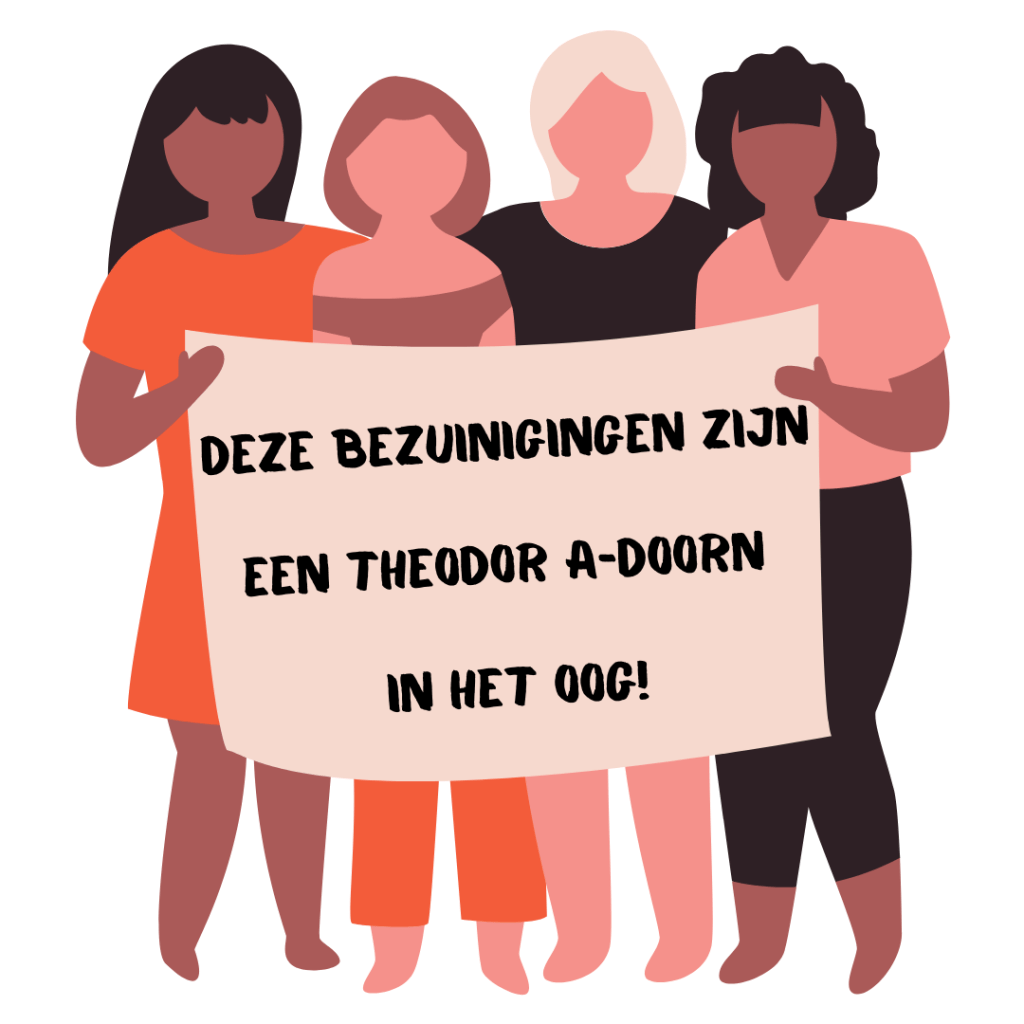
  • Deze bezuinigingen zijn een Theodor A-doorn in het oog!
  • Zeg maar Susan Son-dag tegen de kenniseconomie!
  • Slavoj Zi-zet de studenten voorop!
  • Recht op Frantz Fan-onderwijs!
  • Stop Sara Ah-met bezuinigen!
  • Bezuinigingen? Homi Bha-bagger!
  • Melanie Klein beetje jammer dit!
  • Hélène Ci-zoek het maar uit met je bezuinigingen!
  • Bezuinigingen: Nietz-je beste idee!
  • Deze bezuinigingen zijn niet Gram-sjiek!
  • Wij gaan ge-Edmund Burkt onder de bezuinigingen!
  • Spino-zak er maar in!
  • Ik Hei-denk er anders over!
  • De regering Dipesh Chakra-bakt er niks van!
  • Zonder onderwijs spreken we straks allemaal Homi Brabbeltaal!

Documentary: Het Heet Thee

By Talin de Jeu, Miriam Stuefer and Holly van Zoggel

Het Heet Thee originated from a shared interest in tea, gender, and the intersections of the two. With this documentary, we aim to dissect how mythologies surrounding tea and femininity are created and kept alive. By shooting images of the tea habits of ourselves and the people surrounding us, by filming artworks and china, and by collecting additional photographic footage from local archives and movie scenes, we search for intersecting and contradicting aspects of the personal, political and historical.

The documentary roughly follows the making process of tea: starting with ingredients, how they are grown and harvested, moving to the making of tea and the china it is consumed from, followed by the social aspects of drinking tea, and lastly its dregs. The focus on our own hands, shot on handheld phone cameras, emphasises our closeness to the subject but also the situatedness of our narrative. These images are intertwined with different types of archival material. This way, we wanted to underline the vast history and the physical and cultural contexts that all boil down into a single cup of tea. The images in the first chapter show people –  predominantly women – working on tea plantations. Even though tea is strongly connected to femininity, the power still lies with men, as  they are the ones judging the tea’s quality. We visualised this dichotomy between femininity and masculinity in our tea-culture with the two humorously named teas Decollethee and Theetosteron.

Although we do question the myths through our documentary, the style and nature of the film is subtler than if we had used a voiceover to explain our ideas. We chose this approach because we did not want to teach the viewer how gender(roles) and tea are intertwined. Instead, the documentary is a search for the parallels that constitute the myth, formalized in a way similar to the way myths circulate in our society: with subtlety but ever-present in its details.

The documentary Het Heet Thee was created in the BA course Moving Documentaries.

Documentary: Banden met Barrels

By Fenne van Beek, Jildou de Jong, Niko Oussoren, and Puck Gregoor

We, Fenne van Beek, Jildou de Jong, Niko Oussoren, and Puck Gregoor, are excited to present to you our short documentary, Banden met Barrels. It is a documentary created for the second-year course ‘Moving Documentaries’ as part of our bachelor’s program in Art and Cultural Studies at Radboud University. As four Dutch students, we wanted to shed light on bicycles, particularly student bicycles. Because where would the average student actually be without their bike? It may seem like a simple, ordinary object, and it is, but the bicycle is also a significant cultural phenomenon whose importance we often overlook. Bicycles are essential in Dutch student life for their practicality and reliability, despite their worn-out appearance. As will become evident in this documentary, the student bicycle can serve as a starting point for many conversations and two-wheeled journeys. We hope Banden met Barrels sparks nostalgia and prompts audiences to pause and appreciate the humble bicycle as more than just a mode of transportation, but as a symbol of freedom, community, and adventure.

The documentary Banden met Barrels was created in the BA course Moving Documentaries.

Documentary: Knuffels

By Rosa Floris, Lotte Lammers, Marta Ora, Laury van de Ven and Tim Wiesner

In Dutch, the word ‘knuffels’ holds a charming dual meaning, referring to both plush toys and hugs, and thus embodying a sense of comfort and care in a single term. Etymologically rooted in ‘knuffen’, meaning to bump or shove, the term ‘knuffels’ connotes a form of affection that entails both a gentle embrace and a playful nudge, driving home the idea of a push-and-pull, perpetually dynamic bond. This bond is at the center of our documentary, Knuffels, and explored through various interviews with Arts and Culture students of Radboud University. Knuffels pertains to the ambiguity of affection towards plush toys, and attempts to formulate an answer to the question: how do individuals attribute meaning to plushies within the context of ownership, and what psychological, emotional, and symbolic significance do these objects hold for their owners?

Knuffels aims to show truths; the audience is shown small aspects of the documentary’s construction, but not enough to betray the true extent of our involvement or to problematize the notion of truth. Instead, these few elements of construction work to disarm suspicion in the viewer and therefore aid in framing the contents of the documentary as truthful. The presentation of several voices, which at times contradict each other, serves this purpose. Subsequently, we have chosen to make fabric the common denominator in all shots and scenes, which vitalizes a soft aesthetic that fits, frames and harmonizes these oftentimes nostalgic sentiments expressed in the interviews.

As for the documentary in its entirety, the viewer could consider the footage a tapestry that we have carefully woven in collaboration with the interviewees, and from which we later cut and sewed together different pieces to make our final product – the visuals do not fabricate, the fabrics merely visualise. As a result, Knuffels quite literally embraces a storytelling predicated on multiplicity, be it in terms of lived experiences, perspectives, or the very essence of affection itself.

The documentary Knuffels was created in the BA course Moving Documentaries.