
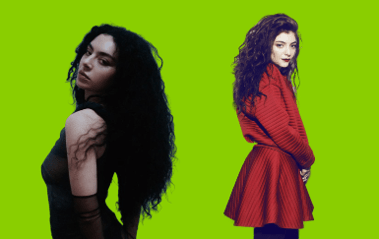
By Just Celebrities: Sjoerd Baas, Ana Cabrian, Julia Leijzer, Rik Pastoor and Aimée Walkate
“Yeah, I don’t know if you like me
Sometimes I think you might hate me
Sometimes I think I might hate you
Maybe you just wanna be me”
– Charli XCX in Girl, so confusing featuring Lorde
Meet Charlotte Emma Aitchison; a singer- songwriter from Great-Britain. You probably know her by her stage name Charli XCX. A name drawing from her MSN Messenger-phase, which she used when she was younger and still out of the limelight. Charli first gained attention in the early 2010s and has since become a key figure in modern pop. After several albums, with popular songs like “I love it”, “Speed Drive” and “Apple”, 2024 has seen her being transported into the mainstream as a big artist and global public figure.
She (co)writes most of her own songs wherein she handles subjects like hedonism and love. Musically, her style has been perceived as dark wave, witch house, gothic pop, synth pop, pop punk, avant-pop, although she states that she does “not identify with music genres.”1 Instead, in each of her album-cycles, she is known to adopt a different aesthetic altogether. Most recently, the world became acquainted with BRAT; the bright green in-your-face vibe of the summer.
It’s BRAT?
With the release of the BRAT album, on the 7th of June 2024, Charli XCX concluded months’ worth of build-up and anticipation for one of her most ambitious projects to date. However, this moment right at the start of the summer marked only the beginning of much bigger hype. Not only did the songs of the album – which topped charts around the world – garner massive appeal, but BRAT became a way of life.2 In line with the hedonistic attitude that Charli XCX professed on earlier work, the singer now delved further into the introspective aspects that come with her fame and party girl-attitude. Being a brat is about being a complex character; you can admit your flaws and recognize what makes you human, but you can also do whatever you want, however you want it.
Central to the appeal of BRAT is its relatability. Throughout her lyrics, Charli XCX shares insights into her emotional state-of-mind, often coming across as vulnerable, but always in control and empowering. She preaches partying, simultaneously as a way of escapism and embracing self-doubt. One of the central themes on BRATis Charli’s complicated relationship with other women. She sings about “perfect” girls and questions her friendship with other pop artists, most notably New Zealand singer and contemporary, Lorde.
It’s so confusing sometimes to be a girl
Roughly two-thirds into BRAT, Charli delves headfirst into a comparison of herself with one of her contemporaries, specifically, someone who she has always been compared with throughout her career. This sparked debates among fans, and eventually agreement, on who Charli was talking about.
People say we’re alike
They say we’ve got the same hair
We talk about making music
But I don’t know if it’s honest
Can’t tell if you wanna see me
Falling over and failing
And you can’t tell what you’re feeling
I think I know how you feel
Because of their synchronous rise through the ranks of the international pop music scene, around the early 2010s, Charli XCX and Lorde have always been subject of comparisons. From something as seemingly innocent as their style of hairdo, to more serious judgements on musical style and aesthetics, both artists could not escape the forced associations with the other. Central to the song is the anxiety and social stress that comes along for artists when the media forces them in competition with their peers.
Then the remix of the song came out. A near-identical version of the song, but with an added verse in which Lorde reacts to Charli XCX. This provided the invested fandom with a much-needed discourse on the insecurities both females shared towards each other. Hence the title “Girl, so confusing” which underlines the way both artists struggle to come to terms with how they should relate to each other in light of the media and their careers.
Charli on Mental Health
Charli XCX has been publicly open about her mental health struggles. She has spoken openly about experiencing anxiety, stress, and the pressures that come with being in the music industry. She does this in the lyrics of her songs, but also via social media and interviews.
Much like the conversational struggle with Lorde on “Girl, so confusing”, the insecurity Charli XCX experiences in regard to other women is reflected through the song “Sympathy is a knife”. She opens up about her feelings when she sings about a woman who triggers feelings of doubt and insecurity in herself. The sentence “This one girl taps my insecurities, don’t know if it’s real or if I’m spiraling” emphasizes this.
The theme of the song is about the internal struggle of constantly comparing oneself to other women. The lyrics of the song give an exploration of Charli’s own feelings, the words explore the complex feelings of self-perception, insecurity, and the impact of seeking validation from others.
Cause I couldn’t even be her if I tried
I’m opposite, I’m on the other side
I feel all these feelings I can’t control
Oh no, don’t know why
All this sympathy is just a knife
Why I can’t even grit my teeth and lie?
I feel all these feelings I can’t control
Oh no, don’t know
The metaphor of sympathy being a knife suggests that seeking validation from others can sometimes backfire, deepening emotional wounds. In trying to gain empathy, Charli XCX sings about ending up feeling more vulnerable, as the sympathy can worsen their pain.
For many fans, Charli XCX’s openness about her mental health struggles is perceived as inspiring. Reactions from fans seeing a pop artist opening up about her emotional well-being helped them feel less alone in their own mental health.
Meet Ella Marija Yellich-O’Connor, a singer from New-Zealand, who is better known under her stage name Lorde. This reflects her fascination with royalty and aristocracy. Her music style has been described as indie-pop and alt-pop.
Lorde
Similarly to Charli XCX, Lorde also opened up about her mental health. In 2023 Lorde wrote a letter to fans in which she talks about her loneliness and heartbreak. “I eat chocolate to try and manipulate the endorphins, bring back the sweet happiness of Easter morning. I sit in the time machine and wait for it to move, but it hasn’t been invented yet.”3
These mental health struggles are also apparent in the song “Liability”. “Liability” is a song from Lorde’s second album (Melodrama). In this second album, she shifts from the collective “we” of her first album (Pure Heroin) to a more personal “I” perspective. In an interview with Vogue, Lorde explained how the first album was more about her and her peers, while the second album was more about her personal experience.4
I’m a liability
In the song “Liability”, Lorde talks about how she feels like a burden to the people around her.
The truth is I am a toy that people enjoy
‘Til all of the tricks don’t work anymore
And then they are bored of me
In these lyrics, for instance, she mentions how she is afraid that people are going to find out they would rather not spend so much time with her.5
Lorde explained in an interview with 60 minutes Australia how the song “Liability” surprised her: “it really appealed to a lot of young people […] people say to me: that’s exactly how I felt during high school […] even though I am in this quite specific situation myself, other young people can relate to what it is that I’m feeling”.
Mental Health, Consciousness-Raising and Feminist Standpoint Theory
Music and mental health have been proven to positively affect one another. Some people with mental illness can have trouble expressing themselves with words. Thus, music is used in therapy to help the patients express their emotions and create a relaxed mental state.6 It is even used by psychiatrists for treating people with depression.7 On the other hand, music can be used to improve one’s mental state outside of therapy as well. Just listening to music everyday reduces stress and anxiety. Research by psychiatrist Lavinia Rebecchini shows that listening to music decreases the levels of, among other things, stress hormone and adrenaline.8 She even argues that due to these decreased levels of stress and adrenaline, the immune system might improve. This ties in with the Sustainable Development Goal number three: Good Health and Well-Being, as mental health is an important part, if not the most important part, of good health and wellbeing.
Moreover, the artists themselves also play a major role in helping with mental health. They can reduce stigma by singing or talking about their own mental health issues. When artists discuss mental health, they can increase knowledge of symptoms, treatments and services.9 Lyrics that discuss mental health issues can help the individual create more self-awareness and physical/psychological relaxation.10 However, not every celebrity is equally impactful. There are three different kinds of celebrities: the traditional celebrity, the social media celebrity and the microcelebrity.11 Originally, microcelebrities were most impactful in reducing stigma, because they are regional celebrities, and their fans have a personal connection to them. Therefore, traditional celebrities, like Lorde and Charli XCX, were least relatable to the fans, as they are not connected to every-day life anymore. This has changed since the invention of social media, as all celebrities can easily have direct connections to their fans, creating this relationship between the fans and the celebrity.12 Social media has given traditional celebrities a way to talk directly to their fans about mental health, which reduces the stigma surrounding mental health issues.13
Furthermore, music itself is an important vehicle for social change and songs can be used as platforms through which certain messages can be spread to a wider audience. In other words, music can be used as a tool for consciousness-raising. This refers to works that are created in a way that will draw people’s attention to a certain social issue and increase their understanding of it, as well as how the issue has an impact on their personal life.14 This understanding will then hopefully encourage people to contribute to solving the issue. As mentioned above, one such problem is the stigma surrounding the concept of mental health. Consciousness-raising songs can serve as a way of raising awareness about mental health issues by addressing topics of emotional well-being, such as anxiety, depression or any other mental health related concerns. As a consequence, these songs can help normalize conversations about mental health and reduce the stigma around it, as well as potentially motivate individuals to look for help. Therefore, consciousness-raising songs can challenge societal norms and advocate for social change, in this case, how mental health is perceived and treated. Celebrities, such as Charli XCX or Lorde, that use their music to speak up about their personal experiences with mental health struggles, can increase knowledge and help change the public perception of mental health.
What is more, the aforementioned case studies of artists Charli XCX and Lorde exemplify feminist standpoint theory. This is used with the purpose of placing women’s stories and experiences at the center of the research.15 To elaborate, feminist standpoint theory wishes to identify and challenge cultural values and power dynamics that contribute to the subordination of particular groups, specifically women, as well as highlighting the distinct knowledge that can be obtained from a female perspective.16 Individuals indicate a standpoint when they portray and are critical of the power relations that are present in a society, as well as the consequences of those power relations for members of different groups.17 Lorde’s song “Liability”and Charli XCX’s album BRAT reflect marginalized perspectives, namely those of women, and challenge dominant structures surrounding emotional vulnerability, self-worth and other mental health struggles. Both of these artists use personal emotional well-being experiences to critique societal expectations and power structures that surround femininity, emotional expression and mental health. By shedding light on the experiences of the marginalized group, these songs can capture the attention of listeners that share similar struggles, consequently creating a space in which awareness can be brought to conversations about how mental health is perceived by a broader social system.
Footnotes
- Charli XCX, “I do not identify with music genres”, Twitter, tweet, published at 22-07-2022, 20:43. https://x.com/charli_xcx/status/1286008932377350144. ↩︎
- “BRAT, by Charli XCX”, Official Charts, accessed October 27, 2024https://www.officialcharts.com/albums/charli-xcx-brat-0/. ↩︎
- Lorde, “How I’ve Been; Revised”, Tumblr, email, September 20, 2023, https://lordeemailarchive.tumblr.com/. ↩︎
- Lorde, “73 Questions with Lorde | Vogue”, Vogue July 27, 2021, video, 12:51, at 2:20, https://www.youtube.com/watch?v=MSRBV9udKi8&t=234s. ↩︎
- Lorde, “Extra Minutes | Lorde Opens Up on the Meaning of her Hit Song “Liability””, 60 Minutes Australia, video, 3:10, at 0:40, https://www.youtube.com/watch?v=M70iz2UjQyI. ↩︎
- L. Rebeshi, “Music, Mental Health, and Immunity”, Brain, Behavior, and Immunity – Health vol. 18, no. 1 (2018): 1-6, at 2, doi: https://doi.org/10.1016/j.bbih.2021.100374. ↩︎
- Ibid. ↩︎
- Ibid., 3. ↩︎
- P. C. Gronholm and G. Thornicroft, “Impact of Celebrity Disclosure on Mental Health-Related Stigma”, Epidemiology and Psychiatric Science vol. 31, no. 62 (2022): 1-5, at 2. ↩︎
- C. Stephensen and F. Baker, “Music Therapy and Mental Health Recovery: What is the Evidence?”, in: P. Nielsen, R. King and F. Baker, Creative Arts in Counceling and Mental Health (Thousand Oakes, SAGE: 2016): 95-107, at 97. ↩︎
- Ibid., 3. ↩︎
- Ibid. ↩︎
- Ibid., 4 ↩︎
- A. Trier-Bieniek and A. Pullum, “From Lady Gaga to Consciousness Rap: The Impact of Music on Gender and Social Activism”, in: A. Trier-Bieniek et.al. (eds.), Gender & Pop Culture (Leiden: Sense Publicity, 2014): 81-102, at 85. ↩︎
- Ibid., 88. ↩︎
- J. T. Wood, “Feminist Standpoint Theory”, Encyclopedia of Communication Theory (Thousand Oakes: SAGE, 2009): 397-399, at 397. ↩︎
- Ibid., 398. ↩︎
Bibliography
“BRAT, by Charli XCX”, Official Charts, accessed October 27, 2024https://www.officialcharts.com/albums/charli-xcx-brat-0/.
Charli XCX, “I do not identify with music genres”, Twitter, tweet, published at 22-07-2022, 20:43. https://x.com/charli_xcx/status/1286008932377350144.
Gronholm, P. C., and G. Thornicroft, “Impact of Celebrity Disclosure on Mental Health-Related Stigma”, Epidemiology and Psychiatric Science vol. 31, no. 62 (2022): 1-5.
Lorde, “73 Questions with Lorde | Vogue”, Vogue July 27, 2021, video, 12:51, at 2:20, https://www.youtube.com/watch?v=MSRBV9udKi8&t=234s.
Lorde, “How I’ve Been; Revised”, Tumblr, email, September 20, 2023, https://lordeemailarchive.tumblr.com/.
Lorde, “Extra Minutes | Lorde Opens Up on the Meaning of her Hit Song “Liability’’”, 60 Minutes Australia, video, 3:10, at 0:40, https://www.youtube.com/watch?v=M70iz2UjQyI.
Rebeshi, L., “Music, Mental Health, and Immunity”, Brain, Behavior, and Immunity – Health vol. 18, no. 1 (2018): 1-6, at 2, doi: https://doi.org/10.1016/j.bbih.2021.100374.
Stephensen, S., and F. Baker, “Music Therapy and Mental Health Recovery: What is the Evidence?”, in: P. Nielsen, R. King and F. Baker, Creative Arts in Counceling and Mental Health (Thousand Oakes, SAGE: 2016): 95-107.
Trier-Bieniek, A., and A. Pullum, “From Lady Gaga to Consciousness Rap: The Impact of Music on Gender and Social Activism”, in: A. Trier-Bieniek et.al. (eds.), Gender & Pop Culture (Leiden: Sense Publicity, 2014): 81-102.
Wood, J. T., “Feminist Standpoint Theory”, Encyclopedia of Communication Theory (Thousand Oakes: SAGE, 2009): 397-399.


