The History of Feminism(s) Around the Globe

Women on the Timeline, a project initiated by two of our very own Arts and Culture students, Anouk Wolkotte and Charlotte Hermanns, aims to honour the contributions of women and non-binary folks to our society. Because many of those are still missing in our collective memory, Charlotte and Anouk wish to create a diverse community to redirect the spotlight, with the hope to inspire young women and girls. They publish articles written by their team of permanent writers thrice a week. Guests are invited to contribute as well! The history of feminism and topics related to diversity and inclusion are explored in a monthly column, which we will be publishing on this Culture Weekly website. Find them on Instagram: @w_o_t_t   Facebook: @WomenOnTheTimeline Mail: womenonthetimeline@gmail.com and contact them if this project sparks your interest!

We now present the first article of the column:

The History of Feminism(s) Around the Globe – Written by Saskia Bultman

When you think of feminism nowadays your mind might go to #metoo, pink ‘pussy’ hats or Chimamanda Ngozi Adichie’s famous TED talk on ‘We should all be feminists’. But what are the roots of this huge movement? Maybe the best way to talk about the history of feminism, is to look at how this history has been told in the past, and how it is told today.
The history of feminism is traditionally told – in Western countries, school books and popular culture – as a series of ‘waves’. In this narrative, first-wave feminism (roughly late 19th-early 20th century) was focused on overcoming legal obstacles, and focused on issues such as the right to vote, or, suffrage. Second-wave feminism (1960s-1970s) had a more cultural focus, and criticized sexist institutions and practices of discrimination, focusing on issues such as the limited expectations of marriage and motherhood for women, reproductive rights such as access to abortion and birth control, rape, domestic violence and equal pay. Third-wave feminism (1990s-2000s) focused on a more intersectional understanding of feminism, criticizing former feminist movements for excluding non-white and working-class women. Besides becoming more inclusive of women of colour, the third wave also focused on sexuality, redefining women and girls as powerful and in control. Fourth-wave feminism (beginning in the early 2010s) focuses on issues such as body shaming, rape culture, #metoo, trans* rights, disability, and the representation of marginalized women in politics, culture and business.
The roots of this series of ‘waves’ are commonly traced back to a standard cast of well-known figures. Traditional histories of feminism begin, for example, with seventeenth-century writers, such as Aphra Behn (a playwright who depicted men and women as equals) and Sarah Fyge
(who, as a teenager, wrote an impassioned poem in defence of women in response to an incredibly misogynist piece of verse by Robert Gould), who drew on Protestant religious traditions to claim women’s equality. The next figures to appear in this version of the story, are those who were inspired by the ideas of equality in the eighteenth-century American and French revolutions, such as the French activist Olympe de Gouges. In response to The Declaration of the Rights of Man and the Citizen, which asserted, in 1789, that all men ‘are born and remain free and equal in rights’, de Gouges wrote The Declaration of the Rights of Woman and of the Female Citizen, arguing that women should be included in the new revolutionary ideas on equality for all. Next, traditional narratives often move on to the nineteenth-century suffragettes, such as the Pankhursts in England and Susan B. Anthony and Elizabeth Cady Stanton in the United States (who campaigned for women’s right to vote), down to later twentieth-century figures such as Betty Friedan (whose work on the discontent of American housewives is said to have sparked the second wave of feminism) and Gloria Steinem (who criticized societal beauty standards in an exposé for which she went undercover as a Playboy ‘Bunny’).
In later years, figures such as the eighteenth-century author Phyllis Wheatley (the first African-American woman to publish a book of poetry) and Sojourner Truth (a black abolitionist who demanded equal rights for African-American women) were added to the story.
While all of these figures are undeniably important (as is witnessed by their achievements), the traditional history of feminism remains predominantly white, and focused on the Anglo-Saxon world, particularly England and the United States.
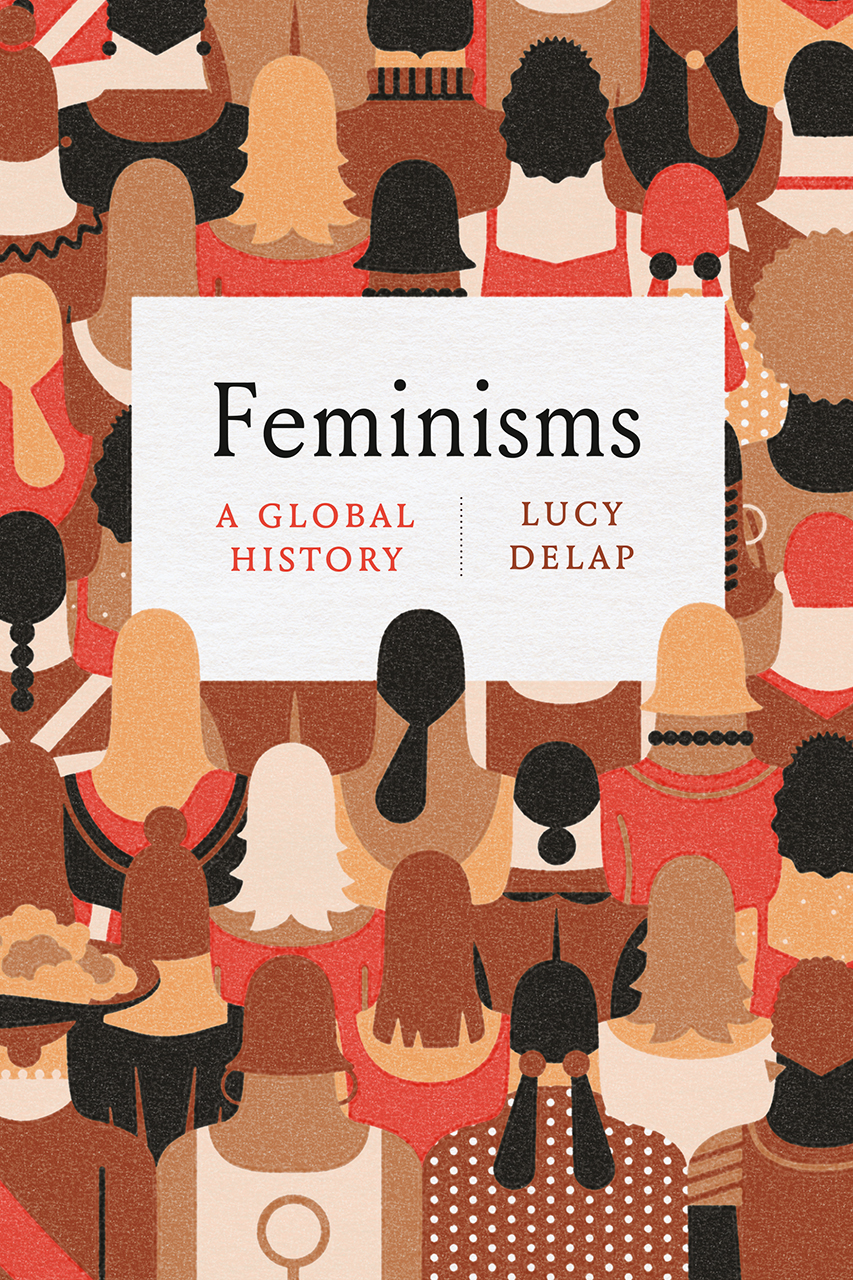
Recently, however, the history of feminism has acquired a broader focus. As Lucy Delap argues in her recent (and really quite thrilling) book Feminisms: A Global History, there isn’t just one story of feminism to be told. Instead, there have been many feminisms, which were all shaped, from the outset, by women and men of varying historical contexts, nationalities, ethnicities, sexualities, ideological backgrounds, classes and ages. The metaphor of the ‘wave’, which presents feminist history as neatly progressing from one set of concerns to another, doesn’t do justice to this complexity. What’s more, it limits our focus to one part of the world.
As Delap shows, throughout at least the last 250 years, in other parts of the world things were happening that were just as much a part of the history of feminism. In 1886, for example, when women were campaigning for the right to vote in Europe and the United States, an anonymous woman in what is now Ghana (then under British rule) wrote a rousing letter to local newspaper Western Echo:
We Ladies of Africa in general are not only sadly misrepresented but are made the foot-ball of every white seal that comes to our Coast … We have been sadly abused by people of such description, and because we have said nothing they continue to abuse us with impunity … Although we have not white or angelic faces we are capable of as high a degree of culture as any white lady.
Examples such as this, from non-Western thinkers (which Delap’s book is packed with), are not often included in traditional histories of feminism. They are important, however, because they illuminate the diversity of the movement and its concerns, and highlight the contributions of non-Western feminists, which are often overlooked. Rather than suffrage, this anonymous
woman’s concern was with an ‘African’ feminism that countered colonial ideas about women of colour.
This is all the more significant, considering that suffragettes in Europe and the United States – who are popularly depicted as the ‘only’ feminists active at the time – often expressed colonial attitudes in their activist work. When Dutch feminist Aletta Jacobs travelled through a series of African and Asian countries in the early twentieth century, for instance, campaigning for women’s right to vote, she characterized herself as a ‘motherly friend’ to the inhabitants of South-Africa, who she described as ‘children … who only need to be led’, as historian Ena Jansen has shown. As we can see, placing different feminist histories alongside each other can make us aware of the divergent struggles women around the globe had – which leads to a whole new narrative.
Viewing feminism in a global framework can also make its history less Eurocentric. With regard to women’s right to higher education, for example, Delap points out that the same developments were taking place all across the world: Britain’s first university college for women opened in 1869, and in Brazil women obtained the right to enter higher education only a decade later, in 1879. Connections like this give us a fuller understanding of the movement’s history, and prevent us from taking Europe or the West as our only reference point.
In her book, Delap calls for a new approach, which involves placing stories of feminisms from different parts of the world and different periods of history alongside each other, and studying their interactions and linkages, as well as the ways in which they were at odds with each other. This leads to a history of the movement that includes figures such as Alexandra Kollontai (an early-twentieth-century Russian revolutionary who advocated for free love) alongside groups
such as the French ‘femmes en lutte’ (who, quite differently, emphasized the maternal qualities of women in the 1970s and 1980s), and figures such as German feminist Karin Schrader-Klebert (who envisioned a universal feminism arguing that ‘women are the Negroes of all nations’) next to African-American activist Frances Beal (who, around the same time, in 1974, envisioned a far narrower brand of feminism when she termed white women the ‘economic enemies’ of black women, saying: ‘If your mother worked in a white woman’s kitchen, she knows what I mean’).
Taking a global view also offers alternative starting points for the history of feminism. Rather than with seventeenth-century English writers or nineteenth-century suffragettes, it might begin in Sierra Leone in 1792, when female householders were given the right to vote (a right they lost when the country came under British colonial rule in 1808), or at the Rosetta Women’s Conference held in 1799, when Egyptian women came together to discuss their gendered roles in society, as Delap shows in her book.
From ‘waves’ of feminism and (white) feminist ‘foremothers’ to the expansion of the feminist canon with other important women (of colour), the telling of the history of feminism has changed over time. Hopefully the new focus on the global history of the movement will lead to new information being uncovered about the concerns, struggles and accomplishments of feminists, past and present, around the globe. Perhaps the stories of Women on the Timeline, which focus on women from all parts of the world and all periods of history, will lead readers to make new, unexpected connections, and prompt them to read about the achievements of women who have been forgotten, but who played an important role in the worldwide history of feminism. Every reader will be able to determine, for herself, which histories, and which feminisms, resonate the most.
To Nazareth and back: an uncomfortable/hopeful journey through time

Written by Anna Geurts

More of Anna Geurts’ articles on historianatlarge.wordpress.com

I – living in western Europe, 2020 AD – have just returned from a visit to Mary and Joseph’s home: their cottage and carpentry workshop in Nazareth. How is that possible, you may wonder, in times of coronavirus? I’ll tell you.

The Dutch woods between Nijmegen and Cleves house a remarkable museum. The museum, called Orientalis, is dedicated to educating visitors about three large monotheistic religions from south-western Asia: Judaism, Christianity and Islam. It is situated in a beautiful park landscape in which dispersed groups of buildings tell a story of shared roots and cultures, aimed at enhancing mutual understanding and (re)conciliation between these faiths.

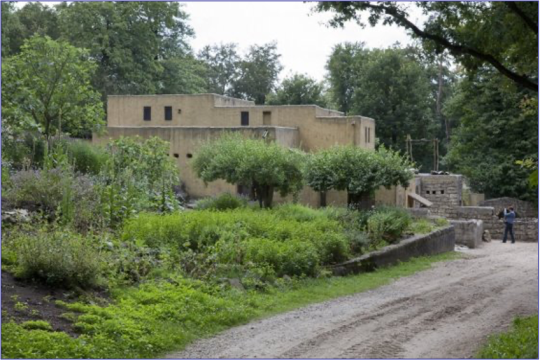
Museum village Beth Juda/Nazareth, photo by C.S. Booms (2009) (CC-BY-SA 3.0).

Yet things are not so simple, even within a relatively small museum such as this, and even (or especially?) in a land far away from the pain of Palestine-Israel.

This is not in the first place a critique, but an account of the fascination which this museum holds.

While walking through the museum park, I feel myself move through many layers of history, and many layers of meaning. For the greater part, this is a very exciting experience. But it is also unnerving. Those layers across which I walk can be distinguished quite precisely:

It all started in the 1900s when three Dutch Catholics – until about that period a heavily marginalised cultural minority in the Netherlands – met on a pilgrimage to the Biblical lands. On their return to Europe, priest Arnold Suys, artist Piet Gerrits and architect Jan Stuyt decided to offer their less fortunate Dutch brothers and sisters the opportunity of seeing the holy places for themselves, right there, virtually in their own back yards.

They bought a piece of land east of Nijmegen, and from 1911 started building what was to form a halfway stage between a Catholic church – with its Biblical pictures and stories – and a theme park. They called it ‘foundation Holy Land’.

Imagine a super-elaborate open-air nativity scene. A place of devotion, of education, but also a place of enjoyment and even entertainment, with its forest, hills and meadows, its cottages, its recreated scenes from well-known stories, its group visits, monks acting as tour guides, and the refreshments that must undoubtedly have formed part of the day out. And, let’s be honest, most real pilgrimage journeys also have something both of the austere and of the frivolous.

So, there we have the museum’s first layer, created in 1911 and the decades that followed.

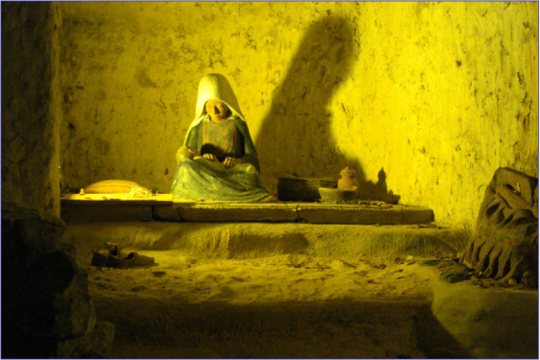
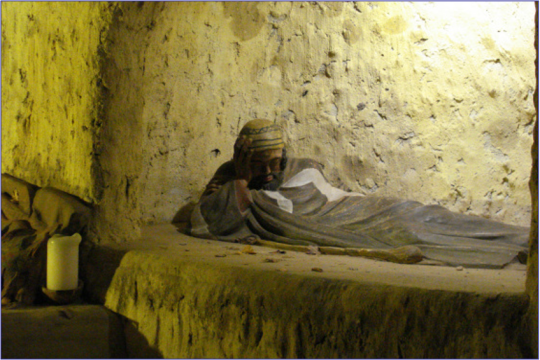
But of course, what the creators of the museum really wanted to show was the holy land as it existed in the days of Jesus. And so, visitors are led on a tour past Nazareth, past the cave where Jesus was born, and past the house near Nazareth where he grew up. (On the matter of that nativity cave, by the way: while we see Mary admiring the new-born baby Jesus in her lap, husband Joseph is taking a well-deserved nap. Poor guy, the twenty-first-century visitor thinks: modern expectations of fatherhood must have been taking their toll.)

Joseph resting after the birth of Jesus.

Especially the Jewish village (aka Nazareth, pictured above) makes for a real voyage of discovery, with its Mediterranean vegetation, its contrasts between hot outdoor and cool indoor spaces, and its mountainous winding paths that makes wheeled traffic nigh impossible – a boon for clamber-happy children, while probably a nightmare for wheelchair users who might therefore have to miss out on what is one of the best, most immersive parts of the museum.

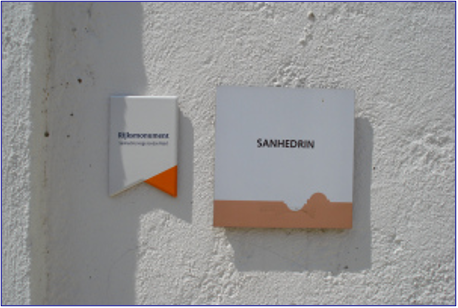
But what’s that? That modern-looking plaque on one of the Jewish cottages? Isn’t that the emblem of the twentieth-century bureau for national built heritage, the kind of emblem usually found on medieval castles and around the grand canals of Amsterdam?

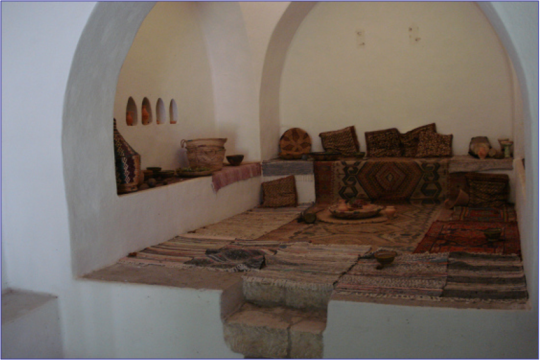
Carpenter’s workplace and home, design Piet Gerrits (1924).

It turns out that, in a highly ironic gesture, the national heritage service in 2003 (now no longer anti-Catholic, nor anti-Jewish, one imagines, and with a refreshingly broad-minded view on what counts as ‘national’) officially declared these faux Palestinian buildings to be part of Dutch national heritage.

Interior of the same.

There is more. The buildings, designed to exemplify the architecture of Biblical times (an idea which in itself forms a mixture of history and narrative, mind) – these buildings were modelled on nineteenth-century Palestinian buildings.* The assumption of the Dutch creators of the park, in line with a view on world history dominant in Europe at the time, was that life outside Europe, especially outside the city, had remained virtually unchanged for thousands of years. Therefore, when we visit Joseph’s carpenter shop, a site where we may imagine the infant Jesus playing with bits of left-over wood, we are at the same time visiting a rather pretty nineteenth-century house – or at least one as remembered by a Dutch traveller who spent quite some time studying western-Asian design. And so, we may imagine an entirely different set of children running around the place – or not so different after all?

So far, we have been criss-crossing between historical antiquity, Biblical narrative, nineteenth-century Asian architecture, twenty-century Dutch monuments and Catholic devotional tourism.

But we are not done yet. From the 1960s onwards, the museum changed tack as it moved in the direction of interreligious education, dedicating more space to Jewish history and later also to Muslim lives. This led to a series of new buildings and displays, and a reinterpretation of existing displays, many dedicated to contemporary themes ranging from Omani fashion (the Omani state is an important recent donor of the museum), to European celebrations of Eid al-Fitr, and the poverty philosophy of the current Pope. One could teach a veritable course on the history of museum education here.

Two more layers to go.

First, there are the temporary exhibitions and events, which this year are related to ‘75 years of freedom’. ‘Freedom’ here refers to the period since the allied forces conquered the Dutch territory from the German forces in 1945. And, truly, the museum has some surreal tales to tell, of twentieth-century soldiers in bivouac on the mock-Roman military square of no less than Pontius Pilate himself; and of locals who refused to collaborate, hiding away in the nativity cave.

In WWII, people found a hiding place in the nativity cave.

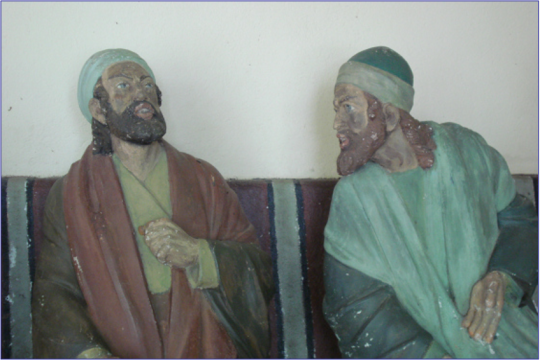
But wait. There’s a final building: the Sanhedrin, the court where Jesus was reputedly trialled by a council of rabbis (such a council was called a sanhedrin). This structure, too, has Dutch national-heritage status. But must we therefore display it in the same way as it was built?

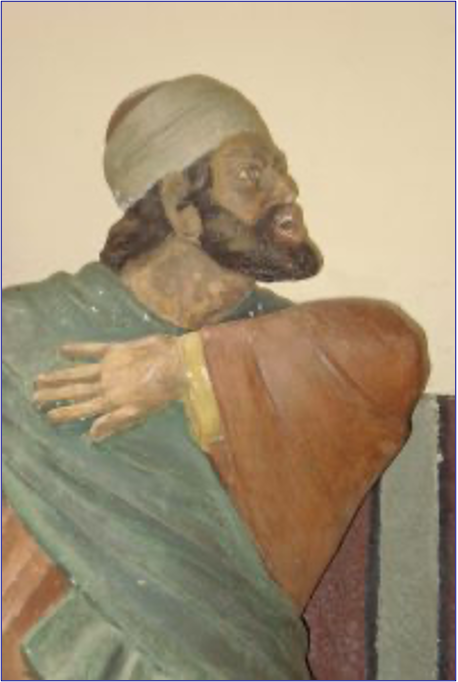
The Sanhedrin was artist Piet Gerrits’s interpretation of what such an assembly building, and such as assembly, may have looked like in ancient Judea, based on the Bible and on archaeological excavations, but, I suspect, also on the long art-historical tradition in which Gerrits had been educated. The building was installed in 1940 and a range of mannequins added in 1952. In the inner room, the assembly itself is taking place before our very eyes: eleven bearded men are passionately discussing Jesus’ verdict. Jesus himself must be imagined to have stood at the centre of the room, in the position where present-day visitors find themselves.

Now I may be mistaken, but when I enter the room, I feel there is something the matter with these mannequins. Eleven bearded men in togas, gesticulating vehemently. The expression on their faces – is it earnest, motivated to learn the truth, as you might expect a council of judges or jurors to be? Rather, their faces seem contorted in anger. Instead of dignified, some of the councillors look evil, as if they are playing the villain in a Disney film. Are they passionate in disagreement? Or, instead, in their agreement that Jesus should be convicted? One gets the sense that one is dealing with a mean set. Is a more historical interpretation of the Bible perhaps making way here for a more overtly ideological one? And what about the facial features of these councillors? Are their noses bigger than those of the figures who play a more positive role in the museum’s story of Jesus? Their teeth more often bared, their eyebrows more pronounced? And how about their postures and gestures, which certainly stand in a long tradition of Christian painting?

Standing in this room, I get the unpleasant feeling that I am looking at the remainders of a centuries-old Christian idea of Judaism. An old idea of Judaism that we now more commonly refer to as anti-Semitism, and that seems to have survived in the artistic style of the by that time 74-year-old artist Piet Gerrits, who may still have been caught up in his Catholic revival, a project which had by that time long been completed.

It may be time to give these sculptures a new context; to remove them from their self-evident place as telling a story that does not need a counter-story.

True, the much more recent interpretation sign in the courtyard of the Sanhedrin gives a fairly neutral explanation of the biblical story of Jesus’ last days. Still, the centre piece of that courtyard is a so-called Judas tree, which again draws attention primarily to Christian traditions of Jewish guilt and Christian martyrdom. It gives the entire Jesus route in the park a flavour of animosity rather than peace, love and forgiveness, which seem to be the aspects of the Christian faith which the current museum directors want to emphasise.

I am editing this column just as Facebook and Instagram have announced that they will start to remove some of the harmful stereotyping of Jews that happens on their platforms (although far from all). Facebook and Instagram are obviously surfing on the hype/working under the pressure of the current media attention for the Black Lives Matter movement. But the fight against racism, including anti-Semitism, is of course much older. And even within European museums, which are usually run by people of white, Christian backgrounds, efforts to get rid of the racism that is inherent in so many of these museums, have been long underway.

We all know that it is precisely the kind of hate-mongering stereotypes that are often propagated through images of Jesus’ last days, that keep sabotaging peaceful relations between (cultural) Christians, (cultural) Jews and (cultural) Muslims. Therefore, in a museum that is constantly reinventing itself anyhow, these are the images that need tweaking first of all; especially now that the museum’s new mission expressly preaches understanding between the faiths.

Museum Orientalis offers a veritable walk through time. A walk that is at times pleasant and picturesque, at times fascinating, but at times also uncomfortably close to the violent tendencies in our history.

Orientalis deserves a visit. But the Sanhedrin deserves a renewed display.

* See the interpretation signs in the museum itself, as well as the Heilig Land Stiching website.

All photos by APHG, unless noted otherwise.

For the museum at its most picturesque, see for instance this blog.

Materialities: a virus and face masks

Written by Anneke Smelik   

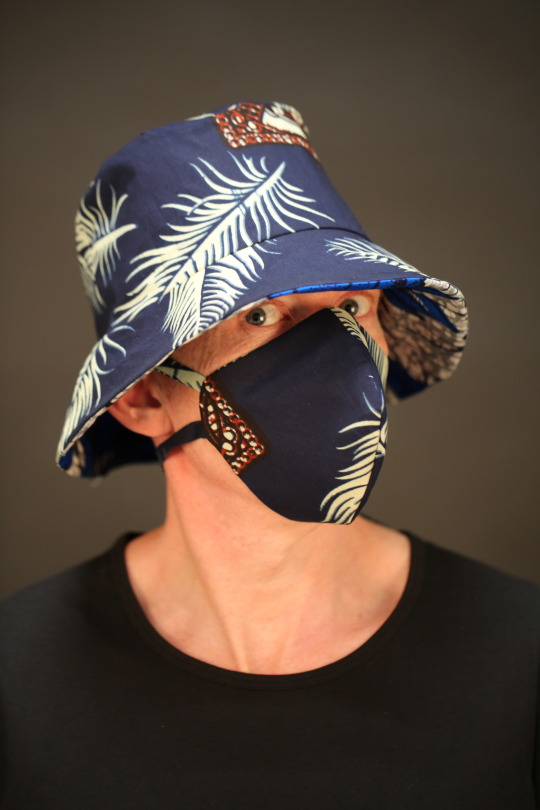
Image: Duurzame Mode 025

The fashion and beauty industries are suffering financially from the corona crisis, but some clothing companies, including large fast fashion ones such as Zara (Spain) and H&M (Sweden), are converting to the production of Personal Protective Equipment (PPE) in the form of face masks and protective gowns. Now that face masks are slowly entering the streets of European cities, there is the critical issue of accessibility: where to buy them and how to remain fashionable? DIY videos instruct people how to
make do with materials on hand, from fabric and sheets to bras and T-shirts. Volunteers make masks for hospitals and nursing homes, while private consumers have become producers at home.

Luxury brands like Armani, Gucci and Prada in Italy and LVMH in France (Dior, Fendi, Louis Vuitton and Givenchy) resort to making face masks for their respective governments, while luxury perfume makers such as Bvlgari and Guerlain have pledged to make hand sanitizers (Bramley 2020). Fashion brands and collaborations between industry and government become sources of local and national pride in times of crisis. To address aesthetic concerns many smaller fashion brands or designers are making fashionable face masks, including sequined, 3D printed and recyclable ones (Philipkoski 2020). In the Netherlands designer Sjaak Hullekes (Hulle Kes) and tech-fashion designer Melanie Brown (Bybrown) make fashionable face masks, while The Fashion Filter designs them together with the Technical University of Eindhoven. In the region Arnhem-Nijmegen the platform for sustainable fashion has developed a project with local designers to produce sustainable face masks: ‘FACE MASKS 025’.

In an earlier contribution to this blog I wrote about new materialism. In the context of the Covid-19 pandemic, materials and materialities come into stark relief. As the virus spreads globally from body to body, the importance of material protection, along with ‘social distancing’, becomes paramount. Initial material shortages of face masks, protective gowns, ventilators and testing swabs presented life-threatening conditions due to sheer demand as well as supply chain disruptions. By the end of April, many countries were recommending or demanding cloth face masks for everyone in public spaces, with the clarification that medical masks should be reserved for healthcare workers.

The question whether ‘to mask or not to mask’ (Eikenberry et al. 2020) has become quite the topic of debate. There have been mixed and dramatically changing messages whether the general public should engage in mask-wearing. Cultural as well as material and medical factors had influenced some of the earlier advice for the public not to mask in Europe and the USA. In addition to concerns about material shortages and perceptions of a false sense of security, there had been concerns about stigmatization and discrimination (Tufekci et al. 2020). Unlike the invisible virus, the mask is highly visible and has not been customary in western cultures. Mask usage in public for health purposes is much more common in Asian countries, especially since the SARS outbreak in 2003. In China, mask-wearing
is a practice associated with modern material culture.

While there are benefits to individual wearers, depending on the particular material and fit issues associated with the mask, it is basically an act of generosity to others to don a cloth mask. Inasmuch as ‘western’ cultures have tended toward individualist rather than collectivist needs, compliance requires a transformation in meaning and thinking. As Austria began to mandate mask-wearing in public spaces such as grocery stores, for example, Chancellor Sebastian Kurz noted that it would be a ‘big adjustment’ as ‘masks are alien to our culture’ (Norimitsu 2020).

The pandemic reminds us that we are all material subjects (Smelik, 2018), dependent on fabrics, clothes, and other materials not only for protective, but also for aesthetic, cultural, and social reasons. When I donned a – very ordinary – face mask for the first time, I was struck how hot it was walking in the sun, how it itched behind my ears, and that my glasses got fogged up. As I realized that the highly visible face mask is a material object that protects me, us, from the material yet invisible Covid 19 virus, I felt acutely how our daily life is characterized by non-human actors invading as well as protecting our all-too-human (and hence vulnerable) bodies. We are material subjects made up of nonhuman and human components within the larger contexts of material culture, local circumstances and global circuits.

* This blog is based on a text that Susan Kaiser and I wrote together, “Materials and materialities: Viral and sheep-ish encounters with
fashion”. Editorial introduction to Critical Studies in Fashion & Beauty, vol 11 nr 1, in press June 2020.

References:

Bramley, Ellie Violet (2020), ‘Prada the latest brand to make medical face masks’, The Guardian, 24 March.

Eikenberry, Steffen E.; Mancuso, Marina; Iboi, Enahoro; Phan, Tin, Eikenberry, Keenan; Kuang, Yang; Kostelich, Eric; and Gumel, Abba B. (2020), ‘To mask or not to mask: Modeling the potential for face mask use by the general public to curtail the COVID-19 pandemic’: https://doi.org/10.1101/2020.04.06.20055624

Onishi, Norimitsu, and Méhuet, Constant (2020), ‘Mask-wearing is a very new fashion in Paris (and a lot of other places)’, New York Times, 9 April.

Philipkoski, Kristen (2020), ‘30+ fashionbrands pivoting to make stylish coronavirus masks’, Forbes, 12 April.

Smelik, Anneke (2018), ‘New materialism: A theoretical framework for fashion in the age of technological innovation’, International Journal of Fashion Studies, 5(1), pp. 31-52.

Tufekci, Zeynep; Howard, Jeremy; and Greenhalgh, Trish (2020), ‘The real reason to wear a mask’, The Atlantic, 22 April.

Yoga and Cultural Appropriation

Written by Roel Smeets

4:30 AM. While my 5-month-old daughter is still asleep, I go downstairs to do my daily meditation and yoga practice before she wakes up. Since three years or so, I practice Ashtanga Yoga, a dynamic sequence of postures characterized by a synchronization of breath and movement. This style of yoga originates from the Indian southwestern city Mysore, where Sri K. Patthabhi Jois (1915-2009) founded the Ashtanga Yoga Research Institute in 1948. In Ashtanga Yoga, ‘Mysore’ refers to the way it was originally taught by Patthabi Jois. Whereas most yoga nowadays is taught collectively in led-classes with teachers indicating the pace, Mysore style Ashtanga Yoga is practised individually and taught one-on-one within a group setting.

When I first set foot in a Mysore room early one morning, I was struck by the electricity in the air. People breathing like Darth Vader (called ‘ujjayi
breath’). Sweat dripping from strong, supple bodies. Energetic, flowing
movements. Initially, I was primarily drawn to the physical aspects of the
practice. I felt that there was something poetic about folding your body into a variety of geometrical shapes. As I continued to practice, my interest in
yoga’s cultural roots grew. Obviously, I knew that yoga was more than just a
physical workout, but the exact nature and history of this spiritual tradition
were largely unknown to me. I started reading some of the classical yoga texts, such as the Yoga Sūtras of Patañjali (400 CE), and delved into yoga
scholarship. I learned the Sanskrit words of the Ashtanga Yoga chants by heart. Meditation gradually became a more important part of my practice. But as I emerged myself into the history and customs of this tradition, a feeling of unease started to grow upon me.

This is why. Modern yoga as practised in the West is an obvious example of cultural appropriation, in the sense that elements from a minority culture are adopted by the dominant culture and transformed into something differently. The rationale is this:

– Yoga is a spiritual tradition originating from India

– People from India are minorities in Western countries, and
India has a history of colonization by Westerners

– Yoga is practised on a large scale in the West and has
become a billion dollar industry

– In the West, the term ‘yoga’ now denotes something that is
different from its original meaning and uses

To be clear, I am definitely not the first to point this out. Especially in light
of India’s colonial history, it is striking to see that this spiritual tradition is now subject to modern forms of colonization and appropriation. It is thus not strange that India has uttered the wish to reclaim yoga.

Still, practising yoga as a Westerner, or as someone who does not have Indian roots, does not necessarily make you a bad person. As most cultural phenomena, yoga is not a stable, fixed practice, it is in constant flux and has witnessed many transformations over the centuries – arguably, the recent Westernization of yoga is just one of those changes. However, I think that yoga practitioners do have a moral obligation to be aware of the the way yoga has changed as a result of its appropriation by Westerners. To help raise such awareness, I will outline one of yoga’s transformations that took place during its rise in the West.

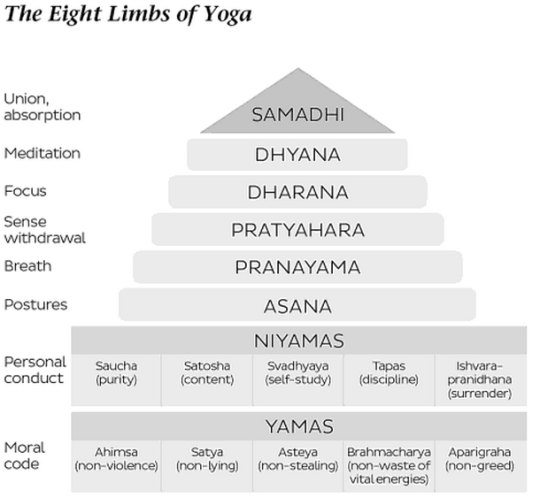
Most people nowadays associate yoga with physical postures on a mat. This association is, however, something fairly recent. As scholars James Mallinson and Mark Singleton describe in Roots of yoga (2017), most ancient writings on yoga instruct students in a multifaceted system of which physical postures is just one of several ‘limbs’. These range from fourfold to fifteenfold systems. Ashtanga Yoga, for instance, is based on an eightfold system as described in one of the most well known yoga texts, the Yoga Sūtras of Patañjali (400 CE). The first two limbs – niyama  and yama
relate to behaviour towards oneself and others, such as discipline (tapas) and non-violence (ahimsa). These limbs bear similarities to the moral codes prescribed in various religious strands, such as the Christian ten commandments. Postures (asana) is the only limb referring to the physical postures that most people associate yoga with today. Interestingly, the Yoga Sūtras do not contain any instructions about how to do a headstand or to how put your leg behind your head, asana simply refers to a ‘steady and
comfortable’ seated position. This seated position is perfect for working on
the other limbs such as breath-control (pranayama), sense withdrawal (pratyahara), focus (dharana), and meditation (dhyana). Finally, the goal of all of this is to reach a state of samadhi, commonly defined as union, absorption, or enlightenment.

image

Physical postures are just one element of yoga. Although later yoga texts such as the Hatha Yoga Pradipika (1500 CE) describe more complex postures than just the seated position described in the Yoga Sūtras, it is clear that the focus on the physical aspect of yoga only came into being in the twentieth century. In most Western countries, yoga today seems to  exclusively refer to asana, and is commonly considered as just one of many physical workout routines, which is exemplified by the fact that fitness studios and sport centres often provide yoga classes (also at Radboud Sports Centre). The clearest example of modern-day Western yoga’s
prioritization of the physical aspect is the existence of yoga championships, where ‘yoga athletes’ are judged merely on the physical appearance of the postures.

The physical aspect of yoga drew me to the practice in the first place, and this is probably also what attracts other (Western) practitioners to it. I primarily saw it as workout, used it to train my body, and it gradually replaced my long distance runs and fitness sessions. Was I doing yoga, or was I just doing some stretching exercises? Probably the latter. But although I was not fully aware of the importance of the other limbs of yoga, breath-control (pranayama), sense withdrawal (pratyahara), focus  (dharana), and meditation (dhyana) started to become equally important aspects of my daily practice. Do I now have the right to say that I am doing yoga? I am not sure. There is a huge gray area between cultural appropriation and cultural appreciation. Who draws the line, and where should the line be drawn?

Life Writing in the Picture: Using Infographics in Biography

by Dennis Kersten

There is more to biography than books, you know – but not much more. Indeed, book-length prose narrative seems the medium of choice in life writing. Not surprisingly perhaps, since it has proven to be a strikingly versatile form. However, for the telling of life stories, it continues to pose serious problems as well. Conventionally linear and chronological, biographical narratives may be seen to artificially create order in fundamentally chaotic lives and so suggest meaning where there
may not be any.

In an effort to overcome the limitations of narrative, the protagonist of Julian Barnes’ famous metabiographical novel Flaubert’s Parrot (1984) decides to present the “facts” of the life of the author of Madame Bovary in,
respectively, a chronology, a bestiary, a “train-spotter’s guide”, a dictionary
and an examination paper. He never learns who the “real” Gustave Flaubert is, but his go at biography does teach him how one life may be told in a seemingly inexhaustible variety of ways, all true to historical fact. If only Flaubert’s biographers could have used digital designer tools and capture the man’s life and work in a series of infographics! Surely, if Flaubert’s Parrot had been written today, it would have included a chapter with visualized biographical data.

Ammonite Press have published a series of short life writing books, titled Biographic, each part of which represents the lives of cultural icons through tables, graphs, pie charts and other impressively designed visuals. So far, the series has spawned instalments about Coco Chanel, Albert Einstein, Jimi Hendrix, Vincent van Gogh and William Shakespeare, amongst 15 others. There is even one about a completely fictional figure: Sherlock Holmes.

The aim is to convey these subjects’ “essence” and “defining facts” by visualizing their “thoughts, habits and achievements” and, thus, create “vivid snapshots” of them. Which is not to say that there is no narrative at all in the Biographic books: the opening pages of many parts in the series, in which the above mentioned objectives are described, are quite “texty”. And in the chapters to come, readers are guided through the infographics by sometimes quite elaborate explanatory notes. In fact, some of the visuals are text illustrations rather than infographics. Still, the combination of word and image in Biographic calls for a reading of its writing of lives from the perspective of intermediality.

Infographics may be used to great effect, especially when they document data in both an efficient and aesthetically pleasing manner – a point emphasized by books like David McCandless’ Information is Beautiful (2009). In some cases, there is no more impactful way to present facts than to visualize them in one single image. A great example would be Pop Chart Lab’s poster of who played what on which song by The Beatles (2018). With each instrument represented by a unique colour, it is immediately obvious that Beatle songs became increasingly complex instrumentation-wise as
the Sixties progressed, and that that process went hand-in-hand with Paul McCartney’s growing dominance as a player. His “Yesterday” suddenly appears a true turning point in this context.

In Biographic Bowie, infographics are used to a similar end. For instance, the track listing of David Bowie’s Hunky Dory (1971) is presented with
colours for the themes dealt with in the songs it contains. Thanks to that, you instantly realize that the songs about “American heroes” such as Warhol and Dylan are grouped together on side B, like a mini-concept album-within-an-album. The faces of Bowie’s many characters (from Major Tom to the Thin White Duke), but also his changing fashion styles: these are, indeed, best visualized. Shown in one spread, the evolution of both is dramatically highlighted.

Okay, so the use of two consecutive pages to illustrate a quote from one of Winston Churchill’s war memoirs with the door of 10 Downing Street may not be the most efficient or aesthetically pleasing way to get information across in the biography of the British former-PM. Does the repetition of cigars, bowler hats and Spitfires across 50 “defining” Churchillian facts not risk his reduction to caricature? The Aladdin Sane lightning bolt almost
becomes a brand in Biographic Bowie. More generally, why is the series focused on the usual suspects amongst “great lives”? Why is it especially interested in artists? And where are the female icons? Only three of its twenty parts are devoted to women: Jane Austen, Chanel and Frida Kahlo.

Life writing is beautiful, but not only because biographical information is. It also shows how biographers try to make sense of the “facts” they bring together by giving shape to stories about lives that are, essentially, shapeless. In that sense, the Biographic books, which must have been challenging to write and design, are fascinating study material for life writing watchers. With their playful and “fun” appearance, they will undoubtedly attract new readers to life stories that have been documented extensively already – an achievement in itself.

They also raise new questions. Can such happily colourful books also represent the darker pages in an historical figure’s life? And would their infographic approach work for the writing of lives that may be iconic, but the opposite of “great” in all other respects? Dictators leave trails of data, too, of course. What about marginalized and largely unknown subjects? Can the “essence” of their legacy be captured in maximally 50 icons? Perhaps future experiments in life writing along the lines of Biographic will answer these questions. Oscar Wilde once almost said, “Everybody is clever with infographics nowadays,” which may be true for a time in which everybody with a personal computer can be a graphic designer. The Biographic
books stand out, though. A fan of their intermedial life writing, c’est moi.

On W. B. Yeats’s ‘The Cat and the Moon’

By Frederik van Dam

As 2018 drew to a close, the Irish College in Belgium hosted a
conference on innovation and experiment in contemporary Irish fiction
.
It was a lively gathering, with many inspiring speakers; the interest in and
relevance of global climate change was striking and, of course, apposite. The animating force behind this gathering was Hedwig Schwall, for whom the conference was also the celebration of her retirement. Instead of briefly
recapitulating my own modest contribution to this conference, I thought I’d pay homage to Hedwig by providing a short reading that takes its cue from her work.

This is a belated reading. Years ago, when I was scanning the field for a possible research topic for my BA dissertation, I mentioned to my tutor that I was fascinated by the poetry of W. B. Yeats. To pursue that interest, he replied, I should seek out our in-house expert on the subject. I did not heed his advice. Instead of writing on Yeats, I soon found myself working on the novels of Anthony Trollope. But this decision was only a delay. Among many other things, Trollope’s early novels, which are set in Ireland, made me more attentive to the tangled tale of Irish literature in the Victorian age. As a result, I was brought – inevitably – into Hedwig’s ken. What would I have approached her with, though, had I listened more attentively to Yeats’s fanciful poems and not been lured away by Trollope’s earth-bound prose?

I might have tried to impress Hedwig with some reflections about Yeats’s ‘The Cat and the Moon’ (first published in The Wild Swans at Coole, 1919). The poem’s title signals that it will revolve around a psychological duality that Hedwig has so often tackled in her literary criticism; a Schwallian duality, as it were. Incorrigibly and incurably self-willed, cats are conventionally seen as conscious creatures, while the moon, at once dark and faintly illuminated, is a traditional trope for the unconscious. The poem itself, however, dissolves the opposition between the conscious and the unconscious even before it has been created, and instead emphasizes similarity more than difference. The first stanza presents the comparison between the feline and Selene in the lucid terms of a family resemblance:

The cat
went here and there
And the
moon spun round like a top,
And the
nearest kin of the moon,
The creeping
cat, looked up.

(Yeats,
p. 167, ll. 1-4)

Initially, Yeats’s cat is ‘creeping’, which suggests that without the moon it is a mere beast of the earth. As the poem continues, however, the bond between the animal and the moon is moved into the register of the aesthetic. ‘When two close kindred meet’, the poet asks, ‘What better than
call a dance’ (p. 167, ll. 12-13)? A creature whose pupils range ‘from round to
crescent, / From crescent to round’ (p. 168, ll. 23-24), Minnaloushe is
‘[a]lone, important, and wise’ (p. 168, l. 26). By staring at the moon, in
other words, the cat’s spirit is raised, elevated. Significantly, the speaker
is excluded from the dance that he observes. The poet is the passive witness of an aesthetic spectacle that seems to take place on the other side of knowledge, a spectacle from which he, as a thinking being, is excluded. The sentiment is not unlike that found in many of Matsuo Basho’s haiku, such as the following:

Though the
moon is full
There seems
an absence –
Suma in summer.

(Aitken
31)

This particular haiku expresses a sense of unfulfillment in the presence the moon, a kind of yearning for self-forgetfulness. Yeats adds a second layer to this experience by introducing a creature into the scene. It is not the moon itself but a creature staring at the moon that makes the poet (and, at a remove, the reader) feel that sense of unfulfillment, that absence, which suggests a possible cause: by virtue of the presence of the cat, the poet
is made aware, if nothing more than that, of the animalistic part of his being from which he has been separated. Without wanting to suggest that this proto-existentialist sentiment is characteristically Irish, it is a testimony to Yeats’s influence that it can be found in the many contemporary works of Irish literature of which Hedwig has been active promotor and studious scholar. Sara Baume’s A Line Made by Walking (2017) provides one of the most recent articulations of this experience.

I look up
to the turbine, which doesn’t appear to go to sleep as the flower-heads do. It
stays up at night, continues to spin. Two white lights glow from the generator
at its axis, a set of cat’s eyes, but each of the blades remains unlit. […]
It
feels as if the cat’s eyes are looking down, looking back at me. Watching over
the garden, the bungalow. But I’ve never been good at judging the distance or
size or position of objects in the sky. I remember riding in the back of my
mother’s Ford Estate: I was four, it was night-time, and the moon was full. I
was gazing out the window, and I couldn’t understand why it moved through the
sky at the same pace as the car along the road, why we never managed to leave
it behind. ‘Drive faster!’ I commanded my mother, but refused to tell her why,
and so, she didn’t.
I
turn my attention back to the tuck-up petals.
How
do the flowers know it’s night-time? Why is the moon everywhere?

(Baume 171)

As in Yeats’s poem, two instantly recognizable images – the eyes of the cat and the light of the moon – mutually reinforce one another in order to power a reflection on the strange and alien quality of the world that surrounds us. I like to imagine that a research proposal on the reception of Yeatsian tropes, as found Baume’s novel, would have appealed to
Hedwig’s heretic side. After such knowledge, she would have said (channelling Herman Servotte, channelling T. S. Eliot), what forgiveness?


Aitken,
Robert. A Zen Wave: Basho’s Haiku and Zen, 2003. Washington: Shoemaker & Hoard,

Baume, Sara. A Line Made by Walking. Boston and New York: Houghton Mifflin Harcourt, 2017.

Yeats, William Butler. The Collected Poems. Ed. Richard J. Finneran. Second edition. New York: Scribner, 1996.

Bertolucci’s autonomy of art revisited

by Marcel van den Haak

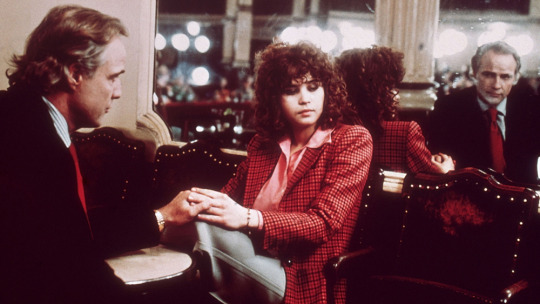
A few weeks ago, the acclaimed film director Bernardo Bertolucci died. He not only wrote and directed such grand epic films as Novecento (1976) and The Last Emperor (1987) and the stylistically innovative Il conformista (1970), but also the highly erotic Last Tango in Paris. In this 1972 film, a 45-year-old recently turned widower played by Marlon Brando and a 19-year-old engaged woman, Maria Schneider, have a series of sexual encounters in an empty apartment that they both wish to rent, without exchanging personal information. It was very controversial at the time – and it still is, yet for different reasons. This shift in moral concerns marks a broader turn in discussions on art that I will explore.

The film’s graphic sex scenes, the anonymity of the encounters and even the overt bisexuality of the young lead actress led to much moral condemnation at the time. Wikipedia gives an astonishing overview. Some critics called it “pornography disguised as art”; British censors gave it an X rating, which was still too light for some conservatives; New York moviegoers were threatened by bystanders calling them ‘perverts’ and ‘homos’; several countries such as Spain banned the film completely; and in Italy the main actors involved (including Bertolucci and Brando) were even given suspended prison sentences.[1]

image

At the same time, the movie was hailed by critics and audiences as a ground-breaking masterpiece. One of the most famous film critics ever, Pauline Kael, wrote one of her most famous reviews on precisely this film. She gave an in-depth interpretation of the story, particularly of the innovative look at sex in film – not portraying it as merely a mechanical act but as the expression of the characters’ drives – as well as the powerful debunking of American masculinity. She discussed the gliding camera style and the “sequences that are like arias,” and she reasonably compared Bertolucci to many great filmmakers of the past: Renoir, Vigo, Carné, Von Sternberg, Ophüls.[2] Other reviewers, such as Roger Ebert, later added the realness of the acting, including coughs and disconnected sentences.[3] In
other words, the reviewers touched upon all those elements of a piece of art that make it just that, art.

Last Tango in Paris is a fine example of an artwork in which aesthetics and ethics collide. In the art world, it is common practice that art is judged solely with aesthetic criteria, such as the innovativeness in form and style, the complexity or depth of the content, and perhaps the authenticity of what is portrayed. Moral judgements, that others in society might have, should be put aside. This idea originated in the nineteenth century. It stems from a misconception of Kant’s and Schiller’s ideas on the distinction between the Beautiful (aesthetics) and the Good (ethics). These great, eighteenth-century German thinkers analytically separated these two concepts, yet without disconnecting them entirely: the Beautiful should be at the benefit of the Good, art is meant to improve human beings. Thinkers in post-revolutionary France adopted this distinction between domains, but interpreted it as a full autonomy of the arts, regardless of possible moral benefits or objections. Art should be for art’s sake, not for morality’s (or money’s) sake.[4] This idea lies at the core of modernism, which reached its height in the early twentieth century, such as in literature (Woolf), visual arts (Kandinsky) and music (Stravinsky). It is still strong today, although societal benefits of the arts are often deemed important, too. Strikingly, Pauline Kael compared both the shocked and the astonished reactions at the first US screening of Last Tango in Paris in 1972 with the riot at the premiere of Stravinsky’s Le sacre du printemps in 1913, often exemplified
as the ultimate artistic revolution against the bourgeois establishment.

This maxim – art for art’s sake, form over content, aesthetics over ethics – serves as an ideal defence mechanism against any moral objections towards art. Art is a free place in which the rules of society ‘out there’ do not matter. Within the walls of a museum or a theatre you can do whatever you like; the audience will perceive it as something sacred in itself: Art. Moreover, art is the place to push the boundaries, to break taboos, to act like an iconoclast. Conservative, reactionary, religious and prudish critics can object all they want, but in the art world we don’t care.

This ‘system’ works as long as the artists see themselves as progressive – as is often the case – and their moral critics whom they can ignore as conservative. Bertolucci was a Marxist and an iconoclast, whereas his critics propagated family values and resisted licentious sex. What we see lately, however, is a steep rise of moral objections against artworks from a progressive standpoint. Art that is deemed sexist, racist, homophobic or culturally appropriative has increasingly come under fire. Art can be aesthetically beautiful, a comedian’s joke can have an original punchline, but when it in one way or the other denounces women, people of colour or LGBT persons, it is put under a magnifying glass. Often it is not the art itself that has an issue, but the artist who produced it. Can we, for instance, still watch a Kevin Spacey movie without second thoughts? Art works are also criticised in retrospect. Mozart’s opera The Magic Flute is stripped of its most misogynist and racist scenes, an 1896 painting by J.W. Waterhouse was recently removed from Manchester Art Gallery because of similarities with #MeToo situations (though this soon turned out to be a publicity stunt); and even Friends fans are re-evaluating their favourite yet homophobic episodes from the 1990s. Of course, such debates are not entirely new – e.g., already in 1972 a feminist group criticised Last Tango for “male domination”, as the same Wikipedia page shows – but the strength, scope and impact of the current discussions are expanding.

Another point of this type of criticism is the way an artwork came into being. Here we return to Last Tango in Paris. Decades after the film’s release, in 2006, actress Maria Schneider revealed how Bernardo Bertolucci and Marlon Brando had sexually humiliated her, particularly in an anal rape scene.[5] Without her prior knowledge (or only just before) and certainly without her consent, Brando had used butter as a lubricant. Schneider felt raped and held Bertolucci accountable. Hence, Last Tango became controversial again. This story has come back in the limelight several
times: after Schneider’s death in 2011, and particularly when a semi-remorseful interview with Bertolucci on Dutch TV (College Tour, 2013) had found its international way in 2016.[6] He stated that he felt guilty towards her, but that he did not regret his decision. He wanted to capture her pure
reaction rather than let her act humiliation and rage. Hence, he expressed his guilt as a person, not as an artist. And he explained further: “To make movies, sometimes, to obtain something, I think that we have to be completely free.”

In other words, in order to make something aesthetically beautiful, in this case something authentic, one can put ethical issues aside. It is the modernist defence mechanism against moral objections to art that we got to know so well in the past century. However, when the critics are from the same – progressive – side of the spectrum as most artists are, this standpoint gets more uncomfortable. Moreover, if participants within the art world itself are protesting, such as actors Jessica Chastain and Chris Evans after seeing the Bertolucci interview, it seems to get untenable.[7] Many artists still emphasize the autonomy of their art (“we have to be completely free”) when encountered with moral criticisms on sexism and the like, and they refuse to ‘censor’ themselves. Some even regretfully say that prudishness is back, only a few decades after the ‘liberating’ 1970s, without realising that the current critique is of an entirely different type.

image

However, more and more artists are taking these increasing critiques into account, be it out of fear for Twitter storms and consumer boycotts – yes, social media can greatly escalate the impact of such critiques – or due to true awareness. This might differ per occasion, but in general, I sense that a shift is taking place. Can we still defend art as a purely autonomous place that does not have to abide to the norms of the rest of society? Are the current debates putting an end to this modernist paradigm that has endured for so long? Or is it just a strong but temporary storm? For now, these are open questions.

So, can we still watch Last Tango in Paris? In her obituary, Dutch cultural columnist Joyce Roodnat – herself a #MeToo accuser of another recently deceased acclaimed filmmaker, Claude Lanzmann – thinks we can: “Thank you Bernardo Bertolucci. Your films changed my life. I forgive you everything.”[8] Well, that might go a bit far, but I’d say we can enjoy the film, but with reservation. Nevertheless, present-day directors will no longer get away with it.

[1] https://en.wikipedia.org/wiki/Last_Tango_in_Paris

[2] https://www.criterion.com/current/posts/834-last-tango-in-paris

[3] https://www.rogerebert.com/reviews/great-movie-last-tango-in-paris-1972

[4] Gene H. Bell-Villada (1996), Art for art’s sake and literary life. How
politics and markets helped shape the ideology & culture of aestheticism
1790-1990
. Lincoln & London: University of Nebraska Press.

[5] https://www.dailymail.co.uk/tvshowbiz/article-469646/I-felt-raped-Brando.html

[6] https://www.youtube.com/watch?v=RMl4xCGcdfA

[7] https://twitter.com/jes_chastain/status/804966641998168064 and https://twitter.com/chrisevans/status/805091489814548480

[8] https://www.nrc.nl/nieuws/2018/11/28/mijn-laatste-tango-met-bernardo-a2779325

A New Chapter in Space Exploration

By László Munteán

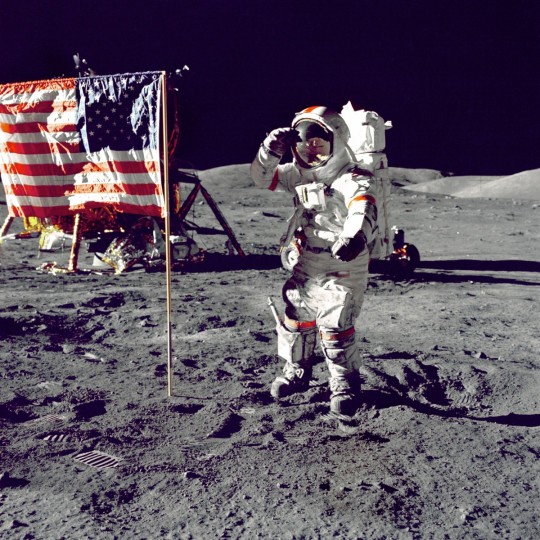
This coming July will mark fifty years since the legendary landing on the Moon by the crew of the Apollo 11 on July 20, 1969. Although the upcoming anniversary may not yet be at the forefront of our minds, Damien Chazelle’s First Man, featuring Ryan Gosling as the astronaut Neil Armstrong, is without doubt an early tribute to the mission. Considering the difficulties Armstrong and Buzz Aldrin faced when trying to plant the American flag into the dusty soil of the Moon, an event yielding one of the most iconic photographs in history, the absence of this symbolic event in Chazelle’s film is rather conspicuous. This is not to blame the filmmaker, however. Quite the contrary, in a new era of America First, this lacuna in a Hollywood blockbuster is rather refreshing insofar as it allows Armstrong’s psychological voyage as a man traumatized by the loss of his daughter to take center stage.

As First Man is still playing in movie theaters around the world, images about the successful landing of NASA’s spacecraft InSight on the surface of Mars on November 26 have gone viral. Among a series of objectives, the spacecraft is tasked with gathering information about the material composition of Mars. Instead of drilling a hole for a flagpole, InSight sends a probe deep into Martian soil. After years of trial and error, such an
achievement is, both literally and metaphorically, groundbreaking. The
belligerent rhetoric of Cold War space race that underpinned the Apollo
expeditions and left six American flags on the surface of the Moon has long
been replaced by the legacy of international cooperation in the service of
science.

image

In light of First Man’s silence on the flag raising ceremony and incoming footage of InSight’s activities on Mars, it is particularly intriguing to examine how NASA, a national agency of aerospace research, positions itself in its new promotional video entitled “We Are NASA.”
Less than three minutes long, the video opens with a montage of archival footage of emblematic launches accompanied by bombastic music and a fragment of Kennedy’s famous 1962 speech about sending a man to the Moon. A male voice reminiscent of the one used in Hollywood trailers declares that “we are building the next chapter of American exploration.” This chapter entails “returning to the Moon to stay so we can go beyond to Mars.”

While the rhetoric of “exploration” and the “pioneering spirit” is deeply rooted in the American notion of the frontier and coast-to-coast expansion, a notion which Kennedy upgraded by speaking of space as the final frontier, the voiceover also informs us, so as to underscore the aims for the new chapter, that “This is not hypothetical. This is not about flags and  footprints. This is about sustainable science.” At this point, we see
children looking at a photograph of the Apollo 11 Lunar Module with the American flag. The visual and textual rhetoric that unfolds in this sequence is laden with tension. On one hand, NASA takes pride in its achievements over the past sixty years and gladly embraces the vocabulary of the frontier and exploration. On the other hand, the new chapter of exploration on which it embarks seems to continue with a sentiment that absorbs us in Chazelle’s representation of the Moon landing in First Man: while acknowledging the legacy of American scientific ingenuity and the heroic act of the astronauts, the flag is withheld from anchoring this sentiment exclusively onto the fabric of the nation, as did the 1969 documentary Footprints on the Moon, featuring Wernher von Braun as narrator. If the gesture of refraining from using the national symbol in First Man brings to the fore Armstrong’s personality, “We Are NASA” re-inscribes the rhetoric of the all-American frontier into sustainable science as a means by which “to go farther than humanity has ever been.” At a time when scientific insights are often dismissed as fake at the presidential level, NASA’s new promotional video unmoors scientific goals from nationalism and inscribes science as a national interest.

(Re)Discovering Connie Converse

Music streaming service Spotify has been criticized for making a ‘mindless’ way of listening to music possible. Unlike a record, which you have to turn over, or a cd that stops playing after a while, on Spotify you can endlessly stream one song after the other. The other day, however, a song started playing on my Discover Weekly playlist that utterly grabbed my attention. The song was ‘Father Neptune’ by Connie Converse. It sounded like some home recording by a contemporary ‘New Weird America’-type singer. I
listened to it again, completely struck by the way it sounded and its
self-deprecating, and highly amusing, lyrics. The song features a woman singing about her sailor husband, who quite openly loves the sea more than his wife: ‘When my man goes to sea / He steps so high and free / I think I know as I watch him go / That he has no need for me, for me’. Despite feeling rejected, she prays to ‘Father Neptune’ to keep her husband safe while he’s away at sea. Throughout, the song uses rhyme and repetition to great comic effect, and the delivery and the silly guitar riff in
between the verses make it all the more humorous. Then, there’s a verse that adds great depth to the song: ‘I know it’s a boat / That keeps him afloat / But I like to think it’s me / And if it were not for this / I would sink / To the depths / Of the sea’. All of a sudden, this quirky old-timey song about a sailor and his wife becomes about people’s ability to tell themselves little lies to make their day-to-day existence bearable – and, even worse, to know
that they’re doing this, while continuing to fool themselves nonetheless.

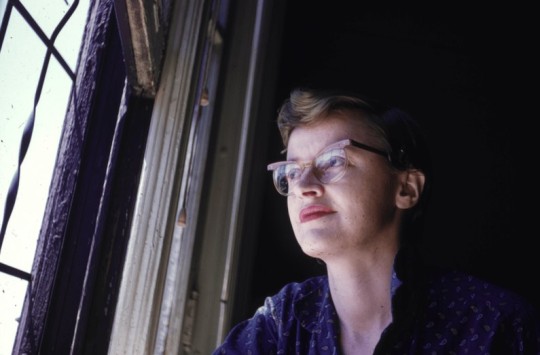
Intrigued by the song, I looked up the album on Spotify. Based on the quirky album artwork and the name of the artist, I thought this must be some vintage-inspired contemporary musician. A Google search revealed, however, that she was a singer from the 1950s, with a fascinating life story. The first hit – her Wikipedia page – tells you her full name (Elizabeth Eaton ‘Connie’ Converse) and her dates (born August 3, 1924 – disappeared 1974). Still further intrigued, I started to read more about this singer, who turned out to be a recently ‘(re)discovered’, but still relatively little-known musician.

image

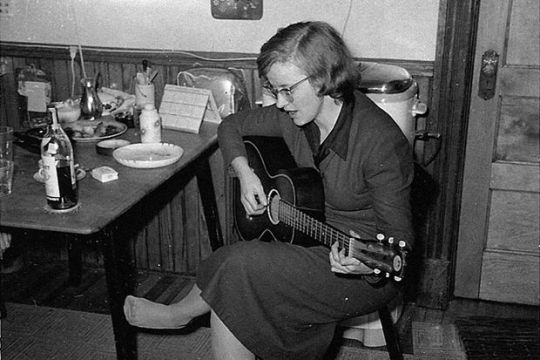
The main sources of information about Connie Converse’s life are a number of online articles and a 40-minute documentary called We Lived Alone: The Connie Converse Documentary by Andrea Kannes (2014). In these articles, the main facts about her life and her recent rediscovery are listed over and over: she was born in New Hampshire, won a scholarship to Mount Holyoke College in Massachusetts, and left the college after two years to move to New York City. There, she wrote and recorded songs in her Greenwich Village apartment and performed at friends’ dinner parties, accompanying herself on guitar. Halfway through the 1950s, she recorded a set of songs in the kitchen of artist and entertainer Gene Deitch, who held music gatherings at his house. While Deitch and others tried to help her become well-known, her career as a musician never took off. In 1961 – the year Bob Dylan moved to Greenwich Village, and after around 12 years of trying to become well-known for her music – she gave up composing and moved to Ann Arbor, Michigan, where her brother lived. Here, she got a job at the university as editor of an academic journal. Then, in 1974, after writing a set of letters to friends and family, which could be construed as ‘goodbye letters’, she drove off, never to be seen again. To this day, nobody knows what happened to her – whether she ended her life, as her brother suggests on Kannes’ documentary, or whether she decided to start afresh somewhere else. Then, in 2004, Gene Deitch played some of Converse’s songs on a music historian’s radio show, and two listeners were inspired to set up a record label for the sole purpose of making Converse’s music known to the
public. Five years later, a collection of her music was released as How Sad, How Lovely (which you can listen to here: https://connieconverse.bandcamp.com/ or purchase here: http://www.squirrelthing.com/artists/connie-converse).

The common narrative in all the articles is that Connie Converse can be seen as a ‘singer-songwriter’ long before Bob Dylan was doing his thing in Greenwich Village, and as a ‘female singer-songwriter’, writing cleverly composed songs with confessional lyrics, long before anybody like Vashti Bunyan, Karen Dalton or Joni Mitchell came along.

As the articles show us, Connie Converse’s story has all the ingredients for creating a fierce and devoted fanbase: her story is repeatedly told as the story of somebody who was lonely-but-brilliant, independent and intellectual, and who seemed to live in the wrong place at the wrong time. There is a sense that she was ‘wrongfully’ overlooked during her lifetime, and that the large body of work she left behind (only a part of which is currently known to the public) is in desperate need of being uncovered,
written about and recognized. Also, because her songs don’t easily fit into any genre, she functions as a blank screen on which people can project their own labels: she has been classified, for instance, as ‘[a] prototype of the DIY artist’ [1], or as ‘a “singer-songwriter” before that term or style existed’. [2] Labels such as these create the distinct feeling, among her fans, that she was ‘ahead of her times’, which is another feature of the ‘textbook cult artist’ [3] that Connie Converse has been described as.

One thing the writers have in common is that they are all completely bowled over by her music. Also, many of them seem glad that Connie Converse’s music is ‘finally’ getting the recognition it deserves. And here I have to agree: Connie Converse’s music is simply great. The chords are unusual, the lyrics tell wonderful stories, and the songs are incredibly moving, as well as very, very funny. Her repertoire is very diverse, and includes songs in which she humorously criticizes the restrictions women faced in the 1950s (‘Roving Woman’), profound songs about loneliness and isolation (‘One By One’) and songs that feature surrealist humour, like ‘Unknown (A Little Louder, Love)’, which starts: ‘Once there was a trumpeter / Blew his love a ballad / That was not enough for her / So he blew her a lobster salad’. She plays around with rhythm, melody and pauses to create emotional effect, and while telling stories about domesticity and love, her songs also explore the darker side of life. This goes, for instance, for ‘Talkin’ Like You (Two Tall Mountains)’. This song is about a woman living on her own in a valley that people call ‘lonesome’, who states that she isn’t ‘lonesome’ at all. After the opening, there is a beautiful melody and the speaker sings about a whippoorwill ‘sitting on [her] windowsill’ and a ‘brook running by [her] kitchen door’. We get the idea she is perfectly happy being there by herself. Then, there is a humorous twist: it turns out that everything there is ‘talking’ at her, like her lover used to do. ‘See that brook
running by my kitchen door / Well, it couldn’t talk no more / If it was you //
Up that tree there’s sort of a squirrel thing / Sounds just like we did when we were quarrelling / In the yard I keep a pig or two / They drop in for dinner like you used to do’.
This is the reason she isn’t lonely there: she has
all sorts of creatures and things reminding her of her annoying ex-lover. By
the time the song ends, she no longer ‘goes’ to the valley, as she sings in the beginning of the song, but ‘lives’ there: ‘In between two tall mountains / There’s a place they call “lonesome” / Don’t see why they call it lonesome / I’m never lonesome now I live there’. Despite the humour, there’s a sense here that the speaker can’t escape her somewhat tormented mental state – and that she is kidding herself in thinking that she isn’t lonely. Several of the songs on How Sad, How Lovely feature characters like this, with complex inner lives.

image

Of course, Connie Converse’s story is not unique. Elements of it are similar to the stories of singers like Sibylle Baier or Eva Cassidy. Also, music critics have pointed out similarities between her music and that of her female contemporaries, such as Peggy Seeger and Susan Reed. One reason why Connie Converse’s story is interesting, though, is that it shows us how a new discovery can change existing periodizations and, with this, our view of music history. Indeed, the ‘discovery’ of Connie Converse sheds new light on singer-songwriters and folk artists such as Bob Dylan, female
singer-songwriters and their precursors, and the music scene in 1950s New York. This reminds us, once again, that the periods that scholars, music historians and journalists refer to in their work, and that we teach to students, are not fixed entities with clear-cut boundaries, but are artificial constructions, made on the basis of the cases at our disposal. What’s more, the story of Connie Converse shows us that becoming ‘famous’ does not necessarily depend on talent, but relies on a combination of many factors: connections, reviewers, record labels, music journalists, scholars, luck, and timing.

[1] In press releases for Howard Fishman’s play on Converse’s life, A Star Has Burnt My Eye (2015).

[2] Spinning on Air podcast (2009, https://www.wnyc.org/story/62099-connie-converse-walking-in-the-dark/).

[3] New York Times review (2016) of Fishman’s play (https://www.nytimes.com/2016/11/11/theater/a-star-has-burnt-my-eye-review.html).

“All that is solid melts into air”: Cultural Analytics and Julian Rosefeldt’s Manifesto (2015)

By Roel Smeets

These months, research brought me to autumnal Montréal, Canada, where I am a visiting scholar at McGill University’s .txtLAB. Montréal is the geographical centre of cultural analytics, a quickly evolving discipline that uses the methods of data science for the study of culture. The young and blossoming Journal of Cultural Analytics is hosted here, which is one the leading platforms in this field of study.

In the cold and rainy atmospheres of the city I daily think and talk about devising and fine tuning methods to analyse novels on a larger scale than literary scholars commonly do. I like to think that I am not doing this because I am perverted by a neoliberal logic in which everything, including works of art, have to be measured and classified. I rather tell myself that my algorithmic approach to the contemporary Dutch novel serves a higher goal: revealing patterns of literary representation that are not visible to the human eye. Turning art into data thus becomes a means to a noble end –
or so I believe.

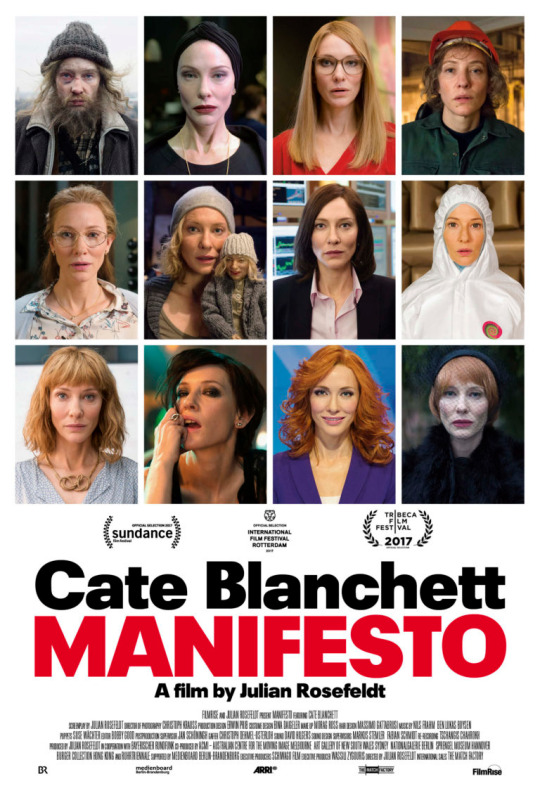
Last weekend, I took a break from research and went to see Julian Rosefeldt’s video installation Manifesto (2015), which was exhibited at the Musée d’art contemporain de Montréal (MAC). In the first room of the exhibition, excerpts from a diverse collection of manifestos are shown on panels, ranging from Marx’ and Engels’ Communist Manifesto (1848), to Filippo Tommaso Marinetti’s Manifesto of Futurism (1909), to Lars
von Trier’s and Thomas Vinterberg’s Dogme 95 Manifesto (1995). In the next room, thirteen short movies are shown in which actress Cate Blanchett utters lines from these manifesto’s while performing various roles such as factory worker, homeless man and schoolteacher.

Manifesto: https://www.youtube.com/watch?v=sOA6ramO1aw

Upon entering the room, I hear Blanchett’s voice orchestrated through a cacophony of sound. I hear the words from the different manifesto’s being uttered all at once. At first glance, it feels as if every short movie expresses radically different statements on the workings and uses of art, culture and society. As if everyone disagrees. But at the end of each short movie, out of the blue, a moment of apparent harmony emerges. All of Blanchett’s characters start to synchronously utter words that all sound very much alike despite their difference in meaning. It is as if all manifesto writers are suddenly on the same page, as if there is nothing but one shared belief, although it remains unclear what that might entail.

The first video features lines from the Communist Manifesto. The chief point of focus lies with the words “All that is solid melts into air”, taken from the
first section of the manifesto. Unhampered by what Marx and Engels might have meant by this, the words serve as metaphor for the seemingly inviolability of the idealistic convictions of all the manifesto’s portrayed in the exhibition. Listening to the concepts and ideas expressed in each individual manifesto, I had the experience of listening to clearly defined, impregnable beliefs, carved in stone. But listening to all these manifestos at once, the apparent solidity of each manifesto melted into air. What seemed solid at first, turned out to be unstable, relative, hilarious almost.

I see Rosefeldt’s Manifesto (2015) as a metaphor for my own research practices. Turning culture into data creates an illusion of solidity. Numbers instead of words, statistics instead of speculation. But a numerical representation of a novel is still a representation, a perspective, a point of view, and therefore not necessarily more true than other representations. I picture a future exhibition where excerpts from dissertations are read out loud with an air of solidity, seemingly disagreeing, but sounding alike. Words on a page melting into thin air.

image