Not just any rock memoir, but a “beautiful one”

Door: Dennis Kersten
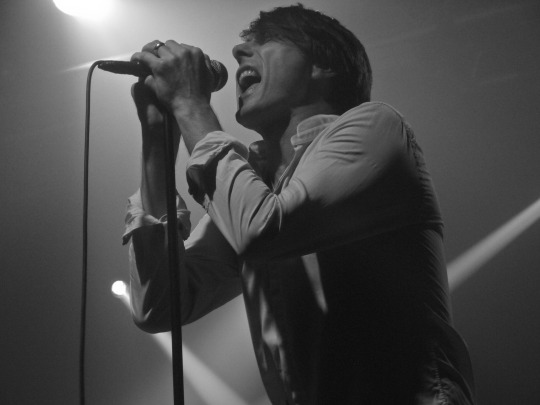
© foto: Simon Q

There is a fantastic anecdote in Brett Anderson’s memoir, Coal Black Mornings (2018) about how the Suede singer as a teenager listened to his favourite post-punk records at the wrong speed (33 rounds per minute, instead of 45): “I fell in love with the slowed down, hellish yowl that
seemed so in keeping with the content”. When he is eventually told, the magic of the music is lost. Also, the awful sound of his third-hand hi-fi set taught him to ignore the bottom end in music, possibly influencing the writing and recording of his clear and simple songs later. As he writes about his younger self, “The parameters of my ability, though at first a limitation, actually ended up being a strength as I incrementally developed the only style I could – my own”.

While reading about the magic of mishearing music in Anderson’s book, I was reminded of the Sunday evening in 1993/4 when I went cycling through Nijmegen, listening to a cassette of Suede’s eponymous debut album. I remember how snippets of sometimes half-heard lyrics seemed to cohere into an invitation to a scene of broken bones in council homes and housewives addicted to mother’s little helpers. A world populated by people “so young and so gone”, and, indeed, so far removed from my own life at the time. What was I to make of lines in which lovers go lassoing, or someone is “born as a pantomime horse”? As I recall, there was absolutely no such poetry to the city I cycled through that evening. I had no need for the domestic violence of “Animal Nitrate”, or the use of drugs in “Sleeping Pills”, but my home town definitely lacked stories – or, at least, that is what I thought while trying to make sense of Anderson’s lyrics.

As can be read in his memoir, Brett Anderson, born in 1967, comes from a similar humdrum background in Haywards Heath, West Sussex.
His childhood and adolescence may have lacked stories, too. To his older self, that is, because the book he has just published is the story of his Haywards Heath days, his escape from the doledrums via student life in Manchester and the formation of Suede with, amongst others, his girlfriend Justine Frischmann. First and foremost, it explores his relationship with his parents, a recurring subject in Suede songs, especially on the reunited band’s two most recent albums. Anderson is concerned with his father’s influence on the development of his personality and bares himself while describing the impact of the death of his mother from cancer. Thus, Coal Black Mornings makes for intimate as well as melancholic reading: it does not start with the sentence “This is a book about failure” for nothing. It is one of the most powerfully emotional and well-written rock memoirs recently published.

The current popularity of the rock star autobiography may be indicative of rock music’s waning significance and the ensuing desire to wallow in nostalgia for the so-called “golden age” of guitar-oriented popular
music: the 1960s, ’70s and ’80s. As Michael Hann claims in The Guardian (31 March 2017), “rock is the new jazz… something fetishised by an older audience, but which has ceded its place at the centre of the pop-cultural conversation to other forms of music, ones less tied to a sense of history”. Clearly, considering the commercial success of life narratives by some of rock’s most heavily canonized names (Dylan, Richards, Springsteen), there is a market for stories about the good old “rock” days. And, yes, they do sometimes create the impression that their authors have come to a
point in their lives from which they can only look back. However, while early-Suede seem to have become rock heritage (2018 did see the release of yet another deluxe edition of their debut), it would be unreasonable to say that with Coal Black Mornings Brett Anderson is simply jumping the rock memoir bandwagon.

Thanks to its focus on his pre-fame life as well as its sophisticated writing style, Anderson’s book qualifies as belonging to a subset of the celebrity memoir that has more on offer than abundantly illustrated (and frequently ghostwritten) sensation stories about the very private lives of the stars. As such, it should be an equally interesting read for non-Suede fans. Its tone, subtlety,  and perhaps “literary” precision in its choice of metaphors may remind readers of recent, critically acclaimed rock star autobiographies like Patti Smith’s Just Kids (2010) and Robert Forster’s Grant and I (2016). Coal Black Mornings is no typical rock memoir either: Anderson is relatively young, while contemporary rock life writing seems to be dominated by musicians who were at the height of their powers in the ’60s, ’70s and ’80s. Blur’s Alex James and The Charlatans’ Tim Burgess have both published at least two autobiographical books, while Pulp’s Jarvis Cocker is, apparently, writing his first, but Anderson’s 1990s Britpop generation remains underrepresented on the autobiography shelves.

With a new Suede album announced for September 2018, Anderson can hardly be said to look back on a fully formed career, neither does
Coal Black Mornings aim to present a complete picture of his life so far. As he explains in its introductory pages, the book, a “prehistory” of Suede, was written with a very specific intention. “The very last thing I wanted to write was a ‘coke and gold discs’ memoir,” he says in the “Foreword”. Instead, he is writing mainly for the benefit of his son, so that “When he is old enough, which may indeed be when I am no longer around, at least he’ll have this to add a little bit of truth to the story of who his dad was and the passions and privations he lived through, and ultimately where we both came from”. Fatherhood has not only changed Anderson as an artist, but having become a parent himself has also made him reevaluate his relationships with his mother and father. His memoir, then, has work to do: in days to come it will tell his son who his father really was and, more immediately, it will help Anderson come to terms with life at 50. Like any autobiographical
narrative, Coal Black Mornings has its duties towards the present and the future, as much as it is about its author’s personal history.

Much has been written about the book’s ending: it stops when Suede sign their first recording contract, about a year before their debut album will top the British charts. Anderson has already been interviewed about a potential sequel, which would inevitably be about “coke and gold discs” as well as guitarists and songwriting partners leaving the band at crucial stages in
its career. In Coal Black Mornings, there is more about the heyday of Suede, and especially band relations, than initially seems the case, though. When Anderson describes his early relationship with “intense” fellow-songwriter Bernard Butler, it is already clear that it is bound to end in high drama, even if he always writes about Butler with deep affection and admiration. References to later periods in the existence of Suede complete the picture of a fascinating group of people, personality-wise: a follow-up to the current memoir might provide more detail, but the dynamics underlying the interactions between Anderson, Butler, Osman and Gilbert are already evocatively rendered.

In addition, this prehistory of Suede does shed light on the origins of many of the early Anderson/ Butler co-writes. Anderson relates how those songs process real-life experiences and build on observations of the people that pass through his pre-band life in shabby London flats – the “Beautiful Ones” of the title of a 1996 Suede hit. A turning point is “the emergence of sex” in the songs Anderson and Butler wrote in preparation for their first album: “The moment that Bernard and I started to dig deep inside
ourselves and into those primal urges like anger and hatred and lust was the moment that we really grew as writers”. (Enter the lassoing in the lyrics of “Moving”, presumably.) The memoir itself is conspicuously light on discussions of sexuality. Anderson only fleetingly refers to his “overtly feminine” stage persona, which he explains as “an expression of grief”. It was his way of dealing with the loss of two of the most important women in his life just before Suede hit the big time: his mother and Justine Frischmann. “This idea of replacing people with gestures and things fed into some of those early songs,” he writes.

When I was out on my bike in the early-’90s, listening to some of those “early songs” on Suede, I thought that at 40 I would understand and live life better. I was sure I would know more words to be able to express myself more adequately. But by the time I reached 40, I felt I had only really learnt to be 30 in the meantime. 40 brings new questions – and calls for yet more words. Judging from his memoir, Anderson is at a similar new crossroads in his life: he is, indeed, not looking back from an end point, but reflecting on what and where he has been to be able to answer the personal questions that matter in the here and now. He should not write a sequel about Suede’s peak period, as some have suggested. I’d say, let Coal Black Mornings do its work. It may be a book about failure, but Anderson’s life writing is a triumph.
Jazz Isn’t Dead, It just Sounds Funny

by: Vincent Meelberg

On Saturday, April 14, 2018 the next edition of the Transition Festival will
take place in Utrecht, the Netherlands. This festival promises to provide a
fresh view on the current developments in jazz, offering concerts where
established jazz artists share the stage with young innovators. And indeed, the
lineup includes well-known names of jazz veterans such as Pat Martino and John Surman, as
well as new(er) bands including Mammal Hands, Sons of Kemet, and
Cory Henry and The Funk Apostles.
While the musical qualities of these newer bands are beyond dispute, whether or
not these artists can actually be considered genuine jazz artists is not always
completely clear. Cory Henry, for instance, brings along his Funk Apostles, not
his Jazz Evangelists. Can we still call his music jazz, despite its obvious
funky sound?

In order to answer
this question, first it must be clear what jazz exactly is. Throughout its
history, jazz has developed from ragtime and New Orleans jazz to jazzrock, fusion,
and free jazz. As a result, it seems almost impossible to characterise jazz in
a productive manner. Some festivals, such as the North Sea Jazz Festival,
stretch the notion of jazz to such an extent that most popular genres seem to
fall under this category. Just take a look at the lineup
of the 2017 edition of the North Sea Jazz Festival
. Headliners of that edition included Usher & the Roots, Grace
Jones, and De La Soul. And Although some of these artists do have a jazzy sound
in some of their songs, they cannot be considered actual jazz artists by any
stretch of the word. So, does this mean that jazz has become an empty term?

According
to jazz critic Ted Gioia
,
jazz still possesses a certain mystique, one that pop artists would like to
benefit from as well. That is one of the reasons why pop stars prefer to
perform at jazz festivals and occasionally even hire jazz artists to play on
their records. That is, as long as the musical result is not too jazzy…

Stanley
Crouch, another jazz critic, claims
that we need to make sure that mainstream jazz is preserved.
Crouch generally dislikes all jazz that deviates from the way jazz was
performed between the 1930s and 1960s, thus to him the fusion of pop with jazz
is a horror. Ultimately, he asserts, people won’t be able to distinguish real
jazz from pseudo jazzpop tunes.

But is it really the
case that jazz is threatened by outside influences? Will jazz disappear when it
adopts elements from pop music, or when pop music borrows elements from jazz?
When we take another look at the history of jazz, then we can see that it is
characterised by impurity, that is, by influences from other musical genres. In
this sense, jazz is an impure genre, impure in the sense that it has always
been hospitable to other musics. Since improvisation is a crucial element of
jazz music, and new generations of jazz musicians improvise while drawing on
their own musical experiences, both as players and as listeners, it is
inevitable that other musical styles will influence their improvisations. they
will simply improvise differently than their predecessors. As a result, jazz as
a genre will evolve and change as well.

So, can we still call all of the artists that will
appear at the Transition Festival jazz musicians? I believe that we can (even
though I am sure that some of these artists would not call themselves jazz
artists). Sure, they may not play the kind of jazz that was played
in the 1950s or 1960s
, but the spirit and
intention is similar. To create new sounds, improvise new stories, and just make
great music.

What’s in a Scent: Olfactory Art

Smell
Transplant Workshop by Klara Ravat at Mediamatic, Amsterdam. Photo by Anisa
Xhomaqi.

door: Marrigje Paijmans

How many people could you recognise from their
body odour? Probably not so many, humans being notoriously bad smellers. What
makes it even harder to collect and recollect scents, is that it is quite
uncommon and undesirable to take a deep and scrutinizing sniff at someone’s
neck. It makes one wonder: are we really such bad smellers or are we just extremely
uncomfortable with smell?

At the exhibition of the 3Package Deal, an Amsterdam funding programme for talented artists, I was introduced
to ‘olfactory art’, also known as ‘scent art.’ The
motto of the exhibition was: ‘Frames are so 2015,’ because the 2016 talents had
distinguished themselves by ‘moving smoothly between disciplines and looking
for collaborations and interactions with other creatives.’ This certainly applied
to the awarded olfactory artist, who was trained as an experimental film maker,
simply because there was no education in olfactory art. And yet, art involving
scent has a long history, the earliest reference dating back to 1938, when the
poet Benjamin Peret roasted coffee as part of a multi-sensory installation by
Marcel Duchamps for the Exposition Internationale du Surréalisme. Today, olfactory
art is on the rise. Mediametic Amsterdam organises a monthly programme called Odorama, exploring ‘everything that reaches and effects the nose.’ The Flemish
professor Peter de Cupere, who has worked in
and on scent art for over twenty years, initiated several online olfactory
exhibitions, such as The Olfactory (2014) and The Smell of War (2015). It is by
itself interesting to see how he experiments with ways to present scent art in the
audio-visual medium of the Internet. De Cupere has responded to the increasing
interest in scent art by launching the Art
Sense(s) Lab
at
the PXL MAD School of Arts in Hasselt, the first full-fledged master programme
in olfactory art!

Peter De Cupere, Invisible (SCENT) Paintings,
2014, Marta Museum Herford. See also https://tinyurl.com/invisible-scent-paintings and https://vimeo.com/98278870.

 The olfactory piece that I witnessed, or rather participated in, was by Klara Ravat. Ravat is particularly interested in people’s discomfort with intimate smells.
One of her favourite novels being Perfume (1985) by Patrick
Sueskind, she is fascinated by the slightly grotesque aspects of scent and
perfume making. In order to preserve a smell and make it applicable, the scent is
captured in alcohol. To me this process bears resemblance to the ways in which biologists
used to preserve reptiles and limbs in formalin. At the
same time, body odours contain so much knowledge and personality: ‘Body scent is almost like a finger print.’ This must be
true, although for most people it is impossible to identify these fingerprints
– at least on a conscious level.

Ravat’s olfactory art cuts across traditional disciplinary and media
boundaries. One of the media she has explored thoroughly for her art is the
workshop. For the Athens Digitals Arts Festival 2016 she hosted a workshop for which all the participants had to collect a scent from
the city. I do not know how people managed to bring their scents to class, but what
they brought in varied from burning car tires to ripped orange and Greek coffee.
The perfume distilled from this assemblage was presented at the 3Package Deal exhibition. It smelled fresh, and yet
slightly overdue, like a dying flower in the rain. One of the first things I
noticed when participating in Ravat’s workshop, was my lack of vocabulary for
describing olfactory sensations.

The workshop I participated in involved twenty people. For a start,
everybody had to smell everyone else’s neck, just behind the ear, where warm veins
touch thin skin. I was slightly worried about my neck’s scent, coming in
straight from a full day of teaching in Nijmegen. While nosing around other people’s
necks I entertained the thought that most people might as well be odourless,
for all the perfumes, shampoos and creams masking their body odours. Some other
necks smelled more like hair or sebum, which was not as bad as I anticipated. I
also noticed that it was more difficult for me to smell a man than a woman –
was it because I was nervous or is there an evolutionary explanation? The next
thing Ravat came up with was a guessing game. Half of the group was blindfolded
and had to remember the body odours of the other half. This proved fairly easy with
those wearing perfume, but was otherwise nearly impossible. One girl was able
to distinguish five strangers in a row and together we applauded her
magnificent nose.

Smellscapes
performance by Klara Ravat at Odorama, Mediamatic, Amsterdam. Photo by
Anisa Xhomaqi.

Ravat’s workshop made me wonder to what extent
olfactory art has the potential of becoming a full-grown art form, scent being
such a limited spectre for most people. Do our noses not lack the refinement
that our eyes enjoy in watching a Rembrandt or our
ears in listening to Schubert? What troubles me as well, is the ways in which
the subconscious effect of scents is exploited for commercial purposes. The food industry uses artificial odours to compensate for otherwise
odourless food. Retailers are developing scents that seduce customers into
buying random articles. Some of these scents are hilarious, such as the artificial
mix of sausage and cheap underwear defining Hema. I find this use of scents
unpleasant, because it exploits the fact that I cannot avoid breathing. Air
pollution can take many different forms.

This ecological inconvenience might well be the
reason for the recently experienced urgency of olfactory art. Since scents
affect us unconsciously, olfactory art is all about getting to know our senses and
how they interact with our brain. It is about generating insight into the most
obscure and diffuse wanderings of our imagination. This insight may be useful
in avoiding or countering the commercial use of scents. On a more aesthetic level, the
effects of olfactory art can be compared to those of the Proustian novel. It
presents us with uncanny scents which, already before we can ‘place’ them,
raise memories of cities, encounters, and emotions. It is a truly artistic
medium in the sense that it creates awareness of the aesthetic experience as
such. Finally, olfactory art has an ethical aspect to it, as it involves honesty
and courage to expose ourselves. Ravat’s workshops are unsettling, because we
do not know what other people smell when they sniff our neck. We will never
know our own body odour, as we will never be able to control how other people
see us. This is frightening and yet revitalising in a time when social media,
curriculum vitaes and cosmetic surgery reign supreme.

My initial doubt as to whether olfactory art can be
considered a serious art form is ‘so 2015.’ An olfactory work connects to other
art forms and social discussions, which completes it as a proper ‘piece.’ It is
certainly time to stop thinking of art in terms of disciplines. Maybe we should
see art as the individual pieces in which different materials, ideas, and
senses come together to create a multi-experience on different levels. Or maybe
we should not see, but rather smell art, as a scent, an essence, a whiff, an
unbounded and highly affective diffusion of ideas.

Period Pieces: The History of Menstruation in Art and Advertising

door: Saskia Bultman

Last week, Bodyform – known as ‘Libresse’
in The Netherlands – launched a worldwide advertising campaign for sanitary
pads. Unlike most ad campaigns for ‘feminine hygiene products’, this one made
headlines: it was the first time ever that a company was using red instead of
blue liquid to advertise the absorbency of their product.

The ad – a twenty-second video – is notably different from the menstrual hygiene ads
we are familiar with. These normally revolve around a woman, dressed in white,
or in ultra-feminine clothes, joyously engaging in physical activities, free
from worry about her period showing. That she doesn’t need to worry about this,
these ads suggest, is thanks to the absorbent capacities of the company’s product,
which are usually demonstrated by a hand pouring blue liquid onto a menstrual
pad, which is immediately soaked up. Whereas menstrual hygiene advertisements previously
stressed the importance of a woman’s period being invisible, Bodyform’s new ad campaign is all about bringing  menstruation out into the open.

The Bodyform advertisement starts
with a woman’s hand in a lab coat pouring red liquid on a sanitary pad, while a
‘detached’ woman’s voice assures us of its ‘ultra-absorbing core’. Next, a young
woman at a dinner party asks her friend for a sanitary pad across the table.
Both men and women are present, and no one bats an eyelid. The ad then cuts to
a scene in which a man – in jeans, sneakers and a headband – is seen buying a
pack of sanitary towels. Neither he nor the male cashier seem to think anything
of it. Besides looking very hip, the man buying the Bodyform pads is also
black, has dreads, and doesn’t look like your stereotypical white ‘domesticated’
husband. It’s normal for any man to
buy menstrual hygiene products for their partners/relatives, the ad seems to be
suggesting. Next, a woman in a red swimsuit is seen from above, lounging in a swimming
pool on a sanitary pad-shaped lilo. The indoor lighting in the pool reflects on
the water in two white curved bands, whose shape is reminiscent of the female
genitalia. This image, paired with the red ‘splotch’ of the woman’s swimsuit on
the white – ‘clean’, ‘pure’ – pad-mattress, seems to suggest, oddly enough,
that the woman herself in this image
represents menstrual blood. Not only is this image difficult to interpret –
what should we make of the suggestion that a woman is her period? – but its message seems to be at odds with the ‘liberating’
intentions of the ad campaign. What comes next is a shot showing a trickle of
blood running down a woman’s leg in the shower. In other contexts – the ‘shower
scene’ in Psycho comes to mind – the
sight of blood in the shower would be threatening or horrifying.  The fact, however, that we see this shot for only
a second, as if ‘in passing’, suggests that menstrual blood running down the
leg is an unremarkable fact of life. The light colour of the blood, moreover,
adds to its innocuousness, and prevents any feelings of horror or disgust in
the viewer. After a scene in which a woman dressed in a sanitary pad Halloween
costume arrives at a house party, the video cuts to a screen-filling circular
splash of bright red liquid – presumably blood. Over a shot of red liquid (i.e.
‘blood’) flowing through water, the words ‘Periods are normal. Showing them
should be too’ appear. Finally, the Bodyform logo is shown, together with the
company’s slogan ‘Live fearless’, and the ad campaign hashtag: ‘#bloodnormal’.

The longer version of the ad, which
the Dutch Libresse website links to,
is over two minutes long, and adds a variety of scenes, including a woman
having sex (presumably while on her period) and women suffering from period pain.
Through other images in the video, Bodyform imagines a world in which a woman
can tell her employer she is working from home because she has a ‘heavy period’,
in which a girl’s classmates, male and female, can pass her a sanitary towel in
class without blushing, joking or commenting, and in which a woman can walk
through a public place (a library, in this case) with a menstrual pad in hand,
without taking pains to hide it from view. In the final scene of the ad, the
woman – clearly coded as a ‘millennial’, marking her as a member of a new
generation of young women – is shown changing her sanitary pad. As soon as it
is brought into view, however, it is blocked out, and a supposed quote from
‘Assorted TV Broadcast Authorities Worldwide’ appears, which states: ‘The sight
of period blood is unacceptable’ – something which Bodyform wants to change,
through their campaign. The company’s idealistic vision is emphasized by the
visuals in the ad. On her way to the bathroom, for example, the young woman is
shown looking, open-mouthed, at a stained glass panel showing a bright yellow
sun – presumably signalling the ‘new dawn’ Bodyform envisions.

Bodyform’s political message is made
even more clear on the company website. Here, they assert that periods are a ‘natural
part of life’, but are only rarely shown. According to Bodyform, this
contributes to the ‘shame and embarrassment many women feel when it comes to
their periods’. Basing themselves on a survey in which 74% of 10,017 men and
women wanted to see more realistic representations of periods, Bodyform has
taken it upon themselves to ‘kill stigma’ by ‘bringing blood out of the dark’. Online
discussions on the campaign show that, while many are celebrating the ad
campaign, opinion on the issue of depicting menstrual blood is starkly divided.

The practice of making menstrual
blood visible is not new. There is a tradition of feminist art that does precisely
this. The best-known examples of this are the artworks Red Flag (1971) and Menstruation
Bathroom
(1972) by feminist artist Judy Chicago. While the former is a
photolithograph of the artist from the waist down pulling out a used tampon,
the latter is an installation of a bathroom with a rubbish bin overflowing with
bloody tampons. With her art, Chicago was calling attention to the taboos
surrounding menstruation. Her work can be seen in what Norma Broude and Mary D.
Garrard describe in The Power of Feminist
Art
as a wider context of feminist artists at the time, who were
‘reclaiming’ traditionally feminine iconography (as well as objects, shapes and
materials), and politicizing them, in order to draw attention to feminist
issues (24).

Nowadays, too, women artists continue
to make art using menstrual blood. While this art is highly diverse, and there
is no room here to reflect on it in detail, there was one ‘trend’ I noticed: in
doing research for an unrelated project, I came across three artists – there
may be more – who made Rorschach-like ‘blots’ out of their own menstrual blood.
Their artworks included Patricia Munson’s Menstrual
Print with Text
(1993), Sarah Anne Ward’s photograph series of ‘period
stains’ in the form of Rorschach inkblots (http://sarahanneward.blogspot.nl/2013/06/tbt-rorschach-cycle.html),
and the print series She’s on the Rag by
Xandra Ibarra (http://www.xandraibarra.com/shes-on-the-rag/).

The Rorschach inkblot test was
developed by Swiss doctor and psychiatrist Hermann Rorschach in 1921, as a tool
to diagnose psychiatric patients. In later decades, however, the test was
reinterpreted as an instrument that could reveal the ‘hidden’ inner self of the
test subject, and it came to be very widely used, in Europe and the US, in a
variety of domains, including career aptitude testing, military selection, cross-cultural
anthropology, psychiatric hospitals and correctional institutions. By now, the
test, with its iconic inkblots, is exceedingly well-known, and has come to
function as shorthand for the discipline of psychology or psychiatry in popular
culture. While the Rorschach test was highly technical, and had very specific
concerns, the popular opinion on the test is that it can be used to
straightforwardly determine whether the test subject is insane or pathological.

All three of the artworks mentioned
above can be interpreted as commenting on the history of the pathologization of
women in psychiatry (represented by the Rorschach test), widely discussed in
academic literature on the history of the discipline. Ibarra, for instance, sells
her Rorschach-prints on Etsy, and then gives the buyers a ‘reading’, parodying
the practice of Rorschach-psychologists and psychiatrists.

In producing their ‘menstrual’
Rorschach-art, these artists are invoking a long history in medical and
psychiatric science of pathologizing women’s menstruation. In the European
scientific literature of the late nineteenth century, notably, Italian doctor
Cesare Lombroso’s work on Criminal Woman,
the Prostitute, and the Normal Woman
(1893), women’s menstruation was
linked with sexual precocity, cantankerousness, a proclivity for lying,
criminality (specifically: shoplifting; and more specifically: stealing
‘feminine’ products such as perfume), insanity and lasciviousness. As Elaine
Showalter noted in her well-known work on female insanity in England, The Female Malady (1985), in the medical
and psychiatric sciences in the Victorian era menstruation was associated with
anxiety and shame, and women’s physical activities were severely curtailed when
on their period. Specifically, travelling, exercising and studying were
prohibited (57).

In the nineteenth century, then, the idea that women had to hide their periods, as well as avoid activity, gained scientific legitimation. While there have been repeated attempts to normalize menstruation and make it visible, only now, in 2017, has the topic been tackled in a mainstream ad campaign, calling on everyone, men and women, to ‘bring blood out of the dark’, and into the open.

Fashioning Colonialism with Scotch & Soda

Door: László Munteán

Last month, the Amsterdam-based youth
fashion company Scotch
& Soda
released a one-minute ad as the vanguard of their campaign “From
Amsterdam, From Everywhere.”

Opening with a wide-angle panning shot of a
godforsaken Nordic landscape peppered with mudflats, rocks, and snowy peaks at
a distance, the short film immediately envelops us into a world of exploration
and the intoxicating pull of the wilderness. As the geographical coordinates in
the top left corner indicate, it is Amsterdam Island, located in the Arctic
Ocean. The young male and female explorers leisurely fighting their way through
the rugged terrain are fashion models wearing Scotch & Soda’s new line of
apparel, which harks back to cinematic representations of life on the frontier
and at once underscores the brand’s urban appeal, especially its rootedness in
the city of Amsterdam.

The voiceover gives a poignant edge to this
amalgamation of the frontier with the city. A male voice with an American accent
addresses Amsterdam as “the beating heart of the flatlands, where boats glide
down the brown canals, surrounded by the tall facades of the Keizersgracht and
the wide-open Dam Square.” As one of the explorer/fashion models saunters in an
ankle-deep puddle, the voice ponders, “Whoever imagined a whole city in a mud hole
when we couldn’t even stand there? Whoever imagined something out of nothing and
built it with their own bare hands?” These last seven words are uttered as
though taken from the lyrics of a rap song, in much the same way that the ad
appears to be a trailer for an adventure film.

Indeed, the adventure-narrative that the ad
mobilizes pays homage to Amsterdam that is not simply a place but, as the
brand’s slogan claims, “a state of mind.” To substantiate this claim, the filmmakers
had set out to seek out places in the world named after Amsterdam, garnishing
the final seconds of the video with takes of Amsterdam in Indonesia, in the
Indian Ocean, and in South Africa. Through this kaleidoscopic conundrum of
image and sound the city of Amsterdam with its Keizersgracht is mapped onto its
namesakes across the world, revealing imprints of a bygone colonial empire. In
a self-congratulatory act of fashioning Amsterdam as a metonym of exploration, the
film nostalgically celebrates the colonial state of mind employed as an
affective (and effective) marketing tool. As the final words of the voice
attest, “North and South, East and West and all the rest. Because Amsterdam is
wherever you want it to be.”

For, what lurks behind the scenic views of Amsterdam
Island in the Arctic Ocean is the story of Willem Barents and the failed
whaling station of Nova Zembla, occupied in 1614 (romanticized by Reinout
Oerlemans’ 2011 film bearing the same title). Amsterdam in the Indian Ocean,
Indonesia, and South Africa are similar (and more lucrative) imprints of Dutch
colonialism filtered through a de-historicized spirit of adventure: “you are a
multiplicity across the distant seas.” Wearing a bomber jacket with “Blue
Heroes” written on its back, the black male fashion model at a gas station in
Amsterdam, South Africa is perhaps the most disturbing effort to occlude
continuing racial tensions with the equalizing force of an imagined global youth
culture. At a time when facing up to the colonial past, slavery, and racism emerges
as a shared imperative on both sides of the Atlantic, Scotch & Soda activates
geography without history, adventurism without colonialism, and nostalgia
without the burden to remember.

Syrian video archives

by Judith
Naeff

The Summer
is a time to relax and enjoy the pleasures of freetime, but taking a step back
from daily routines may also inspire more serious modes of reflection and
contemplation. It is in that context that I would like to draw your attention
to two remarkable video initiatives from Syria. The first is the anonymous
collective Abou Naddara. The collective trains and equips aspiring
filmmakers throughout Syria who regularly upload short video clips from a country
of which we hear the most shocking stories but rarely see how actual people
live their lives. Videos in the form of oral eye witness accounts play an
increasingly important role in Abou Naddara’s archive. Equally impressive, and
visually more interesting is the footage of everyday life in war torn Syria.
This beautiful clip shows the work of cooks. The close range footage of
routinized hands and the damp coming from the rice with lentils stimulates the
senses. It is as if we can touch and smell the food. The song that seems to be
now intradiegetic now extradiegetic is pure voice, deliverd by one of the
workers. The whole scene presents an embodied experience of an everyday
struggle to retain a sense of human dignity under the exposure to extreme
violence.

A more
direct engagement with violence can be found in the clip “The Way to School.”
Yet, here too, the relatively high quality of the footage, the journey against
the current of hurrying school children and parents, the lack of spoken or
embodied engagement by the camera operator with the unfolding scene suggest a
much more distanced and to some extent aestheticized visualization of the
conflict than the ubiquitous camera phone eye witness accounts that circulated
especially at the start of the conflict in 2011-12. Somehow, while the use of
relatively high quality cameras and post-recording editing has a distancing
effect, it also adds a subjectivity to the representation that is much more
intimate than the urgent footage shot by citizen journalists.

The second
initiative I would like to highlight is the Syrian Mobile Film Festival,
which shows that (semi-)professional equipment is not necessary to produce
highly personal and aesthetic narratives of daily life in contemporary Syria.
It is worth browsing through the archives of previous editions. This touching
video was shot during the world cup in Brazil in 2014: http://syriamobilefilms.com/en/project/our-world-cup/.

Chris Potter Underground – Open Minds (2011)

by Vincent Meelberg

This documentary, directed by Jim McGorman,
provides a unique insight into the way a contemporary jazzfunk ensemble
prepares for a concert. Apart from discussing their compositional methods, they
talk about playing and improvisation in general, too. These are not only
excellent musicians, but are also able to very eloquently articulate their
views on music and performance.

Oh, and the music is groovy as hell as well!

‘Do not use it until you need it!’

by Edwin van Meerkerk

Even to its own standards, Hollywood is copying itself more than ever, some have claimed. Copycat behaviour has, however, always been a trademark of American blockbuster movies. One fine example of this is the cult movie Krull, released in 1982. In a multimillion-dollar attempt to ride the waves of success created by the Star Wars trilogy – making it the most expensive film of the early 1980s –

director Peter Yates created yet another blend of science fiction and fantasy. Rather that telling a fairy tale fantasy story with space ships, as George Lucas had done, Yates introduced cyborgs and laser guns to a medieval style fantasy world. Enter
Krull.

Krull is the ultimate example of a plan gone wrong (it has been noted before). Plot line, characters, costume and set design, in every detail of the film, ambition has blown up in the face of its maker. Having said that, Krull is certain to entertain you for the full two hours and one minute, even when you’re just wondering when our hero Colwyn will finally know when he finally needs his weapon (’Do not use it until you need it!’). And if you’re watching the movie with your friends, there’s a nice additional game: who spots Liam Neeson (Schindler’s List) or Robbie Coltrane (Harry Potter) first?

Summer edition / Zomereditie

image

This summer, the Arts and Culture Studies staff presents a selection of fragments from films, documentaries, and tv shows we study, or watch for pleasure. We hope you will enjoy watching, and have a good summer!


Deze zomer presenteert de staf van Algemene cultuurwetenschappen een serie fragmenten uit films, documentaires en televisieprogramma’s die we bestuderen of in onze vrije tijd kijken. We hopen dat je veel kijkplezier beleeft en wensen je een mooie zomer!

Kung Fury

by Martijn Stevens

Kung
Fury is an over-the-top action comedy written and directed by David Sandberg.
The movie features: arcade-robots, dinosaurs, nazis, vikings, norse gods,
mutants and a super kung fu-cop called Kung Fury, all wrapped up in an 80s
style action packed adventure. Kung Fury takes place in a variety of exotic
locations; 1980s Miami, Asgard and Germany in the 1940s, to name a few. […]
Kung Fury was funded mainly through a Kickstarter campaign, where people from
all around the world showed their support for this crazy project. David worked
on the film for a more than a year with almost no budget but a strong vision,
with the help of friends and family.