Ithaca: The Return – The Cost of War and the Power of Penelope’s Silence

By Ketty Iannantuono, Postdoctoral researcher at Radboud Institute for Culture & History

After many years of absence, a man returns home, carrying with him the trauma of war. His wife has patiently waited for him, never losing hope but struggling to keep their home from falling apart. Their distraught son has lived in his father’s myth. Now, they must all come to terms with the less-than-heroic return of an old man: he has survived, but at an extremely high cost. This could easily be a story set in the present, yet it is based on a tale written over three thousand years ago. This is Homer’s Odyssey, as reimagined by Uberto Pasolini in his new film, Ithaca: The Return.

Rather than recounting the epic of Odysseus’ great journey – the kind of story previously adapted for the screen in Camerini’s and Bava’s Ulysses (1954), Rossi’s Odissea (1968), the Coen brothers’ O Brother, Where Art Thou? (2000), or the forthcoming Christopher Nolan blockbuster The Odyssey (set for release in summer 2026) – Pasolini’s Ithaca: The Return opts for an intimate retelling of the classic myth, focusing solely on the last books of the poem (Od. XIII-XXIII). The story is stripped of all the adventures, nymphs, monsters, and gods, and this absence feels strikingly deliberate.

The narrative centers on Odysseus’ (Ralph Fiennes) νόστος – his return to his homeland, where he arrives shipwrecked and naked, one ordinary day. More than a hero, he is a veteran, burdened with the guilt of having lost all his comrades in war. His many years of wandering are only hinted at, not as challenges to be overcome by craftiness and deception or as persecutions inflicted by envious gods, but as the result of his profound alienation and his inability to reclaim control over his life after the absurdity of the Trojan War, which, like every other war – then and now – upends the meaning of all things. For much of the film, Fiennes’ Odysseus is helpless: he barely speaks, hides in the shadows, and witnesses the devastation of his home and family. Meanwhile, his wife Penelope (Juliette Binoche) and son Telemachus (Charlie Plummer) are left with the burden of defending his throne from suitors who are pressuring the queen to remarry. As in the original text, Penelope stalls them by claiming she will choose a suitor only once she has completed the shroud she is knitting for her ailing father-in-law. In reality, she secretly spends her nights unraveling the shroud, buying Odysseus more time to return.

A fundamental theme of the film is the struggle to reconstruct one’s identity, a quintessential Odyssean topos: that of becoming “Nobody.” Returning home with clear signs of grappling with PTSD – at the premiere of the movie in Milan, Pasolini has mentioned reading Vietnam War veterans’ diaries while writing the script – Odysseus struggles to fit back into his old life. Yet, those closest to him recognize him almost immediately: Eumaeus (Claudio Santamaria), who soon understands who the old beggar is; the dog Argos, who has waited twenty years, only to die upon his master’s return; Euriclea (Angela Molina), who recognizes him by his scar; but above all, Penelope, who only needs a glance at the stranger to know that her husband has returned. She doesn’t need any further confirmation of his identity and devises the challenge of the bow not to test the stranger facing her but to push her husband to piece together the fragments of his existence and reclaim his role.

Seemingly in contrast to the Homeric poem (though I can’t help but think of the verses in Book 1, where Odysseus’ son expresses frustration and uncertainty about his identity, unsure of who his father really is despite what others say; cf. Od. I, 200-210), Telemachus refuses to accept that the veteran is his long-lost father. The man before him bears no resemblance to the hero he has heard about since childhood, evoking conflicting feelings of hatred, resentment, and humiliation. But when Telemachus finally sees Odysseus fighting mercilessly and resolutely in the palace hall, violently exterminating the suitors as per the script, he “finds” him again – and in doing so, finds himself and his place in the world.

The Absence of Gods and the Focus on Human Responsibility

In Ithaca: The Return, we are faced with a plausible story, set in a convincingly reconstructed Homeric society that parachutes us into believable Hellenistic Middle Ages, where the aristocracy is in turmoil and power struggles are violent. The film is marked by intense performances –especially from Fiennes and Binoche, who communicate deeply through their tormented yet powerful silences – and a visually striking atmosphere. The exterior shots, often set in rugged locations – shot in Corfu and in the Peloponnese – create a sense of isolation and mystery, contrasted with the claustrophobic palace scenes, which represent a prison-like environment for the protagonists. In almost every frame, both exterior and interior, the sea remains visible, reminding us of the island setting. This serves as a powerful metaphor for the deep isolation experienced by all the characters. Each man (and woman) is an island, bearing the consequences of their actions alone.

In Pasolini’s film, there are no gods swooping in to resolve conflicts. This decision transforms the film from a simple retelling of an ancient myth into a poignant commentary on the human cost of violence and war. With the gods entirely absent, the film places the full weight of Odysseus’ choices squarely on his shoulders. The consequences are real, personal, and deeply felt by everyone involved.

Penelope: More Than Just the Waiting Wife

In the original poem, Penelope is primarily a symbol of patience and fidelity, waiting for Odysseus’ return. While her devotion is admirable, it often reduces her to a secondary character defined solely by her relationship to him.

Feminist scholarship on the Odyssey emerged in the 1990s, shedding light on Penelope’s agency and intelligence. Scholars like Helene Foley (1978), John Winkler (1990), Nancy Felson (1994) and Barbara Clayton (2004), have pointed to Penelope’s role as a clever counterpart to Odysseus. After all, she manipulates the suitors, “weaves her shroud,” and subtly collaborates with her husband’s plot. On the other hand, other feminist scholars have examined the extent to which the Odyssey truly highlights, empowers, or praises women. Lillian Doherty (1995) argues that while the epic’s strong female characters may engage female audiences, they lack significant agency within a male-centered narrative. Sheila Murnaghan (1986; 1995) and Ingrid Holmberg (1995) have contended that Penelope is essentially powerless, her actions controlled by Odysseus and the goddess Athena, who is associated with male power. Other scholars, such as Marilyn Katz (1991), Victoria Wohl (1993), Seth Schein (1995), and Froma Zeitlin (1995), have noted that the Odyssey often challenges the concept of female virtue, particularly through Penelope’s potentially ambiguous actions toward both the suitors and Odysseus. Rachel Lesser (2017; 2018) argues that Penelope’s combination of disempowerment and subjectivity – autonomous yet devoted to her husband – reinforces the Odyssey’s patriarchal ideology.

Pasolini’s adaptation offers a fresh perspective. Penelope is presented as a central character in her own right, with her struggles, strengths, and complexities. She not only waits but also manages the household – handling finances, making key decisions, and defending her home from suitors. She controls her own destiny and even has a say in whether she will accept the veteran as her husband again. Such a take feels much needed, especially in the cinema, where, borrowing the words of Edith Hall (2013), until now “Penelope has still waited”. The situation is more diverse in contemporary literature: it suffices to mention Margaret Atwood’s The Penelopiad: The Myth of Penelope and Odysseus (2005) as an example of a counter-narrative to the traditional Odyssey’s patriarchal tone. Similarly, by giving Penelope more depth – and in this case even more agency in determinig Odysseus’ final destiny – Ithaca: The Return offers a powerful commentary on gender roles and the way history has traditionally sidelined female voices.

Presented at the 2024 Rome Film Festival and the 2025 Toronto Film Festival, Ithaca: The Return hit theaters in the Netherlands on March 27, 2025.

References

– Atwood, Margaret. 2005. The Penelopiad: The Myth of Penelope and Odysseus. Toronto: Village Canada.

– Clayton, Barbara. 2004. A Penelopean Poetics: Reweaving the Feminine in Homer’s Odyssey. Oxford: Lexington Books.

– Cohen, Beth. 1995. The Distaff Side: Representing the Female in Homer’s Odyssey. New York: Oxford University Press.

– Doherty, Lillian Eileen. 1995. Siren Songs: Gender, Audiences, and Narrators in the Odyssey. Ann Arbor: University of Michigan Press.

– Felson, Nancy. 1994. Regarding Penelope: From Character to Poetics. Princeton: Princeton University Press.

– Hall, Edith. 2013. “Why Penelope is Still Waiting? The Missing Feminist Reappraisal of the Odyssey in Cinema, 1963-2007”, in Ancient Greek Women in Film, edited by Konstantinos P. Nikolouzos: 163–185. Oxford: Oxford University Press.

– Foley, Helene. P. 1978. “‘Reverse Similes’ and Sex Roles in the Odyssey”, Arethusa 11: 7–26.

– Holmberg, Ingrid E. 1995. “The Odyssey and Female Subjectivity”, Helios 22 (2): 103–22.

– Katz, Marylin A. 1991. Penelope’s Renown: Meaning and Indeterminacy in the Odyssey. Princeton: Princeton University Press.

– Lesser, Rachel. 2017. “The Pandareids and Pandora: Dening Penelope’s Subjectivity in the Odyssey”, Helios 44 (2): 101–132.

– Id. 2019. “Female Ethics and Epic Rivalry: Helen in the Iliad and Penelope in the Odyssey”, The American Journal of Philology, 140, 2: 189–226.

– Murnaghan, Sheila. 1986. “Penelope’s Agnoia: Knowledge, Power, and Gender in the Odyssey”, Helios 13: 103–15.

– Id. 1995. “The Plan of Athena”, in Cohen 1995: 61–80.

– Schein, Seth L. 1995. “Female Representations and Interpreting the Odyssey”, in Cohen 1995: 17–27.

– Winkler, John. 1990. “Penelope’s Cunning and Homer’s.” In The Constraints of Desire, 129–61. New York: Routledge.

– Wohl, Victoria. 1993. “Standing by the Stathmos: The Creation of Sexual Ideology in the Odyssey”, Arethusa 26: 19–50.

– Zeitlin, Froma. 1995. “Figuring Fidelity in Homer’s Odyssey”, in Cohen 1995: 117–52.

*

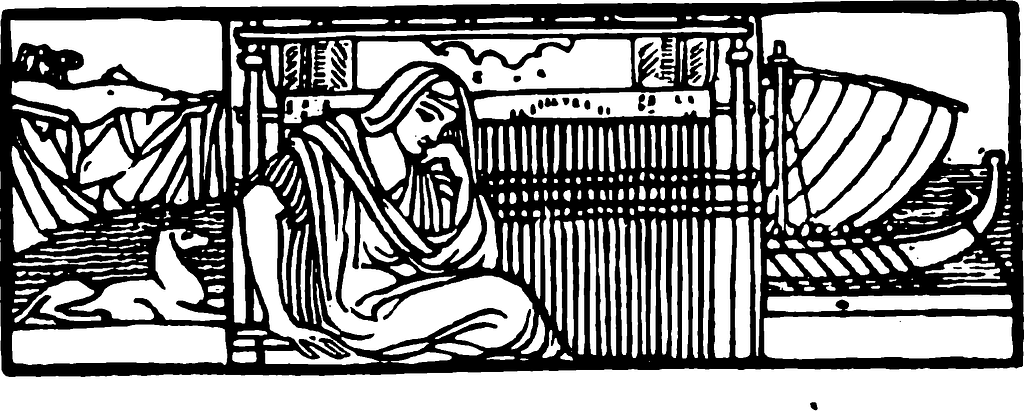
Header illustration by Adolfo de CarolisImmagini, from: Odissea, trad. Ettore Romagnoli, Bologna: Zanichelli, 1927.


Confronting Gender Inequality in the Music Industry: Reflections on the personal approach to research

By Farijn Janssen, Eline Klaessens, Sofieke de Loos and Zsófia Szigetvari

After a day of putting up and handing out pamphlets, our group of young academics – lovingly named “The Gender Groupies (Don’t Be Sexist!)” – were absolutely ecstatic. We had designed these pamphlets to spark conversation about gender inequality in the music industry. We were filled with many emotions: determination, joy and a certain pensiveness…or perhaps reflectiveness. We hadn’t expected many responses or insights from the strangers we had approached to discuss our topic, because it can be intimidating to talk to students about societal issues and we didn’t want to disturb anyone’s peaceful day. However, to our surprise, a receptionist, a festival organiser, a barman and one of his regulars in a cafe took the topic seriously and were enthusiastic to talk about it with us, sparking interesting discussions. Trying to create change in the face of a systemic issue like gender inequality in the music industry, we were starting to see how a personal approach affected others.

This year’s rise of women at the top of pop music shows artists like Chappell Roan, Sabrina Carpenter and Charli XCX establishing themselves in the Billboard Hot 100 all summer long. Alongside this, this decade’s climb from 20.2% women in the Billboard 100 Year-End Charts in 2020 to 35% in 2023 shows a clear increase in the representation of women in the position of music artist. While the on-stage presence of women is more present, this isn’t the case for women “off-stage”, in the studio: producers and songwriters. The USC Annenberg Inclusion Initiative, an organisation that studies diversity, inclusion, and representation in entertainment and media industries, published their research regarding gender inequality in the recording studio. They found that as of 2022, there still were 3.5 men present in the industry for every woman. When it comes to their specific professions, women made up 30% of artists, 14% of songwriters, 3.4% of producers, and comprised 15.2% of Grammy nominees (Smith et al).1 Even though more women have been entering the music industry over the years, these numbers show that men still make up the large majority of the workforce.

If you’re thinking “this must be better in the Dutch music industry”, you’re going to be disappointed. Researchers Pauwke Berkers, Eefje Smeulders, and Michaël Berghman found that women only made up 13% of BumaStemra members, a Dutch collective society for songwriters, composers, and music producers. In the case of Sena, an organisation concerned with collecting rights for performing artists, the percentage of female members was at 19% (Berkers et al. 28).2 In the live music industry, women are more likely to hold positions in hospitality and marketing, compared to programming, directing and tech work in the Netherlands, according to the Cultuur Monitor, which creates an overview of the most important figures in the Dutch creative sector (Swartjes).3 It’s evident that the Dutch music industry, too, is male dominated.

We started to wonder how our research could actually change something in music, realising we had limited time and resources to do so. After listening to Ani diFranco’s feminist rendition of “Which Side Are You On?” and reading Adrienne Trier-Bieniek & Amanda Pullum’s chapter in Gender & Pop Culture, we thought about consciousness-raising and the role of personal narrative in social movements. Trier-Bieniek and Pullum emphasise that consciousness-raising as a feminist tool for change came from 1970s activism, describing the term as follows:

work done to draw people’s attention to a social problem, increase their understanding of it including how it personally impacts them, and hopefully motivate them to help solve the problem. (85)4

Feminist researchers using feminist standpoint theory have the same perspective. We read the work of Ratna Huirem, Kathiresan Lognathan and Priyanka Patowari, who wrote on feminist standpoint theory in the Journal of Social Work Education and Practice last year. We found it fascinating that this method focuses on centering the experiences of women, mainly by treating women and the testimonies of women more as subjects, rather than objects of study. Feminist researchers often befriend those who partake in their research. They do this in order to give them the safety and freedom to speak openly about their experiences living in the patriarchy. They also encourage their participants to come up with their own suggestions on how to move forward (48-50).5 This approach felt intuitive to us as we reached out to a group of friendly acquaintances we knew working in the industry to carry out a survey of their experiences. This would eventually prompt us to design the pamphlets we mentioned earlier in this blog. We decided to ask them how their gender affected the way they were treated within the industry and asked them to offer advice to those who aspire to follow in their footsteps. Our approach was friendly. We were sending them individual, often personally tailored emails. While we didn’t have the time to delve too deep, we remained understanding of our participants’ individual circumstances, and sent emails to update them on our process long after the surveys had been filled out. We’re even sending them this blog!

We decided to go into the city with the pamphlets made from the responses of the survey to talk to people working at creative places. We were told that our effort to raise consciousness about societal issues is an effective way to achieve change on a greater scale. This further encouraged us to visit as many places as possible. This was our attempt to take our personal approach to institutions, visiting the public library, the Lindenberg Theatre, the Festivalhuis and Cafe De Opstand, among others. Even though we stayed in Nijmegen and only spoke to specific bars and institutions who were already helping women gain visibility and equality, our initiative was still appreciated. We were still able to share our newly-acquired insights and connect them to the general, wide-spread problem. The personal stories that we printed out on our pamphlets resonated with the broader audience (especially with women), who understood the importance of our intervention and wanted to expand our possibilities to raise awareness.

We were offered the opportunity to organise a workshop in the theatre, specifically for women who are already making music (both backstage and onstage). We thought that it would be a great opportunity to present our research to those who should take part in it. There, they could even add to our research project. By creating a safe environment, where women can share their stories without being questioned or judged, it can strengthen the sense of community in them. We would like to empower them with knowledge from our research and advice from those who came before them. This way, they can break away from the stereotypes, – about things like female technicians – and embrace their skills.

It’s sad to see that many talented young girls would rather not pursue a career in music, because they don’t see themselves in those positions. We know that our topic triggers difficult feelings about societal issues of gender, but it’s important to have these discussions in the public sphere. It seems only fitting to us that music should become the vehicle to empower marginalised people, because of how deeply it’s intertwined with social movements.

After our own findings, we looked into Playing for Change: Music and Musicians in the Service of Social Movements by Rosenthal and Flacks to enlighten ourselves on how these personal approaches to music can lead to social change. This work analyses the dynamic role that music plays in social movements, and how music can, intentionally or not, inspire social change. Rosenthal and Flacks argue that music can serve as a tool for mobilisation and as a form of expression to build group identity. Music and social action have always been interconnected; however, the effectiveness of music as a revolutionary tool has often been debated, and the authors of this book argue in favour of its effectiveness. They support this idea by explaining that there is a democratisation of music in movements, which allows anyone to create and adapt songs to reflect their own experiences — a form of grassroots activism. This highlights the importance of looking at individual experiences related to music.  Ultimately, music can play a crucial role in shaping and supporting a social call for action due to its emotional resonance and its ability to share values and goals.

When music and activism are combined, they can fight for social change. Rosenthal and Flacks argue that music is not just a reflection of society, but it can also impact social life.  So, we need to look at the people who are creating the music and if they are representing the people listening. They quote, “Art is not a mirror held up to reality, but a hammer with which to shape it” (Brecht qtd. in Rosenthal and Flacks 13).6 This leads us to our question of how changes in the music industry can affect human action in the case of gender inequality. The relationship between music and society is dialectical, as it can help to “create, sustain, and alter social reality as well as reflect it” (14).  For example, music can be used to maintain values of patriotism, as its ideals are often expressed in songs routinely taught in schools, performed at rituals and celebrated in traditions. This makes sense, if most writers and producers are men. Music can therefore be used to affirm loyalty and guide the behaviour of members of established institutions. Because of this, music can reinforce the hierarchy inherent to a social structure (15). Thus, music can serve to both maintain and disrupt a society and is therefore an essential part of social life. So who is making our music?

“Musicking” is the act of participating in musical experiences in some way (Rosenthal and Flacks 30). This participation can be seen as a political activity as it reflects existing practices. According to C. Wright Mills, political music engenders the “sociological imagination,” which helps listeners to see the social roots in songs, which otherwise might have seemed like individual stories of problems. In this way, music reinforces a collective and structural arrangement of power dynamics (30). This means that music has the potential to change society, as it not only reflects social structures but also contributes to identity expression. It holds power, and through grassroots movements and personal experiences, music can guide us in addressing gender inequality. Thus, to make a change, we need to start at a grassroots level, to make the music industry more female-oriented. So, the way music is made by musicians and experienced by listeners can create a new social order where women are more included in the music scene.

Our personal approach to research has made us feel differently about our function as researchers, as we were much closer to our “subjects” than we had ever been, also considering the feelings of those affected by what we write. We also had to be activistic in our approach. We weren’t just looking on, analysing this phenomenon from afar, but in the middle of it. The result was not just a growing passion on our part, but also on the part of those affected by and able to affect change with us.

Footnotes

  1. Smith, Stacy L., et al. “Inclusion in the Recording Studio? Gender and Race/Ethnicity of Artists, Songwriters & Producers across 1,100 Popular Songs from 2012 to 2022.” Annenberg Inclusion Initiative, 2023, assets.uscannenberg.org/docs/aii-inclusion-recording-studio-jan2023.pdf. ↩︎
  2. Berkers, Pauwke, et al. “Music Creators and Gender Inequality in the Dutch Music Sector.” Tijdschrift Voor Genderstudies, vol. 22, no. 1, May 2019, pp. 27–44. https://doi.org/10.5117/tvgn2019.1.003.berk. ↩︎
  3. Swartjes, Britt. “Domein Muziek: 2. Trends en Ontwikkelingen.” Cultuur Monitor, 11 April 2024, https://www.cultuurmonitor.nl/domein/muziek/. ↩︎
  4. Trier-Bieniek, Adrienne and Amanda Pullum. “From Lady Gaga to Consciousness Rap: The Impact of Music on Gender and Social Activism.” Gender & Pop Culture, Sense Publishers, 2014, pp. 81–102. ↩︎
  5. Huirem, Ratna et al. “Feminist Standpoint Theory and Its Importance in Feminist Research.” Journal of Social Work Education and Practice, vol. 5, no. 2, 2023, pp. 46-55. ↩︎
  6. Rosenthal, Rob and Richard Flacks. “An Introduction to the Music-Movement Link”, Playing for Change: Music and Musicians in the Service of Social Movements. London, Routledge, 2011, pp. 1-36. ↩︎

How Can Popular Music Change the World?

In this post, Prof. Dr. Melanie Schiller introduces Culture Weekly’s special section on Popular Music and Social Change

Music is more than just entertainment—it’s a powerful way to reflect and shape society. From civil rights anthems to protest songs against wars, music has carried the struggles, dreams, and demands of generations. It can amplify the voices of marginalized communities and bring people together to fight for causes like gender equality and environmental justice.

Over the years, songs like “We Shall Overcome” became symbols of the Civil Rights Movement, while punk rock pushed back against authority in the 1970s. Today, hip-hop tackles issues like systemic racism, and artists use their platforms to address urgent challenges like climate change. Music connects people through shared emotions and inspires them to act, leaving a lasting impact on culture and society.

Understanding this connection means looking at not just the songs but also their historical and cultural backgrounds. By exploring the role of music in social movements, we see how melodies and lyrics become tools for resistance, unity, and hope—proof that the right song at the right time can drive real change.

As part of the course Popular Music and Social Change in the master’s program Creative Industries, students took this idea further by creating real-world projects linking popular music to the United Nations’ Sustainable Development Goals (SDGs). Each group chose an SDG—like reducing inequality or promoting education—and designed a musical intervention for their local community. Projects included social media campaigns about the environmental impact of fast fashion inspired by Taylor Swift fandom, interactive playlists to discourage smoking, and educational leaflets highlighting gender inequality in the music industry.

Through these creative efforts, the students explored a big question: How can music save the world? Their projects showed how music can inspire progress, spark conversation, and bring us closer to solving global challenges.

Ficcability: Television, Fanfiction and Feelings

By Julia Neugarten

When I am feeling down, I watch an episode of Gilmore Girls, an early-2000’s dramedy about a mother, her teenage daughter, and their romantic entanglements in the idyllic town of Stars Hollow. Now, before you point out all the ways that Gilmore Girls has aged poorly – and yes, it has classist and fatphobic undertones and the way it portrays Korean Americans leaves much to be desired – I want to note that the show is also optimistic, kind-hearted, clever, funny, and female-centric. In short, Gilmore Girls is (almost) everything I look for in a feel-good show.

Here’s something else I tend to do when I’m feeling low: I read fanfiction – or fic – on Archive of Our Own, one of the largest English-language fanfiction websites. Because of the way the archive is structured, I can look for stories that either allow me to wallow in my self-pity (which we call angst in fanfiction-jargon) or stories that pick me up and fill me with warm fuzzy feelings (which we call fluff). Natalia Samutina described fanfiction as “emotional landscapes of reading,” because it lets readers curate their emotional trajectory this way.1 My own recent research also shows that some responses to fanfiction praise stories for their capacity to bring about specific emotions, especially comfort.

I am satisfied with my coping strategies. I’m sure everyone feels sad from time to time, but a Gilmore Girls + fanfic double whammy never fails to cheer me up, which is why I find it strange that very little fanfiction has been written about Gilmore Girls. And since I am a data-driven scholar of fanfiction, I decided to quantify this matter: which TV shows generate a lot of fanfiction? Which generate almost none? What could explain the difference in fanfiction production between these shows?

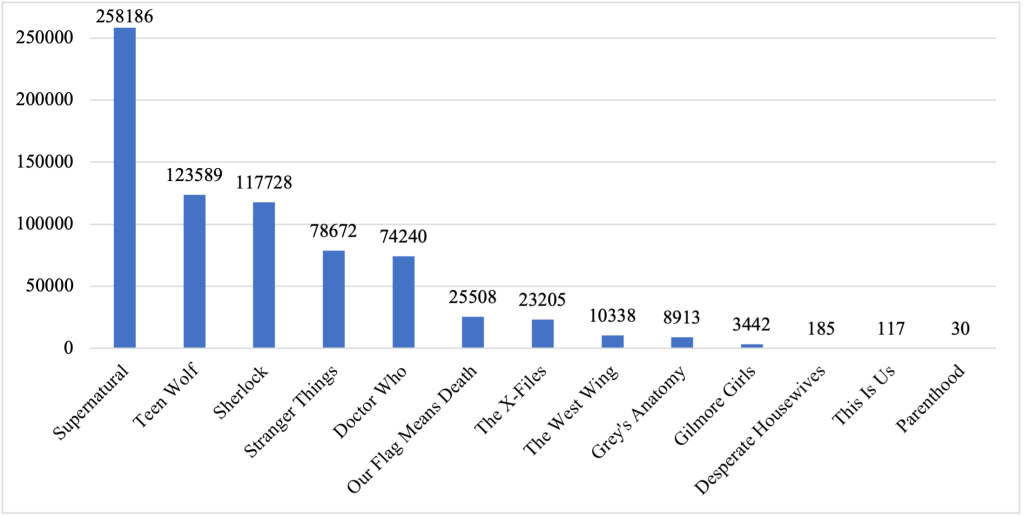
Here are some TV shows I randomly hand-picked, visualized with the number of fanfics written about them on Archive of Our Own as counted at the start of 2024.2

How many stories?

Works of fanfiction per TV fandom

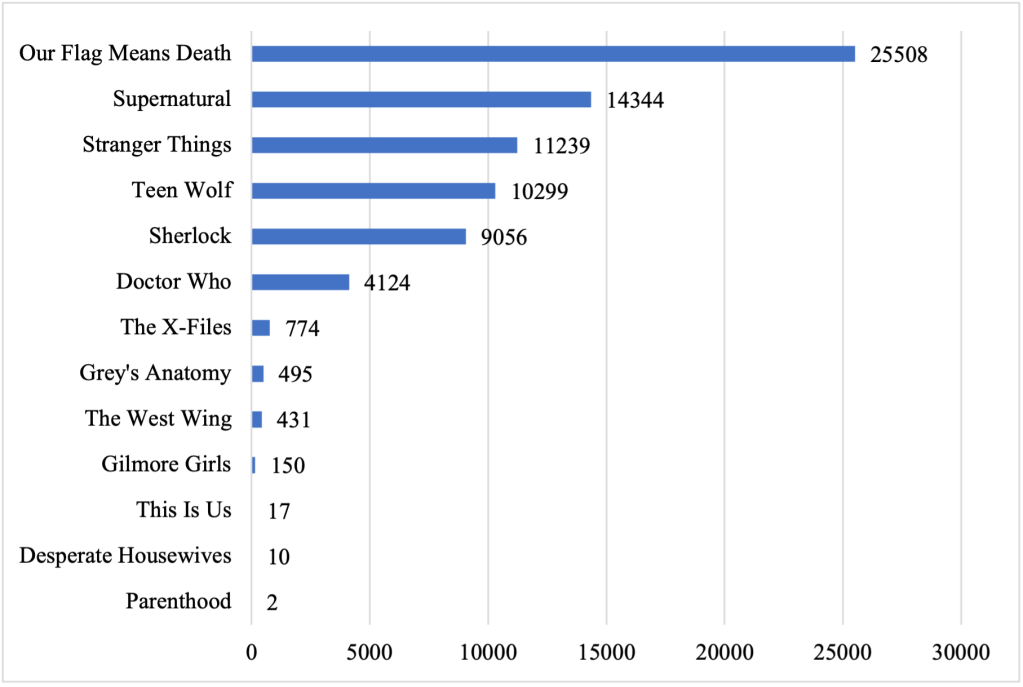
If you’re familiar with TV fandom, the numbers I found probably don’t surprise you. After all, some of these shows have had much more time to accrue a committed fanbase than others, and some also have many more episodes. So, let’s divide the number of stories written about each show by the number of years that have passed since it first aired; that’s the amount of time they’ve had to accrue fanfiction.

Fanfiction Production Over Time, Seasons, and Episodes

Works of fanfiction per year

Our Flag Means Death comes out as the clear winner here. Since its inception in 2022, this show has had a very active and vocal fanbase. But Our Flag Means. Death has only had two seasons; what is the effect of that?

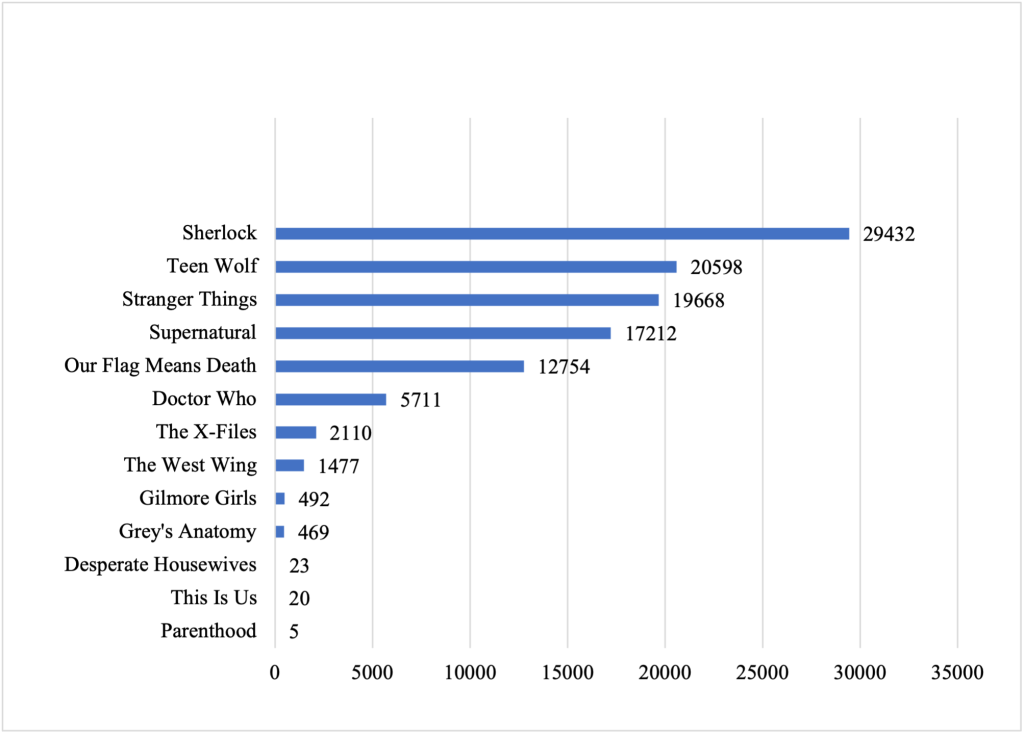
Works of fanfiction per show’s seasons

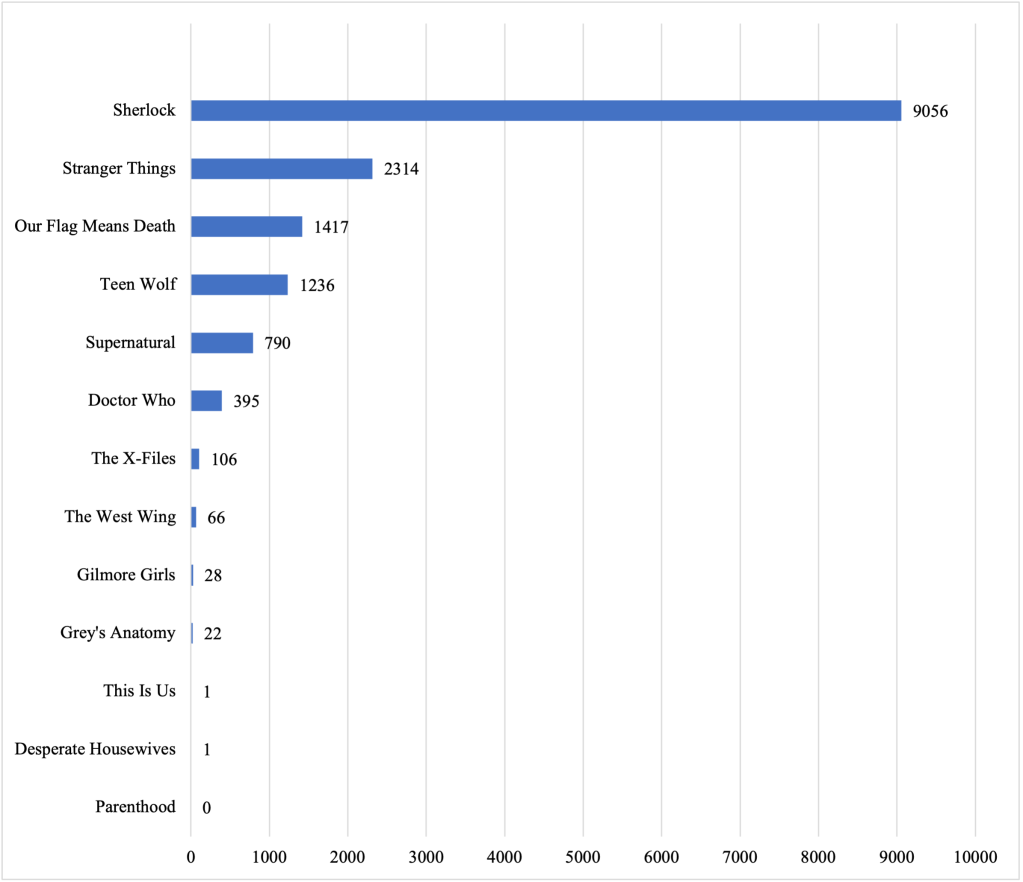
In this comparison, the clear winner is Sherlock, which has a meager four seasons. Sherlock generated an impressive 29.000 works of fanfiction per season, almost 30% more than the runner up, Teen Wolf, which averages a little more than 20.000 stories per season over six seasons.3 When looking at the average number of stories produced per episode, Sherlock also comes out as the clear winner with more than 9.000. Runner-up Stranger Things has a little over 2.000. This could be due to Sherlock’s unusual format, which consisted of very few episodes per season, all of which were movie-length.

Works of fanfiction per episode

We can conclude that Sherlock fandom has been unusually industrious. But Sherlock isn’t the reason I decided to run these numbers; Gilmore Girls is. In all these comparisons, Parenthood, Desperate Housewives, This Is Us, Grey’s Anatomy and Gilmore Girls are consistently the lowest scorers. These shows have inspired fewest fics overall, fewest works per episode, per season, and per year. Why? What do these shows have in common?

Introducing Ficcability

To explain this phenomenon, I propose the concept of ficcability: the extent to which a particular tv show or other narrative invites, inspires, and encourages the production of fanfiction. This concept builds on Henry Jenkins’ idea of drillability.4

“the ability for a person to explore, in-depth, a deep well of narrative extensions when they stumble upon a fiction that truly captures their attention.”

Jenkins’ notion of drillability calls attention to the fact that not all stories are equally open to interventions and extensions from the audience, and that formal features of the story, such as the perceived depth and extensibility of the narrative, can either invite or discourage rewriting and transformation.

The Unficcable: Emotions-Only Shows

So, what makes a story ficcable? In her 2008 analysis of fan discourse around the TV show Roswell, Louisa Ellen Stein found that fans distinguished between two types of shows, which they called Emotions-Only and Special People-shows.5 As explained by a fan:

“Special People programs focus on talented individuals who face conflict from without, whereas Emotions-Only programs feature ‘normal’ characters whose conflicts come from within themselves and from their relationships with each other.”  

And what do all shows that inspired relatively little fanfiction – Parenthood, Desperate Housewives, This Is Us, Grey’s Anatomy and Gilmore Girls –  have in common? That’s right; they are Emotions-Only shows. These shows are about families, colleagues, neighbors, and lovers, about the (mis)communications that structure our social world, our desire to be recognized and understood, to share, to connect, to belong. They are comfort shows, in the sense that their emphasis on emotional trajectories can be comforting to watch. These shows help us navigate our feelings and desires by showing us characters who struggle to negotiate social situations we may recognize from our own lives. Additionally, these shows tend to emphasize emotional fulfillment and happy endings for their characters, essentially closing off the narrative. This focus makes narratives such as Gilmore Girls emotionally satisfying. I hypothesize that this makes fanfiction less necessary to give audiences the emotional and narrative closure they seek.

The Ficcable: Special People Shows

By contrast, shows that inspire a lot of fanfiction – Supernatural, Sherlock, Teen Wolf, and Stranger Things – are Special People programs. Their protagonists are monster hunters, genius detectives, werewolves or members of a select group who have access to another world. These shows emphasize action over feeling, plot over person, exterior action over interior character development. These are shows where the narrative tension and structure comes from dramatic encounters with monsters, villains, and crimes, where personal and emotional responses to these dramas are sidelined to make room for action and excitement. Supernatural rarely lingers on the emotional strain of hunting monsters. Later seasons of Sherlock turned attention to the relationship between Sherlock and John, but complicated murder mysteries always remained more central to the plot than feelings. Because of their emphasis on plot, these shows leave an emotional gap that fanfiction communities are then inspired to fill.

Storyworld: An Additional Aspect of Ficcability

Ficcability is also impacted by the construction of a storyworld. In shows structured around monsters and mysteries, the plot is endlessly extensible. In the world of a show like the X-Files or Supernatural, there is always a new monster to fight, a new mystery to solve. As a result, these storyworlds capture the imagination, inviting fanfiction communities to come up with their own fantastical creatures and improbable situations. These adventurous worlds might invite more fanfiction than the ostensibly realistic storyworld – small-town America – of a show like Gilmore Girls.

So ficcability is a property of a TV show that relates both to the imaginative potential of its storyworld and to the show’s position on an axis that goes from emotion-oriented to action-oriented.

Problematizing Ficcability

A closer look at Our Flag Means Death (OFMD), the clear winner in the Fics/Year-category, problematizes the concept of ficcability.  OFMD is a show about pirates. It’s heavy on the action and its storyworld is full of adventure. At the same time, interpersonal relationships are central to the show, and the comedy largely comes from the clash between adventure-oriented characters and storylines and the strain these fast-paced plots put on interpersonal relationships.

In one of the funniest moments of the show’s second season, a group of enemy pirates decides not to torture and kill the protagonists. Instead, the enemies mutiny, because they no longer feel that their captain is providing them with an emotionally nurturing work environment. That’s right. An emotionally nurturing work environment. On a pirate ship.

In this scene, OFMD explicitly stages the incompatibility of fictional characters’ emotional fulfillment and their adventurous lifestyles and storyworld. Perhaps it is the show’s acknowledgement of their characters’ emotional needs – in the face of their adrenaline-fueled adventures – that makes it so incredibly ficcable, and perhaps Our Flag Means Death is exploring possibilities for a different kind of TV show – and associated fandom – that combines the ficcable with the emotionally resonant.

This aligns with the observation, taken from Stein’s case study, that some fans praise TV shows’ ability to transcend strict genre categorizations. I hope to see many more transgeneric shows on TV in the future, because they seem eminently ficcable to me!

Many thanks to Fenna Geelhoed for giving feedback on an earlier draft of this blogpost.

Footnotes


  1. Samutina, Natalia. “Emotional Landscapes of Reading: Fan Fiction in the Context of Contemporary Reading Practices.” International Journal of Cultural Studies, vol. 20, no. 3, 2017, pp. 253–69, https://doi.org/10.1177/1367877916628238. ↩︎
  2. I am sure other fanfiction platforms, such as Fanfiction.net or Wattpad, have very different distributions over fandoms. ↩︎
  3. This comparison does not account for the fact that fanfiction production is unlikely to be stable over time. ↩︎
  4. Jenkins, Henry. “Transmedia Education: The 7 Principles Revisited.” Pop Junctions, 21 June 2010, http://henryjenkins.org/blog/2010/06/transmedia_education_the_7_pri.html. ↩︎
  5. Stein, Louisa Ellen. “‘Emotions-Only’ versus ‘Special People’: Genre in Fan Discourse.” Transformative Works and Cultures, vol. 1, Sept. 2008. URL: https://doi.org/10.3983/twc.2008.043. ↩︎

Writing Questionnaire 2024

By Julia Neugarten

Writing is the bread and butter of the humanities scholar. It is our chisel and our marble, our raison d’être, and yet the bane of our existence. With the daunting task of writing a dissertation in the forefront of my mind, I was curious about my colleagues’ writing habits, and so I circulated a questionnaire among the employees of the department of Arts and Culture Studies at Radboud University. The response I got was inspiring and insightful, and whether you’re a student or a scholar, a poet or a playwright, some of it may be helpful to you as well.

How much do we write?

Twelve people responded to the survey. On average, they spend 226 minutes per week writing, or a little under four hours.1 The amount of weekly writing time per person varies by a lot, ranging from 60 to 750 minutes. Together, these 12 people spend 45 hours per week writing.


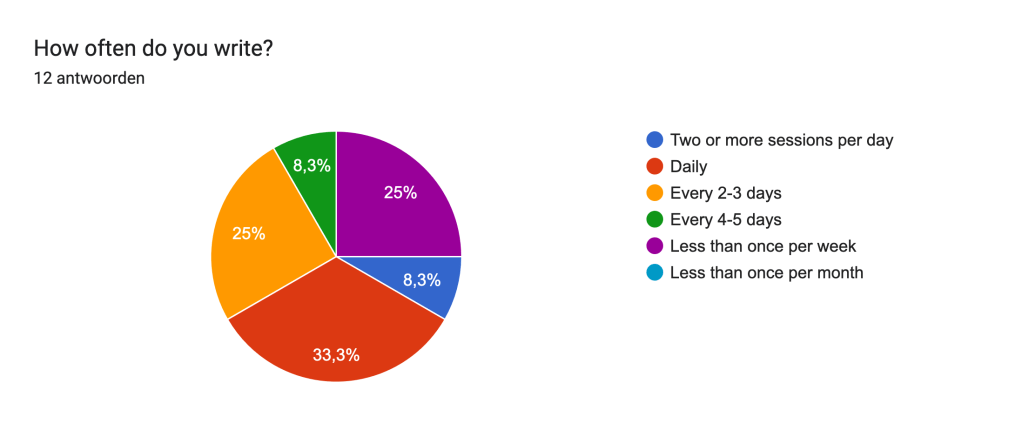
Some people measure writing in time and others measure it in output, so the questionnaire asked about both. Conventional wisdom holds that it is best to write every day,2 and about one-third of respondents do. Shout-out to the person who manages multiple writing sessions per day.

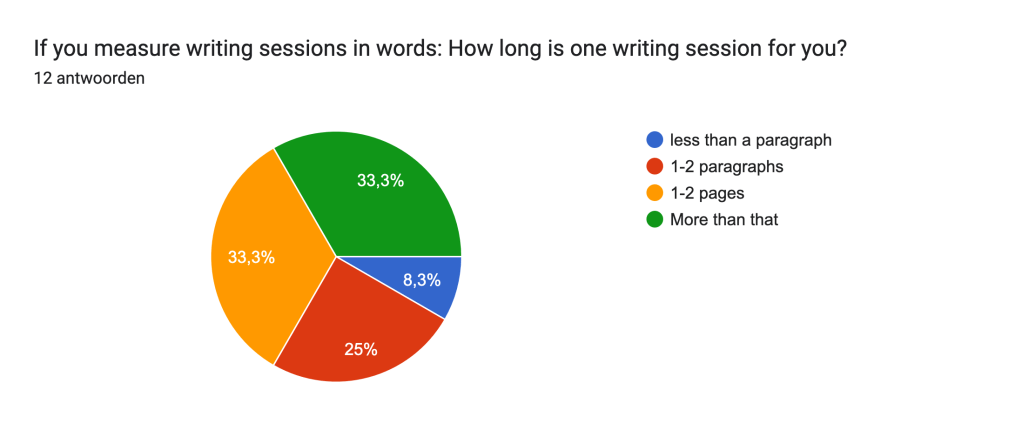
When comparing writing time to word production, interesting differences emerge. One respondent estimates that their writing sessions take longer than 2 hours and results in less than one paragraph of writing. Another estimates that they produce more than two pages in a session of under 30 minutes. Of course these questions do not account for the quality of the writing, or how much actually ends up getting published. This is purely about production.

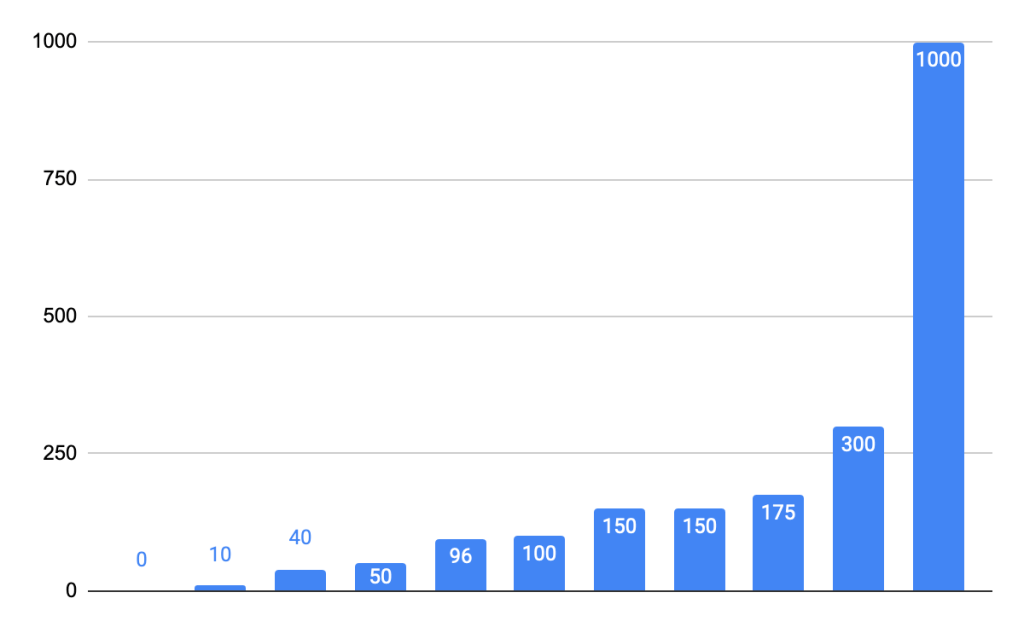
I also asked: How many pages of academic text do you estimate you have written in the past year, assuming a page is around 250 words?3 Here’s the reported response in pages, with each bar representing one respondent.

Notably, the person who estimated their output at 1000 pages a year (actually, their response was ‘more than 1000 pages’) also reported that they were not happy (2 out of 5) with how much they wrote.

How do we feel about writing?

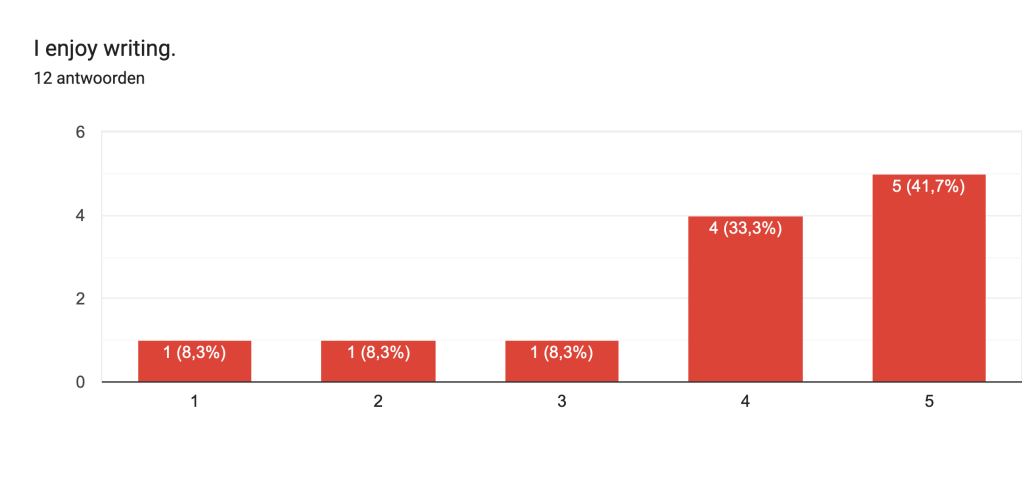
Fortunately, most respondents report that they enjoy writing.

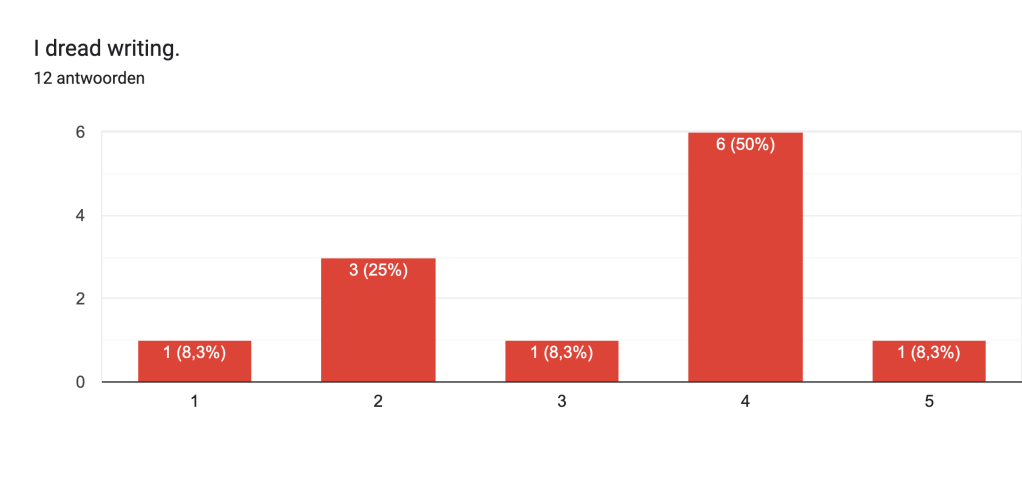
Meanwhile, more than half also report that they dread writing. For example, the person who said they enjoy writing not at all identifies the following phases in their writing process:

pain. agony. suffering. killing. relief.

Interestingly, 4 respondents (1/3) dread and enjoy writing approximately in equal measure, reporting a score of 4 or 5 in response to both questions.

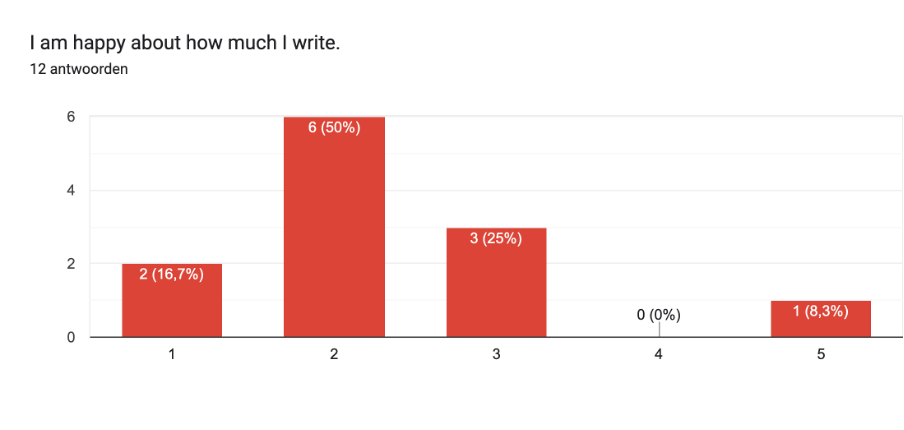
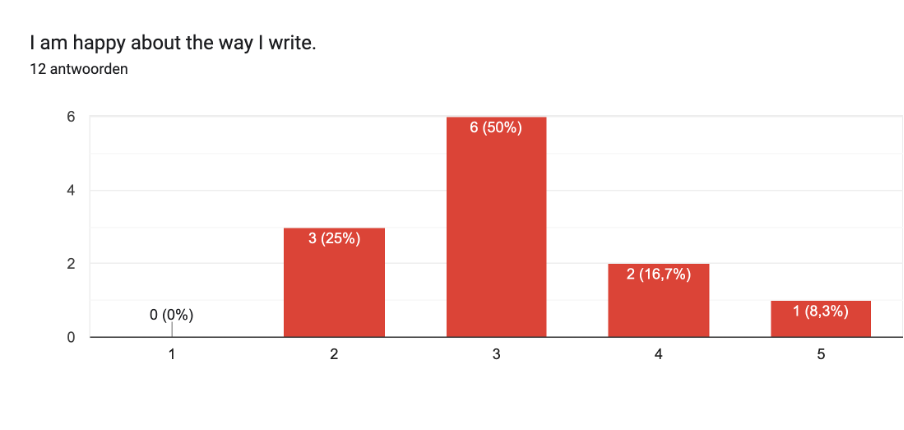
Around 3/4 of respondents are not very happy about how much they write, although most are at least moderately satisfied with how they write. The numbers on writer’s block are pretty spread out, although those who experience a lot of writer’s block also, unsurprisingly, report lots of dread around writing.

What are our writing techniques and processes?

I was curious about the strategies my colleagues used to get their writing done, and the steps they followed to structure the writing process. Many people mentioned that hot beverages, isolation and frequent exercise were key to getting them writing. The Pomodoro Method, where you alternate between 25-minute writing sprints and short breaks, was praised twice for boosting productivity.4

I was happy to see that I’m not the only one who feels like successful writing requires some kind of ritual to get you into the appropriate mindset. Someone reports that they need to:

block a whole day at a time (otherwise no way of getting into the ‘mood’)

Another respondent uses music to set the right atmosphere:

I have a playlist that is always the same so that I don’t REALLY hear it. I sometimes alternate music styles because the rhythm of the beat impacts the way that I think and write.

Many respondents say it can feel intimidating to start writing. For one writer, Word feels too ‘official’ and so writing on paper in the initial stages is a good way to lower the threshold. Interestingly, they also describe a Google Doc as less intimidating than a Word document.

Outlining is also mentioned as a good way to get rid of the empty page, and someone reports:

I tend to “trick” myself and write pieces in bits and bobs.

When it comes to the best order for writing and revising, responses are mixed. Some people write their texts from beginning to end, saying:

[I] can only move on to the next section of text if all earlier paragraphs are as complete and finished as I can make them.

Other people write the conclusion first, or write from beginning to end except for the introduction, which they save for last. Some people do not adhere to a linear order at all during writing. One piece of advice I particularly like is the idea to see the structuring of a text and its writing as carried out by two separate entities:

With pieces that I find really difficult to write I will write an outline where I briefly state which point I want to make in each paragraph so that I separate the role of opdrachtgever and uitvoerder of my own writing: I first write myself an outline, and then I pretend that I’m just the writer who was hired to execute it wether they agree or not.

This quote also touches on the next question I asked: Do you view writing and research as separate tasks? Most people answered yes to this question, although there were a couple of firm ‘no’s’ – like the person who says: “Writing is thinking. Writing is research” – and some people were unsure. Personally, I like this view:

Writing is about communicating results, not about creating results.

This separation lets us see the craft of writing as a separate academic skill, which I find valuable. Another respondent explains:

[Research and writing are] not neatly separated in time: once I start trying to write a final text I’ll discover along the way that I need research for specific steps in my thought process. So in practice they may seem to blend, but I regard them as separate sometimes very quickly alternating activities. Also: my experience is that writer block is what happens when you lose control over the difference between research, thinking and writing, and between writing and editing. It is, in my personal practice, important to be able to write horrible first drafts.

So the separation of writing and research seems productive to many. Nonetheless, I find it useful to think of writing as the material process through which scholarly research comes into being, especially in the humanities. That idea is described elegantly by one of the respondents who says no, writing and research are not separate:

my keyboard is my laboratory, this is where I atomise my data and pour them in textual flasks to see which ingredients react under which conditions.

Writing Advice: the Best and the Worst

Finally, I asked respondents about the best and worst writing advice they ever received. Most good advice mentioned the discipline to write every day, and a variety of methods for lowering the threshold on writing, so that writing every day became easier. Those tips included, for example: outlining first, lowering one’s own expectations about the quality and elegance of the first draft, starting to write at whatever point in the text is already clear to you. Similar advice is communicated in motto’s like “Done is better than perfect.” and “The best PhD is the Submitted PhD.” In other words: the perfect is the enemy of the good.

There’s one more piece of advice that I really like, and might write on a sticky note to keep by my desk:

Some of my most productive writing has been when I felt the joy of making discoveries and communicating my findings. Keep the joy!

Overall, what people mentioned as bad advice was often the inverse of what they considered good advice: perfectionism, especially. But some core values about the societal role of academic writing also came out in response to this question:

Writing styles are not neutral choices – they also communicate an intent and what I dare call a “vibe”. We are trying to communicate and collaborate – I’m not a fan of taking writers who’s style is hermetic or hostile towards more naïve readers as role models. Also, writing may seem like a solo activity, but I believe that at it’s core academic writing is a deeply social and collective activity: we write it down for others to take apart and re-use. (…) as academic writers we are pretty much valuable precisely to the extent that we make ourselves available to being cited and re-purposed for someone else’s research. So any advice that places to much emphasis on writing as the work of a Lone Genius Having Ideas does not make sense to me.

In a similar vein, someone observes:

Worst advice: writing is is method to order your own thoughts. It isn’t. It is a method to order the readers’ thoughts.

To conclude: in this piece, I’ve tried to order my own thoughts about the writing processes of my colleagues, and in the process I hope I have also helped you order yours. I’m going to experiment with writing academic texts in a different order, and I wish you all happy writing!

If you want to examine every response in detail, you can consult the full results of this year’s Arts and Culture Studies Writing Questionnaire here, with my added calculations in bold.

Footnotes

  1. Full disclosure: I myself am one of the 12 respondents. ↩︎
  2. Authors credited with this advice include Ray Bradbury, Stephen King, Graham Greene and Eric Hayot, the author of The Elements of Academic Style whose insights on academic writing inspired me to
    create this survey. ↩︎
  3. I removed one respondent from the dataset here, who reported 12.500 pages. That must have been a typo, or maybe they meant words instead of pages. Otherwise it would be 3.125.000 words. For comparison, depending on the translation, War & Peace is between 560.000 and 587.000 words. I don’t think anyone is writing 5.5 copies of War and Peace per year, but if you’re the respondent and this is actually accurate, let me know. I’d love to interview you. ↩︎
  4. The Pomodoro Method was invented by Francesco Cirillo. ↩︎

The Consolation of Literature: From To the Lighthouse to a Virginia Woolf-Inspired Memoir

By Dennis Kersten

When writing about Dante, T.S. Eliot once remarked that “genuine poetry is communicated before it is understood”. You probably have fridge magnets of it now, and while I don’t like Eliot’s “genuine”, I was reminded of his line when I was blown away by “Alalgura VI” (1992), a painting by Australian artist Emily Kame Kngwarreye at the National Museum of Ethnology in Leiden. It made total sense to me, instantly, but it didn’t give me any clue as to why it had such an impact. It was a kind of love-at-first-sight experience: the one thing that feels so right in a world gone crazy. Surely, Eliot’s statement is applicable to art in general, painting included. Though I sometimes wonder if art can communicate in ways that make understanding wholly irrelevant. Like love, indeed.

How odd when similar things happen with art works I’ve seen, heard or read many times before. Like Talk Talk’s Spirit of Eden album when I bought it on vinyl for the first time. But also Virginia Woolf’s To the Lighthouse, a novel I thought I knew well enough. Both hit me again recently, which made me feel quite emotional, too. Who knows, maybe I’m just going through a midlife crisis. (Ah, good. If I’m halfway through, I will apparently live to be 92.)

I read Woolf again to be able to better understand a book I was planning on reviewing before lockdown struck: Katherine Smyth’s All the Lives We Ever Lived: Seeking Solace in Virginia Woolf (2019), a memoir I was going to read alongside David James’s academic study of literary consolation, Discrepant Solace (2019). Smyth’s debut book tells the story of her life so far, from her Rhode Island childhood to the aftermath of the death of her alcoholic father. One of its key themes is the question how a favourite novel – To the Lighthouse – may provide the language for the often traumatic experiences Smyth describes, especially in relation to her father’s deterioration and later illness. Reflections on consolation establish a binding thread in a generically complex book, which calls for a closer look at Smyth’s quest for the consolation of literature with the help of David James’s state-of-the-art research.   

Back to The Lighthouse

Set in the early-twentieth century, Woolf’s fifth novel tells the story of how the Ramsay family spend their holidays on the Isle of Skye, in the company of friends like painter Lily Briscoe and the young couple Paul Rayley and Minta Doyle. It begins with a scene in which Mr Ramsay berates his wife for promising James, their youngest son, a trip to the nearby lighthouse when the weather is making a turn for the worse. The Ramsays entertain their guests with dinner parties, among other things, but there are tensions between Mr and Mrs R. as well as between their friends. In the middle part of the novel, Mrs Ramsay and two of her eight children die, one as a casualty of the First World War. The concluding part, which takes place ten years after the first, sees the family reunite on Skye. James Ramsay gets to sail to the nearby lighthouse at last and Lily completes the painting she started in the novel’s early chapters.

While preparing my review of All the Lives We Ever Lived I was thinking if Smyth’s attraction to To the Lighthouse could be explained by its metafictionality, which might be of special interest to life-writers. From its opening pages onwards, the novel probes the nature of art itself – for example, in passages in which characters like Lily think about the capacity of painting to give access to “wisdom”, “knowledge”, “truth”, or a one-ness with others that is all communication-before-understanding. Lily is fascinated by Mrs Ramsay and how she appears to be at peace with her life despite a visibly tense marriage, the more so while many other people present wrestle with confinement in one way or another (Charles Tansley, an admirer of Mr Ramsay, tells her that women can’t paint). She hopes to capture in art what she “sees”, as she refers to it, while observing Mrs Ramsay, her family and their visitors: the “essence” of other human beings and their relations with each other.

Lily’s ruminations on painting resemble those of an author like Woolf herself. And it’s hard to escape the supposition that if she had been a writer of fiction she would have produced a book like To the Lighthouse, with its shifting perspectives and innovative use of focalization. In the novel, the Ramsays’ holiday home comes to life especially in chapters that describe how Mrs Ramsay experiences it inwardly (as in chapter 5 of “The Window”, the first part of the novel). How different this is in sections focalized around her husband’s consciousness: he is considering the Questions of Life, but he doesn’t really take notice of his wife, his children or much of the drama in which they’re all involved. Ironically, Mr Ramsay may be a celebrated “metaphysician” among his student-disciples, but he does not really think that deeply – unless he’s reflecting on Shakespeare, Thomas Carlyle or his own reputation. He doesn’t “see”, because he doesn’t feel, Lily would say. She understands that he’s “afraid to own his feelings” (50-1) for fear of being seen for what he probably is, a mediocre academic who hasn’t fulfilled the promise of his early career.

As an artist, Lily wishes she could be one with her subjects like you would if you loved them – thus, beyond the type of philosophizing that distracts Mr Ramsay from seeing life properly. She asks herself if “loving, as people called it, [could] make her and Mrs Ramsay one? for it was not knowledge but unity she desired, not inscriptions on tablets, nothing that could be written in any language known to men but intimacy itself, which is knowledge, she had thought, leaning her head against Mrs Ramsay’s knee” (57). She wonders if she’s in love with Mrs R. and if artistic vision could be as sharp as love, going straight to the essence of others without having to consult a Great Man or two first.

I can imagine why Smyth would be fascinated with To the Lighthouse. Of all of Woolf’s novels, it may also be my own favourite (ask me again tomorrow, however, and I might choose Orlando – no, Jacob’s Room). But I can also understand why a novel that thematizes the above would be the perfect main intertext of a solace-seeking memoir that inevitably struggles to find form for Smyth’s subject matter.

Discrepant Solace

Discrepant Solace (2019) by David James, an authority in the fields of the legacy of literary Modernism and “uplit”, presents the first in-depth analysis of “a peculiarly prevalent phenomenon for contemporary writing” (35): the way in which consolation “as an affective state [is] staged by the formal components of literary works themselves” (7). James is interested in how the forms of present-day novels and memoirs about painful life experiences force readers to examine solace without offering easy escape routes from those experiences through the aestheticizing of trauma. James argues that, in early-twenty-first-century fiction and life-writing, solace is actually “discrepant” and undeserving of the “hazy reputation” of consolation in art in general (9). The way in which “discrepant solace brings together narratives that twin the aesthetic conundrum surrounding how writing consoles with the ethical one of whether consolation is desirable at all” (7) is even more of an issue in memoir, James contends (7 and 10) – something to bear in mind while scrutinizing Smyth’s book. Historicizing the phenomenon in literature, he points to the “modernist genesis” of discrepant solace (51) and suggests that it’s tempting “to see the heightened reflexivity of [its] articulation as a recent strategy belonging to texts that are working through postmodernism’s numerous afterlives” (24). But more about that later…

To the Lighthouse is actually one of the first literary texts James discusses. His analysis of discrepant solace in Woolf prefaces a close reading of Ian McEwan’s more recent novel Atonement (2001), an example of a contemporary fiction processing the legacy of Modernism. He argues that the celebration of twentieth-century literary Modernism’s “criticality” (i.e. its power to unsettle and subvert) is rooted in criticism’s traditionally hostile view of literature as a medium of consolation. Arguments along these lines by, to name but a few, Herbert Marcuse, Neil Lazarus and Tyrus Miller, “rehearse the assumption that as soon as literature consoles it immediately compromises its own capacity for critique” (45). James warns against the type of binary thinking that sees “disconsolation” as “the only alternative to consolation” (45) and offers his detailed reading of To the Lighthouse as evidence of how Woolf “doesn’t treat consolation uncritically” (46). “For what we witness in To the Lighthouse”, he says, “is neither the outright refutation of solace with a force that ‘engenders disconsolation,’ in Lazarus’s phrase, nor a plea to transcend history’s harm through ‘the admirable design of words,’ to recall Miller’s” (47).

James writes that in Woolf’s novel style does not smooth over trauma and pain (for example, by providing comfort in the shape of a false sense of wholeness), but its restless syntax and rhythm do not combine to simply deny its readers the easy comfort of an aesthetically pleasing form either. As he shows, modernist writing like or inspired by Woolf’s rather forces its readers to reflect on the very nature of consolation as well as on the question how art may offer solace in the first place:

“the recognition (…) of consolation’s unsustainability is something [Woolf’s and McEwan’s] fictions transport in compelling forms that refuse to deliver the redemptions of pristine design. Only by this refusal, these novelists suggest, can literature articulate what [Philip] Tomlinson termed the ‘better-founded solace’ that comes (…) ‘from looking squarely at the worst’” (56).  

The Novel and the Memoir

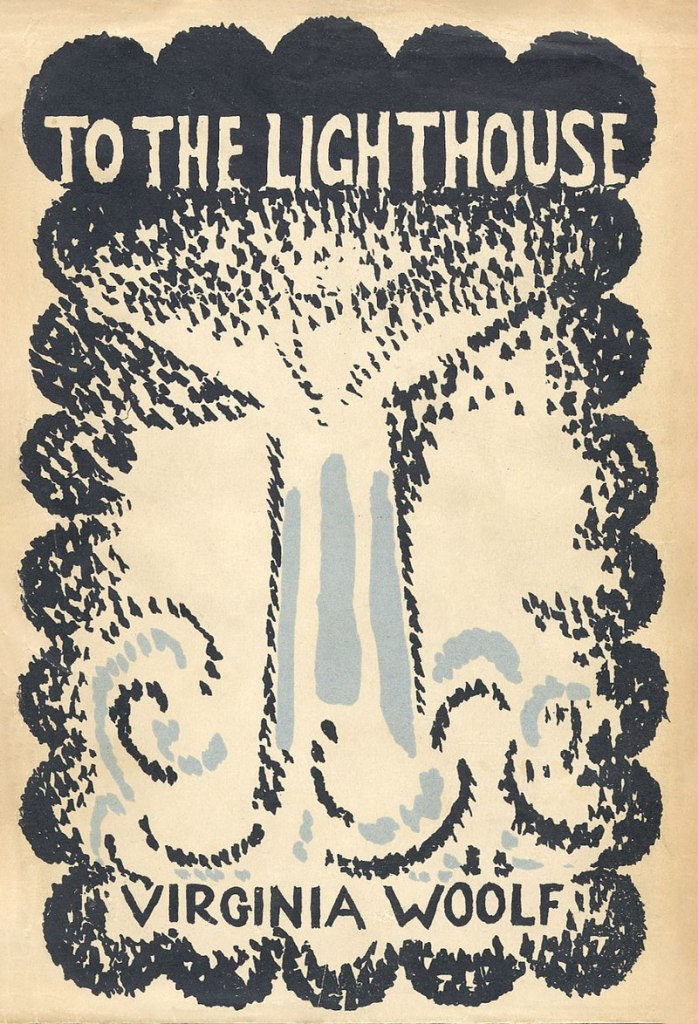
The paratexts of Smyth’s All the Lives We Ever Lived already signal the memoir’s reliance on earlier books: its main title is a phrase from a poem cited by Mr Ramsay in To the Lighthouse, while its dustjacket clearly references Vanessa Bell’s designs for the first editions of her sister’s novels and other writing. In addition, immediately after the dedication to her mother, Smyth includes a quote from Woolf’s novel as motto. Tellingly, it is a passage (from chapter 7, in the third part of the novel) in which Lily sees Mrs Ramsay disappear from view: “It was strange how clearly she saw her, stepping with her usual quickness across fields among whose folds, purplish and soft, among whose flowers, hyacinths or lilies, she vanished”.

In many other places, too, To the Lighthouse supplies Smyth with the language and form she needs to be able to write about her childhood and parents. In some cases, she literally lets Woolf’s characters speak for her, especially where she’s interpreting the meaning of things that happened to her in the past. Interestingly, Smyth quite often quotes Lily in these instances:

My father took the Laser [a sailing boat] on my return. He always left the basin, and sometimes I would stand on the float, still in my life jacket, watching the white sail grow fainter and fainter (“So much depends,” thinks Lily, watching from the lawn as the dull speck that is the Ramsay’s sailboat recedes into the bay, “upon distance”; so much depends upon “whether people are near us of far from us.”). (81)

Even as a child I had looked at this picture with interest, feeling a kind of condescending sorrow for the old man from my grandmother’s other life who had had the bad luck to die. (“Oh, the dead!” thinks Lily, “one pitied them, one brushed aside, one had even a little contempt for them.”). (116)

Woolf’s novel also hands Smyth frames with which to order her own experiences – most notably when it comes to her parents’ relationship. However, she does not schematically project the story of the Ramsays onto her own family’s situation. She reflects on the similarities between her parents’ marriage and that of the Ramsays, but she makes comparisons with that of Paul and Minta in other places as well. Mrs Ramsay features heavily in sections about Smyth’s relationship with her own mother, but when her father dies of cancer, he suddenly becomes the Mrs Ramsay of Smyth’s book. In this respect, All the Lives We Ever Lived is a challenging read: by continuously drawing attention to its form (including the ways in which it makes use of its intertextual relation with Woolf), the memoir highlights the complexity of seeking solace in literary writing. 

Halfway through her book (in chapter 18), Smyth recognizes that her parents’ marriage can only be done justice in fiction, or in life-writing that takes a fictional text as its main frame of reference. As Smyth suggests but never explicitly states, the solace of fiction is not in the answers it offers to life’s biggest questions, but in the many perspectives on those it presents. Because fiction is inconclusive by nature, it can only ever be indirectly applicable to readers’ lives. Indeed, as All the Lives We Ever Lived so compellingly shows, a novel’s “indirection” allows readers to compare their own situations with those of fictional characters without offering definitive conclusions.

The same can be said for life-writing so inextricably linked with fiction, especially if it is fiction by Woolf, whose work, Smyth observes, “is characterized by inconclusiveness” (120). Reading Woolf helps Smyth understand that grief need not be what it is popularly understood to feel or look like (255). But the realization that solace may be “discrepant” might actually be consoling in itself:

“[T]here are… readers for whom Woolf’s nuanced portrayal of loss – which acknowledges the frustration, inconstancy, and even tedium of grief in addition to its horror – provides not just a welcome challenge to the prevailing wisdom but also a vital consolation” (255).

New Registers of Feeling and Thinking

What would David James make of All the Lives We Ever Lived, which, of course, documents another reader’s search for consolation in To the Lighthouse – precisely the kind of text he would have studied if he had focused on reader responses to discrepant solace in Woolfian modernist fiction? Its form might further complicate matters: combining autobiography, biography and literary criticism, Smyth’s memoir raises the question whose pain and redemption we’re talking about when discussing the work of consolation in literature. Is it the author’s, as is most likely in the case of a memoir (which is not to say, of course, that the fiction of To the Lighthouse may not be a processing Virginia Woolf’s own feelings of loss and mourning)? Or is it a fictional character’s, like Lily Briscoe trying to cope with the death of Mrs Ramsay in To the Lighthouse? What about readers who seek solace personally and perhaps identify with the suffering of the subjects of life-writing and fiction? A book about the solace of fiction like Smyth’s might console yet other readers. As Radhika Jones writes in her New York Times review of All the Lives We Ever Lived: “I suspect [Smyth’s] book could itself become solace for people navigating their way through the complexities of grief for their fallen idols”.

James’s book is an important publication, not only in the sense that he spends ample time on the intricate interplay of all of these levels of consolation, or because he connects at least three areas of research in refreshingly new ways: contemporary fiction, life-writing and the “post-postmodern”. He also convincingly shows how present-day literature’s discrepant solace finds a precedent in early-twentieth-century Modernism, thus enlarging our understanding of the extent to which contemporary, post-postmodern culture can be seen to work through the legacies of earlier aesthetic regimes and sensibilities. In fact, James’s perceptive analysis of contemporary literature’s exploration of misunderstood or less celebrated aspects of Modernism bears great significance for the discussion of what academics have labelled “Metamodernism”, the structure of feeling that is said to have replaced Postmodernism as a cultural dominant.

Like scholars working in that field, he acknowledges the emergence of new “registers of feeling” that “at once disobey the commodifying, banalizing logic of postmodern pastiche and contravene the equally flattening, bureaucratized logic of neoliberal rationality” (224). However, he refrains from using the “Metamodernism” term: “If the postmodern model no longer fits certain limbs of affective experience in literature now, then the understandable appetite for replacement labels seems less important than recognizing that writers’ unexpected kinships possess aesthetic, philosophical, and political valences that exceed compartmentalization” (224). Future research will shed more light on how the particular needs and concerns of early-twenty-first-century authors like Smyth inform their reinterpretations of twentieth-century Modernism and, so, give shape to post-millennial art and culture.

The Consolation of Inconclusiveness

All the Lives We Ever Lived is, then, as much a book about the consolation of literature as an example of a text that offers a version of solace itself. It’s certainly not an easy read, let alone a book that dispels trauma by turning a troubling life narrative into a perfectly formed, redemptive story. Indeed, as its subtitle indicates, it’s about Katherine Smyth seeking instead of finding solace. But precisely as a result, her memoir is an unforgettable reminder of the power of literature as a medium of discrepant solace. Reading it with David James’s main arguments in mind, I felt compelled to ask myself how books console me personally – a question that, post-lockdown, seems to increasingly occupy others as well (see, for example, Michael Ignatieff’s On Consolation: Finding Solace in Dark Times (2021), but also Laura de Jong’s 2023 series of author interviews about literary consolation for de Volkskrant newspaper).

Of course, I’m a different To the Lighthouse reader than both Smyth and James, but it could very well be that the new impression the novel’s made on me is, in fact, related to the solace issue that James so insightfully analyzes. I certainly find hope in the potential of both fiction and life-writing to continuously generate alternative meanings and acquire new relevance to readers already familiar with certain texts. Their lack of wholeness, closure or soothing answers to unsettling questions holds a promise (i.e. of future meaning and relevance), which also positively affects my experience of reality. Because even when its promise may never be fulfilled, literature encourages me to imagine real life as something that can and always will evolve. Thanks to great books like Woolf’s, I now see the world around me as inconclusive in the most optimistic sense of the word. And after reading Smyth and James, I’d like to think that if fiction has any responsibility towards reality, it’s not to faithfully represent what already is, but to show what could also be. Literature will always keep communicating, and there is real solace in that kind of generosity. Or that’s what I think. And if I’m wrong, I have at least another 46 years to find out.

Works Cited

James, David. Discrepant Solace: Contemporary Literature and the Work of Consolation. Oxford UP, 2019.

Jones, Radhika. “A Grieving Woman’s Eloquent Homage to Virginia Woolf.” The New York Times, 11 Feb. 2019. NYTimes.com, https://www.nytimes.com/2019/02/11/books/review/katharine-smyth-all-lives-we-ever-lived.html.

Smyth, Katherine. All the Lives We Ever Lived: Seeking Solace in Virginia Woolf. Atlantic Books, 2019.

Woolf, Virginia. To the Lighthouse. Vintage Classics, 2016.

Between Stereotypes and Stories

written by Anna P.H. Geurts

Historians such as myself love a good story. And while they usually look for these stories in old manuscripts or eyewitness accounts, they won’t say no to the odd amusement park every now and then.

One of the older themed amusement parks of Europe is the Efteling in the Netherlands. Some of the attractions at the Efteling are based on specific stories, such as Rapunzel or Pinocchio. Others are based simply on ideas, images or types that circulate in the European cultural imagination. The idea that trees might come alive, for instance, or that dragons guard treasures. But also ideas about a mysterious orient, or an inhospitable Africa.

The problem with these latter images is that they were created to justify the conquest of these regions and the use of violence against them. And in the present day, they still support power differences between different areas in the world.

What’s more: I would argue that for a visitor to an amusement park, there is nothing much amusing about simply seeing stereotypes repeated. Surely, we want to be surprised at least a little, in order to really feel entertained?

However much I admire the Efteling, it certainly has its store of such stereotypical imagery. The dark ride Carnaval Festival may be the most well-known container of these images. Like Disney’s It’s a Small World, it features national buildings and national ‘types’ of people from around the world. That means that the very essence of the ride is a celebration of cliches. Some of these cliches are, however, fairly harmless: a choir of Dutch frogs, for instance. In other scenes, the designers have responded creatively to these cliches, like they responded creatively to the talking-tree idea mentioned earlier. This is where Carnaval Festival is at its best. The cliches are used for a visual joke, or they are turned into something beautiful. I remember being in awe as a child of the Japanese masks that were on display, the Scottish bagpiper, the shadow play with kites, or the arctic ceiling.

A third type of scene on this ride, however, has been using cliches in a much more problematic manner. The room representing the makers’ idea of ‘dark Africa’, for instance. The human figures which elsewhere on the ride are mostly just friendly (and blue-eyed, even in Mexico or Hawaii!), here had a stupid look on their faces (and no irises at all). They sported exaggerated lips as found in the ‘Sambo’ or ‘coon’ characters, and facial piercings that, although in vogue in Europe now, were probably meant to stand for anything but civilisation by the makers of the ride in the 1980s. They lived in a forest, were perpetually engaged in warfare (or else perhaps a symbolic demonstration of masculine prowess), brandishing spears and shields, and were observed by several colonial figures in khaki (or were the Africans threatening some of them? This always remained a little ambiguous).

Although the scene also included several humorous components, it may be clear why it has attracted criticism ever since opening to the public. It propagated a historical colonial image of Africa and was as such also very much out of tune with the rest of the ride, that instead focused on contemporary touristic imagery. It therefore suggested to the average European visitor that all of Africa is a forest, and that when travelling there they would be met by a troupe of silly bush warriors and – still – a colonial regime.

When the ride closed for a major technical overhaul, therefore, the Efteling also adjusted this scene, as well as several Asian ones.

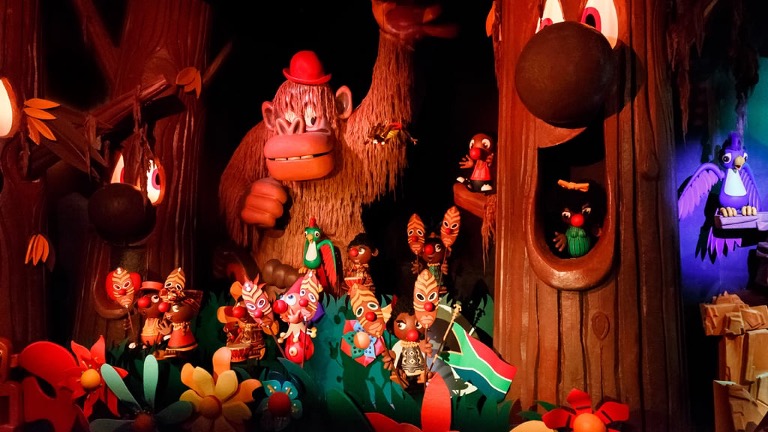
The scene now looks like this:

Much has been done to meet the critics. Still, this visitor wonders whether the designers of the overhaul have really understood their critique.

Not only have some harmful stereotypes remained unchallenged and some new ones added. Why, for instance, are these African characters the only ones who are situated in uncultivated ‘nature’? Why, also, is an entire continent conflated into one scene, as if cultural distinctions do not matter when it comes to Africa, while the entire ride is premised on such cultural distinctions? For instance, we find a central-African rainforest and a tropical ape (an Indonesian Orangutan?) together with a South-African flag. The new music composed for this scene even seems to be Caribbean – ‘Black’, too, after all?

But equally, the spokespersons for the Efteling do not show much awareness of what this is all about. In interviews, they speak of an anti-colonial criticism coming from people who did not grow up with the Efteling: as if those hurt by the depictions cannot be Dutch or Flemish nationals; as if appreciation and critique cannot go together; and as if, most surprising of all from a commercial viewpoint, one first needs to ‘learn’ about the Efteling in order to join in the fun.

Equally, they suggest that colonial imagery has only become harmful in recent history. The ride had to change, they say, because it no longer fitted the present ‘diverse’ day and age. But surely, the entire point of colonial imagery, from the very start of colonisation onwards, is that it would harm the colonised? The world has always been a diverse place, and the ride has always attracted criticism. Only perhaps the Efteling is now finally seeing the commercial potential of attracting a more diverse group of visitors?

Finally, the new figures are presented as a great improvement because instead of nose-rings, they now wear ‘traditional African costume’. However, it is precisely the idea of Africa as a ‘traditional’ place – stuck in time – that has justified and still justifies colonial exploitation. (I am not entirely clear what is wrong with the piercings, by the way. Only that some view them as backwards, which may again invite a view of Africa as primitive. But should we go along in seeing piercings this way?)

As said, some harmful stereotypes remain, in the Efteling, not just in Carnaval Festival but in other rides, too.

Still, this year has seen a bright light on the horizon. Two more attractions based on colonial ideas have just closed for renovation and it seems that these, in contrast to Carnaval Festival, will not continue the old pattern of presenting stereotypes but introduce two more fundamental changes.

Firstly, the Adventure Maze and Monsieur Cannibale will shift perspective 180 degrees. Rather than continuing to be based on European images of the colonised, they will be based on the cultural heritage itself of a formerly colonised region. They will spotlight two stories from Sinbad the Sailor’s cycle of adventures, written probably in western Asia or Africa in the early modern period.

Even better: they will not just be based on simple types or cliches that float around in the cultural imagination but on actual stories, with plot, characters, and a lot of space for different interpretations and ways of enjoying them: like the tales of Rapunzel or Pinocchio that we see on display elsewhere in the park. I look forward to seeing the Efteling embody these stories to their fullest.


About the photos: Promotional photos by the Efteling, used here for review purposes with reference to the Berne Convention and the doctrine of fair use.

Shot on iPhone: Apple’s World Picture

By Niels Niessen

The following text is the introduction to a longer essay published in Advertising & Society Quarterly (2021). The full text can be read here.

On January 9, 2007, at the Macworld Expo in San Francisco, Apple co-founder and CEO Steve Jobs launched the iPhone. In fact, Jobs started his presentation by announcing three revolutionary new products: “an iPod with touch controls, a revolutionary mobile phone, and an Internet communicator. … So three things … Are you getting it?” The crowd is getting it. “This is one device, today Apple is going to reinvent the phone” (Figure 1). Jobs then continued to demonstrate the iPhone in his signature style, mindfully switching from a Beatles song to Bob Dylan, from a phone call to the photo album, and from a sunny weather forecast to an equally sunny outlook on Apple’s stock. One thing Jobs only mentioned in passing is that the iPhone is also a camera, albeit initially only with two megapixels (MP), and without flash or auto-focus. Almost a decade later that camera became one of the main vehicles driving Apple’s brand identity.

Still from the 2007 keynote event at which Steve Jobs launched the iPhone.

Apple’s advertising of its phone-as-camera, and more generally Apple’s promotion of its brand through photos and videos shot on its devices, took flight with its World Gallery campaign (Figure 2). The campaign was launched in 2015 as part of the marketing of the iPhone 6, by now with an 8MP camera, true tone flash, and phase detection autofocus. For a period of two years, the World Gallery displayed photos shot by iPhone users on billboard ads in urban centers across the globe. The campaign further included print ads, short videos shot by users, and the 2016 TV commercial “Onions,” in which a girl rises to fame thanks to her iPhone. The World Gallery campaign was produced by TBWA\Media Arts Lab, which since 2006 has been Apple’s bespoke creative agency. In 2015, at the Cannes Grand Prix festival for advertising, the campaign won a Golden Lion in the outdoor category, as the jury considered Apple’s campaign a “game changer.”

Apple’s 2015 World Gallery campaign

This essay takes the Shot on iPhone campaign as a lens onto Apple’s new American Dream, designed in Silicon Valley and manufactured in China, under terrible working conditions. The essay asks: What do the images featured in the World Gallery have in common, other than the camera on which they were shot? And what inspiration did Jobs take from Edwin Land, the co-founder of the Polaroid Corporation and the inventor of in-camera instant photography? Taking the World Gallery as its focal point, the essay demonstrates that advertising has always been integral to Apple’s business operations.

The World Gallery is a fascinating campaign. The campaign is modern and postmodern at once, in that it attaches a material product (the iPhone) to an immaterial world view (Apple’s brand image) expressed through images made by means of that product (the iPhone camera) but in such a way that the product’s materiality is effaced (the iDream). And the campaign is analog and digital at once: smartphone photography printed in magazines and on billboards. In a social media era of viral and targeted advertising, in which “messages sent to large groups of people in one swoop” are no longer considered cost effective, Apple advertises with a good old one-message-fits-the-globe strategy.

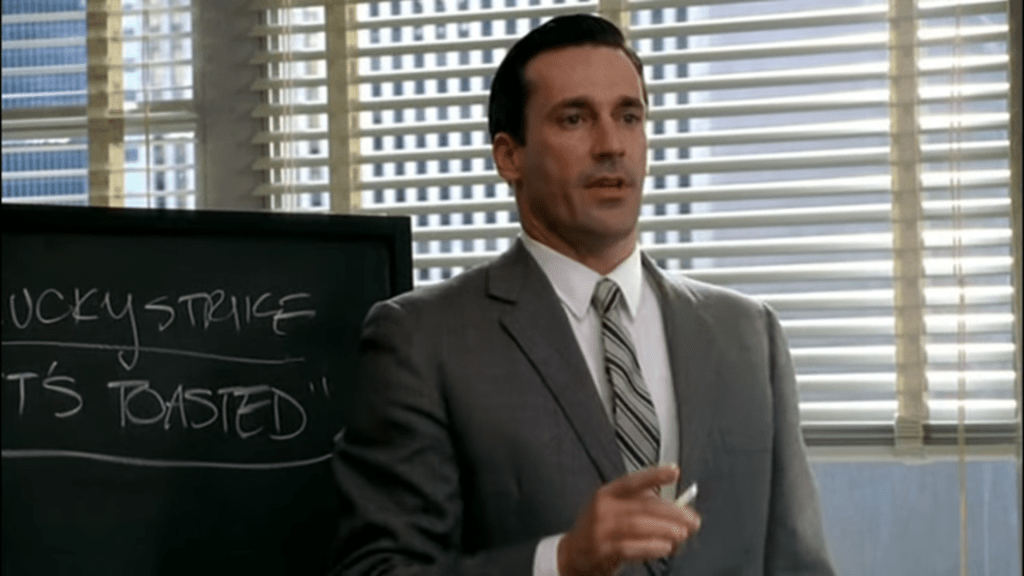
Don Draper in Mad Men (AMC): “Advertising is based on one thing: happiness.”

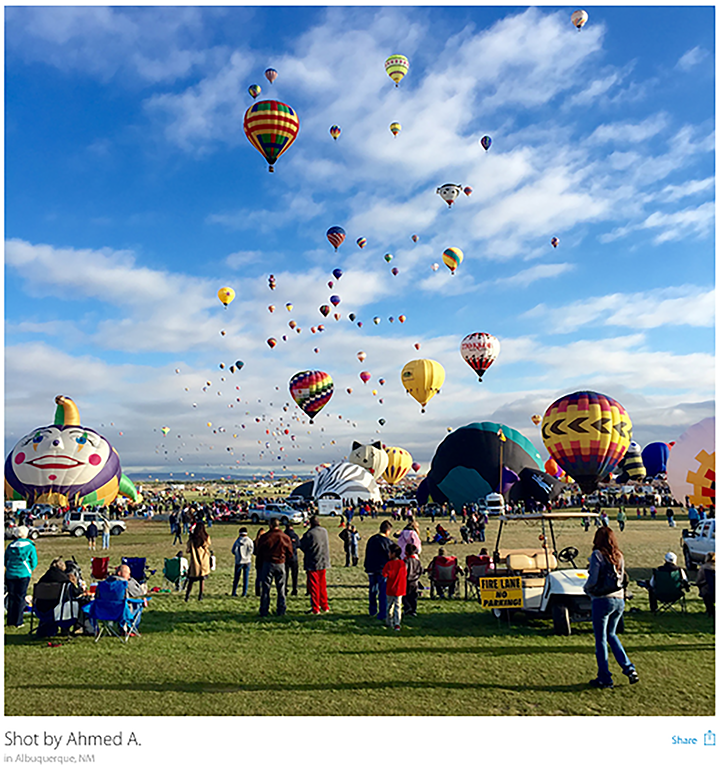
On that campaign’s modern side, we have traditional billboards that reassure people that whatever they’re doing, it’s ok, you are ok—to paraphrase fictional advertising genius Don Draper in television show Mad Men’s pilot episode “Smoke Gets in Your Eyes” (in which Don explains the principles of the 1960s American Dream industry, Figure 3). Advertising, as Welsh social and cultural critic Raymond Williams wrote, is “the official art of modern capitalist society.” In his 1980 essay “Advertising: The Magic System” Williams argues that modern advertising works like magic. By this he means that advertising spins a web of associations around a commodity while obscuring the material reality in which that commodity is produced and consumed. That magical smoke screen is also at work in the World Gallery. The campaign manages to obscure the iPhone’s material reality to the point no iPhone is actually seen in the campaign, and only the iPhone’s feelremains (Figure 4).

Apple’s World Gallery

At the same time, and on the campaign’s postmodern side, the iPhone’s absent presence expresses Apple’s design philosophy. According to this philosophy, technology becomes intuitive to the point it self-effaces in people’s use of it. In this respect, the iPhone is present in every picture, in the crisp aesthetics that carry the “hyperrealism” of advertising photography to the digital age. In his 1991 book Postmodernism, or, The Cultural Logic of Late Capitalism, Fredric Jameson refers to postmodernism as an “age that has forgotten how to think historically.” Apple’s world picture, its belief in a world made better by design, is the epitome of this postmodern logic detached from historical materiality. The iPhone is designed to be a weightless technology that intuitively yields to the eternal present of digital media streams. The material reality magically veiled in this timeless flow is a capitalist reality, in which on the production side the earth is mined and labor exploited. Meanwhile, on the side of consumption, the iPhone facilitates the control capitalism of data-mining platforms like Google and Facebook, whose digital infrastructures interpellate—i.e., at once address and create—the smartphone user as a dividual. This dividual is what becomes of the individual under control capitalism and its datafying logic: a posthuman subject who is scattered and shattered to the point they’re no longer in-dividual, undivided. The material reality of that scattered dividual contrasts sharply with Apple’s world picture, at once romantic and digital in its aesthetic, of technology as second nature (Figure 5).

Apple’s World Gallery

The essay has six sections. Section one analyzes the World Gallery. Section two situates the World Gallery within Apple’s advertising philosophy from the late 1970s to the 2020s. Section three argues that Apple’s advertising strategy over the years has become integral to its product design. Section four juxtaposes Apple’s new American Dream to the material reality of digital era capitalism. Section five imagines how people in, say, 125 years from now will look back on the launch of the iPhone. Section six is about apples. Throughout, moreover, the essay is a visual essay that captures Apple’s world image, the feel of its phone—with, in conclusion, a personal touch that I shot on my own iPhone.

For the full essay follow this link.

Niels Niessen is a Researcher in Arts and Culture Studies where he works on the research project Platform Discourses: A Critical Humanities Approach to Tech Companies

The World Under Lockdown: Empty Spaces in the Photographs of the COVID-19 Pandemic

Written by Airin Rezazadeh Farahmand

Before 2020, we probably needed to rely on science-fiction movies and dystopian novels to imagine a global pandemic. By now, however, we are all well aware of what a world stricken by an infectious disease looks like. In late 2019, a number of pneumonia cases of unknown etiology were reported to the World Health Organization by Chinese authorities. Soon after, it was discovered that the cases were caused by a new virus (now familiar to all of us by the name COVID-19) that apparently has succeeded in crossing the species barriers. The anxieties over the rapid spread of this new virus was well reflected in the title of CNN’s report, published on 7 January 2020: “A mysterious virus is making China (and the rest of Asia) nervous. It’s not SARS, so what is it?”. This new virus was not nerve-wracking only for Asia. Proven to be highly contagious, it quickly turned into a global concern.  In the space of a few months, the virus caused a global pandemic, which is still on-going as I’m writing these lines today. 

Although the outbreak evoked different responses in different countries, the common reaction was the emergence of new norms and regulations. Handshaking was considered too dangerous. Face masks and gloves became part of daily outfits. Access to public spaces was limited and large gatherings were prohibited. The outbreak not only heralded fundamental changes in the ways people used to live and interact with each other but also changed the meaning of social spaces drastically. With people being advised to stay at home, work remotely and avoid unnecessary commuting, internet communication replaced face-to-face interaction. The ramifications of living in this new world, highly reliant on virtual spaces, were reflected in a number of cultural practices including photography. Photos capturing empty public spaces as the result of the imposed lockdowns proliferated social media soon after the start of the outbreak.  The photos of these emptied out spaces became an effective way of documenting the visual impact of the pandemic on our daily lives.  Like most crises captured in modern times, the camera not only became a tool of documentation, providing factual accounts of what was going on in the world, but also shaped a visual narrative through which the pandemic was framed. 

It is important to note that emptiness should not be taken at its face value, as it is never devoid of cultural and social significance. Courtney J. Campbell,  Allegra Giovine and Jennifer Keating, for instance, in their book Empty Spaces: perspectives on emptiness in modern history, show how emptiness is not merely an indicator of the absence of the usual content of life, but rather  a sign of disruption in more abstract qualities that are deeply implicated in our economic, political and social systems (5). Similarly, by depicting cities without human subjects and deprived of their social function, the photos of empty public spaces reflect on our anxieties of living in a highly globalized world, where the likelihood of a biological disaster threatening our very existence as human species seems more real than ever. These anxieties are not a new phenomenon. In fact, they have been repeatedly depicted in fiction, most notably in post-apocalyptic and dystopian movies. Therefore, it doesn’t come as a surprise that the images of empty spaces depicting the recent pandemic bear strong resemblance to the already-existing ones in popular culture. The iconic opening sequence of Francis Lawrence’s 2007 movie I am Legend starts with an aerial shot of New York City that is peculiarly vacant. The protagonist journeys through the deserted streets of the city which have clearly fallen into decay and have been taken over by nature. Similarly, Steven Soderbergh’s Contagion (2011), uses the same strategy to show how the spread of the virus has disrupted normal daily life. In shots that interestingly share a great deal of similarity to the photos depicting the recent pandemic, we see empty gyms, conference rooms, churches and stations indicating the interruption of the normal flow of everyday life.

In his analysis of the American zombie series The Walking Dead (AMC, 2010–) and the British production Survivors (BBC, 2008–10), Martin Walter explains that emptiness in these types of movies is used as a way of commenting on the structures of our contemporary capitalist society.  According to Walter, the familiarity of these spaces raises critical questions about the efficiency of the previous order which has clearly failed. As he puts it, “the repeated motif of journeying through empty landscapes conveys ideological viewpoints on capitalist spaces. These spaces increasingly address both a ‘perturbed familiarity’ and discourses of global (in)security” (134). Therefore, emptiness in these movies raises critical concerns about the reliability of the capitalist system that has left us vulnerable to threats such as a global pandemic. Similarly, Dora Apel argues, “by depicting our technologically advanced civilization in states of ruination and decay, post-apocalyptic narratives render our own society as other and encourage us to ask whether the empire of capital represents lasting progress or a road to decline” (152).

The fear of the so-called “next pandemic”, the one that will bring humanity to the end, is engraved in the popular culture of our time. The recurring theme of dystopian futures as a result of human activity in post-apocalyptic fiction, mirrors concerns over many pressing issues among which globalization, rapid technological advances, public health, safety, surveillance, (in)security and the possibility of human extinction stand out.  The photos of empty cities following the corona crisis, therefore, rely in part on the familiar iconography of the previous cultural products to form their visual narrative and evoke a sublime sense of fear in the viewer. Emptiness, in this context, is a key visual trope that addresses the same concerns and issues regarding the structures of our contemporary societies that are raised in fictional works. It gains its meaning when the depicted public spaces are compared to their pre-pandemic state when they were filled with people. In this sense, emptiness becomes a crucial aesthetic tool that dysfunctionalizes our social spaces, presenting them as eerie and uncanny. Freud used the term ‘uncanny’ (‘unheimlich’ in German, literally ‘un-homely’) to suggest a psychological origin for the eerie, peculiar feeling of fear that arises from the confrontation with something familiar that has suddenly turned into its opposite. Accordingly, the uncanny is located on the margin between real and unreal, constantly stressing the boundaries between the two. Similarly, in the photos of empty public spaces, popular destinations marked by their crowd suddenly have turned into unfamiliar venues with almost no human presence. The familiarity that lies at the heart of these barely recognizable spaces, stripped off their social function, adds to the uncanny quality of these photos. 

In his seminal work The Architectural Uncanny, Anthony Vidler uses Freud’s notion to explain the spatial characteristics of the places that can provoke this feeling of uncanniness in the visitors. As Vidler explains, what stimulates the feeling of uncanny in the space, is not related to particular spatial conformations as this feeling is not a property of the space itself. Rather, it is in its aesthetic dimension and is created when a space that pretends to offer the utmost security suddenly opens itself to the secret intrusion of terror (3). Uncanny as an aesthetic quality of space is what renders it strange due to an alien presence. It is, as Vidler puts it, “a representation of a mental state of projection that precisely elides the boundaries of the real and the unreal in order to provoke a disturbing ambiguity, a slippage between waking and dreaming” (11). If we look at the photos of the pandemic, emptiness seems to create a liminal space between reality and fantasy. Although the settings have remained the same, the absence of the usual crowd indicates the presence of an alien Other that disallows us to freely enter into these spaces. Being marked as unsafe, these public spaces, without their crowd, look almost like private properties. The emptiness in the photos, therefore, seem to ignite curiosity in the viewers to ask themselves what will happen to public spaces? What will remain of them? These questions are indeed important since they guide us to begin thinking about our conditions as human beings living in the twenty-first century. The photos, therefore, become the spatial visualization of a breakdown in our contemporary world systems by suggesting that emptiness might become the new normal. By visually referencing the already-existing apocalyptic images in popular culture, they build on our contemporary anxieties regarding the possibility of human extinction by emphasizing the human absence in urban settings. It may be too naive to believe that such a thing would be the case. However, even if we accept this prophecy as a form of cultural exaggeration, the criticism that is directed towards the capitalist system that has shaped our century is still very valid and mirrors deep concerns that are inherently embedded in the zeitgeist of our era.

Works Cited:

Anthony Vidler, The Architectural Uncanny: Essays in the Modern Unhomely (MIT press, 1992).

Courtney J. Campbell, Allegra Giovine, and Jennifer Keating, eds., introduction to Empty Spaces: Perspectives on Emptiness in Modern History ( University of London Press, 2019).

Dora Apel, Beautiful terrible ruins: Detroit and the anxiety of decline (Rutgers University Press, 2015).

Martin Walter, “Landscapes of loss: the semantics of empty spaces in contemporary post-apocalyptic fiction” in Empty Spaces: Perspectives on emptiness in modern history, eds. Courtney J.Campbell, Allegra Giovine, and Jennifer Keating (London University Press, 2019), 133-51.

Black Panther Transmedia: The Revolution Will Not Be Streamed

Written by Niels Niessen

The following text is the introduction of a longer essay published in the Journal for Cinema and Media Studies (2021), https://quod.lib.umich.edu/cgi/t/text/idx/j/jcms/18261332.0060.506/–black-panther-transmedia-the-revolution-will-not-be-streamed?rgn=main;view=fulltext.

The Black Panther Party for Self-Defense and the Black Panther figure of Marvel’s comic book universe were both created in 1966. There was no direct link, however, between the political organization that Bobby Seale and Huey P. Newton launched in October that year and the introduction of the first superhero character of African descent a few months earlier in May, in an issue of Fantastic Four (vol. 1, no. 52), which was authored by Stan Lee and Jack Kirby (see Figure 1).

Figure 1. Introducing the Black Panther in Fantastic Four, no. 52 (Marvel Comics, 1966).

As Lee states in a 2009 interview:

It was a strange coincidence because, at the time I did the Black Panther, there was a political party in the country— mostly Black people— and they were called The Black Panthers. And I didn’t think of that at all! It had nothing to do with our character, although a lot of people thought there was some tie- in. And I was really sorry— maybe if I had to do it over again, I’d given him another name, because I hate that confusion to be caused. But it really had nothing to do with the then-existing Black Panthers (cited in Clark 2018).  

The 2018 film Black Panther directed by Ryan Coogler also does not make explicit reference to the Black Panther Party. But the film’s promotional materials do indirectly invoke the historical reality in which both Black Panthers appeared in the late 1960s cultural air. One of the film’s promotional posters depicts T’Challa— the reigning Black Panther— in visual citation of the iconic 1967 portrait of Huey P. Newton, seated on a throne, a rifle in one hand, a spear in the other (a photo that in turn was a mockery of colonialist portraiture). Moreover, one of the film’s trailers contains remixed samples of Gil Scott- Heron’s “The Revolution Will Not Be Televized,” a track from 1970, which is also the year Black Panther Party membership reached a peak. In this trailer, as the Black Panther flies across the screen, a male voice- over cites the following, tuned to the beat of Vince Staples’s “BagBak” (2017):

            You will not be able to stay home, brother.
            You will not be able to plug in, turn on, and cop out. . . .

            The revolution will not be televised. . . .
            The revolution will be live.

Marvel thus links its Black Panther universe to the long history of African American struggle. These offhand gestures beg the question of how Black Panther’s mainstream Afrofuturism holds up to the political activism it invokes. Does the film merely commodify revolutionary discourse, and wouldn’t such commodification prevent the film from constituting an “act of civic imagination,” as Henry Jenkins has called the film? (Jenkins 2018) Doesn’t Black Panther’s production by Marvel, a subsidiary of Disney, by definition preempt the film from its claim to politics— especially when recalling the imperative of turn-of-the-1970s Third Cinema that a political film must also be made politically? And how to square Black Panther’s imagination of a never-colonized Black nation with Achille Mbembe’s analysis of “Blackness” as a discursive product of colonization?

Addressing these questions, it is important to acknowledge the wide acclaim Black Panther has received from within the African American community. During a special event in Harlem’s Apollo Theater, Ta-Nehisi Coates described the film as “Star Wars for Black People,” sharing with the audience that he “didn’t realize how much [he] needed the film, a hunger for a myth that [addressed] feeling separated and feeling reconnected [to Africa]” (cited in Beta 2018). Similarly, Tre Johnson writes that Black Panther’s greatest legacy is that Black viewers find “a cultural oasis that feels like nothing we’ve seen before” (cited in Johnson 2018). And as Jenkins observes, Black Panther offered “a shared myth desperately needed in the age of Trump: the film inspired many different forms of participatory culture . . . as people fused its iconography into their personal and social identity” (Jenkins 2018).

So yes, following its release, Black Panther has undeniably manifested itself as a political-cultural event, but this does not, of course, prevent a critical reading of the film. That critique is the gravitational point of this essay. I argue that, taken on its own, the Black Panther film only marginally integrates its offhand promotional references to the history of African American resistance. Despite its multiracial cast and strong female characters, Black Panther at the end of the day is built on a conventional Hollywood logic, while its plot purports an anthropocentric American Dream narrative in which humanity masters nature through technology. (Figure 2)

Figure 2. Technology as second nature in Black Panther (Marvel Studios, 2018).

Yet the film cannot just be considered on its own. The film emerges out of and inscribes itself into a transmedia franchise that in recent decades has evolved as a platform for rethinking African American identity in the post–civil rights era. This has been the case under the authorship of Christopher Priest (who wrote the 1998 Black Panther comics volume on which the movie was largely based), Coates (who picked up the comics’ authorship in 2016, starting with A Nation Under Our Feet), and Kendrick Lamar (who cocurated the film’s soundtrack, including the hit single “All the Stars,” performed with the American singer SZA). As Coates writes elsewhere, in Between the World and Me (2015), the dreamed synergy between nature and technology at the heart of the American Dream is an all-too-human construction torching the planet, socially and literally (Coates 2015).

Figure 3. Black Panther’s science fiction of a nation shielded from global heating.

The Black Panther film revels in such phantasmagoric synergy, telling a fairy tale of an extractive utopia, while it has no sight for the exploitation of bodies and ecosystems that marks the reality of every mining economy (Figure 3). In that light Black Panther is like, say, Apple’s new American Dream, in which technology is posited as second nature and which was equally designed in California. Only when the film is considered in the light of its broader transmedia universe does its superhero texture open to the speculative potential that Michael Gillespie and others have embraced as central to film Blackness. As I will argue in the final section, “The Fire in the Sky,” at those moments Black Panther invites its transmedia traveler to think through what Mbembe calls the “Becoming Black of the world” (Mbembe 2017).

Niels Niessen is a Researcher in the Arts & Culture department.

For the full article and bibliographic references see:

https://quod.lib.umich.edu/cgi/t/text/idx/j/jcms/18261332.0060.506/–black-panther-transmedia-the-revolution-will-not-be-streamed?rgn=main;view=fulltext