Ithaca: The Return – The Cost of War and the Power of Penelope’s Silence

By Ketty Iannantuono, Postdoctoral researcher at Radboud Institute for Culture & History

After many years of absence, a man returns home, carrying with him the trauma of war. His wife has patiently waited for him, never losing hope but struggling to keep their home from falling apart. Their distraught son has lived in his father’s myth. Now, they must all come to terms with the less-than-heroic return of an old man: he has survived, but at an extremely high cost. This could easily be a story set in the present, yet it is based on a tale written over three thousand years ago. This is Homer’s Odyssey, as reimagined by Uberto Pasolini in his new film, Ithaca: The Return.

Rather than recounting the epic of Odysseus’ great journey – the kind of story previously adapted for the screen in Camerini’s and Bava’s Ulysses (1954), Rossi’s Odissea (1968), the Coen brothers’ O Brother, Where Art Thou? (2000), or the forthcoming Christopher Nolan blockbuster The Odyssey (set for release in summer 2026) – Pasolini’s Ithaca: The Return opts for an intimate retelling of the classic myth, focusing solely on the last books of the poem (Od. XIII-XXIII). The story is stripped of all the adventures, nymphs, monsters, and gods, and this absence feels strikingly deliberate.

The narrative centers on Odysseus’ (Ralph Fiennes) νόστος – his return to his homeland, where he arrives shipwrecked and naked, one ordinary day. More than a hero, he is a veteran, burdened with the guilt of having lost all his comrades in war. His many years of wandering are only hinted at, not as challenges to be overcome by craftiness and deception or as persecutions inflicted by envious gods, but as the result of his profound alienation and his inability to reclaim control over his life after the absurdity of the Trojan War, which, like every other war – then and now – upends the meaning of all things. For much of the film, Fiennes’ Odysseus is helpless: he barely speaks, hides in the shadows, and witnesses the devastation of his home and family. Meanwhile, his wife Penelope (Juliette Binoche) and son Telemachus (Charlie Plummer) are left with the burden of defending his throne from suitors who are pressuring the queen to remarry. As in the original text, Penelope stalls them by claiming she will choose a suitor only once she has completed the shroud she is knitting for her ailing father-in-law. In reality, she secretly spends her nights unraveling the shroud, buying Odysseus more time to return.

A fundamental theme of the film is the struggle to reconstruct one’s identity, a quintessential Odyssean topos: that of becoming “Nobody.” Returning home with clear signs of grappling with PTSD – at the premiere of the movie in Milan, Pasolini has mentioned reading Vietnam War veterans’ diaries while writing the script – Odysseus struggles to fit back into his old life. Yet, those closest to him recognize him almost immediately: Eumaeus (Claudio Santamaria), who soon understands who the old beggar is; the dog Argos, who has waited twenty years, only to die upon his master’s return; Euriclea (Angela Molina), who recognizes him by his scar; but above all, Penelope, who only needs a glance at the stranger to know that her husband has returned. She doesn’t need any further confirmation of his identity and devises the challenge of the bow not to test the stranger facing her but to push her husband to piece together the fragments of his existence and reclaim his role.

Seemingly in contrast to the Homeric poem (though I can’t help but think of the verses in Book 1, where Odysseus’ son expresses frustration and uncertainty about his identity, unsure of who his father really is despite what others say; cf. Od. I, 200-210), Telemachus refuses to accept that the veteran is his long-lost father. The man before him bears no resemblance to the hero he has heard about since childhood, evoking conflicting feelings of hatred, resentment, and humiliation. But when Telemachus finally sees Odysseus fighting mercilessly and resolutely in the palace hall, violently exterminating the suitors as per the script, he “finds” him again – and in doing so, finds himself and his place in the world.

The Absence of Gods and the Focus on Human Responsibility

In Ithaca: The Return, we are faced with a plausible story, set in a convincingly reconstructed Homeric society that parachutes us into believable Hellenistic Middle Ages, where the aristocracy is in turmoil and power struggles are violent. The film is marked by intense performances –especially from Fiennes and Binoche, who communicate deeply through their tormented yet powerful silences – and a visually striking atmosphere. The exterior shots, often set in rugged locations – shot in Corfu and in the Peloponnese – create a sense of isolation and mystery, contrasted with the claustrophobic palace scenes, which represent a prison-like environment for the protagonists. In almost every frame, both exterior and interior, the sea remains visible, reminding us of the island setting. This serves as a powerful metaphor for the deep isolation experienced by all the characters. Each man (and woman) is an island, bearing the consequences of their actions alone.

In Pasolini’s film, there are no gods swooping in to resolve conflicts. This decision transforms the film from a simple retelling of an ancient myth into a poignant commentary on the human cost of violence and war. With the gods entirely absent, the film places the full weight of Odysseus’ choices squarely on his shoulders. The consequences are real, personal, and deeply felt by everyone involved.

Penelope: More Than Just the Waiting Wife

In the original poem, Penelope is primarily a symbol of patience and fidelity, waiting for Odysseus’ return. While her devotion is admirable, it often reduces her to a secondary character defined solely by her relationship to him.

Feminist scholarship on the Odyssey emerged in the 1990s, shedding light on Penelope’s agency and intelligence. Scholars like Helene Foley (1978), John Winkler (1990), Nancy Felson (1994) and Barbara Clayton (2004), have pointed to Penelope’s role as a clever counterpart to Odysseus. After all, she manipulates the suitors, “weaves her shroud,” and subtly collaborates with her husband’s plot. On the other hand, other feminist scholars have examined the extent to which the Odyssey truly highlights, empowers, or praises women. Lillian Doherty (1995) argues that while the epic’s strong female characters may engage female audiences, they lack significant agency within a male-centered narrative. Sheila Murnaghan (1986; 1995) and Ingrid Holmberg (1995) have contended that Penelope is essentially powerless, her actions controlled by Odysseus and the goddess Athena, who is associated with male power. Other scholars, such as Marilyn Katz (1991), Victoria Wohl (1993), Seth Schein (1995), and Froma Zeitlin (1995), have noted that the Odyssey often challenges the concept of female virtue, particularly through Penelope’s potentially ambiguous actions toward both the suitors and Odysseus. Rachel Lesser (2017; 2018) argues that Penelope’s combination of disempowerment and subjectivity – autonomous yet devoted to her husband – reinforces the Odyssey’s patriarchal ideology.

Pasolini’s adaptation offers a fresh perspective. Penelope is presented as a central character in her own right, with her struggles, strengths, and complexities. She not only waits but also manages the household – handling finances, making key decisions, and defending her home from suitors. She controls her own destiny and even has a say in whether she will accept the veteran as her husband again. Such a take feels much needed, especially in the cinema, where, borrowing the words of Edith Hall (2013), until now “Penelope has still waited”. The situation is more diverse in contemporary literature: it suffices to mention Margaret Atwood’s The Penelopiad: The Myth of Penelope and Odysseus (2005) as an example of a counter-narrative to the traditional Odyssey’s patriarchal tone. Similarly, by giving Penelope more depth – and in this case even more agency in determinig Odysseus’ final destiny – Ithaca: The Return offers a powerful commentary on gender roles and the way history has traditionally sidelined female voices.

Presented at the 2024 Rome Film Festival and the 2025 Toronto Film Festival, Ithaca: The Return hit theaters in the Netherlands on March 27, 2025.

References

– Atwood, Margaret. 2005. The Penelopiad: The Myth of Penelope and Odysseus. Toronto: Village Canada.

– Clayton, Barbara. 2004. A Penelopean Poetics: Reweaving the Feminine in Homer’s Odyssey. Oxford: Lexington Books.

– Cohen, Beth. 1995. The Distaff Side: Representing the Female in Homer’s Odyssey. New York: Oxford University Press.

– Doherty, Lillian Eileen. 1995. Siren Songs: Gender, Audiences, and Narrators in the Odyssey. Ann Arbor: University of Michigan Press.

– Felson, Nancy. 1994. Regarding Penelope: From Character to Poetics. Princeton: Princeton University Press.

– Hall, Edith. 2013. “Why Penelope is Still Waiting? The Missing Feminist Reappraisal of the Odyssey in Cinema, 1963-2007”, in Ancient Greek Women in Film, edited by Konstantinos P. Nikolouzos: 163–185. Oxford: Oxford University Press.

– Foley, Helene. P. 1978. “‘Reverse Similes’ and Sex Roles in the Odyssey”, Arethusa 11: 7–26.

– Holmberg, Ingrid E. 1995. “The Odyssey and Female Subjectivity”, Helios 22 (2): 103–22.

– Katz, Marylin A. 1991. Penelope’s Renown: Meaning and Indeterminacy in the Odyssey. Princeton: Princeton University Press.

– Lesser, Rachel. 2017. “The Pandareids and Pandora: Dening Penelope’s Subjectivity in the Odyssey”, Helios 44 (2): 101–132.

– Id. 2019. “Female Ethics and Epic Rivalry: Helen in the Iliad and Penelope in the Odyssey”, The American Journal of Philology, 140, 2: 189–226.

– Murnaghan, Sheila. 1986. “Penelope’s Agnoia: Knowledge, Power, and Gender in the Odyssey”, Helios 13: 103–15.

– Id. 1995. “The Plan of Athena”, in Cohen 1995: 61–80.

– Schein, Seth L. 1995. “Female Representations and Interpreting the Odyssey”, in Cohen 1995: 17–27.

– Winkler, John. 1990. “Penelope’s Cunning and Homer’s.” In The Constraints of Desire, 129–61. New York: Routledge.

– Wohl, Victoria. 1993. “Standing by the Stathmos: The Creation of Sexual Ideology in the Odyssey”, Arethusa 26: 19–50.

– Zeitlin, Froma. 1995. “Figuring Fidelity in Homer’s Odyssey”, in Cohen 1995: 117–52.

*

Header illustration by Adolfo de CarolisImmagini, from: Odissea, trad. Ettore Romagnoli, Bologna: Zanichelli, 1927.

As the Crowd Was Chanting More!

What popular concert culture can learn from Punk DIY Ethos in an age of consumption, social media, and sustainability.

By Sybe Kemmere, Cynthia van Mourik, Julie Nijburg, Fleur ter Horst and Caroline Couch

Concerts have always been about more than just listening to music. They serve as the intersection of artist and listener, becoming a nexus of self-expression, fan connection, and honestly – plain fun. In a post-pandemic age, mainstream pop giants have redefined the cultural zeitgeist surrounding concerts. Artists and their fans alike, through the power of social media like TikTok, have developed concerts into a cultural phenomenon at the intersection of consuming music and fashion. From the bedazzled cowboy hats of Chappell Roan’s Midwest Princess Tour to the indie-sleaze revival of Charli XCX’s Sweat Tour, pop concerts have become full-fledged fashion events. For many fans, it is no longer enough to enjoy a concert. What you wear (and post about it) matters almost as much as the show itself.

This expression alone is not a problem, rather it is that these fans turn to fast-fashion as a cheap and convenient solution to meet the expectations of this new concert culture. While at first it might just seem like “it’s just one outfit,” the numbers these pop crowds draw and the amount of social media impressions are massive, and the implications for consumption are frightening.

Taylor Swift’s tour has sold 11 million concert tickets and amassed over 105 million impressions on TikTok for The Eras Tour Outfit alone.1 Amongst these millions of attendees come millions of individual garments produced, purchased, and disposed of. These mass events of single use consumption fuel the growing issue of fast fashion’s global environmental impact, and this connection is one that we just can’t afford to ignore.

The fashion industry is one of the largest global contributors to pollution and climate change, with production alone constituting 10% of global carbon emissions.2 Quantity too has replaced quality: 60% of new clothing is created with cheap synthetic materials, leading to poor quality and limited re-wearability.  Globally we produce 92 billion tonnes of textile waste yearly and the massive influx of non-biodegradable synthetic fast fashion waste clothing builds up.3

Pop concert fans are influencing fast fashion production through their consumption, as the outfits they buy often externalize their connection to the artist or maybe even gain some social media fame. However, after the tour hype is over, many of these items will end up forgotten in closets or, worse, in landfills. The solution to this issue is not telling fans to cease their fan expression through fashion, rather it is to adopt more sustainable understandings of their consumption and adopt mitigating practices.

This is where we believe the mainstream pop fans can learn a few lessons from something completely opposite from them, Punk. Particularly, how the subculture’s DIY ethos informs their consumptive habits regarding expressive acts of “fandom” identification.

While the media might sometimes frame “fandom” as only for teenage girls or geeks, it is everywhere. From sports to music, and cars to fashion brands, fans are found anywhere and anytime. Before delving into what this mainstream pop concert culture can do to reshape their fan expression, it’s important to take a moment and just see how fans not only drive consumption, but act as producers themselves.

Fans are the audience members that form lasting relationships with a phenomenon like a book or artist, and for many this emotional attachment causes fans to express their connection to the product creatively.4 The devotion crystallizes into fan projects, such as the current trend of hyper-specific concert outfits.

Social media only drives this production too, as there is now a low barrier of entry to recognition within fandom spaces for the uniqueness of the work you create or the strength of your identity as a fan. As a result, we have seen more fan output and expression than ever.

Through this creative expression, fans can connect to other fans and develop their own personal connection with their media of choice. Fandom becomes a marker of identity, howeve, even though it is an intrinsic part of the self, one’s fan identity can’t always be expressed in offline daily life. Therefore, events like these large pop concerts become sites where fans can converge, bringing a sense of belonging and safe space for fandom expression, but also a place to see and be seen.

This expression of identity often takes shape in fashion, where one’s clothing says something about one’s status: from punk concerts where everybody is wearing at least one safety pin, to classical concerts where nobody is wearing jeans.

In the mainstream pop-concert world, we have additionally seen how these outfits become aesthetic expressions of one’s fan identity, but also symbolic representations of the original media. Social media has fanned the flames of this, with the aforementioned TikTok videos surrounding the flaunting of one’s concert outfit and discussion of references visually baked into the outfit obtaining hundreds of millions of views. During The Eras Tour, fans went all-out: home-made red carpet looks, cloning Swift’s outfits, or even clothes referencing lyrics and inside jokes. During Beyoncé’s Renaissance Tour, fans wore silver, black and cowboy attire emulating the retro futuristic sonics and aesthetics of her most recent albums.

You don’t show you’re a devoted fan by knowing every lyric, you show you’re a devoted fan by wearing your devotion.

Through the intersection of fashion and concerts, pop fans express their own fan identity, find community belonging, and open the door to obtaining social capital in the quest to be seen as a “real” or “the best” fan. In the quest to obtain this social capital, outfits have become more complex. More garments are consumed and eventually disposed of, exacerbating the previously discussed issues of environmental sustainability.

So now that the issues surrounding sustainability and fan motivations have been explored, what can be done to target issues of over-consumption, while also still retaining the spirit of creative fan expression through fashion? Well, enter the Punk subculture, who adopt ‘Do It Yourself’ or DIY as an aesthetic and practiced values within their communities.

In many Punk subcultures, fashion becomes a reflection of the social realities and independent lifestyle of their movement with a strong focus on celebrating music and criticizing societal establishments. Fashion choices from haircuts to shoelaces become expressions of self-identity: visually signifying one’s identification as a member of a music scene, a punk, and even political affiliations. However, a punk doesn’t go to Shein or Temu to develop their fashion expression or purchase signifiers that will visually display themselves as “more punk.”

Rather the often anti-establishment (if not openly anti-capitalist) nature of Punk centers DIY as a rejection of mainstream expectations regarding consumption. Additionally, this DIY ethos has existed long before the modern understanding of the environmental crisis; nowadays it’s hard to ignore the political implications that pollution and climate change play in the adoption of DIY.

Specifically, The DIY culture in punk focuses strongly on independence, for example producing and distributing music without the interference of a record label. Band members as well as fans even make their own clothing, and bands also travel and perform at DIY events where they connect with their community. By being independent like this, Punks create a social network that enables Punk music and ideologies to spread.5

As for fashion, Punks will DIY their own clothing, remaking objects from waste or second-hand materials. If you want something new, you make it – paint and bleach make any piece of fabric homemade “merchandise” for your favorite band, while safety pins and dental floss stitch garments into new life. This DIY is not only about limiting consumption, but also about production outside of the present system, as Punks push reduce, reuse, repair, recycle to new creative heights.

In contrast, the mainstream pop-cultural space has its own trend of “DIY.” On social media, videos surrounding how fans “DIY’d” their outfits, by styling newly purchased pieces together, gain a following on social media. Punk DIY is not about obtaining social capital. Rather, it is a direct political challenge against mass production and consumption, promoting the creation of one’s fan identity outside of capitalism.6

Now more than ever, in the age of one and done fast fashion concert outfits, mainstream culture needs to learn from the subcultural ethos of Punk DIY.

Trickle up theory in fashion suggests that there is an avenue for the methods and aesthetics of Punk fashion into the mainstream, implying that new trends arise in subcultures on the streets subsequently “trickle up” into adoption by upper and middle classes. This can include adoption of aesthetic styles but also trends surrounding consumption. For example, “thrifting” which once was a way of low-cost clothing consumption for lower classes, has now been adopted by higher classes as an activity for leisure.

Unlike the Punks, Pop-music concert culture is more focused on expression of fandom than on expression of ideals. Absorbing the model of Punk style can provide insight in the implementation of sustainable DIY culture, not only as a method to create fan expression– but to live by. If styles relating to repurposing and identity rather than new consumption would become popular within the big concert cultures, perhaps the same symbolic dimension could make meaning for this group.

Therefore, with the right messaging, if not romanticization, the DIY ethos as both a fashion aesthetic and politicized expression can lead to a greater awareness of the  fashion industry’s environmental damage and the role these fans play in driving this damage.7 The trickle up theory can thus serve as an important starting point in addressing fashion issues because the broader adoption of Punk styles can result in conversations and reflections on these issues.8

What does this messaging look like? True, intentional DIY in mainstream concert spaces needs to become trendy. Organization amongst fans need to center sustainability and DIY in the conversations, while social media can be used to redefine what social capital is gained in effort. While negative, how can social media be used to shame those who post haul after haul of cheap fast fashion?

The burden doesn’t fall on the fans alone. Mainstream pop artists too have an important role in defining the values and practices of their fans, especially as it regards DIY ethics and sustainability practice. If an artist doesn’t value or center the environment, fans likely are not going to care. While artists like Taylor Swift are famously silent about the role themselves, their music, and their fandom play on the environment, other artists, like Billie Eilish, who is currently on her global Hit Me Hard and Soft Tour, is an example of how an artist can carry out the Punk-esque sentiments of DIY ethos and politics in a more mainstream context.

At her concerts, Eilish has partnered with Reverb, a research non-profit that explores the connection between fast fashion and music through consulting, case studies, and on the ground interventions. Reverb attends each show, collecting data about fan consumption and encouraging political actions related to sustainability by connecting fans with local organizing groups, registering to vote, and taking a pledge to eat plant-based meals.

Eilish does not discourage creative fan expression, yet implores her fans to be aware of their consumption, while providing more sustainable alternatives.9 For example, she has organized clothing swaps for ticket holders of her tour, dedicated portions of ticket proceeds to climate issues, and ensured her concert merchandise is limited in scope and made from recycled materials.10 Through someone with as wide a reach as Billie Eilish, underlying messages of sustainable fashion and fan practices ideals can spread.

Fandoms are unique entities, possessing untapped power for connection and expression through music – but also a potential for environmental harm as the effects of consumptive concert culture becomes undeniable on a global scale. Now more than ever it seems the main-stream Popgirlies and their fans can learn from Punks.

Sources:

  1. TikTok. n.d. “The Eras Tour Outfits.” Accessed October 28, 2024. https://www.tiktok.com/discover/the-eras-tour-outfits. ↩︎
  2. World Economic Forum. 2020. “These Facts Show How Unsustainable the Fashion Industry Is.” World Economic Forum. https://www.weforum.org/fashion-sustainability. ↩︎
  3. Resnick, Brian. 2019. “More Than Ever, Our Clothes Are Made of Plastic. Just Washing Them Can Pollute the Oceans.” Vox, January 11, 2019. https://www.vox.com/the-goods/2018/9/19/17800654/clothes-plastic-pollution-polyester-washing-machine. ↩︎
  4. Leksmono, Desideria., & Maharani, Tarisya P. (2022). “K-Pop Fans, Climate Activism, and Participatory Culture in the New Media Era.” Unitas, 95(3): 114-135. https://doi.org/10.31944/20229503.05 ↩︎
  5. Moran, Ian. 2010. “Punk: The Do-It-Yourself Subculture.” Social Science Journal. https://www.semanticscholar.org/paper/Punk%3A-The-Do-It-Yourself-Subculture-Moran bf18c0f5ea7f51d9c6b975994d77b01bac82a474. ↩︎
  6. Triggs, Teal. 2006. “Scissors and Glue: Punk Fanzines and the Creation of a DIY Aesthetic.” Journal of Design History 19 (1): 69–83. https://doi.org/10.1093/jdh/epk006
    Affuso, Elizabeth, and Suzanne Scott, eds. 2023. Sartorial Fashion: Fashion, Beauty Culture and Identity. University of Michigan Press. https://doi.org/10.3998/mpub.12315327.
    Osgerby, William. 2014. “Subcultures, Popular Music, and Social Change: Theories, Issues, and Debates.” In Subcultures, Popular Music and Social Change, edited by William Osgerby. Cambridge Scholars Publishing. http://ebookcentral.proquest.com/lib/rug/detail.action?docID=1790933.. ↩︎
  7. Sklar, Monica, Sharon Autry, and Lauren Klas. 2021. “Fashion Cycles of Punks and the Mainstream: A US-Based Study of Symbols and Silhouettes.” Fashion Practice 13 (2): 253–74. https://doi.org/10.1080/17569370.2020.1794314. ↩︎
  8. Mohr, Iris, Leonora Fuxman, and Ali B. Mahmoud. 2022. “A Triple-Trickle Theory for Sustainable Fashion Adoption: The Rise of a Luxury Trend.” Journal of Fashion Marketing and Management: An International Journal 26 (4): 640–60. https://doi.org/10.1108/JFMM-03-2021-0060. ↩︎
  9. Havens, Lyndsey. 2024. “Why Billie Eilish Insists on Sustainability In Her Career: ‘It’s a Never-Ending F-king Fight.’” Billboard, March 28, 2024. https://www.billboard.com/music/pop/billie-eilish-sustainability-eco-friendly-initiatives-mom-1235642455/. ↩︎
  10. Shoaib, Maliha. 2022. “Can Billie Eilish Convince Fans to Shop More Sustainably?” Vogue Business, June 10, 2022. https://www.voguebusiness.com/sustainability/can-billie-eilish-convince-fans-to-shop-more-sustainably.
    Leksmono, D., & Maharani, T. P. (2022). K-Pop Fans, Climate Activism, and Participatory Culture in the New Media Era. Unitas, 95(3), 114-135. ↩︎

The Lost Generation: a Board Game Based on Hemingway

By Amber van Driel, student in Arts and Culture Studies

As an Arts and Culture Studies student, it is impossible to avoid the city of Paris. One of the ways we encounter it is through the words of Ernest Hemingway in his memoir A Moveable Feast. In one of our courses, we watched Woody Allen’s Midnight in Paris, which was based on the book. This interplay between the works inspired me to read the memoir, and I fell in love with it. When Frederik van Dam gave us the opportunity to create our own transmedial work in the new course Intertextuality and Intermediality, I had my eyes set on this story from the beginning. The result became the board game The Lost Generation.

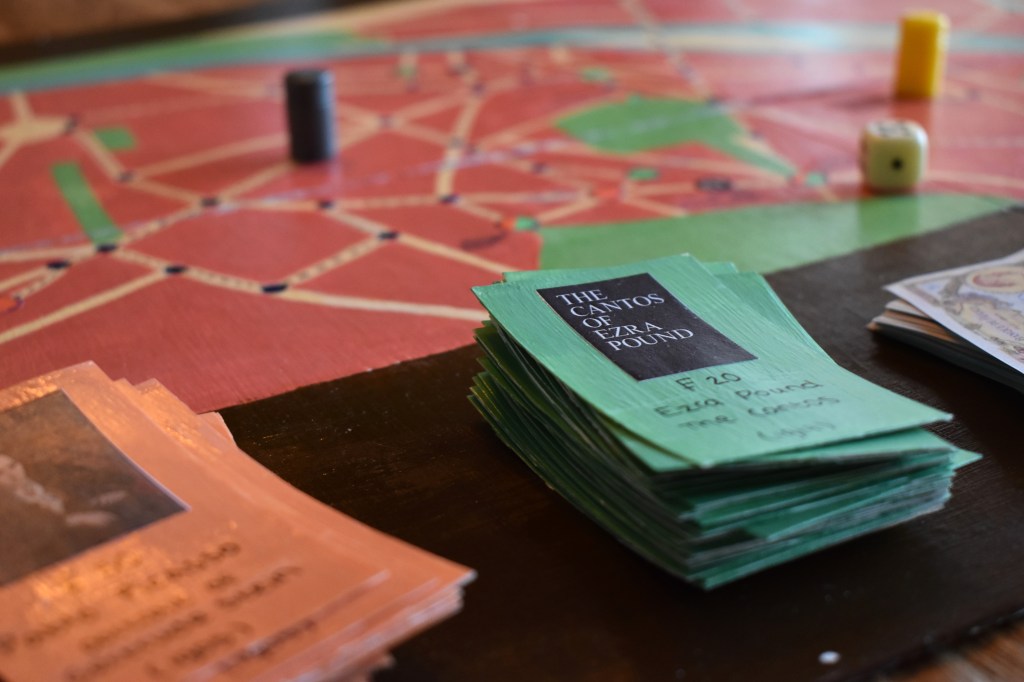
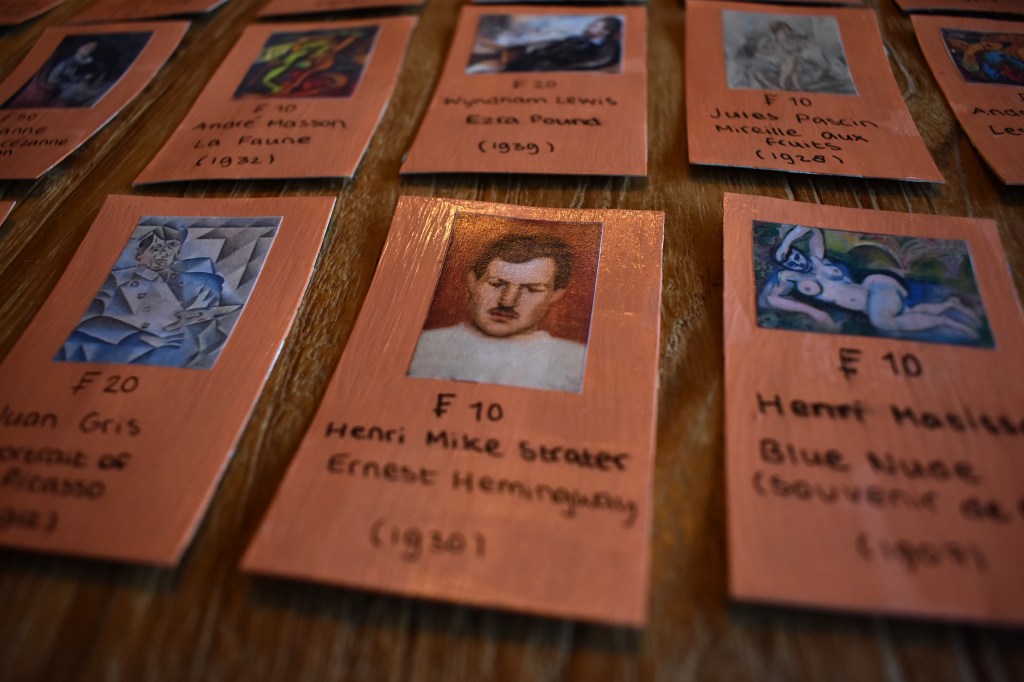
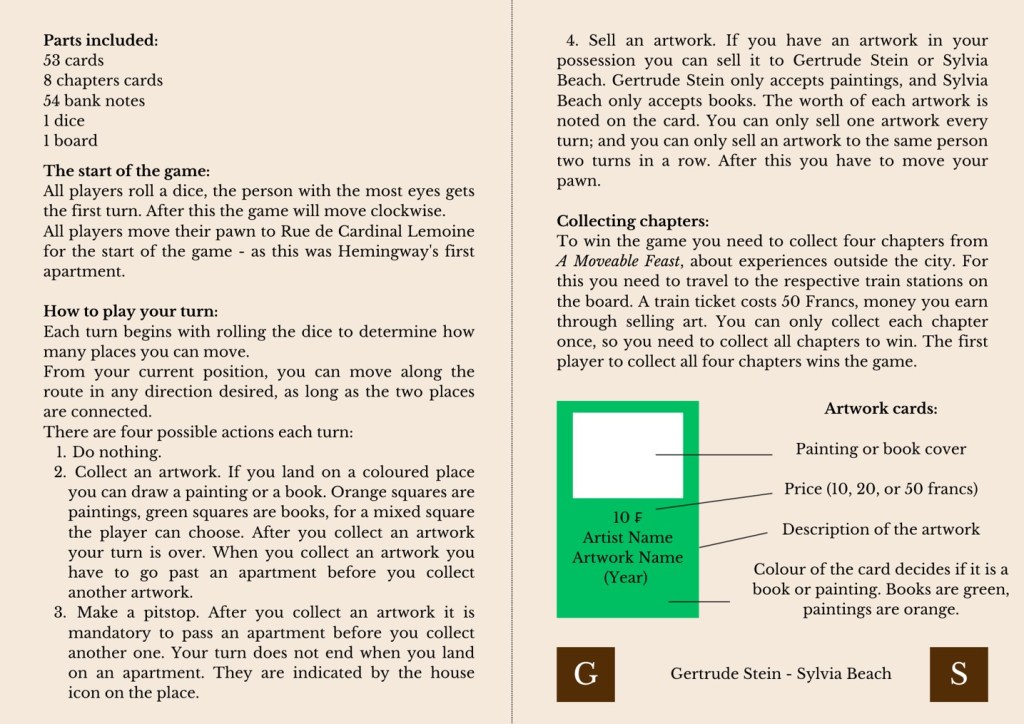
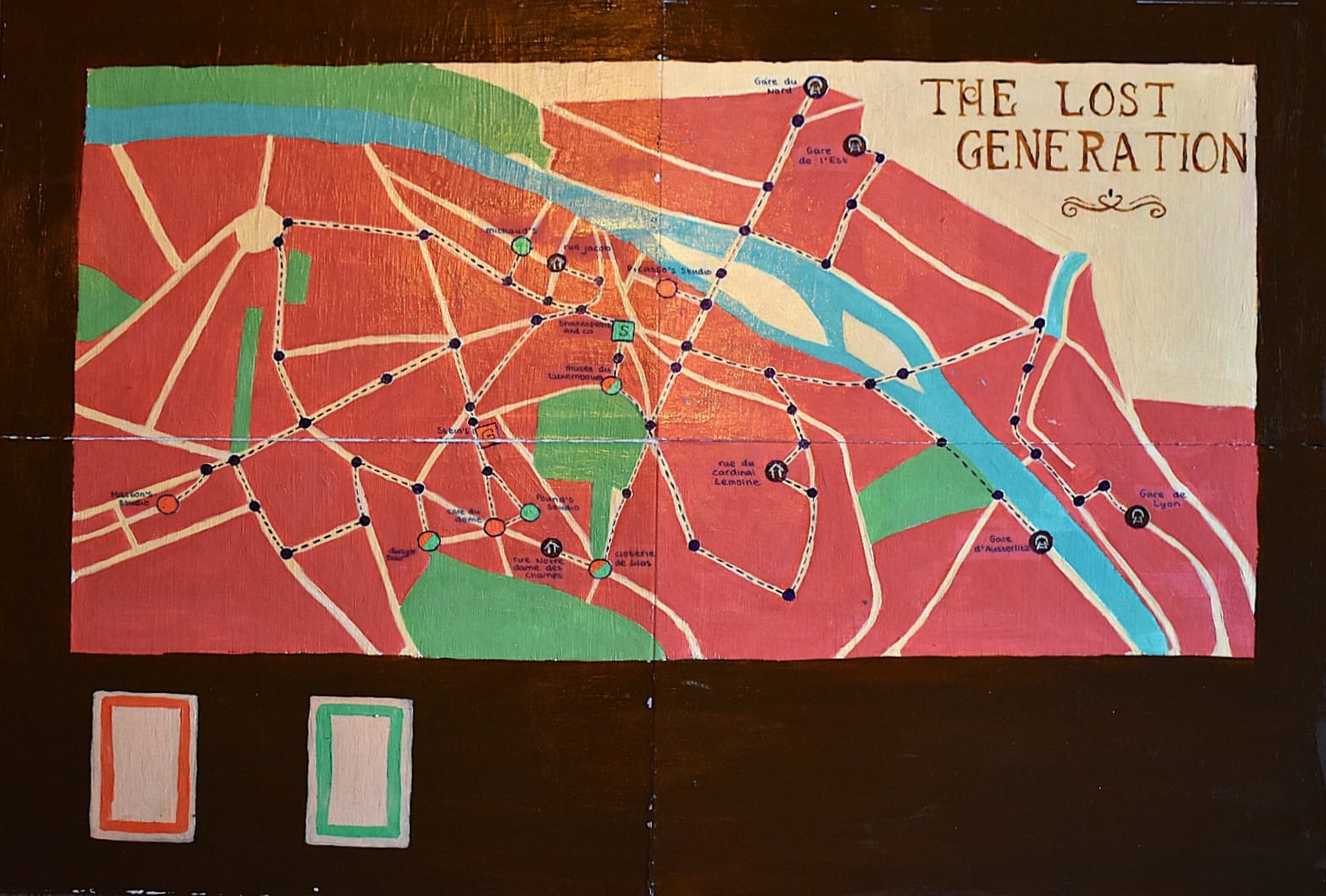
Essentially, the board game is an adaptation of Hemingway’s A Moveable Feast. The board game is an interdisciplinary work that engages with the source-text. To guide me in the process of adaptation, Linda Hutcheon’s theory proved very useful. The main theme, persistent in both the book and the game, is of course the characters – all real-life artists. The game is centred around interactions with these artists: the goal of The Lost Generation is to ‘write’ chapters of Hemingway’s memoir, while collecting the art of his friends. When landing on specific places on the board, players receive cards with artworks on them – either literature or paintings. The players can sell these artworks to Gertrude Stein and Sylvia Beach, to earn enough Francs to buy train tickets. Each train station corresponds with a chapter from A Moveable Feast. These connections are historically and geographically accurate.

Both Gertrude Stein and Sylvia Beach are often mentioned by Hemingway, and are perhaps some of the most influential ‘characters’ in the book. Because of this, and because I needed some feminine power in this male-dominated book, I centred most of the game around them.

Gertrude Stein was an American author and art collector who moved to Paris in the twentieth century. She is known for the famous salon she hosted in the city, which Hemingway frequently visited. This salon functioned as a meeting space, where many of the important modernist artist’s met each other. Players can thus sell all of their paintings to her, which differ in value.

Sylvia Beach, also an American, was a publisher who lived in Paris. Her bookstore Shakespeare and Company is quite famous, and was described by Hemingway in A Moveable Feast. He also wrote about Sylvia Beach’s publication of James Joyce’s Ulysses, which was a significant moment for the modernist literature field. It comes to no surprise, then, that players can sell works of literature to Sylvia Beach in the game.

I developed the process of the gameplay according to Roger Caillois’ game theory. He distinguishes four different types of games: Agôn, Alea, Mimicry, and Ilinx. These four types each describe a quality that a game can have, and naturally I wanted to incorporate as many as possible, to create ‘the ultimate game.’ Caillois describes Agôn as competition. It is important that there is a complete equality of opportunity for everyone, so the players’ talent becomes the deciding factor. In the case of board games, this talent is usually the strategy they choose. Alea is the element of chance. In board games this is often incorporated as dice rolling, with The Lost Generation being no exception. Additionally, the artwork-cards have different values and are drawn blindly, increasing the role of chance in the game. Caillois defines Mimicry as imitation. Essentially, Mimicry is a form of roleplaying: the player becomes a fictional character and behaves like them.  I associate this with a sense of escapism. Woody Allen captured that escapism perfectly in Midnight in Paris: every generation longs for a different time (or even a different place). The entire board game is based around this desire, with some additional creative liberty. Ilinx refers to a feeling of vertigo. Interpreted literally, this is quite impossible to achieve within a board game. Though one could argue that a radically different perspective on a familiar work from history – A Moveable Feast – can cause disorientation as well. Three – possibly four – out of the four checkboxes ticked off should be the recipe to a perfect board game, right?

To me, the most important and most enjoyable part of the process was designing the board. Because of A Moveable Feast’s strong geographical quality, it felt obvious that the board should be some variation of a map. In the course we encountered narrative cartography through Marie-Laure-Ryan, who categorizes different kinds of intertextual maps. In the case of The Lost Generation, the map is an annotation of a real-world map, as an interpretation of the original text by Hemingway. In this part of the process I took some creative liberty – after some frustrating dead-ends – and used a map provided by Google Maps, of which I altered the scale slightly. Throughout the research, it surfaced that the majority of the book takes places in the Montparnasse neighbourhood, while all the train stations are located much farther away. So I altered the scale, and then ‘annotated’ this map with routes and locations.

Eventually, all this research resulted in a hand painted board game: The Lost Generation. The game is far from perfect, but that was not the point of this research. I learned so much about the process of creating a board game, and a lot about transmedial storytelling. It was fun to actively engage with the theory we encountered in the course, and to expand this fictional ‘franchise’ that I have come to love a little further.  

A Nooge’s Notes to Self: Amy Winehouse In Her Own Words

Dennis Kersten

According to her parents, Amy Winehouse was quite a private person before she became famous as the voice of her generation. As a young girl she’d spend ages in her bedroom writing and drawing stuff she’d typically keep to herself. Even as an artist she would never play her family a new song before it was absolutely perfect. You’d think, then, that Winehouse would have dreaded the prospect of the publication of her juvenilia after her death. Little did anyone know that it would come so soon, after a short but commercially as well as critically successful career, which spawned two studio albums, a number of hit singles and many iconic live performances. As last year’s publication of Amy Winehouse In Her Words suggests, there was little difference between public and private Amy. It shows how her early writing actually prepared for the daring candor and self-deprecating humour of her songs.

The book’s arrival was perhaps inevitable as well: posthumous releases of musicians’ private papers have become something of a staple of pop life writing. The last couple of decades have seen the publication of Kurt Cobain’s Journals (2002), The John Lennon Letters (2012), Jimi Hendrix’ Starting at Zero: His Own Story (2013), Ian Curtis’ So This Is Permanence (2014) and Prince’s The Beautiful Ones (2019). Some of these piece together a more or less complete autobiographical narrative by carefully sequencing extant journal fragments, quotes from interviews and song lyrics (Hendrix), while others bring together facsimile of letters, notebooks and other memorabilia without too much interference from curators or editors (Curtis). Amy Winehouse’s book falls in between these categories and most resembles Prince’s memoir, which supplements His Purpleness’ own writing with editorial commentary and pre-fame photographs from family albums.  

In Her Words was compiled by Winehouse’s parents and is divided into several sections, from “Early Years” and “School Days” to “Fame” and “Legacy”. All of these are prefaced by short biographical chapters by Janis Winehouse-Collins and Mitch Winehouse, who also provide commentary to the visual material. The latter confirms that Winehouse was an “obsessive documenter” (16) of her own life from an early age onwards. She loved making lists: of words to describe herself (“loud, bright, bold, DRAMATIC, MELODRAMATIC”), but also of her “trademarks” as an artist (“walking bass, sweet jazz chords, hip hop beats”). Some of her notes can be read as memos to herself (“New rule: always track m8’s/ layer harmonies over em”). We learn that Winehouse was given the nickname of “Nooge” by her mother, “a Yiddish word that means she was always pushing the boundaries” (37). Even funnier is the letter in which the gobby young Amy tells the story of how she is nicknamed “Main Mouth” by a boy she meets on holiday, who subsequently christens her two best friends “Mouth 2” and “Mouth 3” (93).

The closer Winehouse gets to adulthood, the longer and more seriously self-reflective her writing becomes. Some reviewers have called In Her Words a “sanitised” portrait, a criticism Janis and Mitch anticipate by writing that “Despite what many people presume or have written about Amy’s life in the past, we’re hard-pressed to find much torment or misery in any of her writings” (15). There are definitely stories missing and Janis and Mitch sometimes seem at a loss as to how to read the prose poems and diary-like pages from their daughter’s (late-)adolescence. They comment less frequently on texts from this period, which does leave room for readers to interpret these more emotional texts independently. On the whole, the book is a treat for fans, who are having a field day anyway, with the recent release of Sam Taylor-Wood’s biopic Back to Black, starring Marisa Abela.

A Losing Game

Naturally, any book about a tempestuous life like Amy Winehouse’s – or, indeed, any human life – will have to make compromises as to what to include and what not, even if its title or its whole paratextual presentation may imply that readers will get the whole truth and nothing but the truth. In the end, even life writing texts that “simply” let their auto/biographical subjects speak through the private papers they left behind only offer interpretations of those people’s life stories – or especially such texts, as the material they share with the world is necessarily curated and, thus, an inevitable framing of fact. It’s the eternal dilemma facing all auto/biographers: it’s impossible to represent “the whole truth” without form, but form has the nasty habit of shaping meaning.

So if, as Winehouse sang, love is a losing game, then life writing is at least… complicated. Perhaps the more so in biographies, texts that write the lives of others, even if the biographical and autobiographical are never easily separated (hence, the use of the slash in “auto/biography” by life writing scholars). Indeed, as Joanna Biggs writes in her LRB review of Catherine Lacey’s novel Biography of X (2023), “The problem with biography is that it’s impossible.” Of course, all depends on what you expect life narratives to do, but the representation of actual people in writing is never as perfectly factual, objective and disinterested as some auto/biographies want us to believe.

The “problem” of biography may actually explain many readers’ fascination for “real life” stories, but perhaps also why biofiction – the merging of fact and fiction in, for example, novels about historical individuals – remains one of life writing’s most popular sub-genres. Fiction is form shaping meaning without fixing it. Or, to borrow from Michel Foucault, fiction is form shaping a proliferation of meaning. Biofiction, especially when it writes the lives of artists, also offers the opportunity to refer to the work of its subjects without suggesting one-to-one correspondences between life and art. In fictionalised life narratives about authors, you can let their own fiction speak again (and for itself), raising fundamental questions about the relation between life and art as well as the very process of life writing itself. The strongest scenes in Taylor-Wood’s Back to Black may be those in which Amy/ Marisa Abela is seen in action as a singer and performer. Winehouse’s songs and how they are delivered say it all, really. The more so since the film – perhaps deliberately, then – spends more time on Amy’s life beyond the studio and the stage.

Playing with Chronology

As a life writing text, In Her Words has an intriguing and meaningful shape as well. The order in which the story is told contributes to the image it construes of, as it says on the back cover, a “girl who became a legend”. It tries to create a more or less coherent and auto/biographically fairly conventional narrative with, among other things, chronologically organised chapters on childhood, school, professional life etc. The book emphasises certain topics while skipping others and there is an interesting dynamic at work in the interaction between the visual material and the accompanying commentary – especially when some writings and/ or photographs are explained and others aren’t.

The book spends quite some time on Winehouse’s childhood and adolescence, while the “Fame” section only starts on p. 230 (of 288) and contains more photographs than personal notes; a result, her parents write, of her touring schedule, a lack of privacy and the impact of her addictions. A striking absence is Blake Fielder-Civil, Winehouse’s former husband. When reading In Her Words – Winehouse’s notes as well as her parents’ commentary – you’d think he never even crossed paths with his wife, while Taylor-Wood’s film turns their love affair into one of its focal points. In their foreword, her parents do once mention the “ill-fated relationship” documented by the Back to Black album (26), but they refrain from naming Fielder-Civil.

In Her Words may be structured rather traditionally chapter-wise, it does play with chronology in a number of significant ways. The highlighted quotes from Winehouse’s writings on spreads of pages not only function to link and comment on parts of her life story, they also generate emotional responses when their dramatic irony is recognised. For example, the final quote of the book reads: “I’ve got all this time to make that happen… I’ve got years to do music”, sentences that acquire the weight of “famous last words” as a consequence of their appearance as some sort of book conclusion. Sometimes, a phrase from a letter or a note is anachronistically superimposed on a photograph from another, often earlier source. One instance is the handwritten Michael Jackson reference “You know Im bad Im bad Im bad” projected onto a picture of a moody young Amy (67), which creates a humorous effect by appealing to readers’ knowledge of Winehouse’s later life.

Apart from these ironic anachronisms, there are also quotes that acquire a specific meaning when taken out of context. In “Early Years”, amid memorabilia of her childhood, Winehouse comments: “Seeing as I was very young, I don’t remember much. But I do remember being an angel” (74). As becomes clear one section later, this apparent retrospective reflection on her younger self is actually lifted from a primary school scrapbook chronicling her appearance in a nativity play as, well, angel (87).

The Genuine Article

Without explaining anything away, In Her Words makes you want to revisit her two studio albums, Frank and Back to Black, as well as wonder about the connections between Winehouse’s private writing and her songs. As said, the book adds to the suggestion that her song lyrics organically developed from the autobiographical dimension of her private writing, but it does so while raising the question if Winehouse’s songs should also be listened to as further exploring that writing’s note-to-self aspect. Which is not to say that she’s wasn’t interested in communicating with an audience, or that it’s difficult to identify with the very personal emotions she processed through songs like “What Is It About Men” and “You Know I’m No Good”. She was never so pretentious as to present her own experiences as symbolising the “human condition” – to put it MELODRAMATICALLY. But even without intentionally universalising personal pain, Winehouse clearly struck a chord with fans who love her music not only because they recognise themselves in her stories, but also because she told these with such brutal honesty.

She certainly wasn’t some kind of ten-a-penny, sweet-talking singer-songwriter; “Main Mouth” could be tough as well – both on others and herself. In fact, most music fans’ first introduction to Amy Winehouse will have been her debut single and Frank opening track “Stronger Than Me”, in which she effectively disses a “weak” boyfriend by, among other things, asking him if he is gay. (Fittingly, in Taylor-Wood’s film, Winehouse’s harder side is first revealed via the scene in which she dumps said boyfriend.) Equally vulnerable and defiant, she was real: in an industry in which authenticity is so often just another performance, Amy Winehouse stood out as the genuine article. To her parents’ credit, In Her Words doesn’t hammer home the message. But then again, there’s no need with the kind of material it so beautifully presents.

The Hidden Curriculum

By Edwin van Meerkerk

For the past year and a half I have had a series of intensive talks with lecturers and students all over campus. This is part of an educational innovation project on sustainability in education. Since I am specialized in – and fascinated by – teaching and learning, this project is also a way to dive more deeply into the question what we are talking about when we’re talking about education – or rather: what are we doing when we’re ‘doing education’? For this project, we visited every nook and cranny of our campus and met with staff and students from 38 bachelor’s programmes. And while our ‘sample’ of lecturers and students is not statistically representative, some patterns are starting to emerge that go beyond the specific group of people we talked to.

We started our first interview by asking students and lecturers to describe their programme in two or three sentences – as if they were at a family gathering and an aunt or uncle asks “what is it you’re studying again?” All save one of our 76 interviewees answered by describing the content of the curriculum: “my study is about …” That may seem logical, but it is highly problematic, given that in the subsequent interviews and workshops we organized, we found a consistent pattern of focus on the content (also referred to as “the basis” or “the core”) and a disturbing silence when it came to identifying what students are able to do with that content. Both lecturers and students found it very hard to tell which skills, attitudes, or competencies students learn. Digging deeper into this matter, we found that (luckily) students actually do learn important skills, but that in many cases these skills were not assessed or given feedback on. We call this the hidden curriculum.

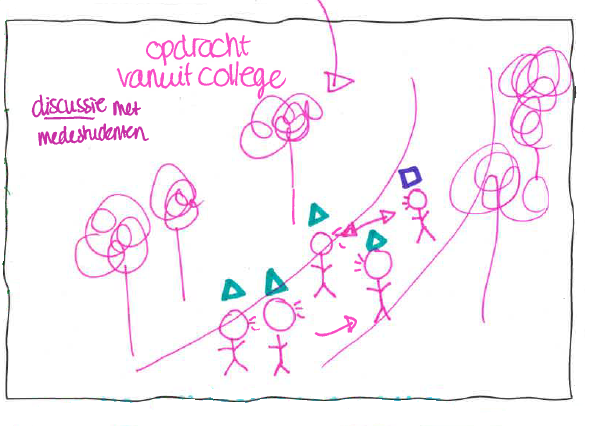
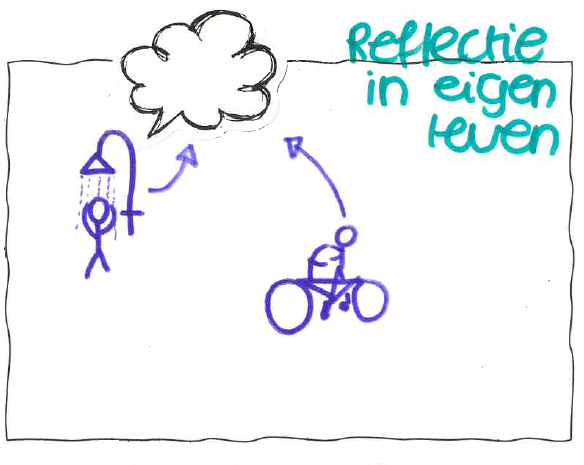
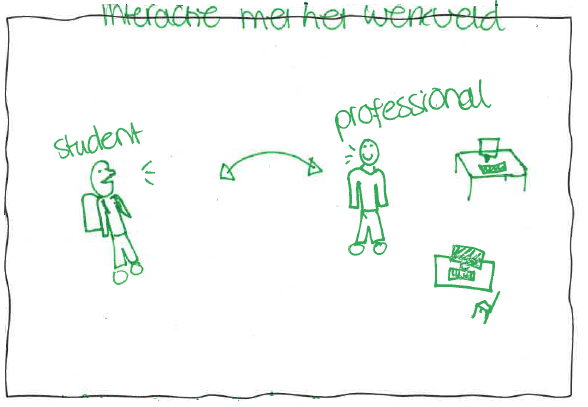
This hidden curriculum at universities is a curriculum that, in the words of one of the participant lecturers, was “who we really are”. Students across disciplines affirmed that they could recognise fellow students by these skills and attitudes as different from students in other disciplines. But how do students acquire these skills? As one lecturer put it, between classes “magic happens”, without the lecturers explicitly guiding or steering students in this learning process. We then tried to make this explicit by asking lecturers and students to make a storyboard of the learning process, visualising student activity during a course. This proved to be a difficult, but often revealing exercise. Reflecting on one’s learning process, developing critical thinking skills, learning to work in teams are key objectives, yet they very likely happen outside our lecture halls.

It is time that we recognise that the most important aspect of our discipline is not what it is about, but what we want our students to be able to do with the content we are treating in class. Only then can we answer why it is important for cultural students to be able to analyse films, songs, visual art, theatre, and poetry; why it is extremely relevant for students (and for society) that people are trained to critically analyse cultural practices and policy. Because we are just as relevant as any other discipline, from Economy to Physics, from Computing Science to Psychology. The world needs public servants, journalists, educators, and other professionals who are able to critically reflect on the cultural aspect of the global crises we are in the middle of: climate, migration, housing, social safety, discrimination, and war. And we do teach them that – we just don’t always know how.

Do you want to think with us in opening up our hidden curriculum? Send me a message at edwin.vanmeerkerk@ru.nl.

Ficcability: Television, Fanfiction and Feelings

By Julia Neugarten

When I am feeling down, I watch an episode of Gilmore Girls, an early-2000’s dramedy about a mother, her teenage daughter, and their romantic entanglements in the idyllic town of Stars Hollow. Now, before you point out all the ways that Gilmore Girls has aged poorly – and yes, it has classist and fatphobic undertones and the way it portrays Korean Americans leaves much to be desired – I want to note that the show is also optimistic, kind-hearted, clever, funny, and female-centric. In short, Gilmore Girls is (almost) everything I look for in a feel-good show.

Here’s something else I tend to do when I’m feeling low: I read fanfiction – or fic – on Archive of Our Own, one of the largest English-language fanfiction websites. Because of the way the archive is structured, I can look for stories that either allow me to wallow in my self-pity (which we call angst in fanfiction-jargon) or stories that pick me up and fill me with warm fuzzy feelings (which we call fluff). Natalia Samutina described fanfiction as “emotional landscapes of reading,” because it lets readers curate their emotional trajectory this way.1 My own recent research also shows that some responses to fanfiction praise stories for their capacity to bring about specific emotions, especially comfort.

I am satisfied with my coping strategies. I’m sure everyone feels sad from time to time, but a Gilmore Girls + fanfic double whammy never fails to cheer me up, which is why I find it strange that very little fanfiction has been written about Gilmore Girls. And since I am a data-driven scholar of fanfiction, I decided to quantify this matter: which TV shows generate a lot of fanfiction? Which generate almost none? What could explain the difference in fanfiction production between these shows?

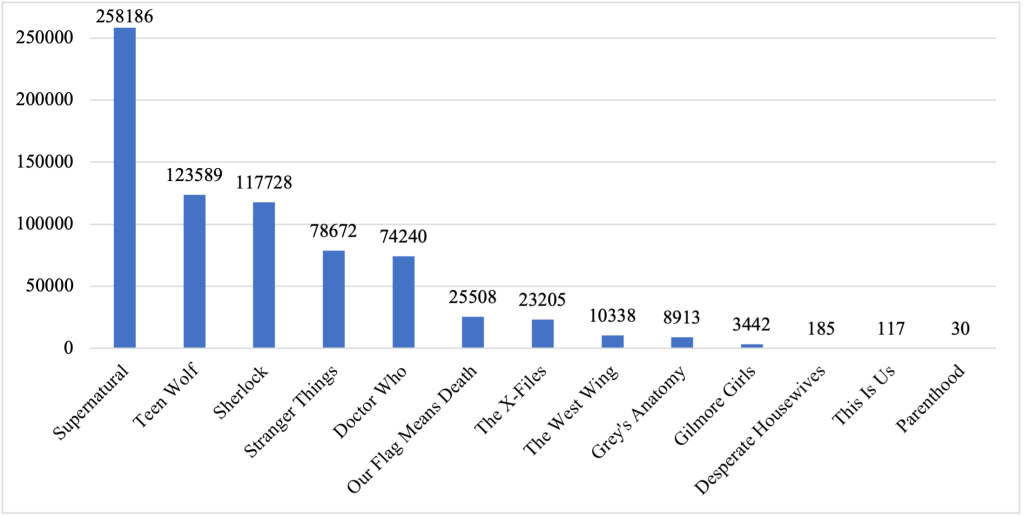
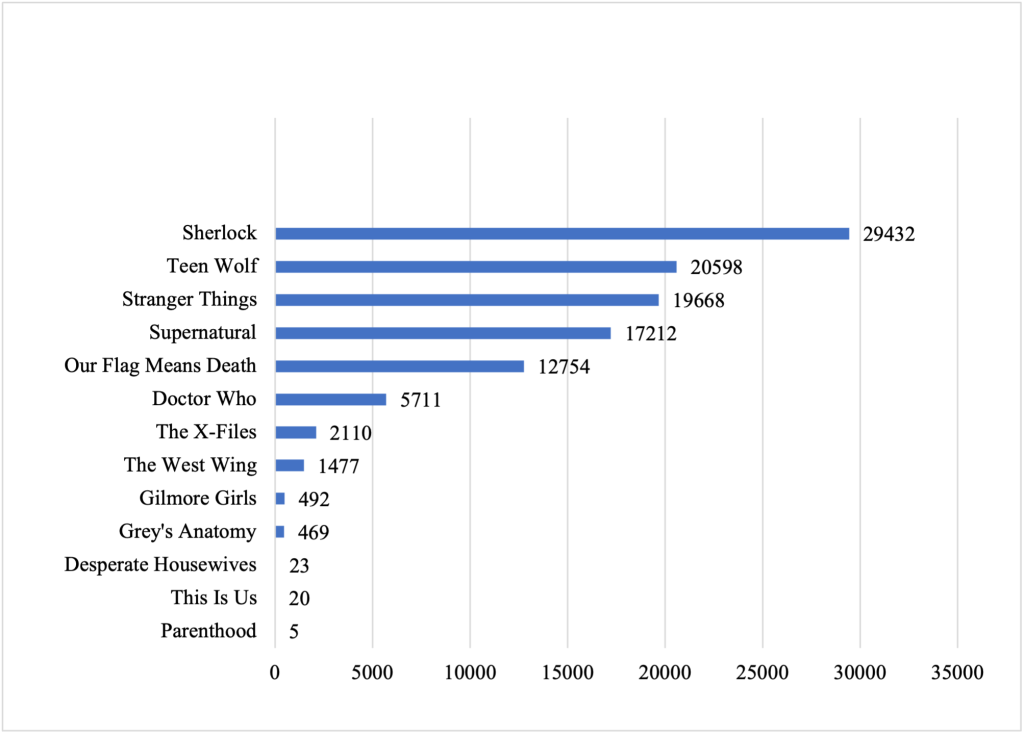
Here are some TV shows I randomly hand-picked, visualized with the number of fanfics written about them on Archive of Our Own as counted at the start of 2024.2

How many stories?

Works of fanfiction per TV fandom

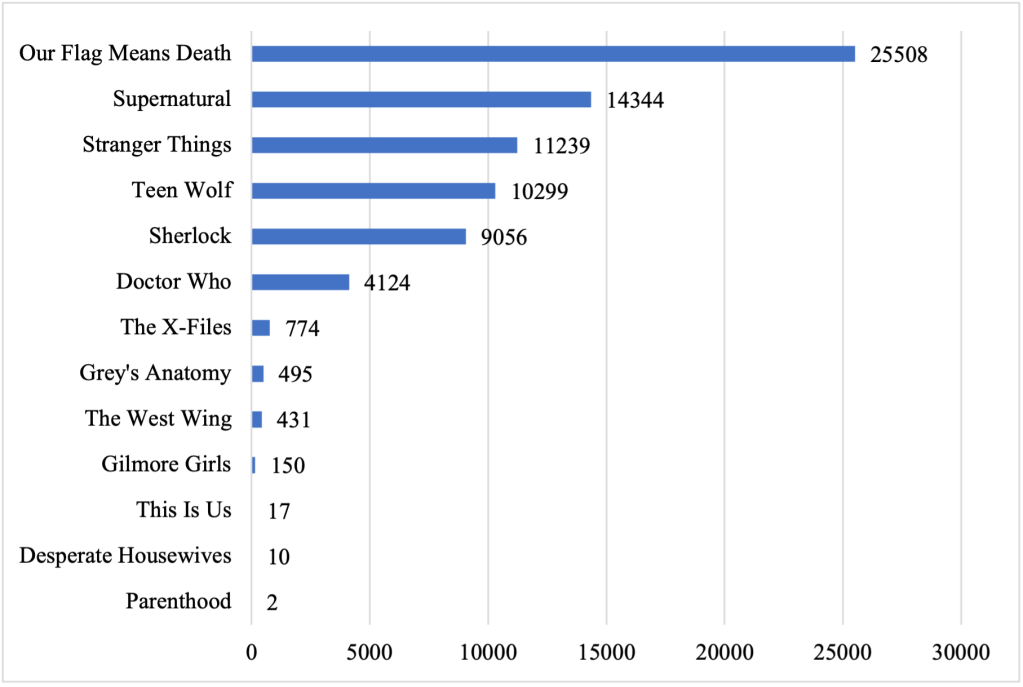
If you’re familiar with TV fandom, the numbers I found probably don’t surprise you. After all, some of these shows have had much more time to accrue a committed fanbase than others, and some also have many more episodes. So, let’s divide the number of stories written about each show by the number of years that have passed since it first aired; that’s the amount of time they’ve had to accrue fanfiction.

Fanfiction Production Over Time, Seasons, and Episodes

Works of fanfiction per year

Our Flag Means Death comes out as the clear winner here. Since its inception in 2022, this show has had a very active and vocal fanbase. But Our Flag Means. Death has only had two seasons; what is the effect of that?

Works of fanfiction per show’s seasons

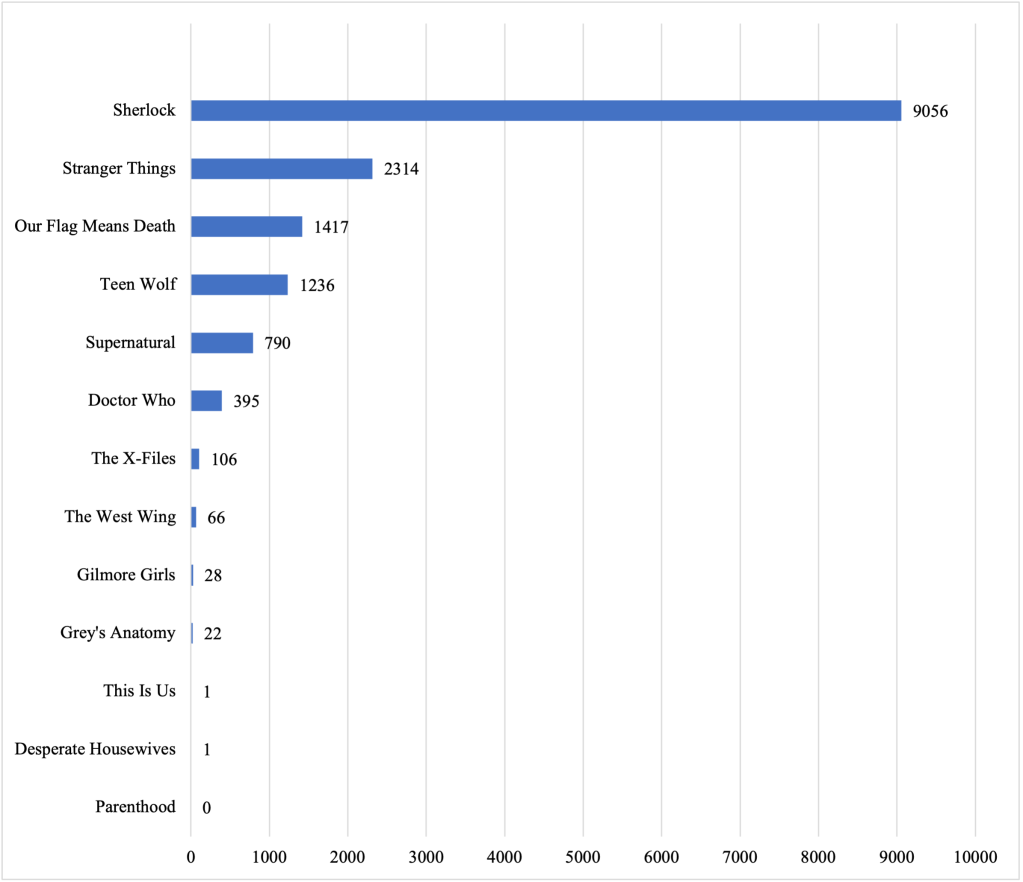
In this comparison, the clear winner is Sherlock, which has a meager four seasons. Sherlock generated an impressive 29.000 works of fanfiction per season, almost 30% more than the runner up, Teen Wolf, which averages a little more than 20.000 stories per season over six seasons.3 When looking at the average number of stories produced per episode, Sherlock also comes out as the clear winner with more than 9.000. Runner-up Stranger Things has a little over 2.000. This could be due to Sherlock’s unusual format, which consisted of very few episodes per season, all of which were movie-length.

Works of fanfiction per episode

We can conclude that Sherlock fandom has been unusually industrious. But Sherlock isn’t the reason I decided to run these numbers; Gilmore Girls is. In all these comparisons, Parenthood, Desperate Housewives, This Is Us, Grey’s Anatomy and Gilmore Girls are consistently the lowest scorers. These shows have inspired fewest fics overall, fewest works per episode, per season, and per year. Why? What do these shows have in common?

Introducing Ficcability

To explain this phenomenon, I propose the concept of ficcability: the extent to which a particular tv show or other narrative invites, inspires, and encourages the production of fanfiction. This concept builds on Henry Jenkins’ idea of drillability.4

“the ability for a person to explore, in-depth, a deep well of narrative extensions when they stumble upon a fiction that truly captures their attention.”

Jenkins’ notion of drillability calls attention to the fact that not all stories are equally open to interventions and extensions from the audience, and that formal features of the story, such as the perceived depth and extensibility of the narrative, can either invite or discourage rewriting and transformation.

The Unficcable: Emotions-Only Shows

So, what makes a story ficcable? In her 2008 analysis of fan discourse around the TV show Roswell, Louisa Ellen Stein found that fans distinguished between two types of shows, which they called Emotions-Only and Special People-shows.5 As explained by a fan:

“Special People programs focus on talented individuals who face conflict from without, whereas Emotions-Only programs feature ‘normal’ characters whose conflicts come from within themselves and from their relationships with each other.”  

And what do all shows that inspired relatively little fanfiction – Parenthood, Desperate Housewives, This Is Us, Grey’s Anatomy and Gilmore Girls –  have in common? That’s right; they are Emotions-Only shows. These shows are about families, colleagues, neighbors, and lovers, about the (mis)communications that structure our social world, our desire to be recognized and understood, to share, to connect, to belong. They are comfort shows, in the sense that their emphasis on emotional trajectories can be comforting to watch. These shows help us navigate our feelings and desires by showing us characters who struggle to negotiate social situations we may recognize from our own lives. Additionally, these shows tend to emphasize emotional fulfillment and happy endings for their characters, essentially closing off the narrative. This focus makes narratives such as Gilmore Girls emotionally satisfying. I hypothesize that this makes fanfiction less necessary to give audiences the emotional and narrative closure they seek.

The Ficcable: Special People Shows

By contrast, shows that inspire a lot of fanfiction – Supernatural, Sherlock, Teen Wolf, and Stranger Things – are Special People programs. Their protagonists are monster hunters, genius detectives, werewolves or members of a select group who have access to another world. These shows emphasize action over feeling, plot over person, exterior action over interior character development. These are shows where the narrative tension and structure comes from dramatic encounters with monsters, villains, and crimes, where personal and emotional responses to these dramas are sidelined to make room for action and excitement. Supernatural rarely lingers on the emotional strain of hunting monsters. Later seasons of Sherlock turned attention to the relationship between Sherlock and John, but complicated murder mysteries always remained more central to the plot than feelings. Because of their emphasis on plot, these shows leave an emotional gap that fanfiction communities are then inspired to fill.

Storyworld: An Additional Aspect of Ficcability

Ficcability is also impacted by the construction of a storyworld. In shows structured around monsters and mysteries, the plot is endlessly extensible. In the world of a show like the X-Files or Supernatural, there is always a new monster to fight, a new mystery to solve. As a result, these storyworlds capture the imagination, inviting fanfiction communities to come up with their own fantastical creatures and improbable situations. These adventurous worlds might invite more fanfiction than the ostensibly realistic storyworld – small-town America – of a show like Gilmore Girls.

So ficcability is a property of a TV show that relates both to the imaginative potential of its storyworld and to the show’s position on an axis that goes from emotion-oriented to action-oriented.

Problematizing Ficcability

A closer look at Our Flag Means Death (OFMD), the clear winner in the Fics/Year-category, problematizes the concept of ficcability.  OFMD is a show about pirates. It’s heavy on the action and its storyworld is full of adventure. At the same time, interpersonal relationships are central to the show, and the comedy largely comes from the clash between adventure-oriented characters and storylines and the strain these fast-paced plots put on interpersonal relationships.

In one of the funniest moments of the show’s second season, a group of enemy pirates decides not to torture and kill the protagonists. Instead, the enemies mutiny, because they no longer feel that their captain is providing them with an emotionally nurturing work environment. That’s right. An emotionally nurturing work environment. On a pirate ship.

In this scene, OFMD explicitly stages the incompatibility of fictional characters’ emotional fulfillment and their adventurous lifestyles and storyworld. Perhaps it is the show’s acknowledgement of their characters’ emotional needs – in the face of their adrenaline-fueled adventures – that makes it so incredibly ficcable, and perhaps Our Flag Means Death is exploring possibilities for a different kind of TV show – and associated fandom – that combines the ficcable with the emotionally resonant.

This aligns with the observation, taken from Stein’s case study, that some fans praise TV shows’ ability to transcend strict genre categorizations. I hope to see many more transgeneric shows on TV in the future, because they seem eminently ficcable to me!

Many thanks to Fenna Geelhoed for giving feedback on an earlier draft of this blogpost.

Footnotes


  1. Samutina, Natalia. “Emotional Landscapes of Reading: Fan Fiction in the Context of Contemporary Reading Practices.” International Journal of Cultural Studies, vol. 20, no. 3, 2017, pp. 253–69, https://doi.org/10.1177/1367877916628238. ↩︎
  2. I am sure other fanfiction platforms, such as Fanfiction.net or Wattpad, have very different distributions over fandoms. ↩︎
  3. This comparison does not account for the fact that fanfiction production is unlikely to be stable over time. ↩︎
  4. Jenkins, Henry. “Transmedia Education: The 7 Principles Revisited.” Pop Junctions, 21 June 2010, http://henryjenkins.org/blog/2010/06/transmedia_education_the_7_pri.html. ↩︎
  5. Stein, Louisa Ellen. “‘Emotions-Only’ versus ‘Special People’: Genre in Fan Discourse.” Transformative Works and Cultures, vol. 1, Sept. 2008. URL: https://doi.org/10.3983/twc.2008.043. ↩︎

Writing Questionnaire 2024

By Julia Neugarten

Writing is the bread and butter of the humanities scholar. It is our chisel and our marble, our raison d’être, and yet the bane of our existence. With the daunting task of writing a dissertation in the forefront of my mind, I was curious about my colleagues’ writing habits, and so I circulated a questionnaire among the employees of the department of Arts and Culture Studies at Radboud University. The response I got was inspiring and insightful, and whether you’re a student or a scholar, a poet or a playwright, some of it may be helpful to you as well.

How much do we write?

Twelve people responded to the survey. On average, they spend 226 minutes per week writing, or a little under four hours.1 The amount of weekly writing time per person varies by a lot, ranging from 60 to 750 minutes. Together, these 12 people spend 45 hours per week writing.


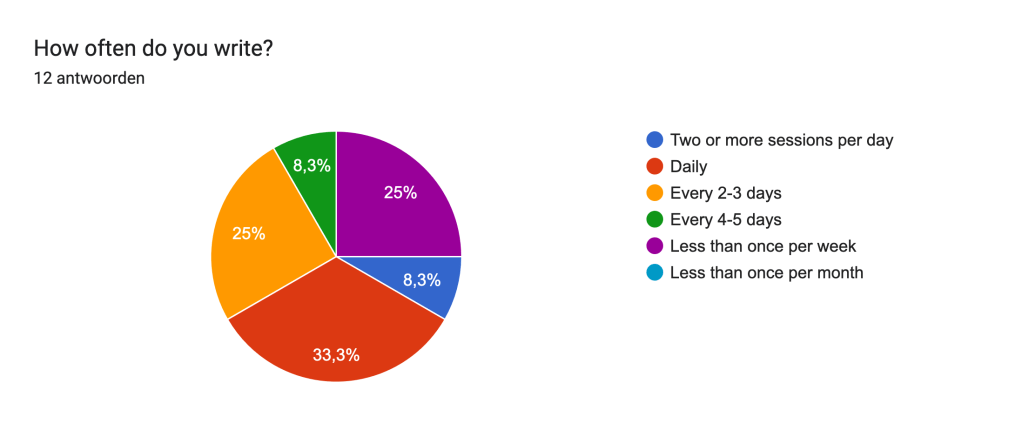
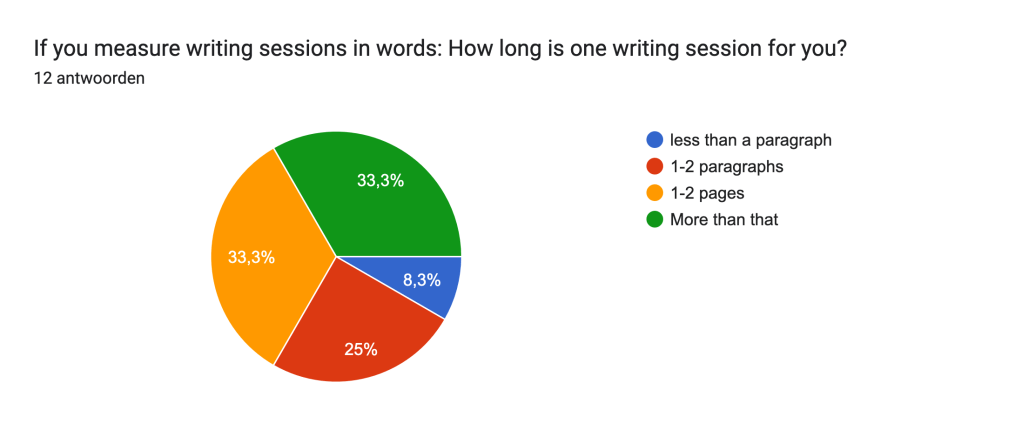
Some people measure writing in time and others measure it in output, so the questionnaire asked about both. Conventional wisdom holds that it is best to write every day,2 and about one-third of respondents do. Shout-out to the person who manages multiple writing sessions per day.

When comparing writing time to word production, interesting differences emerge. One respondent estimates that their writing sessions take longer than 2 hours and results in less than one paragraph of writing. Another estimates that they produce more than two pages in a session of under 30 minutes. Of course these questions do not account for the quality of the writing, or how much actually ends up getting published. This is purely about production.

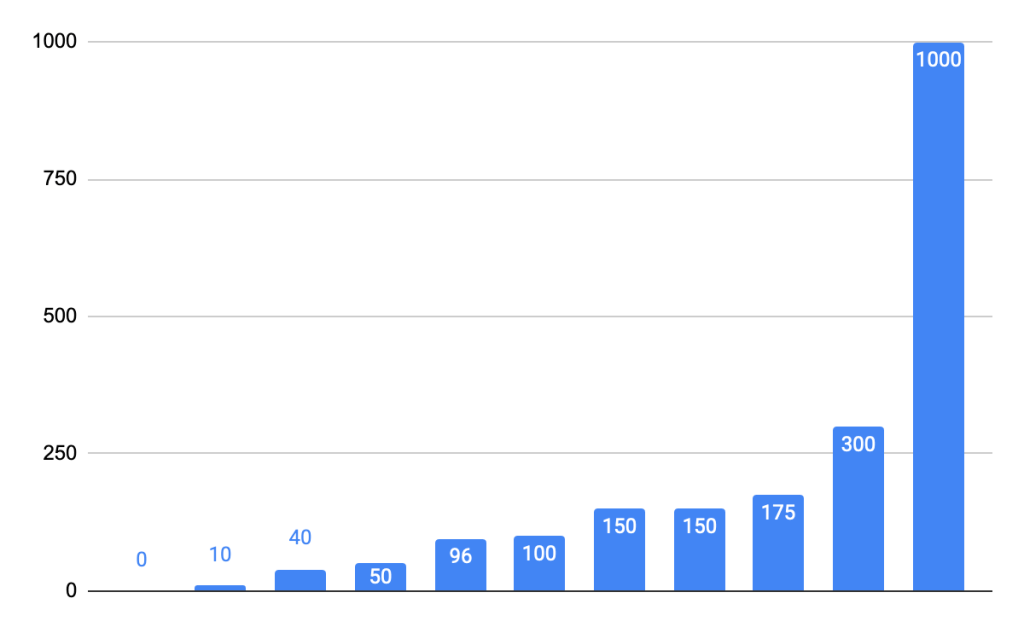
I also asked: How many pages of academic text do you estimate you have written in the past year, assuming a page is around 250 words?3 Here’s the reported response in pages, with each bar representing one respondent.

Notably, the person who estimated their output at 1000 pages a year (actually, their response was ‘more than 1000 pages’) also reported that they were not happy (2 out of 5) with how much they wrote.

How do we feel about writing?

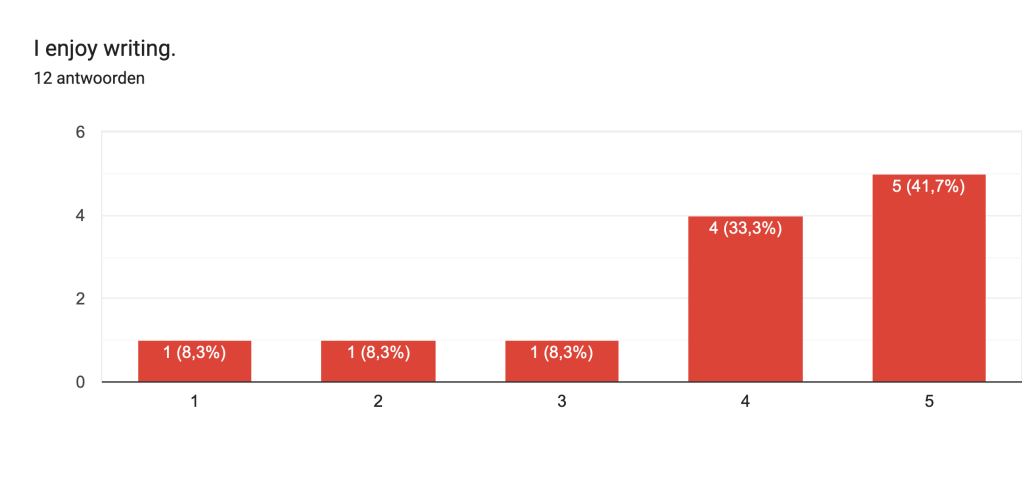
Fortunately, most respondents report that they enjoy writing.

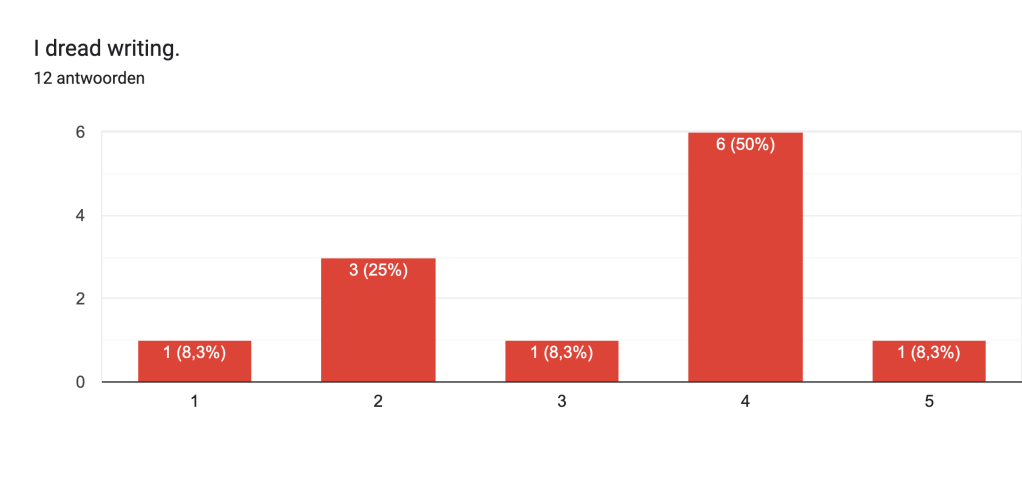
Meanwhile, more than half also report that they dread writing. For example, the person who said they enjoy writing not at all identifies the following phases in their writing process:

pain. agony. suffering. killing. relief.

Interestingly, 4 respondents (1/3) dread and enjoy writing approximately in equal measure, reporting a score of 4 or 5 in response to both questions.

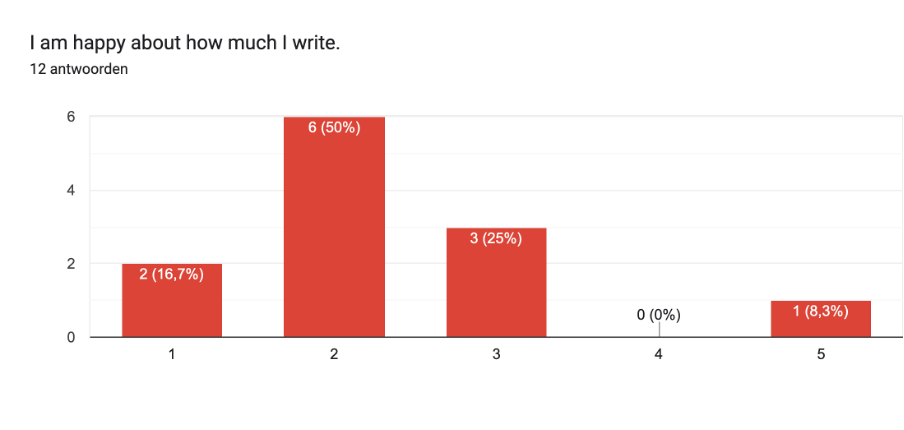
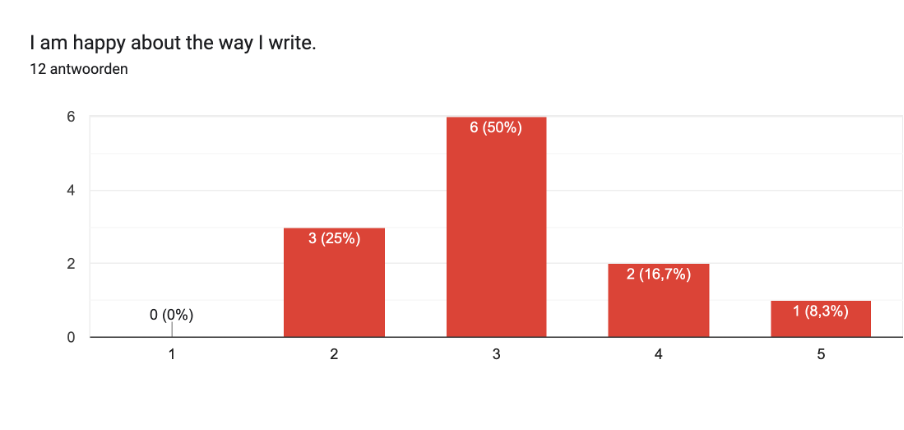
Around 3/4 of respondents are not very happy about how much they write, although most are at least moderately satisfied with how they write. The numbers on writer’s block are pretty spread out, although those who experience a lot of writer’s block also, unsurprisingly, report lots of dread around writing.

What are our writing techniques and processes?

I was curious about the strategies my colleagues used to get their writing done, and the steps they followed to structure the writing process. Many people mentioned that hot beverages, isolation and frequent exercise were key to getting them writing. The Pomodoro Method, where you alternate between 25-minute writing sprints and short breaks, was praised twice for boosting productivity.4

I was happy to see that I’m not the only one who feels like successful writing requires some kind of ritual to get you into the appropriate mindset. Someone reports that they need to:

block a whole day at a time (otherwise no way of getting into the ‘mood’)

Another respondent uses music to set the right atmosphere:

I have a playlist that is always the same so that I don’t REALLY hear it. I sometimes alternate music styles because the rhythm of the beat impacts the way that I think and write.

Many respondents say it can feel intimidating to start writing. For one writer, Word feels too ‘official’ and so writing on paper in the initial stages is a good way to lower the threshold. Interestingly, they also describe a Google Doc as less intimidating than a Word document.

Outlining is also mentioned as a good way to get rid of the empty page, and someone reports:

I tend to “trick” myself and write pieces in bits and bobs.

When it comes to the best order for writing and revising, responses are mixed. Some people write their texts from beginning to end, saying:

[I] can only move on to the next section of text if all earlier paragraphs are as complete and finished as I can make them.

Other people write the conclusion first, or write from beginning to end except for the introduction, which they save for last. Some people do not adhere to a linear order at all during writing. One piece of advice I particularly like is the idea to see the structuring of a text and its writing as carried out by two separate entities:

With pieces that I find really difficult to write I will write an outline where I briefly state which point I want to make in each paragraph so that I separate the role of opdrachtgever and uitvoerder of my own writing: I first write myself an outline, and then I pretend that I’m just the writer who was hired to execute it wether they agree or not.

This quote also touches on the next question I asked: Do you view writing and research as separate tasks? Most people answered yes to this question, although there were a couple of firm ‘no’s’ – like the person who says: “Writing is thinking. Writing is research” – and some people were unsure. Personally, I like this view:

Writing is about communicating results, not about creating results.

This separation lets us see the craft of writing as a separate academic skill, which I find valuable. Another respondent explains:

[Research and writing are] not neatly separated in time: once I start trying to write a final text I’ll discover along the way that I need research for specific steps in my thought process. So in practice they may seem to blend, but I regard them as separate sometimes very quickly alternating activities. Also: my experience is that writer block is what happens when you lose control over the difference between research, thinking and writing, and between writing and editing. It is, in my personal practice, important to be able to write horrible first drafts.

So the separation of writing and research seems productive to many. Nonetheless, I find it useful to think of writing as the material process through which scholarly research comes into being, especially in the humanities. That idea is described elegantly by one of the respondents who says no, writing and research are not separate:

my keyboard is my laboratory, this is where I atomise my data and pour them in textual flasks to see which ingredients react under which conditions.

Writing Advice: the Best and the Worst

Finally, I asked respondents about the best and worst writing advice they ever received. Most good advice mentioned the discipline to write every day, and a variety of methods for lowering the threshold on writing, so that writing every day became easier. Those tips included, for example: outlining first, lowering one’s own expectations about the quality and elegance of the first draft, starting to write at whatever point in the text is already clear to you. Similar advice is communicated in motto’s like “Done is better than perfect.” and “The best PhD is the Submitted PhD.” In other words: the perfect is the enemy of the good.

There’s one more piece of advice that I really like, and might write on a sticky note to keep by my desk:

Some of my most productive writing has been when I felt the joy of making discoveries and communicating my findings. Keep the joy!

Overall, what people mentioned as bad advice was often the inverse of what they considered good advice: perfectionism, especially. But some core values about the societal role of academic writing also came out in response to this question:

Writing styles are not neutral choices – they also communicate an intent and what I dare call a “vibe”. We are trying to communicate and collaborate – I’m not a fan of taking writers who’s style is hermetic or hostile towards more naïve readers as role models. Also, writing may seem like a solo activity, but I believe that at it’s core academic writing is a deeply social and collective activity: we write it down for others to take apart and re-use. (…) as academic writers we are pretty much valuable precisely to the extent that we make ourselves available to being cited and re-purposed for someone else’s research. So any advice that places to much emphasis on writing as the work of a Lone Genius Having Ideas does not make sense to me.

In a similar vein, someone observes:

Worst advice: writing is is method to order your own thoughts. It isn’t. It is a method to order the readers’ thoughts.

To conclude: in this piece, I’ve tried to order my own thoughts about the writing processes of my colleagues, and in the process I hope I have also helped you order yours. I’m going to experiment with writing academic texts in a different order, and I wish you all happy writing!

If you want to examine every response in detail, you can consult the full results of this year’s Arts and Culture Studies Writing Questionnaire here, with my added calculations in bold.

Footnotes

  1. Full disclosure: I myself am one of the 12 respondents. ↩︎
  2. Authors credited with this advice include Ray Bradbury, Stephen King, Graham Greene and Eric Hayot, the author of The Elements of Academic Style whose insights on academic writing inspired me to
    create this survey. ↩︎
  3. I removed one respondent from the dataset here, who reported 12.500 pages. That must have been a typo, or maybe they meant words instead of pages. Otherwise it would be 3.125.000 words. For comparison, depending on the translation, War & Peace is between 560.000 and 587.000 words. I don’t think anyone is writing 5.5 copies of War and Peace per year, but if you’re the respondent and this is actually accurate, let me know. I’d love to interview you. ↩︎
  4. The Pomodoro Method was invented by Francesco Cirillo. ↩︎

Algorithmic Ecologies: Refik Anadol’s Living Paintings

By Adil Boughlala and Anouk Stevens

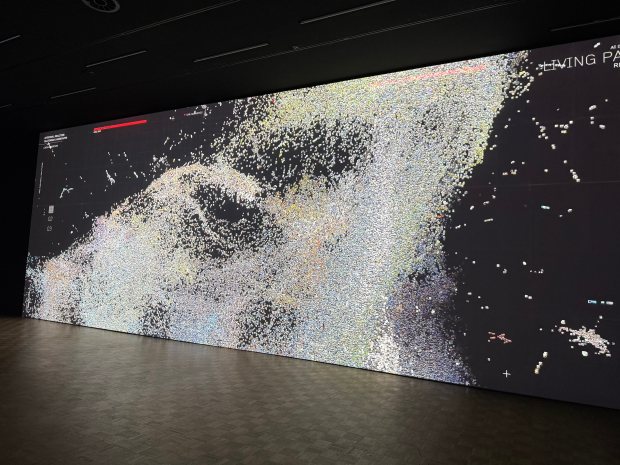
Wavelike patterns move gracefully across the screen as natural colours seamlessly ebb and flow, occasionally revealing snippets of images that resemble familiar landscapes of nature. Living Paintings: Nature at Kunsthal Rotterdam features Refik Anadol’s first solo exhibition in the Netherlands. The abstract artworks by Anadol provide visitors with a visual spectacle that explores the meaning of being human in an increasingly digitised society.1 Through the use of Artificial Intelligence (AI), Anadol creates AI Data paintings, or ‘living paintings’, that immerse the visitor in unthinkable yet recognisable landscapes. Whereas the introduction of new technologies seems to repeatedly highlight the divide between nature and culture – two strands that usually do not meet – the exhibition presents a symbiotic relationship between nature and technology. It blurs the boundaries between the ‘natural’ and ‘artificial’, and thus challenges traditional notions of what is ‘natural’ and ‘cultural’.

The ‘living paintings’ we saw reminded us of ecologies: they pose an immersive and interconnected environment of complex actors that seem to be always moving, always evolving, always ‘becoming.’2 Understanding Anadol’s works as algorithmic ecologies implies that algorithms are not isolated entities but exist within a system where they interact with each other, with data inputs, and with the environment in which they operate. Algorithms are not static, they evolve and adapt based on various factors, creating a dynamic and interconnected system akin to the interactions within an ecological environment. This ecological thinking allows for reflection on environmental conditions, and more broadly the interconnectedness of the planet and its inhabitants. We revisit the Living Paintings: Nature exhibition through this lens of ecologies.

The artist: Refik Anadol

The globally renowned Turkish-American new media artist Refik Anadol is known for his data-driven artworks. He adopts machine learning algorithms to create abstract, constantly changing, dream-like digital realms that usually address humankind’s impact on or position in natural environments. The exhibition displays Anadol’s most significant nature-themed artworks as triptychs, literal windows into a digital realm. Each series is composed of a dataset and features its own unique transformation of data into the artworks presented, from wind prediction data to images of natural parks. According to Anadol, these datasets serve as collective memories, memories that belong to everyone and should not be confined to personal or private memories.3

Contrary to common belief, the process of creating these AI data paintings requires a combination of algorithmic processing and human handpicking. Anadol does this together with a team of data scientists, researchers and designers who, together, form Refik Anadol Studio. By use of algorithms, Anadol ponders the question of whether machines can actually dream, hallucinate, or process individual and collective memories, a recurring element in the entirety of his oeuvre.4 Anadol’s body of work has introduced a new aesthetic to the artworld that intersects art, technology, nature and the human, and is distinctly recognisable as his.

Winds of LA & Artificial Realities: Pacific Ocean

Data allows us to anticipate natural phenomena. Should you wear a raincoat today? Are there potential risks and is it perhaps better to stay inside? The process of datafication allows us to gain knowledge on our natural environment yet it also abstracts our relationship to it by reducing nature into numerical data. The series “Winds of LA” and “Pacific Ocean” reverse this process and visualise data in a manner that becomes readable for non-experts. Both series integrate data collected from weather service companies: “Winds of LA” uses data collected from real-time API weather sensors placed around LA 5 and “Pacific Ocean” integrates publicly available datasets that are shared daily.6 Rather than rejecting the integration of data into our everyday lives, Anadol shows how, with the use of new technologies, artistic translations of data strengthen our understanding of and relationship to our environment. Although the datasets of these two works differ, both take as a point of departure the translation of data into poetic and fluid patterns. Whereas “Winds of LA” transforms data into blue and white squares that mimic the abrupt movements of the winds of LA, “Pacific Ocean” visualises data more smoothly, resulting in a fluid surface similar to the ocean. Instead of presenting data as tabular information, it is transformed into an affective and dynamic image. The natural flow of coloured data on-screen allows visitors to submerge themselves in the artworks and connect with the portrayed natural phenomena.

Winds of LA
Artificial Realities: Pacific Ocean

California Landscapes: Generative Study & Artificial Realities

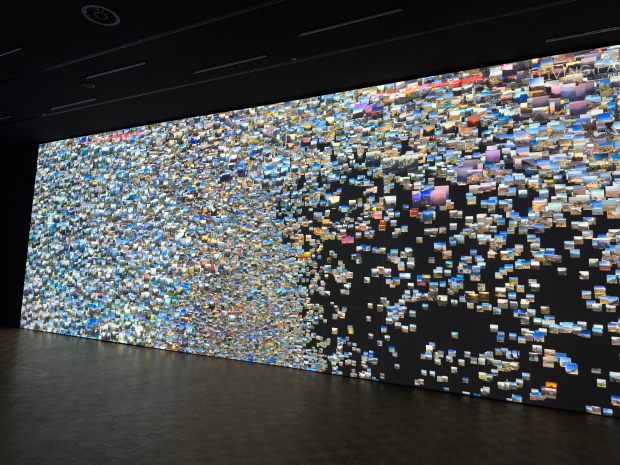
“California Landscapes: Generative Study” and “Artificial Realities: California Landscapes” are two series based on the same dataset of over 153 million images of California’s National Parks. Despite sharing the same dataset, the two series feature two different visual representations: “Generative Study” creates images that are recognisable and similar to the national parks. Yet, the images continuously shift into new forms, visualising natural elements including skies, mountains, trees, waterfalls and much more in fluid ways. While doing so, it projects interconnected lines on top of the images, underlining the algorithmic work at play beneath the screens’ interface. You can see the machine working. Contrarily, “Artificial Realities” proposes a more abstract view of California’s National Parks, similar to “Winds of LA” and “Artificial Realities: Pacific Ocean”. The series draws on the natural pigments of nature, bringing together technology and nature visually, triggering a sense of belonging to the Earth.7 While ”Generative Study” presents more static and photorealistic images in which natural landscapes can be more easily recognised, ”Artificial Realities” offers a more fluid and immersive experience that explores the dynamic and ever-changing essence of nature. In other words, what distinguishes both series is the degree of abstraction utilised in their presentation. The juxtaposition of these approaches prompts reflection on the relationship between technology and nature; as nature is mediated through a flurry of computations, technology can provide us with different versions of how we can perceive nature.

California Landscapes: Generative Study

The contrast between both series is also a testament to the nature of human-machine collaboration: “With the same data, we [Refik Anadol Studio] can generate infinite versions of the same sculpture, but choosing this moment, and creating this moment in time and space, is the moment of creation”.8 This approach not only attests to the need of human intervention, but it also acknowledges the reciprocal agency of algorithms in the creative act. The human is decentred as the algorithm assumes a prominent position. While Anadol decides the perimeters, it is the algorithm that decides the final result. The audience is then invited to reflect on the potential role of machine learning within art, but also to what extent the machine is part of the creative process.9

Artificial Realities: California Landscapes

Living Painting: Immersive Room

Completely unique to this exhibition is Living Painting: Immersive Room. As you step inside this square-shaped box you are embraced by a three-dimensional, kinetic, multisensory space of spectacle that no image or video can do justice. The screens display the same patterns from Anadol’s AI data paintings while the mirrors, strategically placed on the floor and ceiling, create an infinite space in which your body becomes your only reference point. Within this space, you cease to be a mere observer; instead, you seamlessly integrate into the very fabric of Anadol’s artwork. You become an active participant in the algorithmic ecology, a living element within the computational tapestry. The boundaries between the observer and the observed dissolve, offering a rare opportunity to not just witness but also to embody the artist’s vision.

Being included in the algorithmic ecology extends beyond the conventional engagement of art. It also prompts reflection on environmental issues and an affective re-evaluation of our relationship with art, technology, nature, and the interconnectedness between them. Digital technologies are capable of evoking emotional resonance through storytelling; stories have the power to evoke empathy and affective connections with the natural world, which in turn can influence our attitudes and behaviours towards environmental conservation.10 Anadol’s works provide abstract narratives that resonate with us on an emotional and subconscious level, stirring deep-seated feelings of connection to the natural within.

Living Painting: Immersive Room

Concluding remarks

Anadol’s works not only showcase algorithmic ecologies that intersect the realms of art, technology, nature and the human, but they also lend themselves exceptionally well to a relaxed and enchanting experience at the museum. Each video, well over 16 minutes long and presented in a dimly lit room, invites visitors to linger and lose themselves in a mesmerising, digital world of tranquillity. As you ponder your own thoughts, you might occasionally recognise a mountain or a sunset, which brings you back to the world around you.

Living Paintings: Nature is on show at Kunsthal Rotterdam until 1 April. Still not convinced? The exhibition is enjoyable for all ages:

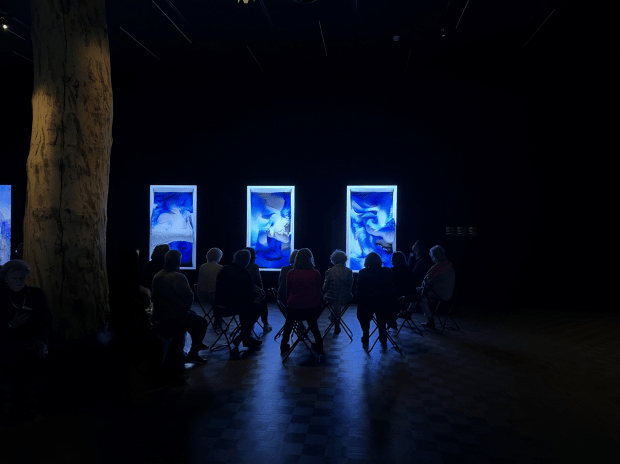
A group of elderly people enjoying “Winds of LA” during a guided tour

Footnotes

  1. https://www.kunsthal.nl/en/plan-your-visit/exhibitions/refik-anadol/ ↩︎
  2. Iris van der Tuin and Nanna Verhoeff, Critical Concepts for the Creative Humanities (London: Rowman & Littlefield, 2022). ↩︎
  3. Alina Cohen, ‘Refik Anadol’s Mesmerizing Data Paintings Are Captivating Audiences Worldwide’, Artsy, 15 February 2023, https://www.artsy.net/article/artsy-editorial-refik-anadols-mesmerizing-data-paintings-captivating-audiences-worldwide. ↩︎
  4. Refik Anadol and Pelin Kivrak, ‘Machines That Dream: How AI-Human Collaborations in Art Deepen Audience Engagement’, Management and Business Review 3, no. 1 & 2 (2023): 101–7. ↩︎
  5. https://refikanadol.com/works/winds-of-la/ ↩︎
  6. https://refikanadol.com/works/artificial-realities-pacific-ocean/ ↩︎
  7. https://refikanadol.com/works/artificial-realities-california-landscapes/ ↩︎
  8. Refik Anadol et al., ‘Modern Dream: How Refik Anadol Is Using Machine Learning and NFTs to Interpret MoMA’s Collection’, The Museum of Modern Art (MoMA), 15 November 2021, https://www.moma.org/magazine/articles/658. ↩︎
  9. Joanna Zylinska, ‘Art in the Age of Artificial Intelligence’, Science 381, no. 6654 (13 July 2023): 139–40, https://doi.org/10.1126/science.adh0575. ↩︎
  10. Alexa Weik von Mossner, Affective Ecologies: Empathy, Emotion, and Environmental Narrative, Cognitive Approaches to Culture (Columbus: The Ohio State UP, 2017). ↩︎

Between Stereotypes and Stories

written by Anna P.H. Geurts

Historians such as myself love a good story. And while they usually look for these stories in old manuscripts or eyewitness accounts, they won’t say no to the odd amusement park every now and then.

One of the older themed amusement parks of Europe is the Efteling in the Netherlands. Some of the attractions at the Efteling are based on specific stories, such as Rapunzel or Pinocchio. Others are based simply on ideas, images or types that circulate in the European cultural imagination. The idea that trees might come alive, for instance, or that dragons guard treasures. But also ideas about a mysterious orient, or an inhospitable Africa.

The problem with these latter images is that they were created to justify the conquest of these regions and the use of violence against them. And in the present day, they still support power differences between different areas in the world.

What’s more: I would argue that for a visitor to an amusement park, there is nothing much amusing about simply seeing stereotypes repeated. Surely, we want to be surprised at least a little, in order to really feel entertained?

However much I admire the Efteling, it certainly has its store of such stereotypical imagery. The dark ride Carnaval Festival may be the most well-known container of these images. Like Disney’s It’s a Small World, it features national buildings and national ‘types’ of people from around the world. That means that the very essence of the ride is a celebration of cliches. Some of these cliches are, however, fairly harmless: a choir of Dutch frogs, for instance. In other scenes, the designers have responded creatively to these cliches, like they responded creatively to the talking-tree idea mentioned earlier. This is where Carnaval Festival is at its best. The cliches are used for a visual joke, or they are turned into something beautiful. I remember being in awe as a child of the Japanese masks that were on display, the Scottish bagpiper, the shadow play with kites, or the arctic ceiling.

A third type of scene on this ride, however, has been using cliches in a much more problematic manner. The room representing the makers’ idea of ‘dark Africa’, for instance. The human figures which elsewhere on the ride are mostly just friendly (and blue-eyed, even in Mexico or Hawaii!), here had a stupid look on their faces (and no irises at all). They sported exaggerated lips as found in the ‘Sambo’ or ‘coon’ characters, and facial piercings that, although in vogue in Europe now, were probably meant to stand for anything but civilisation by the makers of the ride in the 1980s. They lived in a forest, were perpetually engaged in warfare (or else perhaps a symbolic demonstration of masculine prowess), brandishing spears and shields, and were observed by several colonial figures in khaki (or were the Africans threatening some of them? This always remained a little ambiguous).

Although the scene also included several humorous components, it may be clear why it has attracted criticism ever since opening to the public. It propagated a historical colonial image of Africa and was as such also very much out of tune with the rest of the ride, that instead focused on contemporary touristic imagery. It therefore suggested to the average European visitor that all of Africa is a forest, and that when travelling there they would be met by a troupe of silly bush warriors and – still – a colonial regime.

When the ride closed for a major technical overhaul, therefore, the Efteling also adjusted this scene, as well as several Asian ones.

The scene now looks like this:

Much has been done to meet the critics. Still, this visitor wonders whether the designers of the overhaul have really understood their critique.

Not only have some harmful stereotypes remained unchallenged and some new ones added. Why, for instance, are these African characters the only ones who are situated in uncultivated ‘nature’? Why, also, is an entire continent conflated into one scene, as if cultural distinctions do not matter when it comes to Africa, while the entire ride is premised on such cultural distinctions? For instance, we find a central-African rainforest and a tropical ape (an Indonesian Orangutan?) together with a South-African flag. The new music composed for this scene even seems to be Caribbean – ‘Black’, too, after all?

But equally, the spokespersons for the Efteling do not show much awareness of what this is all about. In interviews, they speak of an anti-colonial criticism coming from people who did not grow up with the Efteling: as if those hurt by the depictions cannot be Dutch or Flemish nationals; as if appreciation and critique cannot go together; and as if, most surprising of all from a commercial viewpoint, one first needs to ‘learn’ about the Efteling in order to join in the fun.

Equally, they suggest that colonial imagery has only become harmful in recent history. The ride had to change, they say, because it no longer fitted the present ‘diverse’ day and age. But surely, the entire point of colonial imagery, from the very start of colonisation onwards, is that it would harm the colonised? The world has always been a diverse place, and the ride has always attracted criticism. Only perhaps the Efteling is now finally seeing the commercial potential of attracting a more diverse group of visitors?

Finally, the new figures are presented as a great improvement because instead of nose-rings, they now wear ‘traditional African costume’. However, it is precisely the idea of Africa as a ‘traditional’ place – stuck in time – that has justified and still justifies colonial exploitation. (I am not entirely clear what is wrong with the piercings, by the way. Only that some view them as backwards, which may again invite a view of Africa as primitive. But should we go along in seeing piercings this way?)

As said, some harmful stereotypes remain, in the Efteling, not just in Carnaval Festival but in other rides, too.

Still, this year has seen a bright light on the horizon. Two more attractions based on colonial ideas have just closed for renovation and it seems that these, in contrast to Carnaval Festival, will not continue the old pattern of presenting stereotypes but introduce two more fundamental changes.

Firstly, the Adventure Maze and Monsieur Cannibale will shift perspective 180 degrees. Rather than continuing to be based on European images of the colonised, they will be based on the cultural heritage itself of a formerly colonised region. They will spotlight two stories from Sinbad the Sailor’s cycle of adventures, written probably in western Asia or Africa in the early modern period.

Even better: they will not just be based on simple types or cliches that float around in the cultural imagination but on actual stories, with plot, characters, and a lot of space for different interpretations and ways of enjoying them: like the tales of Rapunzel or Pinocchio that we see on display elsewhere in the park. I look forward to seeing the Efteling embody these stories to their fullest.


About the photos: Promotional photos by the Efteling, used here for review purposes with reference to the Berne Convention and the doctrine of fair use.

Touching Me Touching You

written by Vincent Meelberg

One thing social distancing has taught us is how important touch is for us human beings. When people do not have the possibility to physically touch other people they can develop a condition called touch starvation or touch deprivation. Touch starvation increases stress, depression, and anxiety, which in turn may result in serious health problems such as headaches, depression, and chronic pain. 

And yet, touch seems to be a rather neglected human sense that, at least until recently, we took for granted. Vision, on the other hand, is usually regarded as the most important means by which human subjects acquire knowledge regarding the world, and ever since the visual turn theory has focused on that sense primarily. Hearing, too, is increasingly regarded as a sense worthy of study as well. Touch, however, remains rather undertheorized, at least in cultural studies.

Nevertheless, on October 4, 2021, the US physiologist David Julius and the Lebanese-American molecular biologist Ardem Patapoutian received the Nobel prize in Physiology or Medicine for their discovery of the receptors of nerve cells that allow us to feel heat, cold, pain, and touch. Thanks to these receptors the nervous system is able to detect what the positions of our bodies are, where the arms and leg are, to feel the heat of a warm drink, or the sun on our faces. Without these facilities we would not be able to survive, as through touch we are able to establish contact with the outside world. Also, touch enables us to manipulate and interact with our environment. And interpersonal contact, let alone intimate contact, depends on touch as well. Touch thus seems to be rather important after all, and the pandemic has reminded us of its importance.

Touch is crucial for direct interpersonal contact. According to Matthew Fulkerson interpersonal contact can be established through what he calls affiliative touch: affiliative touch involves contact through touch with another person. Direct affiliative, interpersonal touch is quite intimate, sometimes erotic even. Caressing another person’s body, or kissing someone else’s lips, are examples of quite intimate and affective acts of affiliative touch. 

Affiliative touch can also be distal, indirect, or mediated. This may sound paradoxical, but Fulkerson explains that “[…] through touch we are sensitive to pressure waves and vibrations, as well as other similar signals, and these stimuli are capable of travel through media just like light and sound waves. It thus makes sense that our touch receptors could bring us into contact with distal objects or features, especially when there is a strong mutual informational link between the distal object and our bodies supported by our exploratory actions” (Fulkerson, Matthew. 2014. The First Sense: A Philosophical Study of Human Touch. Cambridge, MA: MIT Press, p. 150). 

And this is how cultural practices such as theatre and musical performances work. These practices establish interpersonal contact through distal affiliative touch. Sounds touch the eardrums, as well as the entire body, of the audience. The actual physical presence of actors on stage can almost literally be felt. We feel the movements of dancers in our own bodies while watching a dance performance. And this is an experience that cannot be had, at least not in the same manner and with the same intensity, by watching or listening to a recording of such performances. These recordings simply do not have the capacity to touch an audience in the way a live performance can. Experiencing performances via recordings only may ultimately even lead to touch starvation as well, albeit of a different kind. 

Despite the somewhat derogatory comment made by the Dutch Secretary of Health, Hugo de Jonge, that one can easily compensate for not being able to visit live performances during the pandemic by watching a DVD, live performances are essential to our mental health. They are not only essential because artistic practices in general may be beneficial to both practitioners and audiences alike, but also because these performances allow for different ways to be touched, to be caressed by the physical presence of performers on stage. Live performances create possibilities for affiliative touch, and as such may help to prevent touch deprivation. In short: in times of social distancing the performing arts are sorely needed.