
The same moon shines on both of us

Anna P.H. Geurts

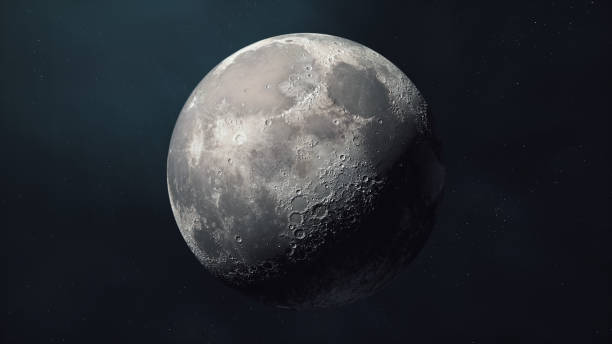
On my recent journey to Suriname, I have been thinking something that I have thought many times before, every time I am separated from a loved one. I see the moon and I am comforted by the fact that, however far away the other person, the same moon shines on both of us. And I am not the only one with this thought. As an historian of travel, I come across it again and again.

This is the thought: However many miles are between us, and however many hours of travel, however many obstacles – sometimes even the bend of the globe prevents us from seeing one another – we are nonetheless united by a single glance at the moon in the sky. We only need to look up and we see the same, very real, physical thing, at the same time.

I am not the first to think this. In my work, I come across many historical travellers with similar experiences. In 1877, German lady’s maid Auguste Schlüter travelled with her British employers to Ireland.

It is Sunday night, the moon sends her silvery light across the ocean, and carries me far away, home to my dear ones and to my dear Hawarden home, and to another spot on earth which I need not name, for Thou knowest all my thoughts.1

In Ireland, the moon reminded Schlüter of her loved ones in Germany and Britain, and of a mysterious unnamed person – her lover? So, what I am finding in my work about nineteenth-century Europeans is that, because the moon was visible from very different locations at same time, it made travellers feel connected to their (other) homes and their beloved. The moon took away the distance for a moment. Sometimes, this was followed immediately by a sense of even greater distance because of the contrast between the moon that seemed so close as to be touchable, and the loved one who was both out of sight and out of touch.

Now, as an historian, I am trained to focus on historical and cultural differences. I am asked to describe how people in the nineteenth century were different from ourselves, for example. But sometimes, I cannot help but espy similarities. Between myself and someone in the nineteenth
century. Or someone in a vastly different time and place.

This same moon hangs over Fu-chou.
Alone, she’ll lean out her window to watch it.2

So begins one of the famous melancholy poems by Tu Fu about travel, migration and separation. Tu Fu was a Tang-dynasty poet living thirteen centuries ago in what is now central China. In his poem, he describes two protagonists united by the same moon, but yet watching it alone.

It looks like this magical property of the moon to annihilate distances – and then to emphasise them – has been felt across the globe and across the millennia.

These examples are about the moon. I have found travel writing in which the sun accomplishes the same, particularly at special events such as a solar eclipse. And other travellers who talk about the stars. More down-to-earth phenomena also did the same for many: long rivers, for example, and the ocean.

Rivers and the ocean did this in a slightly different way from the moon. Not by enabling distant ones to see one relatively small point at the same time, but by offering the vastness and connectedness of one body of water to both individuals at the same time. The Atlantic Ocean, the Indian Ocean and the Pacific Ocean connected one coast to a completely different one. And so, in the mid-nineteenth-century, the Russian writer Ivan Goncharov was on the island of Madeira in the Atlantic Ocean and seems to have felt connected to Russia through the Madeiran flowers he threw into the water and that might in theory reach Russia.3

Dare I propose that we are dealing with the same experience in every one of these instances?

And dare I propose also, therefore, that the moon brings together Tu Fu, Auguste Schlüter, and myself?

Immediately we have to admit that the story is not that neat. In Suriname, I sadly missed the opportunity of looking at the moon when it was full and when I knew certain people far away would also be looking at it. The rainy season covered up the moon. A week or so later, I saw a vivid bright waning moon. The same moon as was visible at the other side of the world, yes, but also a different one. While in Europe, my waning moon is balancing on its point. In Suriname, I see a calmly lying moon. In the same way, Tu Fu’s moon, Schlüter’s, and mine will have looked slightly different, because of our different positions on earth. What is more, our moons will have looked different because the moon has aged. The craters and seas on its surface may be a little worse for wear now compared to more than a thousand years ago, and there’s certainly been more human impact in recent years. My point is that the idea that we are looking at the same thing is perhaps a little bit of an illusion. But an influential and comforting illusion nonetheless.

In my recent book Travel and Space in Nineteenth-Century Europe, I discuss travellers’ attachments to home. In a related article, I outline different forms of what it means to feel distance.

More by Anna P.H. Geurts on Historian at large.

  1. Auguste Schlüter, A Lady’s Maid in Downing Street, ed. Mabel Duncan (London: Fisher Unwin, 1922), p. 17. ↩︎
  2. This translation is by Sam Hamill, in Endless River: Li Po and Tu Fu: A Friendship in Poetry (New York and Tokyo: Weatherhill, 1993). p. 37. ↩︎
  3. Ivan Aleksandrovich Goncharov, The Frigate Pallada, trans. Klaus Goetze (New York: St. Martin’s Press, 1987), p. 86. ↩︎

Between Stereotypes and Stories

written by Anna P.H. Geurts

Historians such as myself love a good story. And while they usually look for these stories in old manuscripts or eyewitness accounts, they won’t say no to the odd amusement park every now and then.

One of the older themed amusement parks of Europe is the Efteling in the Netherlands. Some of the attractions at the Efteling are based on specific stories, such as Rapunzel or Pinocchio. Others are based simply on ideas, images or types that circulate in the European cultural imagination. The idea that trees might come alive, for instance, or that dragons guard treasures. But also ideas about a mysterious orient, or an inhospitable Africa.

The problem with these latter images is that they were created to justify the conquest of these regions and the use of violence against them. And in the present day, they still support power differences between different areas in the world.

What’s more: I would argue that for a visitor to an amusement park, there is nothing much amusing about simply seeing stereotypes repeated. Surely, we want to be surprised at least a little, in order to really feel entertained?

However much I admire the Efteling, it certainly has its store of such stereotypical imagery. The dark ride Carnaval Festival may be the most well-known container of these images. Like Disney’s It’s a Small World, it features national buildings and national ‘types’ of people from around the world. That means that the very essence of the ride is a celebration of cliches. Some of these cliches are, however, fairly harmless: a choir of Dutch frogs, for instance. In other scenes, the designers have responded creatively to these cliches, like they responded creatively to the talking-tree idea mentioned earlier. This is where Carnaval Festival is at its best. The cliches are used for a visual joke, or they are turned into something beautiful. I remember being in awe as a child of the Japanese masks that were on display, the Scottish bagpiper, the shadow play with kites, or the arctic ceiling.

A third type of scene on this ride, however, has been using cliches in a much more problematic manner. The room representing the makers’ idea of ‘dark Africa’, for instance. The human figures which elsewhere on the ride are mostly just friendly (and blue-eyed, even in Mexico or Hawaii!), here had a stupid look on their faces (and no irises at all). They sported exaggerated lips as found in the ‘Sambo’ or ‘coon’ characters, and facial piercings that, although in vogue in Europe now, were probably meant to stand for anything but civilisation by the makers of the ride in the 1980s. They lived in a forest, were perpetually engaged in warfare (or else perhaps a symbolic demonstration of masculine prowess), brandishing spears and shields, and were observed by several colonial figures in khaki (or were the Africans threatening some of them? This always remained a little ambiguous).

Although the scene also included several humorous components, it may be clear why it has attracted criticism ever since opening to the public. It propagated a historical colonial image of Africa and was as such also very much out of tune with the rest of the ride, that instead focused on contemporary touristic imagery. It therefore suggested to the average European visitor that all of Africa is a forest, and that when travelling there they would be met by a troupe of silly bush warriors and – still – a colonial regime.

When the ride closed for a major technical overhaul, therefore, the Efteling also adjusted this scene, as well as several Asian ones.

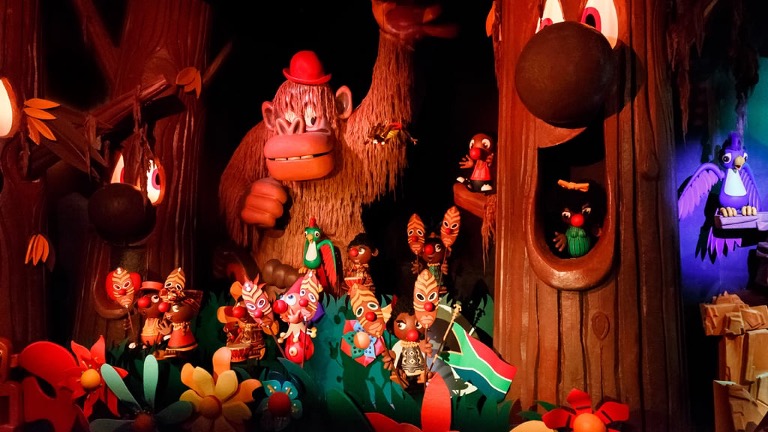
The scene now looks like this:

Much has been done to meet the critics. Still, this visitor wonders whether the designers of the overhaul have really understood their critique.

Not only have some harmful stereotypes remained unchallenged and some new ones added. Why, for instance, are these African characters the only ones who are situated in uncultivated ‘nature’? Why, also, is an entire continent conflated into one scene, as if cultural distinctions do not matter when it comes to Africa, while the entire ride is premised on such cultural distinctions? For instance, we find a central-African rainforest and a tropical ape (an Indonesian Orangutan?) together with a South-African flag. The new music composed for this scene even seems to be Caribbean – ‘Black’, too, after all?

But equally, the spokespersons for the Efteling do not show much awareness of what this is all about. In interviews, they speak of an anti-colonial criticism coming from people who did not grow up with the Efteling: as if those hurt by the depictions cannot be Dutch or Flemish nationals; as if appreciation and critique cannot go together; and as if, most surprising of all from a commercial viewpoint, one first needs to ‘learn’ about the Efteling in order to join in the fun.

Equally, they suggest that colonial imagery has only become harmful in recent history. The ride had to change, they say, because it no longer fitted the present ‘diverse’ day and age. But surely, the entire point of colonial imagery, from the very start of colonisation onwards, is that it would harm the colonised? The world has always been a diverse place, and the ride has always attracted criticism. Only perhaps the Efteling is now finally seeing the commercial potential of attracting a more diverse group of visitors?

Finally, the new figures are presented as a great improvement because instead of nose-rings, they now wear ‘traditional African costume’. However, it is precisely the idea of Africa as a ‘traditional’ place – stuck in time – that has justified and still justifies colonial exploitation. (I am not entirely clear what is wrong with the piercings, by the way. Only that some view them as backwards, which may again invite a view of Africa as primitive. But should we go along in seeing piercings this way?)

As said, some harmful stereotypes remain, in the Efteling, not just in Carnaval Festival but in other rides, too.

Still, this year has seen a bright light on the horizon. Two more attractions based on colonial ideas have just closed for renovation and it seems that these, in contrast to Carnaval Festival, will not continue the old pattern of presenting stereotypes but introduce two more fundamental changes.

Firstly, the Adventure Maze and Monsieur Cannibale will shift perspective 180 degrees. Rather than continuing to be based on European images of the colonised, they will be based on the cultural heritage itself of a formerly colonised region. They will spotlight two stories from Sinbad the Sailor’s cycle of adventures, written probably in western Asia or Africa in the early modern period.

Even better: they will not just be based on simple types or cliches that float around in the cultural imagination but on actual stories, with plot, characters, and a lot of space for different interpretations and ways of enjoying them: like the tales of Rapunzel or Pinocchio that we see on display elsewhere in the park. I look forward to seeing the Efteling embody these stories to their fullest.


About the photos: Promotional photos by the Efteling, used here for review purposes with reference to the Berne Convention and the doctrine of fair use.