Spinning Back to Sustainability

Why Vinyl Recycling Should Be Made Possible Again

By Marije Makken, Imke Kuijpers, Jildou de Jong and Daan Verhaegh

Introduction and the Sustainable Development Goal

In recent years, vinyl records have made a surprising comeback. What was once considered an outdated format is now celebrated again by music lovers around the world. This “vinyl revival” makes record stores flourish again and contributes to a growing sense of nostalgia and authenticity in listening habits (Hendricks 2016, Calamar and Gallo 2009). Record collecting has become a cultural practice that brings people together, allowing them to connect with music in a tangible way.

However, behind this renewed passion lies a pressing environmental issue that receives little attention: the production and disposal of vinyl records are far from sustainable. Vinyl, or polyvinyl chloride (PVC) is a non-degradable plastic material that can be recycled, but often is not (ECVM, 2025). This issue directly goes against the core principles of the United Nations Sustainable Development Goal 12: Responsible Consumption and Production. This goal includes the need to reduce waste, reuse materials, and make consumption systems more circular (United Nations 2025). Yet the current structure of vinyl production and disposal disrupts this cycle rather than supporting it. Vinyl records that could have been recycled and repurposed end up burnt [DV1] in waste facilities. This process recovers some energy but contributes to pollution and the loss of valuable materials (Milieucentrale[JN2] [DV3] ). Besides that, a vinyl record wasted is a music album wasted.

To explore this tension, we conducted research into vinyl’s sustainability in the Dutch context. We attended public panels with experts from major music companies, visited local record shops in Nijmegen, and contacted large waste processors to collect different perspectives on the subject and to create an intervention in which we could try to attract more attention to the topic of vinyl recycling.

Intervention: the research

In our research on vinyl and its sustainability in the Dutch context, we came across some very interesting matters. To begin with, we attended a public panel during The Haarlem Vinyl Festival called “This Is How We Do It – The Path To More Sustainable Record Manufacturing”. Speakers on sustainable vinyl production were in attendance from different fields and countries of vinyl record manufacturing companies, such as Warner Music Group and Republic of Music. In this panel we learned that the return of vinyl has become a trend and is even called the vinyl era. Although consumers are willing to pay a lot for non-sustainable vinyl, they are less willing to pay a little more for sustainable options (Emanuel et al. 2025). In his book Wax Trash and Vinyl Treasures, Roy Shuker describes this as a “hunt”, there is “value to the process of gathering music more than the actual possession of it” (Shuker 2010, 110). In the panel talk however, we learned how music collecting can be done in a sustainable manner.

In this panel talk, we also learned that there is a lot of unsaid or insider information on the sustainability of vinyl production. That reminded us of Paula Serafini’s 2020 paper “A rapist in your path”, where she describes how performance art addresses pressing topics such as gender violence or femicide. Art activism, Serafini writes, becomes a practice that tries to achieve political transformation (2020, 293). This is exactly what we set out to do in our intervention; exposing the unsaid about vinyl sustainability.

We found that focussing on the role of the consumer is not the right angle. In talking to record store owners and vinyl record lovers, we learned that vinyl records simply do not have a sustainable affordance, or sustainable qualities to them. It is up to the artists to make the decision of releasing their music on bio-vinyl (Emanuel et al. 2025). A great example is the band Coldplay, who did an eco-release and printed records on recycled plastic: nine plastic PET- bottles make one record. These plastic bottles come from Boyan Slat’s ocean cleanup initiative (De Machine 2024). Vinyl record production is mostly not sustainable (Devine 2019), a difficult- to-accept fact which is a bit of a taboo among vinyl lovers. This concealed fact made it difficult for us to intervene, since we did not want to step on the toes of people who do not bear the brunt of the responsibility – consumers largely do not have the agency to address the issue. The vinyl revival renewed the practice of hunting for vinyl, loving and ‘consuming’ vinyl, but also printing and selling vinyl records (Hendricks 2016; Gallo and Calamar 2009; Bartmanski and Woodward 2020; Shuker 2010). We consider all of these practices a form of musicking (Hess 2019). Musicking, or participating in any music practice can (or should) be done sustainably, we believe. Re-selling dusted vinyl records is the most sustainable practice when it comes to records. Re-using and reselling them ensures their first cause, which is to be played and listened to. To know more about our local situation surrounding vinyl, we visited record stores in Nijmegen. Rob Berbee, owner of the vinyl record store Vinylarchief in Nijmegen told us that he regularly welcomes crates filled with records that were previously collecting dust in people’s homes. Record stores such as Waaghals, Discords, Kroese, and Vinylarchief also currently bring their unsellable records to the Dar, the local residual waste management company, simply because they are unaware of any facility that recycles vinyl. The store owners expressed that they would gladly participate in recycling initiatives, as they prefer not to throw their vinyl records away with the regular waste.

To make vinyl recycling more accessible for consumers and store owners, our original intervention plan consisted of a recycling bin with two compartments, one for the vinyl and one for the cover. This recycling bin would be placed in vinyl stores and used to collect the vinyl that could be distributed to vinyl recycling companies. We had our eyes on a collaboration with Vinylrecycling, a recycling company in Lelystad, the Netherlands. Unfortunately, we were disappointed to find out that the company had gone bankrupt in 2024. The company was turning PVC – the biggest ingredient in vinyl – into raw material to make new products and distributing this to other companies. In an article by Lelystad News we read that the ‘Inspectie van Leefomgeving en Transport’ (ILT) decided that this raw material was waste. ILT is an inspection service from the Rijksoverheid in the Netherlands that maintains law regulations. And since it is not allowed to export waste to other countries, it became impossible to continue the recycling of vinyl.

The formal CEO of Vinylrecycling, Ivo Besselsen, stated that the company had to bring 20.000 to 30.000 tons of raw material to a landfill where it will be burned (Kunststof Magazine). And their company was not the only one: there are six more recycling companies that have gone bankrupt since the regulation of ILT in 2022 (Thole 2024). The regulation comes from the Dutch government (Rijksoverheid) and is focused on single use plastics, including vinyl. The regulation that caused the bankruptcy of among others Vinylrecycling is the ‘Beleidsregel bestuursrechtelijke handhaving verontreinigd papier-, kunststof-, en metaalafval 2022’ (wetten.nl). Part of this regulation is the enforcement of the export of waste and what is considered waste. In this case the product that comes out of the recycling of vinyls (granulate grains) is considered waste instead of raw material. We can conclude that the regulation the ILT enforced on these companies works against a circular and sustainable environment. This regulation makes it impossible for good initiatives, such as Vinylrecycling, to endure.

This results in shops, like Rob’s Vinylarchief, as well as consumers, not being able to sustainably get rid of their records, since vinyl recycling companies are bankrupt. Reviving vinyl by re-use is sustainable and environmentally friendly, letting it be wasted is much less sustainable. This realization became the foundation of our intervention. Having vinyl records recycled is preventing them from becoming a pollutant, and grants them a new purpose as a recycled raw material. If the system prevents recycling, awareness and policy change may offer the only route forward. Our project seeks to highlight this issue, connect the conversation to SDG 12, and advocate for a more circular and sustainable future for vinyl.

Intervention: the execution

We were left with no other choice than to dive even deeper into the discontinued recycling processes of vinyls. We contacted lots of other waste companies, but quickly discovered that absolutely none of them process vinyl materials in any other way than burning them with the rest of the waste, which is seen as a recovery of energy. The only way we could help the vinyl stores recycle the records they throw away, is if there are companies offering a recycling process to connect with. This meant that we decided to focus our intervention on trying to restore or change the regulation that ended these companies and ask for attention on this matter.

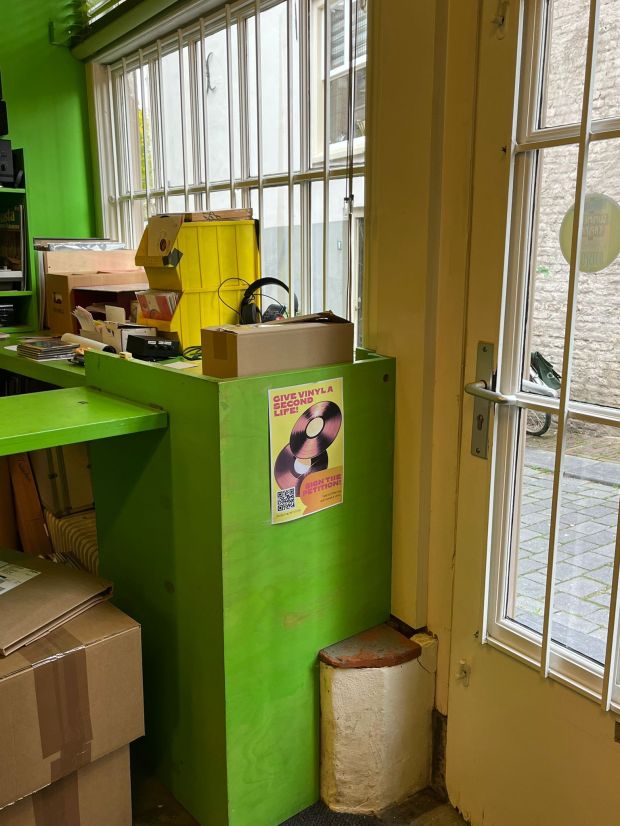
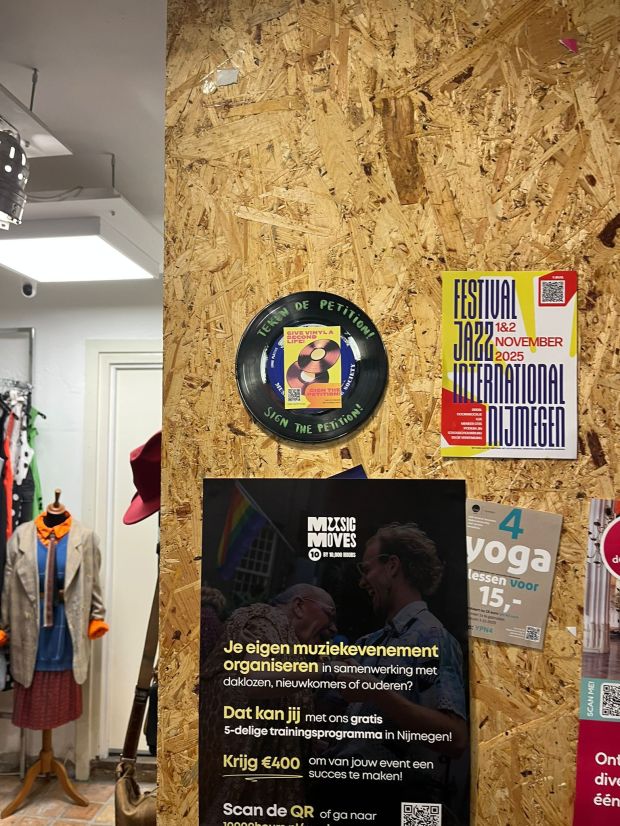
This is how our intervention turned into a petition, in which we ask for a change in the regulation, so the recycled PVC materials are not seen as waste but as new raw materials, and to make the recycling of vinyl records possible again. We set up a petition online and shared it with as many people as we could. We also created posters and flyers with a QR code to the petition, and asked the vinyl stores in Nijmegen that we visited previously to put them up. Kroese was, unfortunately, not interested in doing so, but Waaghals and Vinylarchief were very enthusiastic and hung up our posters in their stores. We hope that the people visiting these stores will notice and look up our petition, and this way we are able to include the vinyl consumers in gaining knowledge on the process of vinyl record production and to think about their sustainability. Hopefully we will keep receiving more signatures, but raising awareness on the issue is our main goal.

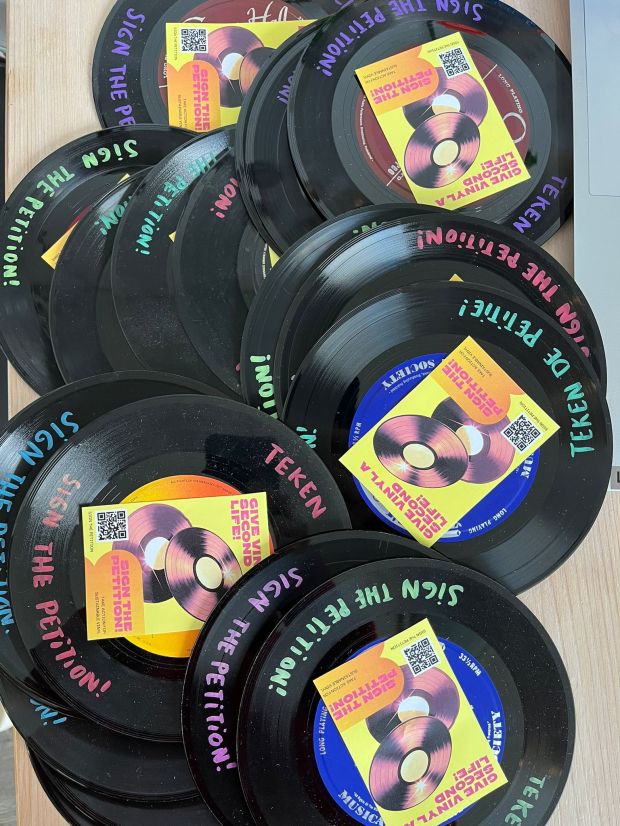
Lastly, we received a box of old records from our teacher Melanie Schiller that she was going to throw away. We put our flyers on the records and walked around the Nijmegen city center to hand them out to people on the streets and to store owners. We chose the Lange Hezelstraat as our main area, because we wanted to raise the issue with a broad and diverse audience and there are lots of vintage and sustainable stores there as well. A few of these stores were interested in placing our records with flyers in their store to help the intervention, which was wonderful. This made it possible to talk to people and to explain why we were doing this. Even though it was difficult to engage in conversation, as people quickly assume you want to sell them something, handing people a record was an effective way to make them see our intentions were about something else. Everyone we talked to was surprised that vinyl is not being recycled at all, so we noticed that this is an unknown topic among the general public. Most people were definitely interested in our case and happy to take a record from us, so it did feel like a successful attempt to instill some more knowledge and attention on the subject of sustainable vinyl and vinyl recycling.

Conclusion

Unless we receive a lot of signatures and we can send the matter to the Dutch government, our intervention will be a small occurrence. We are proud of it, nonetheless. The subject of sustainability of vinyl records and vinyl recycling turned out to be a much more complicated matter than we thought. Therefore, to really gain all the knowledge necessary on this topic, to make an exceptionally strong case for change and to set up a much larger intervention, we would need a lot more time to execute a deep dive into the matter. The best possible scenario would be that the regulation is changed and that the vinyl recycling companies are able to continue their recycling processes. We have heard from Vinylrecycling that the court case is still in progress, which is unfortunately why they themselves could not share much information with us. You never know what will happen, and we are rooting for the recycling companies. Once the recycling of vinyl records is possible again, we would be able to execute our plans of connecting the vinyl stores to the recycling companies and setting up a collaboration. Hopefully we can help the recycling companies in a way with our intervention.

So far, we have received 40 signatures on our petition, which we are proud of. We feel that we have raised awareness on this issue in some way. Of course, we hope to keep receiving signatures. The petition can be found here: https://petities.nl/petitions/maak-vinylrecycling-weer-mogelijk?locale=nl.

Bibliography

Bartmanski, Dominik, and Ian Woodward. 2020. Vinyl: The Analogue Record in the Digital Age. Bloomsbury Academic.

De Machine, “De eco-release van Coldplay,” 2024, in 3voor12.

Devine, Kyle. 2019. Decomposed: The Political Ecology of Music. The MIT Press.

Devine, Kyle. 2020. “Nightmares on wax: the environmental impact of the vinyl revival.” The Guardian, 2020. https://www.theguardian.com/music/2020/jan/28/vinyl-record-revival-environmental-impact-music-industry-streaming.

Emanuel, Karen, Peter Runge, Vladimir Visek, Miriam Lessar, and James Stafford. 2025. Public Panel: The Path to More Sustainable Record Manufacturing – This Is How We Do It. Haarlem Vinyl Festival.

Gallo, Phil, and Gary Calamar. 2009. Record Store Days – From Vinyl to Digital and Back Again. Edited by Scott Calamar. Sterling Publishing Co., Inc.

Hendricks, Jerome M. 2016. “Curating Value in Changing Markets: Independent Record Stores and the Vinyl Record Reviva.” Sociological Perspectives 59, no. 2: 479-497.

Hess, Judith (2019). Singing our own song: Navigating identity politics through activism in music. Research Studies in Music Education, 41(1), 61-8.

Kunststof Magazine. 19 november 2024. “Vinylrecycling failliet: geen uitstel tot uitspraak RvS.”

LelystadNieuws.nl. 7 dec 2024. “Innovatieve PVC recycler met grote ambities failliet.”

Shuker, Roy. 2010. Wax Trash and Vinyl Treasures: Record Collecting as a Social Practice. Ashgate Publishing Limited.

Serafini, Paula (2020). ‘A rapist in your path’: Transnational feminist protest and why (and how) performance matters. European Journal of Cultural Studies, 23(2), 290-295.


Thole, Herwin. 22 nov 2024. “Weer een plastic recyclingbedrijf failliet – Northvolt vraagt surseance aan in VS.” Mtsprout.nl, geraadpleegd op 16 okt 2025.

wetten.nl. Regeling – Beleidsregel bestuursrechtelijke handhaving verontreinigd papier-, kunststof-, en metaalafval 2022 – BWBR0046496. 1 Apr. 2022, wetten.overheid.nl/BWBR0046496/2022-04-01#Artikel3. Geraadpleegd 28 oktober 2025.


De ogen van je oren: niet-visuele beeldvorming in Duitse hoorspelen uit de 20e en 21e eeuw

Door Talin de Jeu, Isabel de Kock en Elly-Anne Zoutewelle

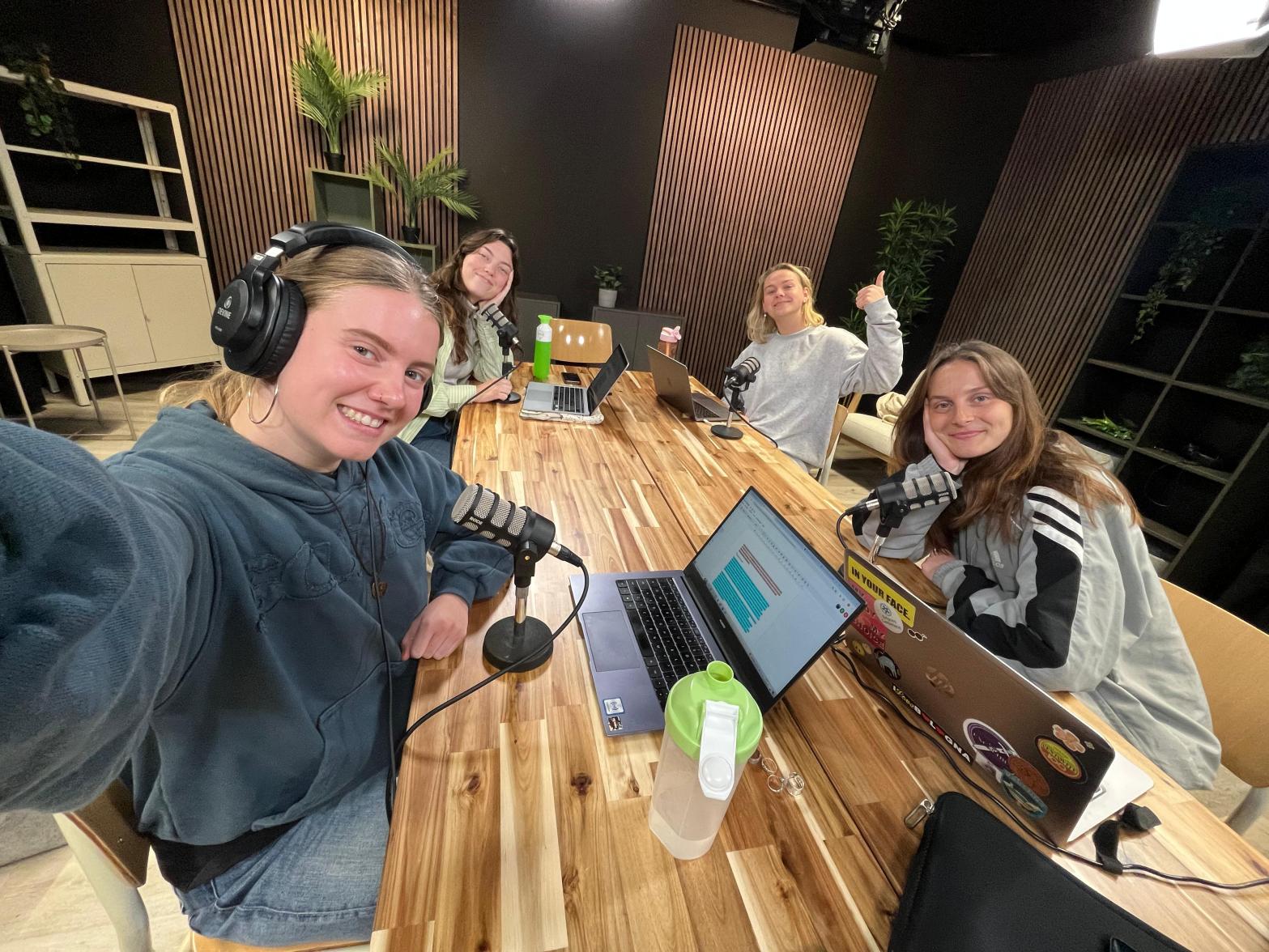
Overal waar je komt, zie je beelden. Je slaat deze beelden op in je hoofd en je vormt er ideeën over. Maar hoe vorm je beelden als je alleen je oren kunt gebruiken? Hoe bepaalt een accent of stemgeluid welke beelden je ziet? Wat gebeurt met beeldvorming als het visuele aspect wegvalt? Drie masterstudenten Literatuur en Samenleving, Talin de Jeu, Isabel de Kock en Elly-Anne Zoutewelle, hebben hier onderzoek naar gedaan door drie hoorspelen te analyseren, twee uit de twintigste eeuw (het Interbellum) en een uit de 21e eeuw. In deze podcast gaan ze met elkaar in gesprek over hun onderwerp en verkennen ze hoe beeldvorming op de radio plaats kan vinden.

Liever geen Spotify? De podcast is ook via andere platforms te beluisteren. Bekijk de opties via Buzzsprout.

De bovenstaande afbeelding is afkomstig uit het Nationaal Archief.

How Gen Z at Radboud University Perceive Gender (In)Equality: Music, Dialogue and Critical Awareness

By Anastasia Yuchynska and Dorota Kuncevič

Regarding the fifth Sustainable Development Goal, “to achieve gender equality and empower all women and girls,” there is still a systemic problem: women are underrepresented in leadership and decision-making positions, frequently encounter obstacles to decent work, experience salary disparities, and employment segregation. Universities play a key role in promoting social change and critical awareness. Higher education institutions are critical spaces for promoting gender equality, yet they continue to reproduce systemic gender inequalities. According to Rosa and Clavero (2021), universities are still unequal spaces, despite formal commitments to inclusion. Meanwhile, work at King’s College London shows that Gen Z holds the largest gender gap in attitudes: younger men and women diverge more sharply in their views on gender-equality than older cohorts. (Skinner & Gottfried, 2025). The European Institute for Gender Equality et al. (2022) recommend strengthening intersectional approaches, providing sustained funding, and integrating gender equality as a core institutional value rather than an administrative compliance task. Such findings illustrate the urgency of engaging Gen Z in participatory, dialogue-oriented formats around gender. Our intervention started with education, where institutions such as Radboud University may function as both a reflection and an outlet for change.

The question guiding our intervention was: How do Gen Z students of Radboud University, across different gender identities, perceive addressed gender (in)equality? We designed an intervention grounded in research. By collecting and visually displaying students’ responses, our goal was to open a participatory space on campus: one for dialogue, self-reflection and critical awareness of gender perceptions, using music as a medium for connection.

At Radboud, our intervention targeted students across genders, inviting them to respond to music, to one another, and to the mediated question of gender (in)equality. We took inspiration from Hess (2018) and her concept of musicking, where we approached music not only as an aesthetic expression but also as a political act. According to Hess, musicking involves all forms of engagement with music: performing, creating, producing, and listening. Hess further suggests that these acts are “sites for identity formation and meaning-making activities”. Musicking is also linked to identity politics as “a mode of organizing around shared identities as sites of oppression”. Hess highlights that identity politics is not just about personal identity but also about collective action. Through music, individuals can articulate their identities and play a significant role in building community. Inspired by this framework, we approached music not only as a form of entertainment but also as a political action.
Why “The Man”?

In practice, we chose the cultural product “The Man” by Taylor Swift as a case study. We chose to use Taylor Swift’s song because it  highlights and critically reflects on the struggle faced by women, comparing them to what life would be like if “I was a man”. Swift’s song invites listeners to consider privileges and societal tendencies towards gender, while exposing the labor expected of women to achieve the same level of success:

“I’m so sick of running as fast as I can

Wondering if I’d get there quicker if I was a man”

(Swift, 2019)

According to Billboard’s Gil Kaufman, “The Man” is a pointed statement about “how much harder women need to work than men to get to the same finish line” (Kaufman, 2019). This framing allowed us to explore student’s reactions to the lyrics through the survey, where we aimed to collect lived experience and foster critical thinking about gender in their own environment.

Our goal was to create an accessible entry point to connect with students’ emotions and lived experiences. The song is culturally familiar, so it provides an accessible way to engage with complex issues surrounding gender. In addition, we wanted students to engage with other forms of media rather than just relying on academic articles when tackling complex issues. “The Man” is lyrically simple, catchy, rhythmically upbeat, and what’s more important, recognizable and memorable. It’s important to mention that we did not use any visual media, but analyzed the song’s lyrics and music.

Our Intervention

Our artistic intervention used Taylor Swift’s “The Man” as a catalyst for reflection on gender equality among Radboud University students. During lunch break at Radboud University, we went around the campus with 2 pairs of headphones and invited participants to listen to “The Man”, reflect on its message regarding gender in a pre-made Google Form and answer questions such as:

  • How does the song make you feel?
  • Can you relate to the experience expressed in the song?
  • Do you think this musical piece emphasizes the experience lived by you/the singer/other people?
  • Does participating in this conversation highlight for you the power of music when reflecting on the topic of gender inequality?

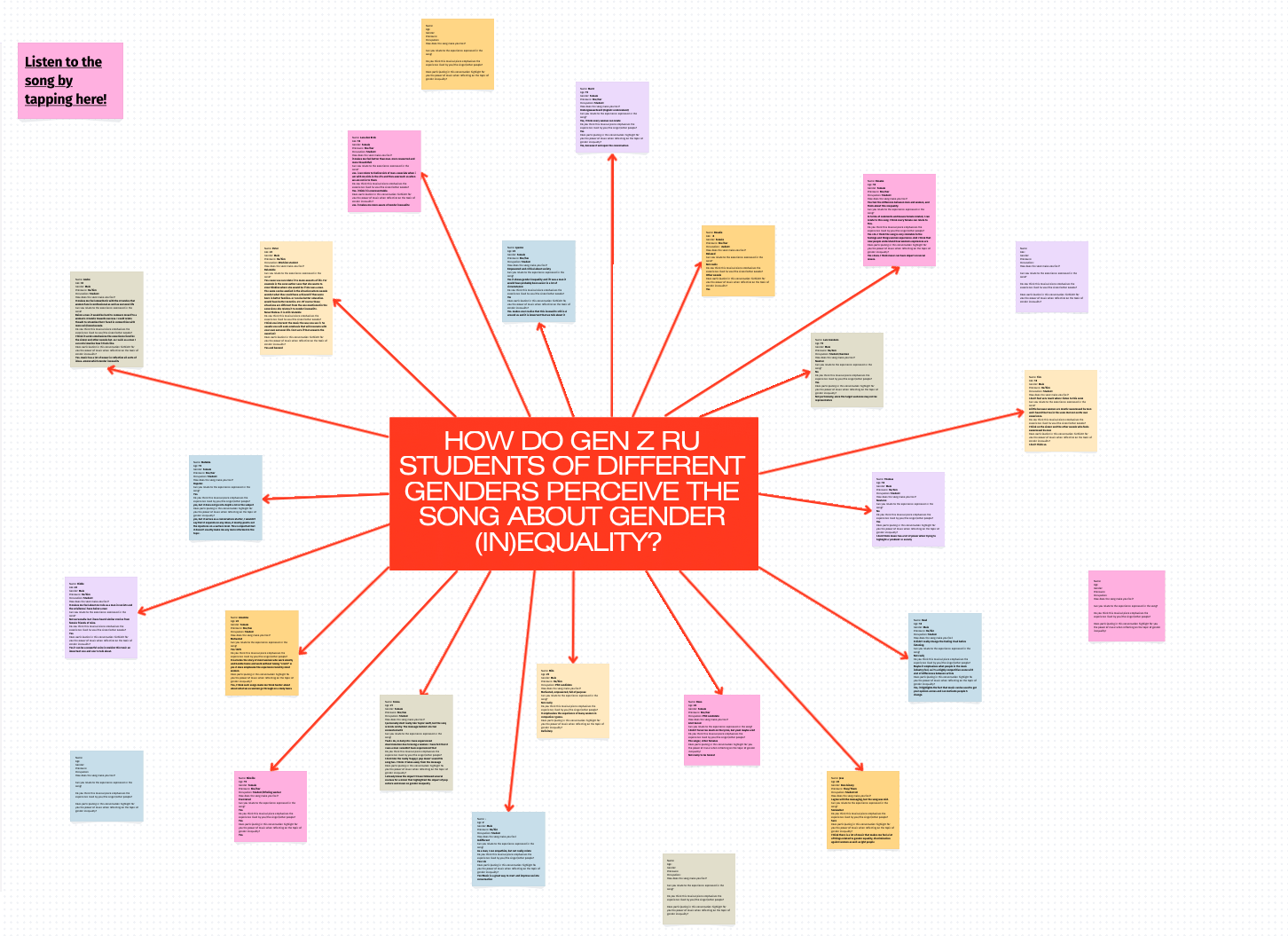
Their answers were collected and put on display, creating a “Web of (IN)equality” that mapped how gender is felt and experienced by different people. By inviting students to respond to our questions after listening to a song, we activated what Hess (2018) calls the political nature of music education, where music became a medium for amplifying marginalized voices. This approach aligns with her statement that “the personal is political,” particularly when addressing systemic inequalities. In our context, where research has shown that Generation Z holds increasingly diverse gender attitudes (Skinner & Gottfried, 2025), musicking offered a way for these tensions to surface. Since activist musicking creates space for challenging dominant narratives and building community, it is also a powerful tool for engaging students in discussions about gender inequality within the university.

To frame our intervention within a more detailed discourse, we draw on Rudy’s (2001) theory of radical and queer feminism, particularly her critique of additive identity politics. Additive identity politics is a model that assumes inclusivity can be achieved by simply “adding” marginalized identities to existing structures without challenging the norms that produce inequality. This model fails because the experiences and backgrounds of women are so diverse that meaningful conversation becomes difficult, which divides communities (p. 205). Rudy (2001) argues that this approach fails to account for the complexity of lived experience and the diversity of backgrounds. Instead, she calls for a queer theoretical approach, in which identity is understood as flexible and shaped by experience. For example, she explains that we cannot frame women’s liberation as an event involving “women only,” because doing so ignores the complexity of oppression and treats “women” as a fixed category in which everyone is the same (p. 209).

By creating our “Web of (IN)equality”, we demonstrate that gender is not a single story but rather many overlapping ones. The visual structure of the web itself reinforces this idea: at its center, the question “How do Gen Z RU students of different genders perceive the song about gender (in)equality?” radiates into a network of colorful notes. Every note represents an individual reflection, and together they form a constellation of perspectives that reveals how gender is felt, perceived, and interpreted through the lens of Taylor Swift’s “The Man.”

An analysis of the web shows several recurring themes. Many female participants wrote about frustration with double standards and a strong sense of recognition with the lyrics, some explicitly mentioning experiences of being underestimated or having to “prove themselves more.” One participant states that “it narrates the story of most women who work silently and handle home and work without taking credit”, while another stated “I think that every woman can relate to this”. These statements reflected a sense of validation, since the lyrics expressed frustration that often went unnoticed. Compared to male participants, female participants were more likely to identify with the frustration conveyed in the song. Male participants tended to express curiosity, reflective discomfort, or display carelessness, even though sometimes acknowledging that the song exposed forms of privilege they had not previously considered. Several responses were notably brief, occasionally limited to a single word or remark, with some participants stating that “It didn’t really change the feeling I had before listening”. Others, however, recognized its emotional impact, noting that: “It makes me feel empathetic with the struggles that women face in professional as well as personal life”. As a result of our intervention, we interviewed 20 people, 54.5% of whom were female, 40.9% male and 4.5% non-binary. In the end, 85% of participants mentioned that this intervention made them reflect on the issues they and/or others have/can experience and highlighted the importance of music in this process.

As previously mentioned, “The Man” was a deliberate and strategic choice. Rather than serving as an exploration of gender inequality, the song was intended to act as a conversation-starter that could open up space for reflection. It highlights everyday injustices in a way that is accessible. Some participants appeared to recognize this function, noting that while the song did not delve deeply into the complexities of gender dynamics, it pointed out surface-level issues and prompted them to think more critically about these issues. Some participants remarked that the song’s impact may be more about raising awareness than transforming perspectives. Nonetheless, these reflections highlight the power of music to spark dialogue and encourage individuals to reconsider their roles within broader societal structures. By using a familiar and culturally relevant piece of media, the intervention was able to bridge the gap between abstract concepts and lived experience, making difficult conversations more approachable and engaging.

Undoubtedly, this project also had its disadvantages. One limitation was superficial engagement. While many participants shared thoughtful reflections, others provided brief, less reflective answers such as “yes/no”, possibly due to time constraints or limited personal connection to the topic. This was specifically visible in the answers by men, who sometimes did not understand the topic or could not relate to the experience. Another drawback was the gender imbalance in participation, as a higher proportion of women than men took part and a small percentage of non-binary individuals were interviewed, which may have influenced the range of perspectives represented. Finally, the temporal, brief limitation of conducting the interviews during a single lunch break restricted the depth and continuity of engagement. It might have been a short moment of reflection which will not stick with our participants.

Reflection

By using music as an entry point, we created a less formal, but also important, place for critical reflection. Participants were part of meaning-making rather than only recipients of information. By doing this, the intervention contributes to the larger objective of SDG 5 – establishing gender equality. For Gen Z at Radboud, the question is not only what they think about gender (in)equality, but how they live it, feel it, and express it regardless of their gender category. We aimed to understand the emotional and social dimensions of these perceptions within the university setting. Using music as a reflective and participatory space, we invited students to share their responses and create a collective artwork that sparked dialogue and self-awareness. Therefore, our intervention moved beyond fixed categories and additive identity politics. Instead, it created space for students to express complex, personal views on gender through music. This is where music was a tool for connection, resistance, and reimagining equality.

It’s important to mention that through the process, we also became participants of the intervention. Doing this project allowed us to recognize how our own assumptions about gender and equality were challenged and reshaped through participants’ perspectives. We recognized that discussions of gender inequality often remain constrained to immediate participant groups, limiting both the diversity of perspectives and the potential impact of the dialogue. To address this, we’ve decided to broaden the scope of engagement beyond the initial participants.

We invite you to engage with the song The Man as a reflective prompt for examining personal experiences and perceptions of gender inequality. After listening, we encourage you to contribute your reflections by responding to the guiding question provided in the link below. By extending this activity beyond the initial intervention group, we aim to broaden the scope of dialogue and foster deeper, more impactful engagement with the objectives of SDG 5: Achieving Gender Equality. The web can be accessed through this link.

Works Cited

(2022). Gender equality in academia and research : GEAR tool step-by-step guide.               Publications Office of the European Union. https://data.europa.eu/doi/10.2839/354799.

Hess, Juliet. “Singing Our Own Song: Navigating Identity Politics through Activism in Music.” Research Studies in Music Education, vol. 41, no. 1, 15 Oct. 2018, pp. 61–80, https://doi.org/10.1177/1321103×18773094
Kaufman, Gil . “Drake, Idris Elba, Leo DiCaprio & More: All of the Celeb Moments on Taylor Swift’s “Lover” .” Billboard, 23 Aug. 2019, https://www.billboard.com/music/pop/celebrity-moments-taylor-swift-new-album-lover-8528181/

King’s College London. “Gen Z Men and Women Most Divided on Gender Equality, Global Study Shows.” King’s College London, 5 Mar. 2025, https://www.kcl.ac.uk/news/gen-z-men-and-women-most-divided-on-gender-equality-global-study-shows

Rosa, Rodrigo, and Sara Clavero. “Gender Equality in Higher Education and Research.” Journal of Gender Studies, vol. 31, no. 1, 23 Dec. 2021, pp. 1–7, https://doi.org/10.1080/09589236.2022.2007446

Rudy, Kathy. “Radical Feminism, Lesbian Separatism, and Queer Theory.” Feminist Studies, vol. 27, no. 1, 2001, pp. 190–222, https://www.jstor.org/stable/3178457

Skinner, Gideon, and Glenn Gottfried. “Masculinity and Women’s Equality: Study Finds Emerging Gender Divide in Young People’s Attitudes.” Ipsos, Feb. 2024, https://www.ipsos.com/en-uk/masculinity-and-womens-equality-study-finds-emerging-gender-divide-young-peoples-attitudes

Swift, T. (2019). The Man [Recorded by Taylor Swift]. On Lover [Album]. Republic Records.


Equal Voices, Equal Volume: Making Sounds of Change Heard in Nijmegen

By Eva Mutsaers, Margherita Lillo, and Teodora Timicescu

In community work, visibility is often a decisive factor for organizations to gain support and resources. However, despite their outstanding and meaningful work, many organizations are overshadowed by larger, more established institutions. The nonprofit organization Sounds of Change faces the same problem. When our group, Equal Voices, Equal Volume (EVEV), discovered this organization, we were surprised to see that few people were familiar with it. This is how our intervention was born: creating and distributing bracelets bearing Sounds of Change’s logo around Nijmegen, paired with a Linktree to the most important pages of the organization, to help them gain more visibility to help their target audience: refugees and minorities.
In recent years, the refugee crisis has become a pressing issue that has gained worldwide attention. Last year, the global refugee population reached 37.8 million, of which almost two-thirds came from Afghanistan, Syria, Ukraine, and Venezuela.1 This results in a global refugee density of 460 per 100.000 people, which is more than twice the number in 2015 and three times that of 2005. The refugee crisis, together with the rise of discrimination and unequal growth, is a current trend that contributes to inequality. To address this, it is important to provide extra support for vulnerable population groups and actively opposing rising discrimination. Sustainable Development Goal 10, by the United Nations, strives to reduce inequality within and among countries. Music can play a role in this. It can be a tool to develop skill, confidence and identity.2 This was the starting point for our intervention.

To address this inequality, we decided to work with Sounds of Change. Sounds of Change is a Dutch non-profit organization that, in their words, uses “the power of music to enable social change.”3 They work in refugee camps, (post)conflict areas, and marginalized communities to help people in these difficult situations and deal with their trauma and emotions by making music together.4  They focus on a prefigurative approach, making music with a group that focuses on sound and not so much on language. In this approach, music making becomes a political act, since it embodies and enacts ideal social relations, making social change possible.5 The music does not have to be complicated at all; they can make music with the simplest instruments and in simple ways, for example, using body percussion and boom whackers, which are colorful tubes in different sizes to make different sounds.6 They focus on giving the participants creativity and the chance to take control, which they are not able to do in their current state of life. Through music, they can share emotions, connections, a sense of belonging, or the feeling of being a team. In this way, Sounds of Change fits what Shapiro et al. state, that music can help develop confidence and identity. Sounds of Change is based in the Netherlands, but they work in different parts of the world, for example, Palestine (Gaza and West Bank), Ukraine, Syria, and Jordan (Sounds of Change, “Our Music Projects in the Middle East”).

Refugees often face mental health challenges due to cultural and geographical displacement and trauma experienced due to war and conflict, fleeing their country, and/or resettlement in a new place.7 They encounter both psychosocial and cultural problems, including culture shock, language barriers, racism, and social isolation. The stress and trauma these people have experienced lead to deep feelings of grief and loss caused by war, resulting in isolation and a longing for a lost home. Musical activities are an effective tool for addressing mental health problems. According to Marsh, making music can help develop “a sense of belonging and empowerment; forms of communication where verbal communication is limited; and to enhance stress relief, cultural maintenance, identity construction and integration within the host country” (ibid). Through different musical therapy strategies, trauma and difficult emotions can be experienced, expressed, and processed in a way that does not cause harm. For example, allowing for social synchrony through the feeling of being rhythmically and physically connected, which makes comfort and connection in social relations feasible.

In places of conflict, such as Gaza or Ukraine, healthcare is not easily accessible, and mental healthcare is needed, even when it is not discussed. Organizations such as Sounds of Change play an important role in providing music therapy for these people and helping them through these incredibly difficult times. To help Sounds of Change increase visibility and strengthen its supporter network in Nijmegen, we aimed to spread its message and inspire others in an engaging way. To bring our intervention to life, we decided to directly apply our skills and passion to the project, letting our excitement and admiration for Sounds of Change’s mission show through our involvement.

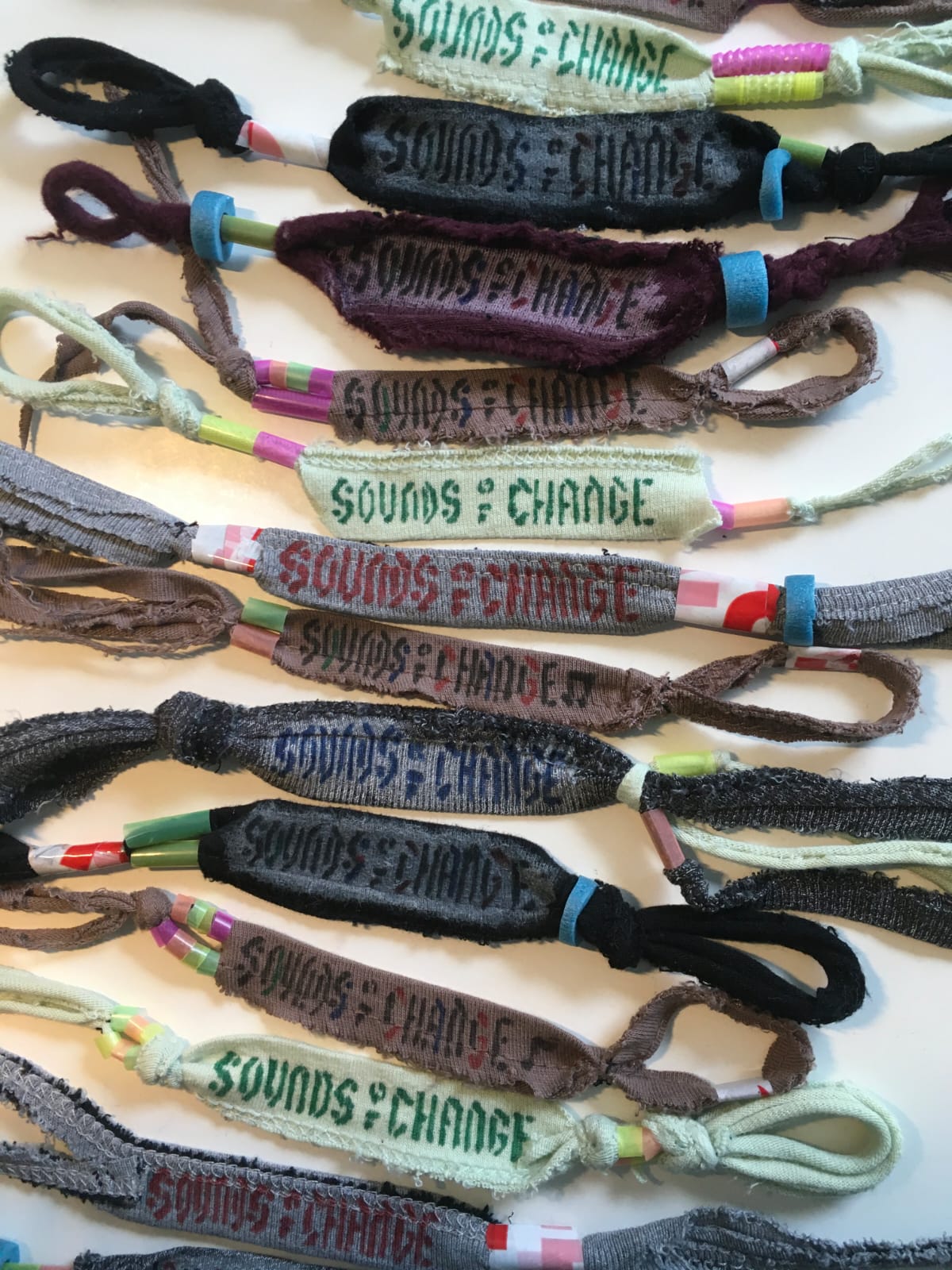
This approach felt similar to fan-based activism and participatory culture practices we studied in our Popular Music and Social Change course at Radboud University. While we recognized the difference between fandom centered on a musical product and supporting a non-profit that uses music for healing and inclusion, we still believed that framing our effort as ‘fan-based’ could help us connect more meaningfully with ourselves and our audience. From this perspective, we envisioned creating wearable bracelets to spread awareness about Sounds of Change and maintain the organization’s aesthetic identity. These bracelets can also foster an emotional connection through sharing—both the physical item and a shared desire for social change, especially regarding inequality in access to mental health care. To provide key information, most bracelets included a QR code linking to a Linktree with the organization’s website (and donation section), Instagram, and YouTube accounts.

Making the bracelets by hand allowed us to incorporate our creativity and values into our play, while also enriching the depth of our contribution. Using found materials for the bracelets added environmental considerations and gave them a do-it-yourself look, which we believe conveys resistance and empowerment by suggesting accessibility and genuine self-expression. In our approach, we chose a pragmatic form of activism focused on achieving specific goals: raising awareness and increasing visibility for Sounds of Change in Nijmegen. Like most pragmatic strategies, we used a practical tool—bracelets featuring the organization’s logo and key links—to help reach our objectives.

But what is participatory culture? Leskmono and Maharani8 referred to participatory culture as a vessel for community building through activism. In participatory culture, content and culture are created and shared by artists, consumers, users, audiences, and fans, allowing people from all over the world to connect through the Internet and social media. In this regard, our intervention can be seen as a participatory culture practice. Not only did the Linktree contain the Sounds of Change social media, namely the Instagram page and the YouTube channel, but the bracelets became a token, a symbol of support for the organization around Nijmegen. Our intervention gained more visibility for Sounds of Change, making people aware of the meaningful work the organization does, while it also created a small community around the organization in the city.9 Stemming from the members of EVEV, as we each have a bracelet, to the people we spoke to, and then to Stichting Gast, we managed to create a small network of people who know and support Sounds of Change in Nijmegen.

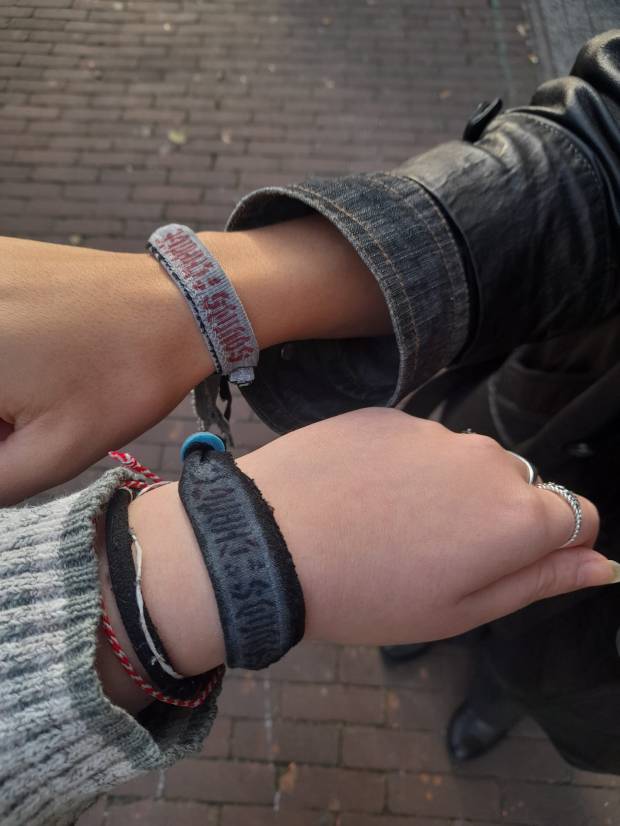
After receiving the approval from Sounds of Change, we decided to give away the 26 handmade bracelets in the city center of Nijmegen on a Saturday afternoon, after keeping one for each member of EVEV (three in total). We approached people in different parts of the city center by simply asking if they would like a bracelet and to learn more about our intervention. Although some of them rejected us almost instantly, as we expected, others did not mind stopping and chatting for a couple of minutes with us, while some even allowed us to take a picture of them tying the bracelets to each other’s wrists. We were pleased to receive such interesting responses, although many of the bracelets remained in our hands. As planned, we headed to one of Nijmegen’s socially engaged organizations to share our initiative with them.

Even before entering Stichting Gast – a local organization committed to providing various forms of help to undocumented immigrants, connected to the café De Klinker and the collectively and voluntarily run venue De Onderbroek – we met two of their volunteers just outside of the building. They happily accepted a bracelet each and allowed us to inform them about Sounds of Change and our intentions. They immediately suggested keeping some bracelets on-site and requested a poster to be displayed in their spaces. We quickly convened to leave some of the bracelets for them, and the next day we visited De Klinker to leave the remaining bracelets along with a larger poster. On this occasion, we also spoke with another volunteer who suggested letting Sounds of Change know that they are welcome in their spaces for potential future collaborations, as they have the capacity to host musical events at De Onderbroek.

This hybrid approach –  approaching people on the streets while also informing existing local initiatives – left us very satisfied. Even if on a small scale and within our limited means, we felt that we successfully managed to meet Sounds of Change’s goals by engaging individuals who were not necessarily already involved in reducing social inequalities and connecting them to our local socially engaged community.

According to Rosenthal and Flacks,10 music is an important social factor. It can be the causal element or the one sustaining social movements. For them, music is a mirror of the world we live in, as it is perceived by the composers. This is why research11 shows that music is a great tool for working with trauma. From the exploration of personal feelings to serving as a tool of self-expression, both verbally and non-verbally, to even developing coping and relaxation skills, music has proven itself to be a steadfast tool. Therefore, we believe that organizations such as Sounds of Change, which actively work with and help people through music therapy, should gain more visibility and support. The opportunity to work with them and help them through an awareness campaign was one that all three of us cherished, found exciting and inspiring.

Supporting Sounds of Change through our bracelets has proven to us how simple, low-budget actions like ours can be meaningful in building a sense of community around shared values and sparking interest in future engagement. This experience strengthened our sense of belonging and empowerment as we found a lively community ready to learn, help, and collaborate with Sounds of Change through our personal contribution.

In this project, we shifted from being only researchers to also becoming activists and striving in both research and practice to reduce inequalities in and beyond the Netherlands. By experiencing the impact of our research in practice, we learned a lot about how to achieve social change. This meant stepping out of our comfort zone and addressing the challenges along the way. In the end, not only did we experience change through this process of becoming activists in practice, but we also helped strive towards change with the people we met along the way.

Footnotes

  1. United Nations. Goal 10 Progress and Info.sdgs.un.org/goals/goal10#progress_and_info. ↩︎
  2. Shapiro, Shain, et al. Your Guide to Music and the SDGs. 2021, playfair.act4sdgs.org/wp-content/uploads/2021/06/SDG_Music_Guide.pdf. ↩︎
  3. Sounds of Change.  “Training Changemakers.” Sounds of Change, http://www.soundsofchange.org/what-we-do-1. ↩︎
  4. Sounds of Change. “Our Music Projects in the Middle East.” Sounds of Change, http://www.soundsofchange.org/projects. ↩︎
  5. Green, Andrew, and John Street. “Music and Activism.” Routledge eBooks, 2018, pp. 171–78. https://doi.org/10.4324/9781315475059-18. ↩︎
  6. Sounds of Change. “Sounds of Change Academy.” YouTube, 22 Nov. 2022, http://www.youtube.com/watch?v=CbfxNDmrGBw. ↩︎
  7. Marsh, Kathryn. “Creating Bridges: Music, Play and Well-being in the Lives of Refugee and Immigrant Children and Young People.” Music Education Research, vol. 19, no. 1, May 2016, pp. 60–73. https://doi.org/10.1080/14613808.2016.1189525. ↩︎
  8. Leksmono, Desideria Lumongga D. and Trisya Putri Maharani. “K-pop Fans, Climate Activism and Participatory Culture in the New Media Era.” Unitas, no. 3, vol. 95, pp. 114-135. doi.org/10.31944/20229503.05. ↩︎
  9. Jasper, James. “Emotions and Social Movements. Twenty Years of Theory and Research.” Annual Review of Sociology, vol.1 , no. 37, 2011, pp. 1-28, doi:10.1146/annurev-soc-081309-150015. ↩︎
  10. Rosenthal, Rob and Richard Flacks. “An Introduction to the Music-Movement Link,” Playing for Change: Music and Musicians in the Service of Social Movements, Routledge, pp. 1- 36. ↩︎
  11. Degmečić, Dunja, et al. “Music as Therapy / Glazba Kao Terapija.” International Review of the Aesthetics and Sociology of Music, vol. 36, no. 2, 2005, pp. 287–300. JSTOR, http://www.jstor.org/stable/30032173. Accessed 30 Oct. 2025. ↩︎

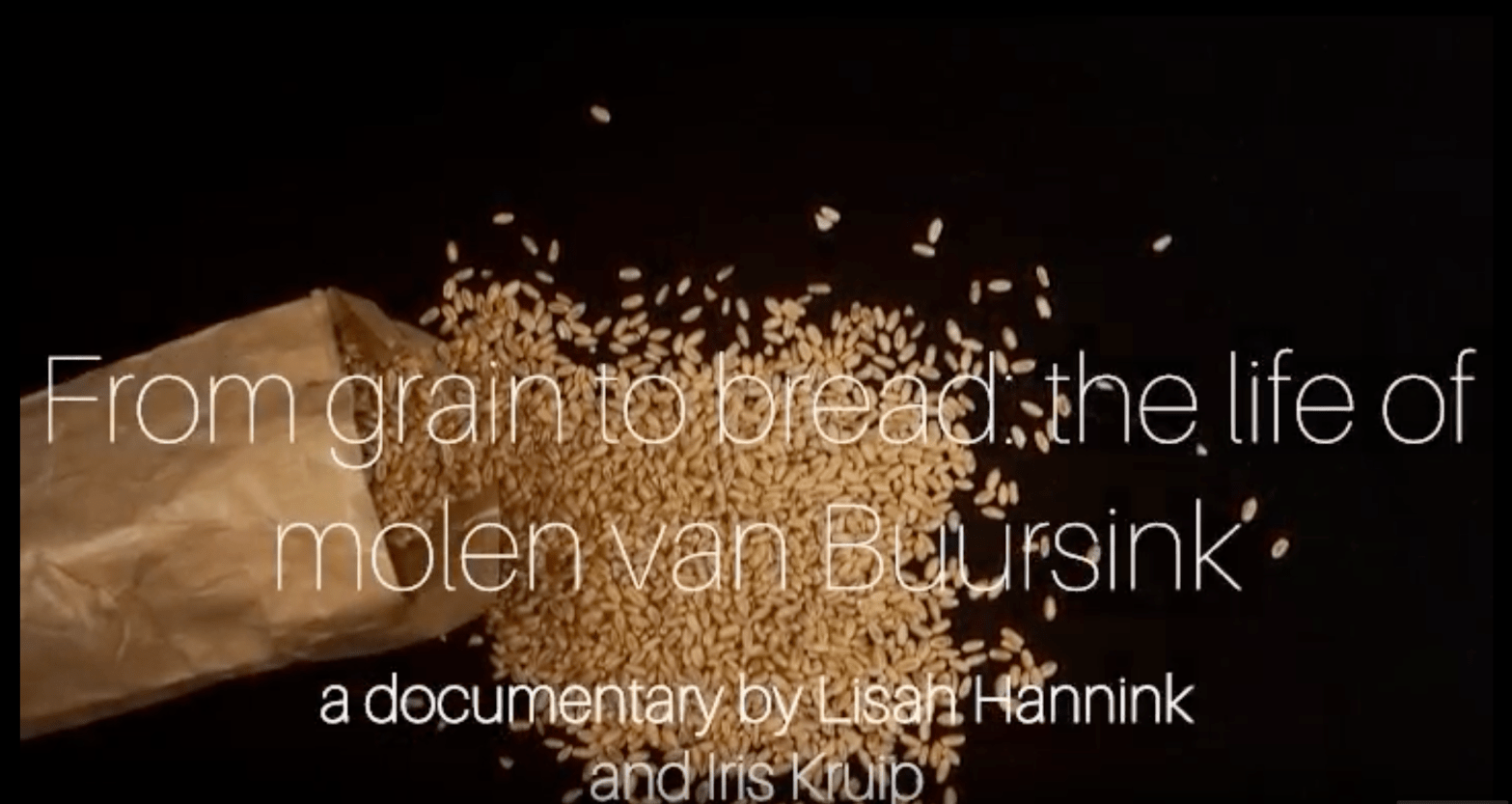
Documentary: From Grain to Bread: the Life of Molen van Buursink

A documentary by Lisah Hannik and Iris Kruip

From Grain to Bread was created as part of the course Material Culture, taught by Liedeke Plate in the BA Arts & Culture Studies at Radboud University.

Artist Statement

Our documentary explores how the transformation of grain into bread reflects broader changes in Dutch culture and community. Bread has long connected people to the land and to each other. While the basic process of turning grain into bread has remained materially similar for thousands of years, the context in which this transformation takes place has shifted from local windmills and communal production to industrialized, outsourced systems that often obscure their material and social origins.

To understand what this shift means, we focused on the Molen van Buursink in Markelo, a functioning 19th-century windmill that once formed the center of local grain processing and still operates today as a heritage monument. By visually following the grain’s transformation, from seed to flour to bread, we sought to capture how material processes shape, and are shaped by, human life. Filming at the mill allowed us to approach material
culture through sensory ethnography (Pink 2010). We were listening to the creaking wood, watching how the mill was operated, and observing how visitors can engage with this historical site.

The project draws on Arjun Appadurai’s and Igor Kopytoff’s idea of the social life and cultural biography of things (1986), Tim Ingold’s notion of making as correspondence between humans and materials (2013), and Jane Bennett’s understanding of vibrant matter (2010). Together, these frameworks guided our exploration of how bread and grain possess their own forms of agency and meaning within human and ecological systems.

Ultimately, our documentary argues that mills like Molen van Buursink are more than relics of the past. They are living mediators between people, materials, and landscape. By revisiting the material life of grain, we invite viewers to reflect on how re-engaging with local practices might restore a sense of connection between food, community, and environment.

Works Cited

Appadurai, Arjun, editor. The Social Life of Things: Commodities in Cultural Perspective. 1st ed., Cambridge University Press, 1986. https://doi.org/10.1017/CBO9780511819582.

Bennett, Jane. Vibrant Matter: A Political Ecology of Things. With Project Muse, Duke University Press, 2010.

Ingold, Tim. Making: Anthropology, Archaeology, Art and Architecture. Routledge, Taylor & Francis Group, 2013, https://doi.org/10.4324/9780203559055.

Kopytoff Igor. The cultural biography of things: commoditization as process. In: Appadurai A, ed. The Social Life of Things: Commodities in Cultural Perspective. Cambridge University Press; 1986, pp. 64-92.

Pink, Sarah. Doing Sensory Ethnography. SAGE, 2013.

Documentary: Nuestra Sazón

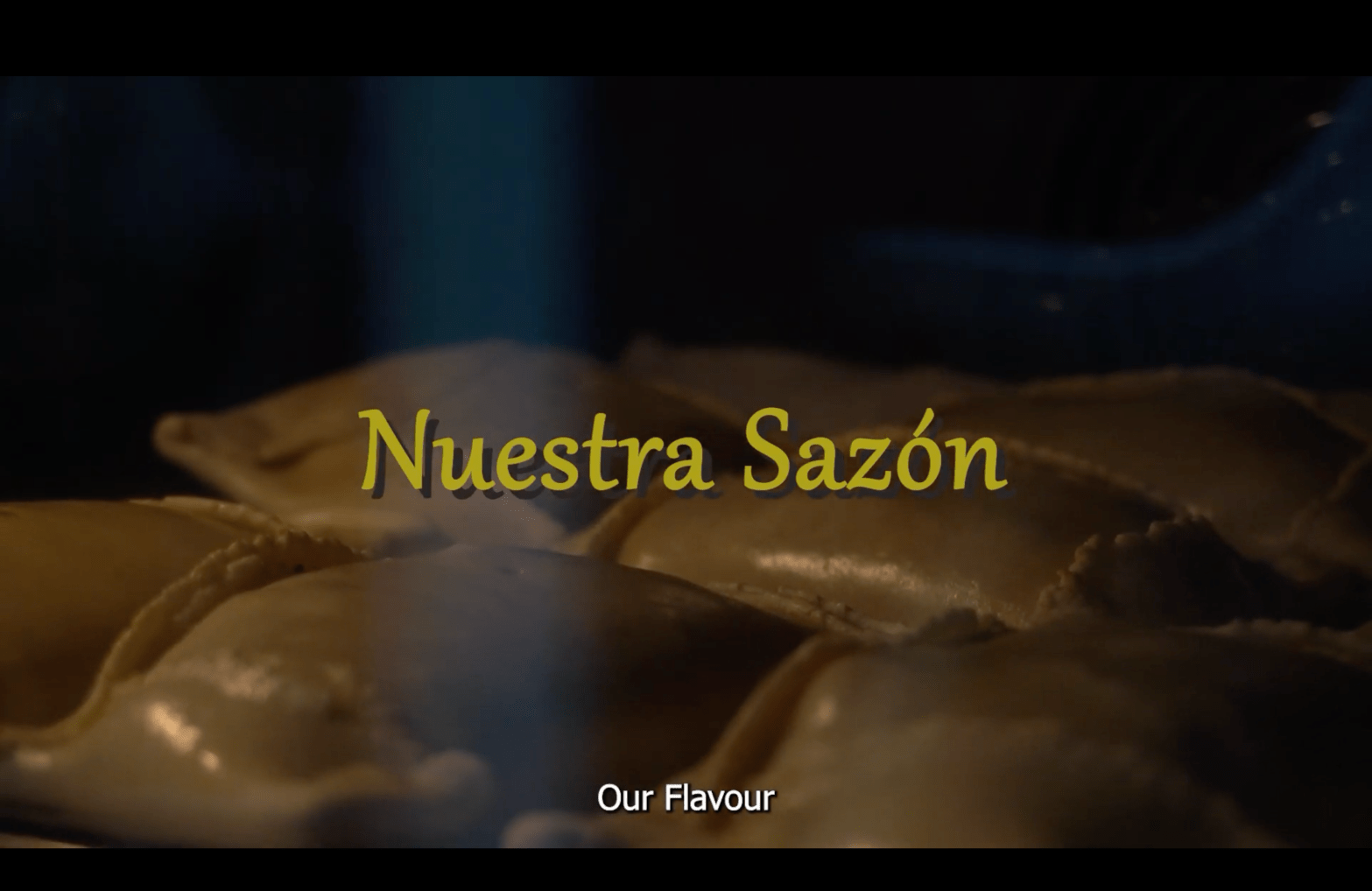
Different countries have their own variations of an empanada, and in our documentary, we follow Siria Olivares Soto, a Chilean cook, as she explores her identity, memories, and her migration process through the process of making empanadas.

This documentary has been filmed through a series of interviews. By not using a voice-over, we attempt to create a sense of intimacy, where the viewer can feel as though they are in the same room as Siria and us, cooking while sharing conversation on the table.

The film follows a three-act structure that begins with the topic of food, then memory, and finally identity. We made the choice to specifically show her hands as she cooks, as this represents the act of cooking and being physically connected to one’s cultural background. Placing focus on the sense of touch, we portray the empanadas as a vehicle and mode of connection beyond the sight as the main sensorial approach.

Nuestra Sazón is not just a documentary about empanadas or about Siria’s personal story. It is an invitation to reflect on how memories are preserved and transmitted through everyday practices, especially cooking. Food, in this case, does not only nourish the body but also creates and preserves our identity: it connects us to our roots, to who we were, and to who we continue to be, even when we live in another country, speak another language, or use other cuisine and ingredients.

Created with the efforts of Constanza Lobos Campusano, Davila de la Court, Irene Ocampo Perez, Maite Gaztañaga Baggen, Nele Brinkmann, and Martin Viatour, under the supervision of Jeroen Boom, Marileen La Haije and László Munteán for the course Moving Documentaries.

Travelogue Romania

By Demi Storm 

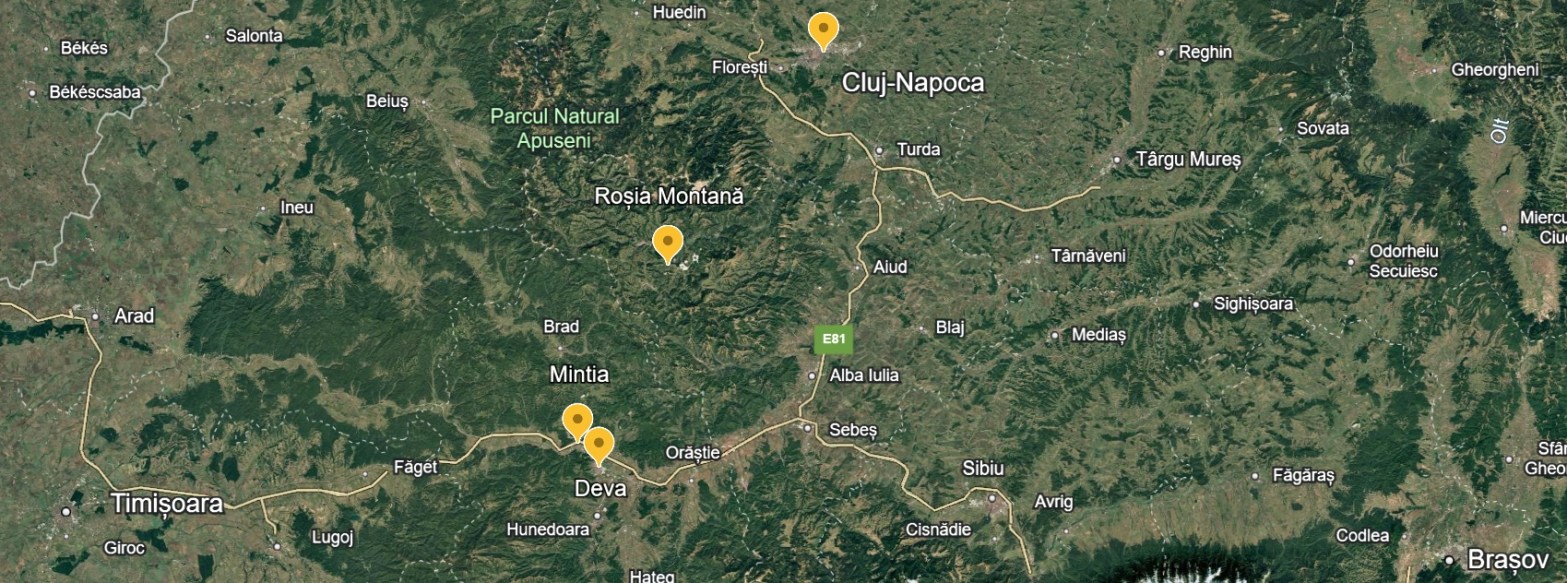
From the 24th of May until the 8th of June 2025, I was on my first ever research trip – which sounds very grownup. This trip to Romania was part of my PhD research on the experiences of space and time of mine- and quarry workers in Roman Dacia, using critical fabulation as a hermeneutic method. As I had never been to Romania before, the goal was to meet some people in the field, to visit Roșia Montană (where a Roman mining gallery can be entered), to go to as many museums as possible, and to see the votive altar that is central to my first case study in its context. To read (and write) about all my experiences of these two weeks would be too much, so in this blogpost I want to highlight only a few: the travel to Romania and the encounter with the votive altar. 

Travelling to Romania 

The travel to Romania took place over the course of three days. As I travelled by train, from Deventer, via Vienna and Budapest, to Cluj-Napoca, I saw the landscape change. On the first train in the direction of Osnabrück I wrote:

No more flat fields but a hilly landscape. Blue sky with some veil clouds. The green of the trees contrasting with the rusty rails. It looks different, it feels different but here too we find graffiti penises on walls.

A couple of naps, many tunnels, and twelve and a half hours later I arrived in Vienna for a short night. 

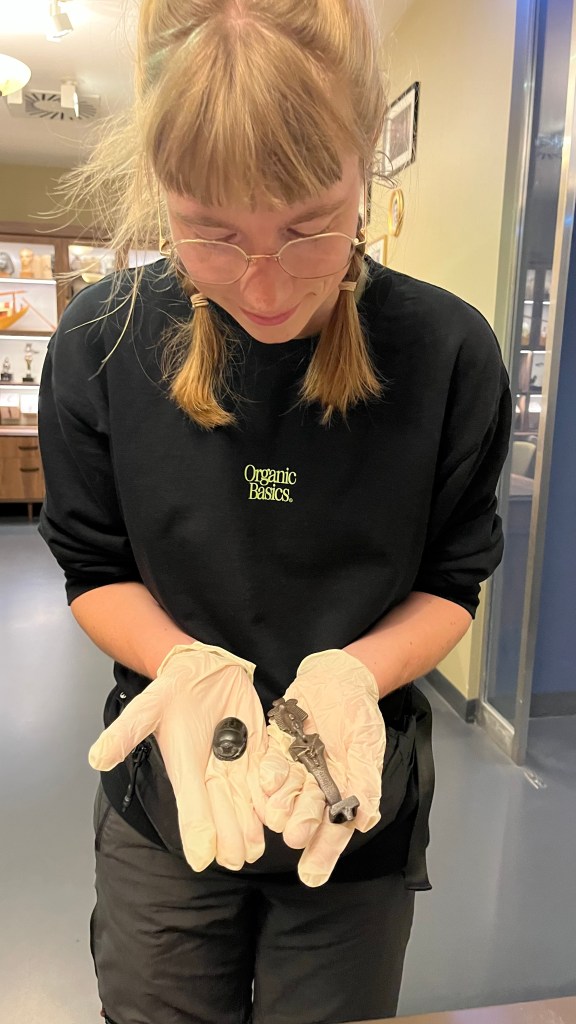
For the second day of travel, I would have loved to write that it was a beautiful trip, but I dozed off many times on the train. When I arrived in Budapest, I had a proper afternoon and evening in the city, which I spent walking around and visiting the Szépművészeti Múzeum (the museum of fine arts). There, I was lucky enough to be able to hold two Egyptian artefacts – a bronze figurine of Osiris and a scarab – in my own two hands, under the supervision of the most enthusiastic volunteer I have ever met.

The third day of travel was themed ‘time travel’. How, you’d wonder? If all goes well, we will cross the Hungarian Romanian border in the early afternoon. Then the time will shift by an hour. Pretty crazy, actually. Poof, an hour later than a second ago. Human choices and decisions. Modern time travel by train, I wrote down in my notebook while the train departed Budapest. But before crossing the border to Romania, I marvelled at the Hungarian landscape:

So many poppies in Hungary. Like red rivers. Vast greenery too; so many different shades of green. A farmer on a rusty brown tractor. Yellow meadows and purple flowers. Don’t forget the houses in the distance, the cars and churches. Hills, even further away. Here too, my favourite crows with a grey waistcoat. Birds of prey and swallows. A deer with a fawn. Bird species I don’t know. The train doesn’t go too fast either, which makes looking around easier.

Crossing the border at 12:48h was so lovely, not necessarily because of the changing time – my phone is still not quite up to speed on crossing national borders and thus time travel into the future. A quick flick of the plane mode on and off and then it’s 13:50h – but because I had arrived in the country of my destination, for me it felt like the research trip was now happening for real. I entered the context of my research and within four hours I would cross paths with Marcus Aurelius Arimo, who lived along the Mureș riverbanks some 1800 years ago – Arimo, for those wondering, is the person who dedicated the above-mentioned votive altar. Now Romania was not in satellite view anymore, it was three dimensional, even four, with the sounds, smells and sensations.

Visiting the Votive Altar 

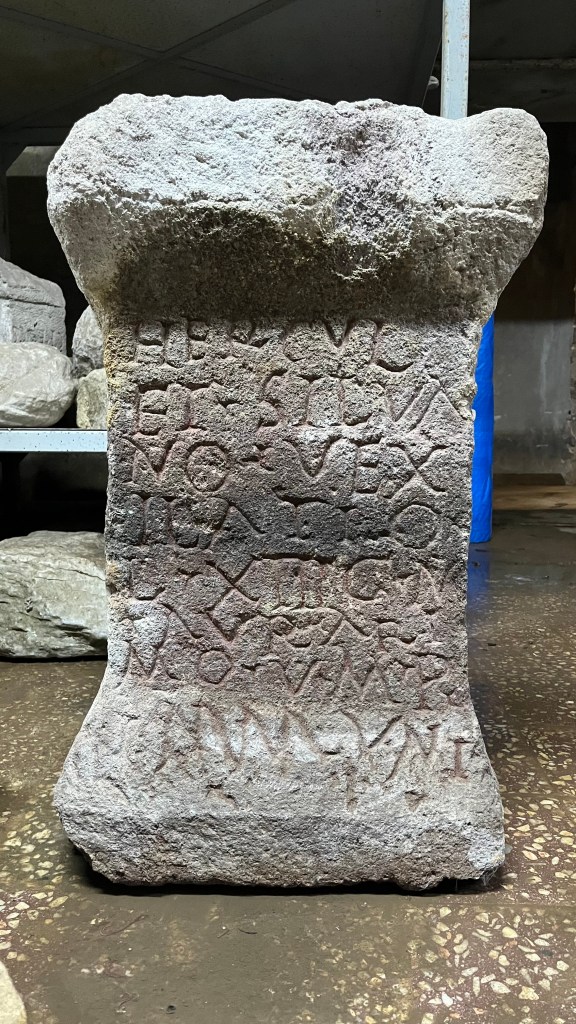
In the second week of my stay, I travelled from Cluj-Napoca to Deva, one of the places along the Mureș that is central to the case study. Here a votive altar was found by nineteenth century quarry workers. The altar was dedicated by Marcus Aurelius Arimo to the gods Hercules and Silvanus around 212-222 CE. Arimo was very likely involved with quarry work, as he was part of one of the special units of the Legio XIII Gemina that worked on extraction of natural resources and the construction of buildings, roads, etcetera. Today, the altar is stored in the depot of the Muzeul Civilizației Dacice și Romane (the Museum of Dacian and Roman Civilisation) and I was able to make an appointment with the museum to visit the depot on the 3rd of June. 

I was so excited to be at the museum, that Tuesday morning. The depot is underground, so we – I was accompanied by two people of the museum – walked down the stairs, narrowed by a metal construction that ensured the mobility of the artefacts in and out of the depot and decorated with spiderwebs. I did not exactly know what to expect of the depot, but I had not foreseen the possibility of past floodings of the space. At some point in time the water stood at about 40 centimetres, which marked its hight on the artefacts. The floor still had some puddles of water and mud and was inhabited by many worms too. It was a dimly lit space, cool – contrasting with the bright sunny and warm weather outside – and in this space I was finally facing Arimo’s altar. That was magical. I had stared at one online photo of the altar many times and now I could see it in real life, experience its dimensions, read the inscription, take photos of every corner, touch it. This experience made me even more aware of the longevity of people’s choices and actions, the history of the artefacts themselves and the dynamics between past and present times, and that was wonderful.

To keep this piece around a thousand words, I will stop writing now. If you want to know more or have any questions: please contact me at demi.storm@ru.nl.

A Series of Becomings: How to Return to Myself from a Decolonial Perspective as an Immigrant in The Netherlands

By Constanza Lobos Campusano

This essay was written as part of the course Struggles of Identity in the Hispanic World, a second-year BA course at Radboud University.

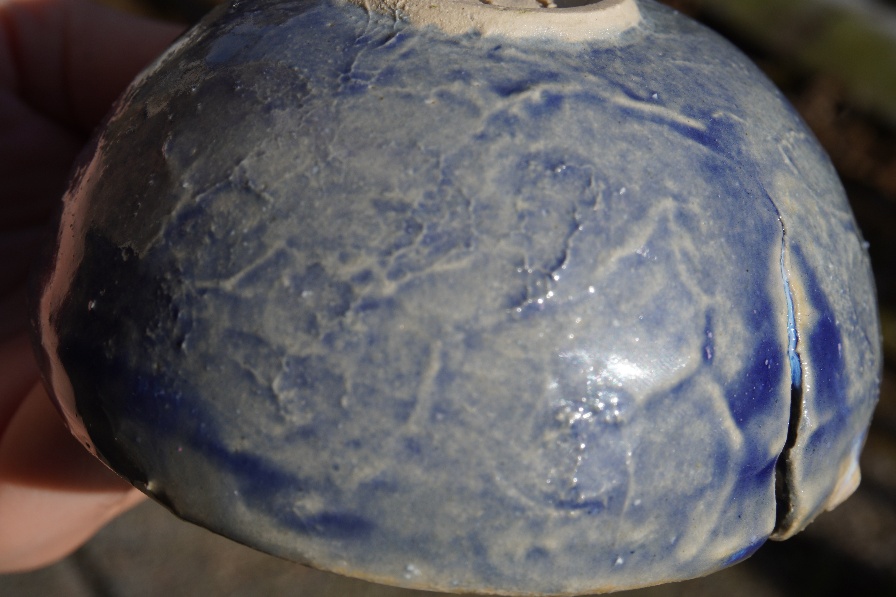
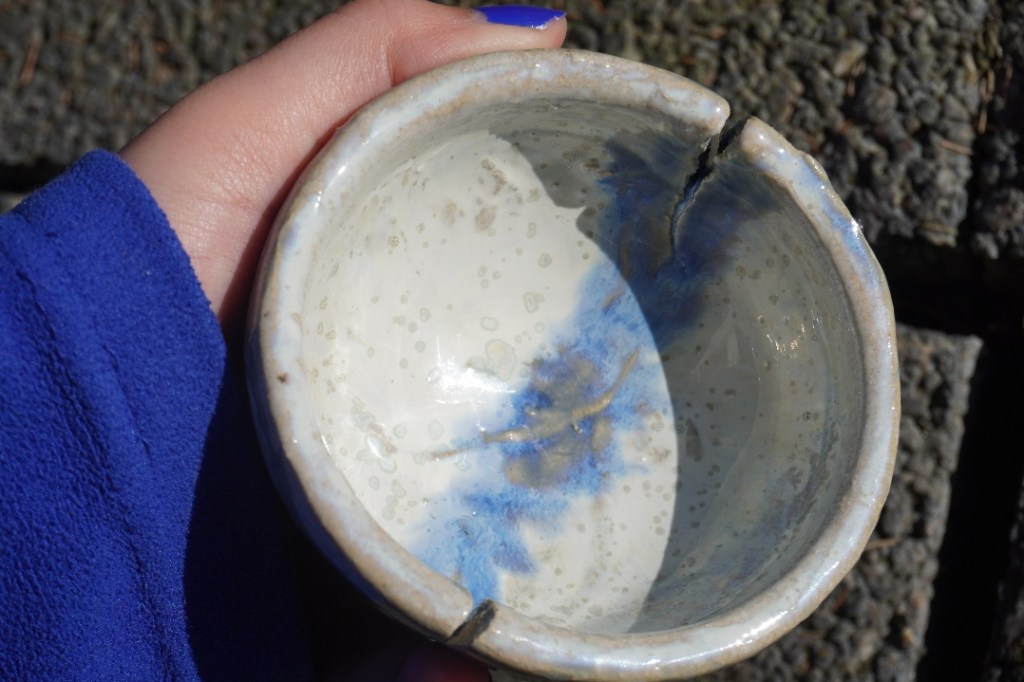
Amid big shifts happening in my personal and political life, I got the chance to explore my identidad y posición for a creative project for the course Struggles of Identity in the Hispanic World. My name is Constanza Lobos, I’m a student of the Bachelor of Arts and Culture here at Radboud and I’m also a Chilean immigrant living in the Netherlands. By using decoloniality as my lens, I created a clay piece to express my experience of migration to Europe.

To articulate my life, I found the right words in the works of Gloria Anzaldúa and Silvia Rivera Cusicanqui. I narrate mi experiencia personal following Anzaldúa’s discursive mode “auto-historia” that comes from merging and blurring personal narratives with theoretical discourse by “inventing and making knowledge, meaning, and identity through self-inscriptions” (“Light in the Dark/Luz En Lo Oscuro” 6). Therefore, I will switch codes from English and Spanish with the aim of uncovering what it means to write myself into existence como un yo indefinido y contradictorio that does (not) belong to one space.

I was born in Viña del Mar, Chile, and my arrival to the Netherlands was por pura suerte. I came here through a partnership visa that involved passing different forms of cultural assimilation such as integration language exams and complying with Dutch cultural norms and values. My Chilean was kept in a shoebox inside my mind since my everyday life involved traducirme a mí misma in English and bits of Dutch. Furthermore, after being asked hundreds of times where I was from, I realized that I was trying to make people understand my background as a way of seeking validation for my existence in this new context. From then, I decided to let people guess and make them face their own preconceptions when it comes to placing someone ethnically ambiguous as myself. Indeed, phenotypically, I have been able to pass as European and avoid being racialized against my own will.

As I mentioned earlier, this creative attempt follows the theoretical framework of decolonial thought because it aligns with my background as a queer immigrant from Latin America living in Europe. I take decoloniality as a lens that speaks about the struggle and survival of colonized and racialized subjects against Western rationality by decentring its hegemonic ways of being and of producing knowledge (Mignolo & Walsh 17). Moreover, being in a constant state of transition relates to the crossings that people from the Global South must go through when moving to a new setting in the Global North. Thus, this displacement is porous; it involves a shift and transformation of fronteras emocionales y físicas beyond countries (Alvarez 2).

Ser Latinx and finding myself in this context, both personal and cultural, produced a constant flux of crisis that gave way to a new (unfinished) identity. This ongoing process is what writer Gloria Anzaldúa in her book Borderlands / La Frontera: The New Mestiza discusses, she conceptualizes the Borderlands as a space where cultures and languages clash and mix with each other, thus creating something new, emerging from the crosspollination (Anzaldúa 9). These borderlands can be psychological, and physically present because they permeate everything around people who live in los márgenes de places and/or themselves. Moreover, it embodies the movement and shifts from desarmar one’s identity to fit in with a new landscape hoping to survive the strangeness until it becomes—not quite—like home (Anzaldúa 8). Living in my own borderlands pushed me to look for ways to explore quién soy by navigating and negotiating my transformation under these new circumstances.

In the search for a new language and way of being, I found in Silvia Rivera Cusicanqui’s Ch’ixinakax utxiwa: A Reflection on the Practices and Discourses of Decolonization the notion of ch’ixi. She describes it as a colour that emerges from juxtaposition, such as combining two opposing colours like black and white, yet the resulting colour is never fully the mixture of the two, in other words, it reflects the “idea of something that is and is not at the same time” (Cusicanqui 105). Framing myself as ch’ixi involves the recognition of a third space that Cusicanqui describes by haciendo espacio for the identities and landscapes that seem to antagonize and complement each other. Therefore, it gives birth to a new culture influenced by the confluir of my values and worldviews (Anzaldúa 71).

Going back to my arrival to the Netherlands, during my first month here I started a ten-week course of throwing clay on the potter’s wheel. Once a week, I found myself surrounded by the conversations of Dutch women from different ages. The teacher couldn’t speak English extensively, so I focused as much as I could on observing the movements of the hands of my instructor while I moved mine in sync, this is how I learned to create pieces en movimiento. My relationship with pottery became un refugio from the constant need to traducirme to be understood by others. Furthermore, it also required a different approach to the practice of making art since it displaced my sight as the main tool by forcing myself to pay attention to mi sentido del tacto. Hence, the act of immigrating and throwing clay on the wheel became permanently entrelazadas en mi vida.  

In Lina Bravo Mora’s Desentierros/Unearthings: A Dirty and Migratory Text on Clay, Soil, Land, Sculpture, and Poetry as Territorial, Somatic, and Healing Practices, she explores working with clay as an act that can be a transformative practice, allowing us to deeply connect to ourselves and the shifting landscapes that surrounds us. I decided to create a piece while challenging myself to close my eyes and focus on mi capacidad para sentir y escuchar to the clay. As a student of Arts and Culture, I have been taught that the way we prize the sense of sight, as the main way to interact with art, is part of a legacy that stems from modern/colonial roots. Likewise, echoing the words of Rolando Vázques Melken on decolonial aesthesis; it is decolonial to attempt to overcome the aesthetics dominated by the gaze that has become the equivalent of power over representation (Wevers 4-5).

Creating a clay piece starts with a different perception of time, it requires a slowness and patience that does not align with the way I carry my life outside the pottery workshop. The moment I sit down in front of the wheel I can feel that my body knows naturally how to move without waiting for my thoughts to catch up. There is a magnetism towards shutting the outside world from the moment I held a ball of clay. Moreover, my first reaction is to move my hands, as I mould it, by carefully taking out bubbles of air that might be inside, for it not to explode in the kiln. My relationship with clay is through sensation and not by theory or written explanation, it demands a different approach based on the interface of touch (Bravo Mora 36). For me, pottery is a decolonial practice that creates sentido through praxis before any theoretical framework, it’s a doing-thinking act that goes against Western modern thoughts (Mignolo & Walsh 19).

After a few minutes, I have made a small ball of clay that I need to throw against the round wood board on top of the wheel platform. Once the clay is set, I take a small sponge that has been soaking inside a bucket with warm water. The wheel start turning as my hands move back and forth between water and clay, feeling my skin be micro-sanded by it as I experience the plasticity and possibilities of the material (Bravo Mora 36). It’s during these moments that I’m fully captivated by the act of creating as I find myself unravelling in the process of it. Having my eyes closed allows me to deeply engage with the materiality of the clay as the abundance or lack of water influences what will become of it. If I can imagine myself as the piece that is forming and unforming, neither Chilean nor an immigrant in the Netherlands, maybe I can embody ch’ixi.

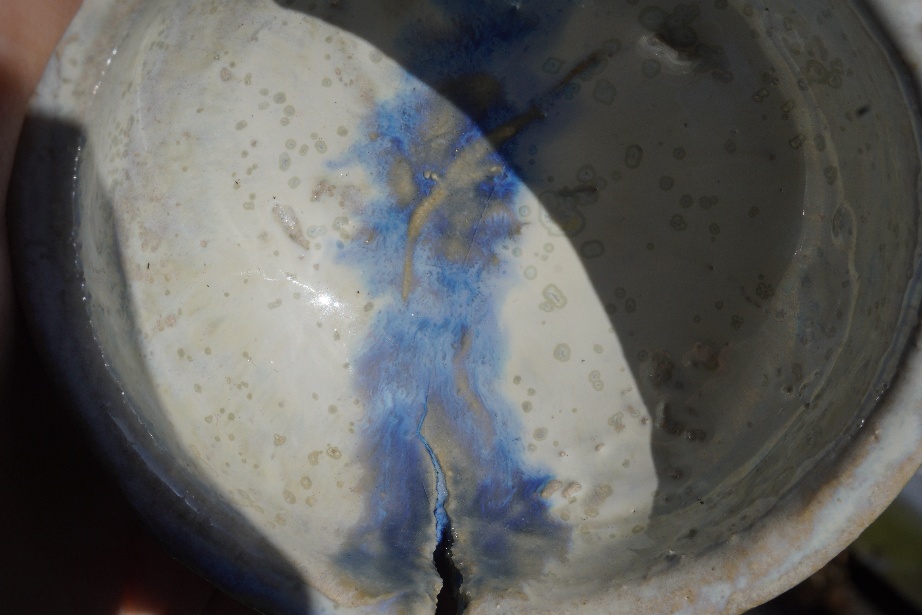
I stop the wheel as my eyes open and see what I have been imagining in my mind. I pass a wire under it to separate it from the wood base. After that, I take it with my hands to look at it and by accident I make a crack on one side by pressing too hard with my fingers. My first instinct is to go to the bucket of wet clay to soak my hands and try to fix it. But as I watch myself trying to restore my error, I realize my disregard for the whole purpose of this experiment. Thus, abracé la grieta, and a new one appeares on its other side. This new accident help me return to a perspective that seeks to make visible a stance that displaces the Western positionality and rationality as “the only framework and possibility of existence, analysis, and thought” (Mignolo & Walsh 28). A través de las grietas, I can appreciate the decolonizing thinking that, according to Cusicanqui, allows us to affirm ch’ixi by creating new ways of knowing and being (107).

As I hold the clay piece, I let it rest for some time, until dry enough to be trimmed. Trimming involves shaving or removing layers of material by pressuring different tools to the piece as it keeps moving on the wheel. Before coming to the Netherlands, I had seen friends moving abroad and looking for ways to reconnect with their culture. In my case, I never felt Chilenx or Latin American while living in my country, but it changed brutally when I had to pack up my life in two suitcases and became unable to escape the immigrant feeling de no pertenecer nunca del todo. Migrating means to become a crossroads, as Anzaldúa says, and the borderlands permeate all the aspects of your life; it is also the place for contradiction, pain, mourning, and grief of what has been left behind. Trimming and letting go of the layers of ourselves causes erosion on multiple levels. Thus, after “movement and traveling, those migratory sediments settle to form new landscapes, deltas, clays” (Bravo Mora 34). 

The final stages of creating this piece involve placing it inside the kiln to be burned and using glazes to paint it. When choosing the colours for this piece, I selected a pearl white which is the colour of the first landscape that I see whenever I take a plane to Chile or whenever someone asks me about how my country looks. I’m referring to la Cordillera de Los Andes, the so-called columna vertebral de Chile. It unites the north and the south in its more than 8500 kilometres in length. Its snowy peaks and fractured geography, in my opinion, reflects what it means to be Chilean and find oneself at the end of the world. The other colour that I chose was blue since my imagery of the country involves the Pacific Ocean and its myriads of deep blue tones. I spent most of my life going to the sea because I was born in Viña del Mar, which translates to Vineyard of the Sea. Since I moved to the Netherlands, I have looked at the sea, lakes, and rivers of this country searching for las mismas tonalidades de azul, as well as its smells.

The way I approached this creative project could not have been possible without Anzaldúa’s ‘auto-historia’ as seen in her book Light in the Dark/Luz En Lo Oscuro: Rewriting Identity, Spirituality, Reality. The Chicana, queer, feminist scholar describes her storytelling methodology which illustrates my efforts in following her example:

Soy la que escribe y se escribe/ I am the one who writes and who is being written. Últimamente es el escribir que me escribe / It is the writing that “writes” me. I “read” and “speak” myself into being. Writing is the site where I critique reality, identity, language, and dominant culture’s representation and ideological control (3)

By finding a safe space to articulate my life, I uncovered mi identidad fracturada y sin raíces by creating art through clay. At the same time, dibujé paralelos between academic writing and storytelling by following the works of Gloria Anzaldúa and Silvia Rivera Cusicanqui. The lived experience of existing in the Borderlands while embodying ch’ixi has showed me how the process of immigrating requires a never-ending (de)construction de mi identidad. These words hope to show how praxis and theoretical knowledge can join towards a new decolonial way of doing-thinking. 

Works Cited

Alvarez, Sonia E., et al., editors. Translocalities/Translocalidades: Feminist Politics of Translation in the Latin/a Américas. Duke University Press, 2014. JSTOR, doi.org/10.2307/j.ctv120qs7g.

Anzaldúa, Gloria E. Light in the Dark/Luz En Lo Oscuro: Rewriting Identity, Spirituality, Reality. Edited by Analouise Keating, Duke University Press, 2015. JSTOR, doi.org/10.2307/j.ctv1220hmq.

Anzaldúa, Gloria. Borderlands / La Frontera: The New Mestiza. 5th ed., Aunt Lute Books, 2022.

Bravo Mora, Lina. “Desentierros/Unearthings: A Dirty and Migratory Text on Clay, Soil, Land, Sculpture, and Poetry as Territorial, Somatic, and Healing Practices.” Simulacrum Magazine, edited by Niels Noot, vol. 32, no. 4, 2024, pp. 29–41.

Cusicanqui, Silvia Rivera. “Ch’ixinakax utxiwa: A Reflection on the Practices and Discourses of Decolonization”. Translated by Brenda Baletti, Duke University Press. The South Atlantic Quarterly, 2012, pp. 95–109, doi.org/10.1215/00382876-1472612.

Mignolo, Walter, and Catherine E. Walsh. On Decoloniality: Concepts, Analytics, Praxis. Duke University Press, 2018.

Wevers, Rosa. “Decolonial Aesthesis and the Museum: An Interview with Rolando Vázquez Melken.” Stedelijk Studies, 11 Oct. 2023, stedelijkstudies.com/journal/decolonial-aesthesis-and-the-museum/.

The commodification of (online) secondhand shopping: An analysis of the relationship between interface design and consumer behavior on Vinted

By Melissa Ho

Secondhand shopping is an activity that has been around for a long time, not only to save costs, but also as a way of decreasing one’s carbon footprint.1 As the fashion industry has become fast-paced and overconsumption behavior worsens, resources are at risk of becoming obsolete and companies’ search for cheap manufacturing leads to exploitation of laborers in the Global South, while polluting the environment with an abundance of textile waste dumped in landfills.2 Consumer’s increasing awareness of the effect of the fashion industry pushes scholars, companies and consumers themselves to search for a more sustainable way of producing, distributing and consuming fashion.

For decades, different design industries have been using the strategy of planned obsolescence to stimulate consumers to keep purchasing new products.3 Planned obsolescence exists in different forms: the purposely faulty made products or materials that last for a limited amount of time, and the social aspect of planned obsolescence which creates trends and the social need to keep up with the taste of the majority of society.4 As companies plan for products to ‘expire,’ the waste accumulates until it does irreversible damage to the earth and its inhabitants. In the case of fast fashion, at its current understanding, it is about fast and cheap consumption of new items, while sustainability aims for long lasting and durable design and products.5

In approaching the consequences of wasteful industries, different scholars have proposed and advocated for a circular economy (CE). According to Kopnina, CE relies on the concept of circularity, which “entails reducing if not completely eliminating the consumption of new (raw) materials and designing products in such a manner that they can easily be taken apart and reused after use.”6 As the fashion industry has become globalized and destructive, to achieve CE, systematic change and collaboration between all levels – design, manufacturing, distribution, consumption – within the industry is crucial.

In addition, studies of consumption behavior and the consumer’s needs are essential in finding solutions to the pressing problems, since consumers may be able to direct or influence the production or distribution process by demanding for change. The assessment of the needs of the different stakeholders is essential to understand and overcome the obstacles of practicing a more sustainable form of fashion.

One of the examples of a circular form of shopping is secondhand, which is increasingly gaining momentum in popularity among youth.7 As Palomo-Domínguez et al. have described, this type of shopping offers possibilities to curate a unique self identity, while recognizing and confronting the environmental impact of the fashion industries.8 Within the globalized and digital world, different mobile marketplace applications have been developed. The secondhand shopping platform, Vinted, has risen in popularity from 2008 onwards, when it was founded in Lithuania. Starting out with the mission “to make second-hand the first choice worldwide,”9 the company has expanded to more than 20 different countries and has been downloaded by millions.10 As the application is intended to promote sustainable and slow fashion, but could also have less sustainable implications, this paper will both highlight the possibilities and the weaknesses of keeping the promise of sustainability through online secondhand shopping.

Literature research will indicate what the motivations for online secondhand shopping may be and how the consideration of environmental and ethical sustainability are taken into account while consuming fashion. Vinted will be analyzed according to the interface design and connected to the concepts proposed in existing research. The following research question will be studied: In the context of the process of a sustainable future of the fashion industry, to what extent is digital platform Vinted contributing to the transformation of secondhand shopping into a commodified practice?

Reviewing literature: conceptualization of the proposed solutions

The main motivation for purchasing clothes is, as Atik and Ertekin have argued, the desire for newness. While this could be applicable to any product, fashion items are for many people an important symbolic medium to express their self-identity or conform to the norms and values of the larger community.11 The restless desire for newness could also be explained by the empty promises from the media and mass-distributed trends, and boredom resulting in the need for novelty, even when this is elusive.12 While this desire for newness depends on the individual, fast fashion corporations like H&M and Zara are not innocent and fuel this hunger by mass producing new collections of clothes, every month or even week, with a limited availability, pressuring consumers to follow the newest trends. The overconsumption leads to the normalization of disposing of clothes at a faster rate.13

Atik and Ertekin emphasize the lack of emotional connection, or the personal affect, consumers have in regards to their personal belongings and how this makes its disposal even easier.14 In this way, the fast fashion industry not only harms the health of workers and the environment, but it also pollutes the consumer’s mind.

Fashion as a sustainable practice has ambiguous connotations, even within the academic field. To clear up misunderstandings, West et al. have argued for the term slow fashion to describe a type of fashion that “is not reliant on things that are new, it is not obsessed with image, neither is it delivered top down from designers through the catwalk and then emulated by fast fashion retailers.”15 They urge consumers to break with current consumption behavior, where quality over quantity is valued. Instead of following trends, fashion should reflect the consumer’s individual creative choice.16 However, in reality this goal is hard to achieve considering the many factors that contribute to the greater problem.

A circular fashion industry is usually considered from a macro-level, top-down perspective where companies and policymakers are expected to take the initiative to make meaningful changes. Circular economy’s (CE) main goal is to provide an alternative for the linear form of production and economy, which refers to products being made to end up as waste.17 As Mishra, Jain and Malhotra have argued, achieving CE requires radical systematic changes throughout the whole value chain, in order to transform waste back to resources.18 CE in fashion could manifest itself through designers and big fashion brands designing garments that “use sustainable raw materials, close the material loops and keep the material and products in the loop, as long as possible”19 with the help of innovation and collaboration between different levels of stakeholders. As certain fashion designs are made with the ‘resilience’ value in mind, Vanacker et al. believe that kind of “product has a high ability to adapt to changing environments.” 20However in reality, if the current system is lucrative enough, the question remains if companies within the fashion industry feel impelled to radically and systematically rethink and redo their way of producing and supplying fashion.

On the other hand, CE could also be approached from a bottom to top strategy. Different scholars have argued and urged for a bottom up approach to slowing fashion down by understanding consumption behavior and proposing different solutions suited for each type of consumer. West et al. have defined different types of consumers and urge to design the transformation to slow fashion according to those differences. They have observed the following types of consumers through interviews: the hierarchist, egalitarian and the individualist. The hierarchist understands slow fashion as a collective responsibility, and if not everyone is participating, they do not feel obliged to do the same. The egalitarian considers every stage of the fashion production and supply chain and the implications their role and responsibility has on the present and future. Lastly, the individualist approaches fashion based on individual choice, narrative and values, which suggests that this type does not consider slow fashion as a personal responsibility if it is not included in their personal values and they may consider other elements, like style, more important.21

In the context of online secondhand shopping, or thrifting, this activity has been made possible through digitalization and globalization. Through a digital platform, the physical, local vintage or thrift shop transforms into an online marketspace available to a greater audience. Individuals are able to curate their used “closet” and directly exchange secondhand items between each other.

Vinted is currently one of the most popular online resale platforms on the market.22 In mainstream media, Vinted commercials promote the platform and simultaneously the idea of consumption and the reuse of garments,23 using slogans like ‘Don’t wear it? Sell it!’ The app is believed to contribute to Gen Z’s (born from 1995 to 2009) motivation and understanding of sustainable fashion as Palomo-Domínguez et al. have argued.24 They describe Gen Z as digital natives; the generation that exists in and is influenced by online spheres. When expanding their knowledge on the impact of the fashion industry on the environment Gen Z tends to depend on the media and trends they consume.25 In regard to Vinted, a part of the participants in Palomo-Domínquez et al. ‘s focus group interviews appreciated Vinted’s contribution to sustainability and gained motivation to act in the same manner, but also considered it as trendy.26 From their research, the authors have obtained consistent findings in which “despite Gen Z’s environmental and sustainable awareness, this generation still presents a majoritarian consumption behavior that supports fast fashion and other non-sustainable models.”27 The majority of the participants who use Vinted prioritized practical attributes like making and saving money, decluttering and the ease of using the platform.28 Thus, while Gen Z becomes increasingly aware of sustainability and the downsides of the (fast) fashion industry, scholars observe an action-value gap.29

While different studies have proposed practical solutions to a complex problem, there is not one way in which it can be tackled. However, there are a few commonalities: slow fashion and emotional durability seem to express the most important components of a sustainable fashion practice. In the case of (online) secondhand shopping, one might wonder if this type of shopping fulfills these needs or exploits them. Cerio et al. argue in their article that platforms like Vinted are over-marketized, causing conflicts between users on secondhand resale platforms. Conflicts regarding market-related topics are the most common, as most users on these platforms value economic aspects (e.g. bargaining) and convenience (e.g. ease of use) the most, favor a competitive atmosphere and consequently often experience negative social exchanges.30 However, this argument becomes more nuanced, as Ceria et al. argue, since consumers are able to adapt to others who may not have the same commercial intentions, and so they are able to rely on “domestic values, such as politeness and trust, which ultimately work to de-commodify commodity practices.”31

Method

By using the walkthrough method in an interface analysis, the format of the app Vinted will be studied from the perspective of the user’s experience. As Light et al. have stated, this method enables the researcher to establish a corpus of data to study the technical and cultural implications embedded in an app.32 This type of analysis offers insights on the intended use of the app and how the interface may or may not influence the user’s behavior. Using the walkthrough method for Vinted may offer meaningful results, as it indicates how both the company and the consumer have agency over their choice and at the same time influence the outcome of each other’s actions. The collected data will be further discussed in the discussion in relation to the literature review.

Vinted: an online thrifting experience33

Vinted’s expected use in three stages

The first stage entails the app’s vision, which refers to “the purpose, target user base and scenarios of use, which are often communicated through the app provider’s organizational materials.”34 Vinted Marketplace claims on their official website that they want “to make second-hand the first choice worldwide” by extending the lifecycle of its member’s used items.35

The operating model, the second stage of determining an app’s expected use, is based on the “business strategy and revenue sources, which indicate underlying political and economic interests.”36 Vinted gains their incentives through advertisements in the app and the amount of downloads they have achieved worldwide. Users do not have to pay for the app nor do they have to pay the company to place orders or sell products. As a secondhand marketplace, there is some implication that they disagree with the current production and consumption cycle, and in this way want to offer alternative consumption behavior, where extending the lifecycle of an item is desired.

Lastly, the third stage involves the modes of governance, or in other words, the ways “the app provider seeks to manage and regulate user activity to sustain their operating model and fulfill their vision,” which is based on documents like guidelines and the Terms of Services.37 Vinted has set rules to ensure that the platform is a “friendly and safe place to trade secondhand items.”38 They request users to comply with the list of items that are allowed to be put for sale and refer to official rules from the European Economic Area. In the guidelines there is a list of prohibited items and a declaration that Vinted has the right to re-evaluate what items are or are not allowed to be listed. If certain items are found to be unsafe or inappropriate, Vinted may remove these items. Additionally, users are given the agency to report incidents of listings of prohibited items.39

Walkthrough method

Registering and entering Vinted

Upon opening Vinted, the user is met with a regular registration system, in which they fill in their information or log in using an existing Google or Facebook account. Once registered, the user enters the platform and is met with Vinted’s minimalist and straightforward interface design on their home page. At the top of the screen there are three categories shown: “Everything,” “Designer” and “Electronics.” Depending on each category, a new page with different items is shown.

On the bottom of the screen the following buttons show different screens: “Home,” “Search,” “Sell,” “Inbox” and “Profile.” The design and affordances of the app offer basic actions for users to follow to browse through items and sell their clothes.

Everyday use40

When scrolling down the “Everything” page, the following topics with fitting images are shown: “Recommendations for you,” “Your favorites,” “Last viewed items.” These categories indicate the app’s ability to adapt to the tastes of the user based on their recorded behavior on the platform. Simultaneously, suggested items suiting the user’s taste may encourage more consumption.

After scrolling down, the category “New” appears and a roster of newly listed items offers the user an overview of what can be bought. The large number of Vinted users results in frequent updates of newly uploaded items. Each item is visualized with an image, the username of the seller, the size, brand and the price of an item. Users are able to “like” the items that they are interested in and they are able to see the amount of likes, or in other words the amount of people interested in a particular item, which may cause pressure to purchase the item before someone else does.

Once the user finds an item that they have taken interest in, they can click on the image and the item appears in a larger size on screen. When scrolling down, the user finds the seller and their reviews symbolized in a five-star system, a description of the item and additional information (e.g. shipping, extra security fees), and more images of items that the seller offers. In this way, the user is able to hunt for more items from one seller’s “closet.” Buying more from one seller becomes a “bundle” and is rewarded with a discount. However, if the user is interested in a singular item, they could simply buy the item or make an offer. The process of negotiation is private between the buyer and the seller through direct messaging, which can be found in the “Inbox.”

Discontinuation of use

By ‘walking through’ Vinted, the discontinuation of using the app is difficult to generalize for every user. However, a few possible reasons can be imagined. Firstly, in the future, secondhand shopping may not be considered to be as trendy anymore as it is right now, causing this form of shopping to become less desired. Additionally, the “newness” of items or the amount of “new” items that are uploaded may become obsolete or less frequent, decreasing the interest to regularly check the content of the app. This could become the case if another app or platform enters the market that may offer different affordances or different products that are more favorable. Ceria et al. have argued that negative social exchanges between users have resulted in refusing or abandoning the use of the platform, and donating the items somewhere else instead.41 Lastly, if slow fashion will be accomplished someday, the desire for newness may get subdued and users become more conscious of their consumption behavior, which may cause lesser use of the app.

Discussion and conclusion

From the findings of the interface analysis, Vinted can be considered a platform that encourages a conscious way of consuming while destigmatizing secondhand shopping, putting purchasing used items in a positive light and encouraging less textile waste. At the same time, Vinted also sustains a market-focused view on shopping, and possibly overconsumption. The international and easy-to-use nature of the platform together with an online shopping experience may afford the user to gain more accessibility and prolong the desire for newness. Consumers long for self-actualization; they want to be able to curate their own unique self through fashion. The access to individuals’ “closets” from over different countries means a wider variety of unique items, but also the thrill of acquiring garments for a bargain, may make Vinted an attractive app for those users. At the same time, the existence of the app could enable consumers to buy items firsthand while considering the fact that they could always resell it, opposed to donating the items to a local charity shop or purchasing used items. Secondhand shopping is considered to be sustainable, but if it becomes excessive consumption where the individual’s values are prioritized, the outcome may not comply with the goal of CE.

The consumer’s behavior may further commodify the thrifting experience, if consumers consider Vinted as a revenue model. For instance, buying used items, that might be trending or rare luxury finds, in bulk and reselling these items for a higher price could lead to the gentrification of secondhand shopping, meaning that the prices within the thrift and charity shops increase and people with lower income may find it harder to afford. However, it is crucial to note that this discussion as of right now mainly consists of hypotheses that have to be studied with the support of qualitative and quantitative research. Qualitative research, like interviews, could further explore the perceptions that Vinted users may have on the changing experience of secondhand shopping. As Gen Z is influenced by social media, it also might be recommended to study how Vinted markets themselves, how Gen Z portray and promote Vinted in their own content, and how this could affect the perception of sustainability in fashion.

All in all, this paper has offered insights into the concepts clouding the process of making the fashion industry more sustainable. While existing literature has proposed different solutions to companies, designers, artisans, policymakers and consumers, the interface analysis in this paper has shown that current consumption behavior could be continued to be encouraged through the app’s design. In Vinted’s case, it could be argued that the platform affords users to translate their consumption behavior in the setting of the app. While some consumers may be genuine about contributing to the common good, others may use secondhand items as an excuse to continue their excessive consumption. Thus, considering the nature of the platform, in addition to the design of the app which promotes the “new” and personalization, and the use of buying and selling as the main strategy in their marketing, it could be argued that Vinted may fuel the consumer’s desire for newness.

To conclude, platforms like Vinted should attempt to alter their business model in order to create and enable conscious shopping in which the needs of consumers are satisfied without their desire for the new and the material. However, aiming for a circular economy cannot be achieved from an industry standpoint only, consumers are needed to break cycles of unethical and unsustainable practices, and so, a solution is not only a one-way street but a complex web of intertwining and intersecting stakeholders.

Bibliography

Footnotes

  1. Su Yun Bae and Ruoh-Nan Yan, “Comparison between Second-Hand Apparel Shoppers versus Non-Shoppers: The Perspectives of Consumer Ethics,” International Journal of Environmental & Science Education 13, no. 9 (2018): 728. e-ISSN: 1306-3065.
    ↩︎
  2. Leo Paul Dana, Rosy Boardman, Aidin Salamzadeh, Vijay Pereira, and Michelle Brandstrup. Fashion and Environmental Sustainability: Entrepreneurship, Innovation and Technology (Berlin: De Gruyter, 2024), 134-7. https://www.degruyter.com/isbn/9783110795431. ↩︎
  3. Helen Kopnina and Kim Poldner, Circular Economy : Challenges and Opportunities for Ethical and Sustainable Business (Abingdon, Oxon: Routledge, 2022), 2.
    ↩︎
  4. Kate Fletcher, “Durability, Fashion, Sustainability: The Processes and Practices of Use,” Fashion Practice 4, no. 2 (2012): 222-25. https://doi.org/10.2752/175693812X13403765252389. ↩︎
  5. Deniz Atik, and Zeynep Ozdamar Ertekin, “The Restless Desire for the New versus Sustainability: The Pressing Need for Social Marketing in Fashion Industry,” Journal of Social Marketing 13, no. 1 (2023): 1, https://doi.org/10.1108/JSOCM-02-2022-0036.
    ↩︎
  6. Kopnina and Poldner, Circular Economy, 1. ↩︎
  7. Isabel Palomo-Domínguez, Rodrigo Elías-Zambrano, and Víctor Álvarez-Rodríguez, “Gen Z’s Motivations towards Sustainable Fashion and Eco-Friendly Brand Attributes: The Case of Vinted,” Sustainability 15, no. 11 (2023): 2, https://doi.org/10.3390/su15118753.
    ↩︎
  8. Palomo-Domínguez, Elías-Zambrano and Álvarez-Rodríguez, “Gen Z’s Motivations towards Sustainable Fashion and Eco-Friendly Brand Attributes,” 3. ↩︎
  9. “About Vinted,” Vinted, accessed October 10, 2024, https://careers.vinted.com/company. ↩︎
  10. CI research paper
    Vinted, “About Vinted.” ↩︎
  11. Atik and Ertekin, “The Restless Desire for the New versus Sustainability,” 3. ↩︎
  12. Atik and Ertekin, “The Restless Desire for the New versus Sustainability,” 3. ↩︎
  13. Atik and Ertekin, “The Restless Desire for the New versus Sustainability,” 5. ↩︎
  14. Atik and Ertekin, “The Restless Desire for the New versus Sustainability,” 5. ↩︎
  15. Jodie West, Clare Saunders and Joanie Willet, “A Bottom up Approach to Slowing Fashion: Tailored Solutions for Consumers,” Journal of Cleaner Production 296, no.1 (March 2021): 2, https://doi.org/10.1016/j.jclepro.2021.126387. ↩︎
  16. West, Saunders and Willet, “A Bottom up Approach to Slowing Fashion,” 2. ↩︎
  17. Kopnina and Poldner, Circular Economy, 1. ↩︎
  18. Sita Mishra, Sheetal Jain and Gunjan Malhotra, “The Anatomy of Circular Economy Transition in the Fashion Industry,” Social Responsibility Journal 17, no. 4 (2021): 527, https://doi.org/10.1108/SRJ-06-2019-0216. ↩︎
  19. Mishra, Jain and Malhotra, “The Anatomy of Circular Economy Transition in the Fashion Industry,” 526. ↩︎
  20. Hester Vanacker, Andrée-Anne Lemieux, and Sophie Bonnier, “Different Dimensions of Durability in the Luxury Fashion Industry: An Analysis Framework to Conduct a Literature Review,” Journal of Cleaner Production 377 (2022): 1, https://doi.org/10.1016/j.jclepro.2022.134179. ↩︎
  21. West, Saunders and Willet, “A Bottom up Approach to Slowing Fashion,” 5. ↩︎
  22. Palomo-Domínguez, Elías-Zambrano and Álvarez-Rodríguez, “Gen Z’s Motivations towards Sustainable Fashion and Eco-Friendly Brand Attributes,” 5. ↩︎
  23. Vinted, “Too Many? | Vinted,” Youtube, uploaded on May 24, 2024, https://www.youtube.com/watch?v=h6ZDnpoEoOU. ↩︎
  24. Palomo-Domínguez, Elías-Zambrano and Álvarez-Rodríguez, “Gen Z’s Motivations towards Sustainable Fashion and Eco-Friendly Brand Attributes,” 2. ↩︎
  25. Agata Balińska, Ewa Jaska, and Agnieszka Werenowska, “The Importance of the Vinted Application in Popularizing Sustainable Behavior among Representatives of Generation Z,” Sustainability 16, no. 14 (2024): 2, https://doi.org/10.3390/su16146213. ↩︎
  26. Palomo-Domínguez, Elías-Zambrano and Álvarez-Rodríguez, “Gen Z’s Motivations towards Sustainable Fashion and Eco-Friendly Brand Attributes,” 16. ↩︎
  27. Palomo-Domínguez, Elías-Zambrano and Álvarez-Rodríguez, “Gen Z’s Motivations towards Sustainable Fashion and Eco-Friendly Brand Attributes,” 16. ↩︎
  28. Palomo-Domínguez, Elías-Zambrano and Álvarez-Rodríguez, “Gen Z’s Motivations towards Sustainable Fashion and Eco-Friendly Brand Attributes,” 16. ↩︎
  29. Anja Kollmuss and Julian Agyeman, “Mind the Gap: Why do people act environmentally and what are the barriers to pro-environmental behavior?” Environmental Education Research 8, no. 3 (2002): 242. ↩︎
  30. Eva Cerio, Alain Debenedetti and Rieunier Sophie, “When the secondhand economy is not as good as it seems: understanding conflicts and their (ir)resolutions between users on secondhand resale platforms,” Qualitative Market Research 1, no.1 (2024): 16, https://doi-org.vu-nl.idm.oclc.org/10.1108/QMR-05-2023-0069. ↩︎
  31. Cerio, Debenedetti and Sophie, “When the secondhand economy is not as good as it seems,” 17. ↩︎
  32. Ben Light, Jean Burgess and Stefanie Duguay, “The walkthrough method: An approach to the study of apps,” New Media & Society 20, no. 3 (2018): 882, https://doi-org.vu-nl.idm.oclc.org/10.1177/1461444816675438. ↩︎
  33. This analysis was conducted on the 16th of October, 2024. ↩︎
  34. Light, Burgess and Duguay, “The walkthrough method,” 889. ↩︎
  35. Vinted, “About Vinted.” ↩︎
  36. Light, Burgess and Duguay, “The walkthrough method,” 890. ↩︎
  37. Light, Burgess and Duguay, “The walkthrough method,” 890. ↩︎
  38. “Catalog rules,” Vinted, accessed October 10, 2024, https://www.vinted.com/catalog-rules?srsltid=AfmBOooyHehpGPegSPnOOy_Xdr9vcl4-Zn7vCf7nPKT XQhN4Mia2M8Sc. ↩︎
  39. Vinted, “Catalog rules.” ↩︎
  40. Due to the limited scope of the paper, only a few aspects of the app will be discussed. ↩︎
  41. Cerio, Debenedetti and Sophie, “When the secondhand economy is not as good as it seems,” 17. ↩︎