Remembering the dead: cinerary portraits

For nearly
a decade, German-born New York-based neo-conceptual artist Heide Hatry has
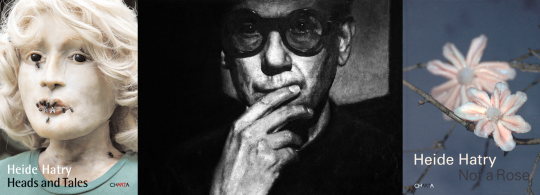
laboured in great secrecy on her new project. Following Heads and Tales (2009), a series of sculptural
busts of women produced using untreated pig skin, flesh, and body parts, and Not a Rose (2012), a book reflecting on the
cultural meaning of flowers that revolves around her photographs of flower-like
sculptures made from the offal, sex organs, and other parts of animals, Icons in Ash: Cremation Portraits is the next step in Hatry’s bio-art
which may also be her breakthrough with a larger public. Icons in Ash is a series of portraits of deceased people made with
their own ashes. Blurring the boundaries between presence and absence, being
and representation, matter and nothingness, it invites reflection on
memorialisation and commemoration practices, on the meaning of life and death, on
the extent to which and ways in which death is present or not in life, and on
such practical matters as what to do with cremains, the dead’s remains left from
cremation. Scatter them over the sea? Keep them in an urn on the mantelpiece?
Turn them into art?

Like all
bio-art, Icons in Ash is not
uncontroversial. Its conversations with the dead – both the ones in which the
artist engages and the ones the viewer carries out with the portrait – are
transgressive, and not only in the sense of crossing the boundary between life
and death, the living and the dead. With her cinerary art, Hatry also hovers
about the threshold between art and the funerary market, which includes urns,
jewellery, and memorials, all designed to commemorate deceased loved ones by
holding remains, ashes, or keepsakes. Crucial to Icons in Ash, however, is the process of becoming-portrait, the
painstaking artistic process of making that literalizes re-membering by
performing it. Icons in Ash ‘does’
memory as a (re)constructive gesture. Taking time, the making of the portrait
is a ritual of transformation of matter. This transfiguration of remains into
portrait is an ingenious way of keeping the memories of deceased loved ones
alive. At once representing (in the sense of mimesis) and re-presenting (in the
sense of making present again), the portraits are memorials for loved ones that
take the ashes out of the cremation urn to reconstitute their likeness with
their remains. As the portrait becomes both the container (urn) and the
contained (ashes) – and in fact container and contained are even further
blurred as Hatry mixes the human ashes with white marble dust (reminiscent of
funerary urns, graves, and stelae) and black birch coal (evocative of the
wooden coffin) – absence is transformed into a material presence in which self
and representation coincide and become one. As such, Icons in Ash also restores the image to its original purpose: to
keep the dead among the living. Whereas the veneration of the dead,
specifically ancestors, is rather marginalized in dominant cultures of the
Global North, Hatry’s art facilitates the presence of death in life, enabling
the dead to grace their survivors with their presence.

So, how
does Hatry do this? As she explains in an interview, because the ashes are pure bones
and therefore monochrome, she uses white marble dust (which doubles as a symbol
of death) and black birch coal (functioning as a symbol of life) to get a
palette ranging over different shades of grey. To make the portraits, she
developed three different techniques, which also differ in how time-consuming
they are for the artist (and hence, how expensive they are for the purchaser). First,
there is the mosaic technique, applying loose ash particles with the tip of a
scalpel on beeswax. This is the most time-consuming method, taking weeks to meticulously
piece together the portrait out of the ashes. Second, there is the method of drawing layers of very diluted ink
onto either an emulsion of ashes and binder, or on a surface of pure
ashes. Finally, and much cheaper than the first two methods, Hatry
developed a photographic technique in which she recreates a photograph on
either a surface of pure ashes or on a surface bearing an emulsion of ashes and
binder. This latter technique especially was developed with the prospective
client in mind; because many people who might be interested in having such a
portrait can’t afford the mosaic-image that is so time-consuming to create. Developing
various techniques of cinerary portraiture, Hatry’s has created a bio-art that
extends our lives in art, enabling humans (and animals: she also does portraits
of pets) to be present in their likeliness.

Websites:
– http://iconsinash.com/
– www.heidehatry.com/
Photo: Heide
Hatry, Roberto Guerra (2016). © Heide
Hatry. Reproduced with the artist’s permission.

Wearable Surveillance II: Smart Fashion and the Quantified Self

by Lianne Toussaint

In my previous blog post on GPS-tracking,
I described wearable devices used to track the whereabouts of “fragile” others:
our pets, elderly, and children. The phenomenon of wearable surveillance,
however, is not limited to tracking and quantifying others. Wearable technologies
(e.g. activity trackers and smart watches) and ‘smart’ clothes have stimulated the
growth of a culture of self-surveillance, in which individuals scrutinize
themselves to monitor and quantify their own health, behaviour, and activities.
Such practices of self-tracking introduce a new and voluntary kind of surveillance
that, contrary to traditional types of surveillance, targets the user herself. At
first sight, this so-called self-tracking appears to be a purely voluntary and
harmless form of individual surveillance for the sake of well-being,
self-knowledge and empowerment. Yet, where does the urge to self-tracking come
from, and how voluntary is it really?

Self-tracking is done mostly in order to monitor and optimize one’s
“performance”, be it in sports, professionally, or more broadly speaking in
terms of physical/mental well-being and health. It has become synonymous with
the Quantified Self (QS) movement, a
‘lifelogging’ community that believes in self-tracking technologies as the key
to improving self-knowledge and overall quality of life. Smart fashion is
particularly fit for this purpose, as it is relatively unobtrusive and mobile
enough to be worn in everyday life. This implies that the integrated sensors
can constantly stay in touch with the user’s body, environment, and behaviour. The
adjective ‘smart’ refers to how these garments are able to record, and often
also respond to, specific stimuli. Smart fashion can not only ‘sense’ your
posture, activity, or stress levels during the day, it may also react to this
input with output in the form of light, vibration, sound, or colour change. So
although the activity of tracking data about ourselves is not wholly new (think
of a weighing scale or stop watch), smart garments intensify the culture of self-surveillance by, for example,
enabling the accumulation of heretofore inaccessible data (e.g. brain
activity
), and the direct display or manifestation
of these data on the wearer’s body (Van den Eede 2015: 144).

The people and companies currently marketing or using smart
fashion seem to see no harm in the practice of wearable self-surveillance, as
long as the monitoring it is done voluntarily and willingly. As Deborah Lupton
argues, however, it is important to realize that the choice for self-tracking
is not made in a social vacuum, but “in a context in which certain kinds of
subjects and bodies are privileged over others” and where socio-cultural norms
and ideas about the responsible, self-disciplined body/self are involved (Lupton 2012). The tendency to
check, control, and monitor ourselves through wearables or smart garments should
be understood in light of our Western, (post)modern ideals about disciplined,
healthy, active, and profitable subjects (Van
den Eede 2015
; Lupton
2016
). The problem with a lot
of wearable self-surveillance technology, then, is that it presents itself as a
tool for voluntary self-management, while hiding its technocratic premise of
what a perfect human body and human life should be (Verbeek, interviewed in: Heijne 2015).

Whose Landscape Is This?

by

Christophe Van Eecke 

Two years ago,
landscape was briefly in the news when the European Parliament voted on a
report on copyright rules drafted by Julia Reda, of the
German Pirate Party. The issue that caused controversy was the so-called Freedom
of Panorama. This is the principle that anyone can take photographs of the
public space because the view (the panorama) of the public realm is public
property. Reda argued that it was important to maintain this freedom, but a
Liberal member of the Parliament, Jean-Marie Cavada, introduced an amendment
stating that anyone who would derive any kind of commercial gain from such a
photograph would have to pay copyright fees to the copyright holder of all “works”
that appear in the image.

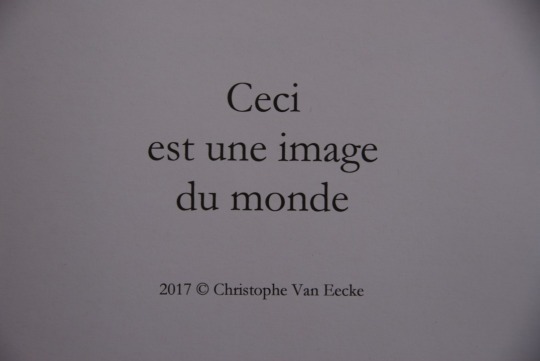
image

The amendment
triggered a petition from concerned European citizens. Such regulations would
make it very difficult, for example, to make a film in the public realm: in
theory, one would have to track down the copyright holders (such as the
architects, if still living) of any building that appears in the image. The
amendment speaks of “works” in the public realm, but, obviously, every building is a “work” from the
perspective of the architect who designed it, and not just famous landmarks.
Even bridges on highways are referred to as “works of art” in official
bureaucracy. Especially for independent, low-budget, or no-budget film-making
the logistics and financial implications of such a measure could easily become
prohibitive.

In the end, the
amendment did not make it and the Freedom of Panorama remained safe. But there
is no guarantee that it will not be assailed again in the future. It was
therefore a clear reminder of the way in which our entire world, including the
very living space we share with each other, is constantly encroached upon by
those who would commodify it as a source of revenue. In the Freedom of Panorama
case, the intrinsically laudable intention of safeguarding the copyrights of
creative artists had transmogrified into corporate copyright run
amok
.

The whole affair
made me think about the limited control we have over our world, and how easy it
is to lose the world to corporate capitalism. What would such a copyright rule
do to our relationship with the world? I could imagine people avoiding the
corporate invasion by retreating into private worlds (an evasion the great
Walter Pater would surely bless from beyond the grave). With recent evolutions
in virtual reality and digital imagery we have already gone a long distance
towards realising such worlds. We are already increasingly disappearing into
worlds that are artificially developed and completely parallel to the real
world. On a less technically sophisticated level, for low-budget film-makers such
a flight into fantasy could also mean a return to the early film practice,
derived from theatre, of working with painted backdrops of invented or
fantastical landscapes. Méliès would suddenly be very topical again!

If the real
world is increasingly owned, copyrighted, or branded, the only freedom left us
is the freedom of the mind, the internal space of imagining. But if we all flee
into imaginary worlds and come together in that realm of fantasy, the corporate
capitalists may one day find that they have bought a brave new world that has
nil people in it.

Now, would that
not be a wonderful revenge of fantasy upon capital?

© Image: Christophe Van Eecke

The Sound of Political Soundbites

by Vincent Meelberg

Soundbites. That is what contemporary politics seems to revolve around.
If a politician is not able to convey his or her message within a single,
catchy phrase, the public is not interested in what this politician has to say.
At least, that is what journalists seem to believe. Political messages need to
fit the headlines of newspapers and, perhaps even more importantly, fake or
real news websites.

image

Interestingly, it is not just journalism that is seduced by the power of
soundbites. Increasingly, politicians themselves make sure that their message
can be summarised in a single catchphrase. The latest example is the manner in
which British Prime
Minister Theresa May tries to “sell” Brexit
. Through soundbites such as “Brexit Means
Brexit” and “Now Is the Time” May tries to convince the public
that, even though she did not support Brexit before she became Prime Minister,
she now fully endorses it and will make sure that Brexit will happen.

But of course the grandmaster of soundbites is Donald Trump. During the
course of his campaign that lead to his presidency, he came up with a number
of controversial soundbites
that were eagerly quoted by news
channels such as CNN and of course Fox News, usually followed by showing the
original footage in which Trump is uttering these phrases. And it is crucial
for the effectiveness of these soundbites that they can be heard, rather than
merely read, because the success of these soundbites is not just determined by
their meaning, but also by the way they sound when spoken by Trump.

It is the previous president of the United States, Barack Obama, who is praised for
his rhetorical qualities
. The way Obama used rhythm and
timing in his speeches gave them an almost musical quality that contributed to
their persuasive power. Who can resist chanting along “Yes we can!”
with his famous speech which helped him win the 2008
presidential elections? And while it cannot be said that Trump’s speeches have
any musical qualities, they are still seductive from a sonic point of view.

Sound is affective. It has a profound influence in the way we experience
events, environments, or interactions people. Furthermore, the way a sentence
is uttered, which tone of voice is used, influences the way we
interpret its contents
. Trump’s voice is affective as well. His voice
is often imitated in order to
create a comical effect
, but we should not underestimate its power to
convince. Perhaps it is exactly because his voice almost sounds like a
caricature that people believe what he is saying. His soundbites are
entertaining because they have a comical overtone. Not because of the contents
of the soundbites, but because of the way they sound. And because they sound
entertaining, some may have been persuaded to ultimately vote for him. People
want change, and he sure does sound differently from other politicians. Many
did not take Trump seriously, in part because he sounds like a caricature, but
recent history has taught us that we should not be fooled by the tone of a
political voice.

Image: https://flic.kr/p/Fppfbm

Slow Fashion

by Anneke Smelik

Admit, do you ever buy fast fashion? After all, it is difficult to
resist buying that incredibly cheap t-shirt or jeans that makes you look so
fashionable for this season. Yet, are you aware of the enormous cost of cheap fashion?
As the filmmakers of the
documentary The True Cost say: ‘The
price of clothing has been decreasing for decades, while the human and
environmental costs have grown dramatically’. The American fashion industry magnate, Eileen Fisher, recently exclaimed
that ‘the clothing industry is the second largest polluter in the world—second
only to oil’. While this may be a hyperbolic claim, it is well-known that the
fashion industry excels in waste, pollution, and exploitation of human labour
and natural resources.

image

Fast fashion emerged at the
end of the 1990s and is characterized by rapid changes in style, ever faster
cycles of global production and consumption, and ever cheaper products. Fashion
is one of the biggest and most
rapidly growing industries that is currently valued at 3 trillion dollars and employs
about 75 million people globally. 90% of the clothes is produced in low-wage
countries, mainly in Asia, while in the price calculation for a piece of
clothing a maximum of 1 or 2 % is accounted for by the wages of mostly female
(80%) textile workers. The fashion industry is a thirsty business, requiring a
lot of water to produce its goods. The manufacturing of a pair of jeans
typically requires about 11,000 litres of water and involves highly toxic dyes.
Due to systematic overproduction, however, the jeans may end up unused on a
waste heap: a staggering 30% of clothes in shops remains unsold. These are
astounding figures.

It is quite a big challenge to make the complex
fashion system more sustainable and more ethical, yet we need to stop the spiralling cycle of
producing and consuming ever more and ever faster. If the problem is a 24/7
society ‘in which producing, consuming, and discarding occur without pause,
hastening the exhaustion of life and the depletion of resources’, as Jonathan Crary
writes (2013: 17), then the solution is to slow down. ‘Slow’ fashion focuses on
creating ethical and sustainable relations between people and their
environment. You don’t have to look far, because some fast fashion chains like
C&A and H&M now feature ‘green’ clothing lines with recycled fibres and
fabrics.

image

There are many initiatives
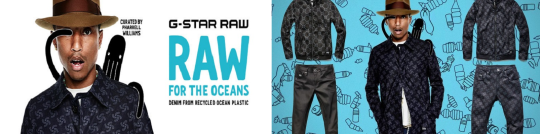
of creating slow fashion in the Netherlands. To name just a few: the Dutch
jeans brand G-star and singer Pharrell Williams launched together ‘RAW for the
Oceans’, a project that uses recycled ocean plastic to create a collection of
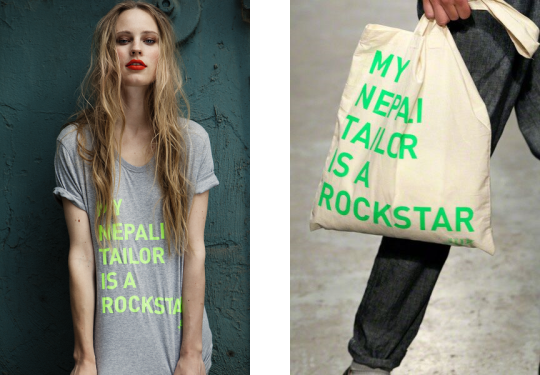
fabrics, including two new sorts of denim. Studio Jux produces the
majority of garments in its very own garment factory in Kathmandu, Nepal. Each
garment made in that factory contains a numbered label, which corresponds to
one of the Nepali tailors that buyers can ‘shake hands with’ on the company
website. At MUD Jeans you can lease your jeans and at
Oh My Bag you can buy fair trade bags. There are clothing libraries where you can
borrow or exchange clothes
. Finally, there are of course the developments to
recycle old clothes and textiles—on a more industrial scale at Texperium where for
example KLM uniforms are recycled and made into new products. Marjanne van Helvert recycles
in a more artsy way for her Dirty Design project. So
many inspiring examples!

Let’s displace today’s cult
of speed and start a movement of ‘slow’ fashion!

Torpignart: Street Art and Urban Regeneration

by Elisa Fiore

image

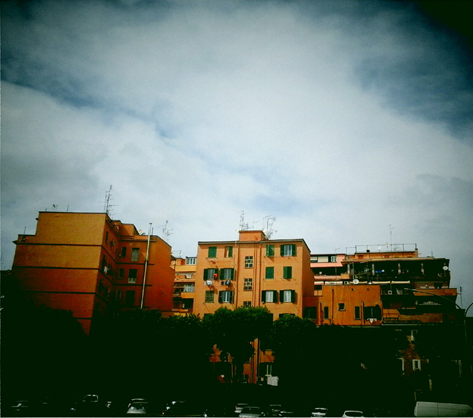
Before I relocated to The Netherlands four years ago, I used to live and work in a neighbourhood of Rome called Tor Pignattara. This area, which counts around 50.000 inhabitants, stretches for about four kilometres south-east of the city centre. It is formally incorrect to define it as suburbs, given that it sits right next to the I Municipality of the City of Rome – the one where the Colosseum and the Imperial Fora are located, to be clear. Still, there is a certain feeling of distance attached to it, which cannot be explained solely by the chronic state of infrastructural “fatigue” the area is afflicted by – public transport is rather inefficient there, and so is general drivability.

image

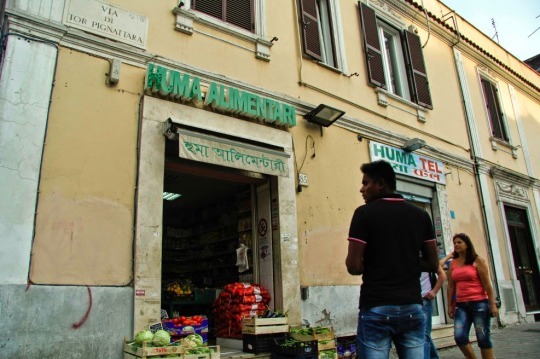
This perceived distance should also be read in connection with the demographic developments that have seen sizable groups of immigrants gradually settle down in Tor Pignattara since the early 1990s (Pompeo 2011; Priori 2012). The largest immigrant group in the area is the Bangladeshi, which counts around 2.000 people – according to official statistics issued by the City of Rome. Often dubbed as an invasion, the Bangladeshi community became the main attribute attached to this neighbourhood, which was soon labelled the Banglatown of Rome. This reputation contributed to figuratively push the neighbourhood farther out from the city centre; not just a few kilometres, but at least a couple of continents and five
seas away.

image

Immigration soon became the scapegoat for the state of cultural, social and infrastructural impoverishment that the neighbourhood was going through – “immigrants do not vote” was a recurring leitmotif used to explain the institutional disinterest in the destiny of Tor Pignattara/Banglatown.

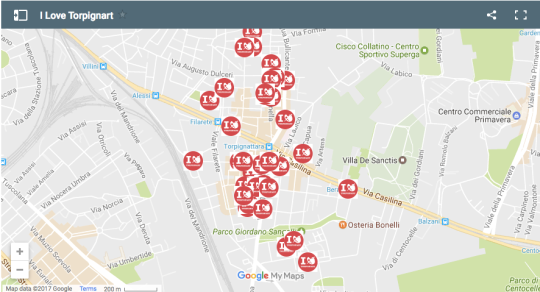
Since 2013, though, a group of active citizens decided that enough was enough: if local government institutions did not take the destiny of Torpignattara/Banglatown at heart, they would do so with a series of initiatives aimed at including the neighbourhood within the ranks of Rome’s historical centre and revaluating its contribution to the city’s cultural identity. Several cultural initiatives were undertaken in the past four years: to name but a few, “Alice nel Paese della Marranella,” a local yearly street event with buskers, music and food; “Karawan Fest,” a series of multicultural cinema nights; and the “Ecomuseum Sundays,” urban trekking events to discover the rich archaeological and anthropological [sic] heritage of the area. But there is one initiative that gained much more momentum than all the others: it is the “I Love Torpignart” initiative, a massive project of muralisation aimed at promoting street art and transforming Torpignattara/Banglatown in an open-air museum. As the map below
shows, in barely four years a remarkable number of murals have been realised in the neighbourhood.

image

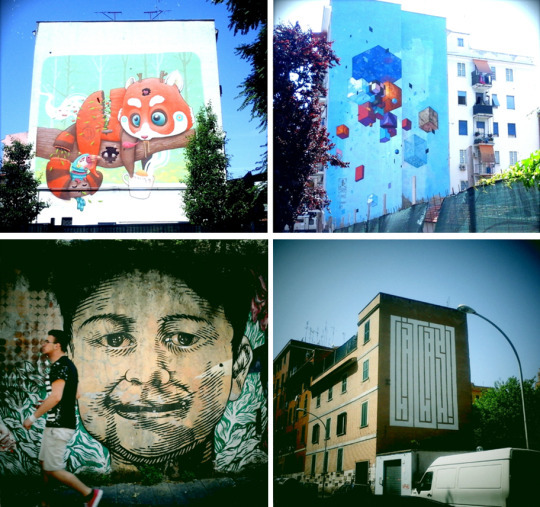
Many of the “blind walls” of Torpignattara/Banglatown have been turned into massive canvas and made available to those galleries and street artists who wished to donate a piece of their art to the local community. And the gifts are, indeed, truly beautiful (for more images, see here).

image

As a result of this operation, Torpignattara/Banglatown has become officially part of M.U.Ro., the street art museum of Rome promoting
the ‘Renaissance of contemporary public art’ in the city.

The “museification” of Torpignattara/Banglatown appears to be successfully bringing the neighbourhood closer to the heart of Mamma Roma. Tourists are finally visiting the area and its artistic, archaeological and anthropological [sic] beauties; airbnbs are springing up at the same rate – or even faster – than that of the murals; small bars, microbreweries and osterie are finally attracting a younger and hipper crowd. If street art alone cannot succeed in regenerating an ‘anonymous and degraded’ urban area, as the people behind I Love Torpignart concede on their website, gentrification might instead well do. As Paola Soriga (2015) and Annalisa Camilli (2015) remark, the muralisation process that is investing Torpignattara/Banglatown as well as other “degraded” suburban areas of Rome – Tor Marancia and San Basilio – is often accompanied by rent profiteering mechanisms that slowly push the more vulnerable groups out of those areas. They also highlight how massive muralisation projects initiated by local organisations have been widely embraced by both local and central governments as very convenient – read, cheap – tools that give an illusion of “quick regeneration” while instead nothing is being actually done to solve the real problems the local communities face.

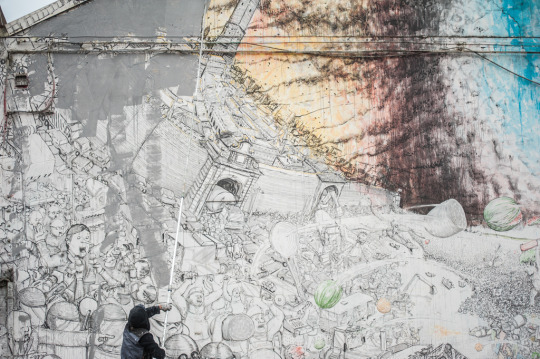
The promotional use of street art has been hotly debated in Italy as well as other European countries over the past year or so. To give an example, last year, the Italian street artist Blu – known as the Italian Banksy – blacked out his famous murals in Kreuzberg (Berlin) and Bologna as a form of protest against the appropriation of militant street art at the hand of ‘opportunistic lords and colonial powers’ (Wu Ming 2016).

image

I think that these stories should have us seriously reflect on the uncritical use of planned commissioned street art as a supposedly innocent tool for urban regeneration. By triggering processes of gentrification and touristification, such projects can result in undesired exclusionary mechanisms damaging vulnerable groups and individuals. It goes without saying that I am not arguing for a whitewashing of the beautiful murals that punctuate the landscape of Tor Pignattara/Banglatown. What I advocate for is a serious politics of engagement capable to distribute gains and losses so as to promote more ethical interventions in the interest of the community as a whole. It would be a shame if, one day, we came to realise
that the colourful canvas of Tor Pignattara/Banglatown were actually complicit in the whitewashing of the local community.

References:

Images
1. Sign of the Tor Pignattara tram stop. Image credit: Wikipedia https://commons.wikimedia.org/wiki/File:Fermata-torpignattara-trenino.svg
3. Niccolò Berretta on Vice News https://www.vice.com/it/article/torpignattara-roma-settembre-2014-492
4. https://ilovetorpignart.wordpress.com/mappa-dei-murales/
5 a: Dulk; b: Etnik; c: Diavù, Lucamaleonte, Nic Alessandrini; d: L’Atlas; e: Aakash Nihalani.
6. http://www.internazionale.it/opinione/wu-ming/2016/03/18/blu-bologna-murales-mostra

Texts and articles:
Camilli, A. (2016). “Benvenuti a Shanghai”,
[http://www.internazionale.it/reportage/2015/04/10/roma-tor-marancia-murales-street-art]
Henke, L. (2016). “Why we painted over Berlin’s most famous graffiti[https://www.theguardian.com/commentisfree/2014/dec/19/why-we-painted-over-berlin-graffiti-kreuzberg-murals]
Pompeo, F. (2011). Pigneto-Banglatown, Migrazioni e Conflitti di Cittadinanza in una Periferia Storica Romana, Rome, Meti Editions.
Priori, A. (2012). Romer Probashira. Reti Sociali e Itinerari Transnazionali Bangladesi a Roma, Rome Meti Editions.
Soriga, P. (2016). “A spasso tra le meraviglie della street art di Roma”, [http://www.internazionale.it/reportage/2015/04/21/street-art-roma]
Wu Ming (2016). “Blu, i mostrificatori e le sfumature di grigio”, [http://www.internazionale.it/opinione/wu-ming/2016/03/18/blu-bologna-murales-mostra]

Websites:
I love Torpignart, https://ilovetorpignart.wordpress.com/

90 Volte Torpigna, http://www.90voltetorpigna.it/
M.U.Ro., http://muromuseum.blogspot.nl/p/m-u-r-o-f-e-s-t-i-v-l.html
Alice nel Paese della Marranella, https://www.facebook.com/MarranellaVillaggioUrbano/
Karawan Fest, http://www.karawanfest.it/

Everything that goes around

By Puck Wildschut

When I
started brainstorming on a subject for my Culture Weekly blog I was hard
pressed not to talk about the new president of the United States, but
about something fun, say music, sports or books. I felt culture lovers would surely
appreciate a positive and disinterested note on what’s happening in te world,
as a counterweight to all of the disturbing news we are constantly hearing.
Sadly, Mr. Trump and his blatantly inhumane views are quite literally
everywhere nowadays and my unconscious just can’t seem to stop spotting
references to the man and his rise to political power. So yes, this blog is
about Trump, which is regrettable, but is also about some very good music, one
of my favourite books and even that crazy little thing called hope.

Wednesday
23rd November 2016 was a good day. That evening, I went to a show of
one of the greatest bands in the world, Living Colour, and witnessed the best
gig I had seen in years. Living Colour is about as anti-Trump as it gets:
They’re an African-American crossover quartet who have been fighting rascism,
sexism, and capitalism throughout their entire career, starting in the late
1980’s, using their lyrics, musical skill, music videos and interviews to
battle unequality and prejudice in society. During their show, Trump was
referenced a couple of times. Frontman Corey Glover was visibly and audibly
still shocked about ‘their’ new president: “When we left on tour, we left
behind our country. When we’ll return in a couple of days, we’ll be going back
to a country that’s gone completely bananas.” [quote by approximation – PW]. In
a sense, it seems that Living Colour warned us about Trump a long time ago, in
songs and videos such as ‘Cult of Personality’ (Vivid, 1988) and
my personal favorite ‘Type’ (Time’s Up, 1990). ’Cult of personality
is a powerful attack on the value people ascribe to status, image and succes,
which earily describes the current U.S. President’s irresponsible behaviour: “I
sell the things you need to be/I’m the smiling face on your T.V./I’m the cult
of personality/I exploit you still you love me/I tell you one and one makes
three”.

image

In ’Type’,
I believe Living Colour provides us with one of the most apt descriptions of
the nature of current society, as much nowadays as in the 1990’s, when the song
was first released: “We are the children of concrete and steel/This is the
place where the truth is concealed/This is the time when the lie is
revealed/Everything is possible, but nothing is real”. These and other lyrics
by Living Colour paint a disturbingly accurate picture of modern day political
America, which is not to say that they are prophetic, so much as that they
anticipate where our own behaviour as citizens and consumers will lead to: a
world in which the most powerful man alive is considered a sociopath by many,
a.o. his own ghostwriter Tony Schwartz (see Tony
Schwartz on Bill Maher’s Real Time
). The interesting thing with Living Colour is that they firmly place
the blame on us: we, the people, are the ones that allow greed and money
to rule the world and vote a megalomaniac to become president of the most
powerful nation in the Western world. Which brings us to that favourite book I
mentioned…

When it
became official that Trump would be running for the Republican party, I was
immediately drawn towards my bookcase and furiously leafd through Bret Easton
Ellis’ lit-body horror novel American Psycho (1990).  I remember my first thought on Trump’s
nomination being: “Well, at least he won’t get elected for office unless the
American voters collectively go and turn into a bunch of murdering
psychopaths.”, since the novel’s protagonist Patrick Bateman is a
murderer-rapist-psychopath who revers Trump and his lifestyle.

image

Well, that
wasn’t exactly what happened next in the real world (sigh of relief), but I could
still hear Bateman in almost every Trump-supporter I saw interviewed, admiring
all his economic accomplishments and his power to exclude people unlike ‘the
average, hard-working American’ from his plans to make America great again.
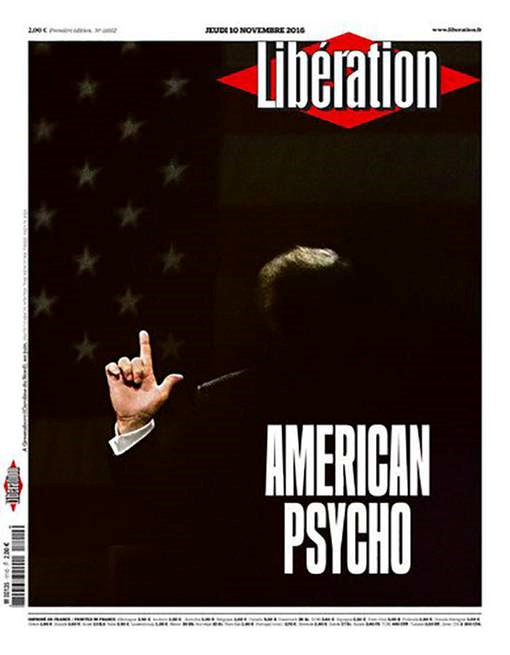
Like Bateman. The French newspaper Libération had the same verdict of
Trump as me, at least.

image

Well, I
promised you some good music (check), a favourite book (check) and some hope
(here it comes!). It might not sound very hopeful, but here’s the thing: As
Living Colour shows us, we, the people of the world, are the ones that have
created a world-wide political climate in which someone like Trump can become
the White House’s most important occupant. Even if you’re a vegan leftist
hippie like me, you have to acknowledge that we are all stuck in the capitalist
way of life, in which even those critical of Trump and the values he professes
buy houses, get mortgages, want to have more and more and more stuff and (yes,
it’s true) put their own well-being before that of everyone else. And now we
are pissed off, because a man’s in charge in the U.S. that we feel represents
nothing of what we stand for, precisely because he epitomizes the way of
life we have been living for around the last 35 years. “Everything that goes
around, comes around”, Living Colour’s Corey Glover ironically sings to us in
‘Type’. But what it also means is this: That we, those very same people, have
the power to change things. And just as Trump is changing al the good stuff
that his predecessor has brought the world, we have the chance to let the world
know that we will change it back – back to the environment-friendly,
not-xenophobic, tolerant road Obama set it upon during eight harsh years of being
a true leader of America and the rest of the world. So march, protest, sign,
organize, come together, try to be a lover of life instead of a consumer of
goods, and eventually change will come. And also, get angry, because we need
some fire to counter the self-righteousness of conservative leaders in America
and elsewhere. You can start heating up right here: Living Colour – Who Shot Ya?
(Notorious B.I.G. cover) (2016)

Image credits:

1) Living
Colour Live @ 013 Tilburg 23 November 2016. Source: http://www.maxazine.nl/2016/11/24/intiem-concert-living-colour-hoogtepunt/. © Conny van den Heuvel,
DCHPhotography

2) Patrick
Bateman (Christian Bale) Trumping it in Mary Harron’s (director) film
adaptation of American Psycho (2000). Source:
http://www.cinemablend.com/new/American-Psycho-Ending-What-Really-Happened-70126.html

3) Cover Libération
9 November 2016. Source: HLN.BE 9 november 2016

Living Memorial

by László Munteán

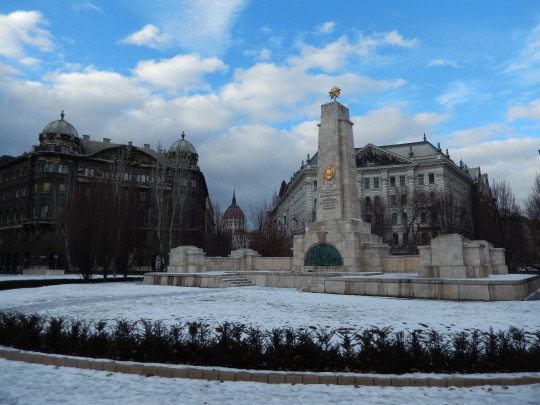
15 January 2017. My early-afternoon walk takes me to Freedom Square, located in the close vicinity of the Hungarian Parliament. The square has long been a battleground of contrasting visions of the nation’s past, present and future. At the spot where the national flag was flown at half-mast, commemorating the loss of two-thirds of the country’s territories after World War I, is now a Soviet war memorial built in 1945 and dedicated to the soldiers of the Red Army that died during the siege of Budapest. Commonly perceived by Hungarians as a monument to Communism, rather than a war memorial, it has been vandalized several times, most recently at a large-scale anti-government protest in 2006.

image

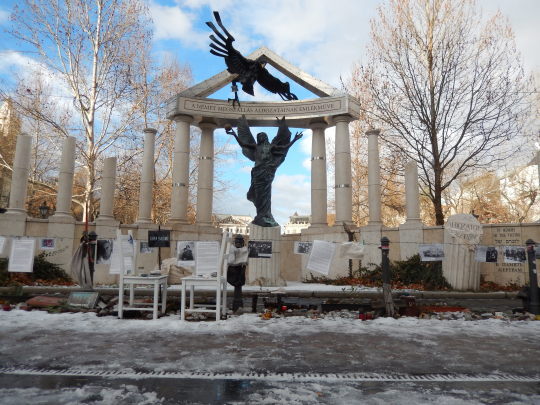
What interests me, however, is another memorial erected at the opposite end of the square in 2014. Initiated by the ruling government, this new memorial commemorates Hungary’s occupation by German forces on 19 March 1944. What looks like a classical colonnade topped by a tympanum frames archangel Gabriel attacked by an eagle stooping down. A row of broken columns—conventionally symbolizing lives cut short by violence—surrounds the tympanum on both sides. The text on the plinth reads, “in memory of the victims” in Hungarian, English, Hebrew, German, and Russian. The term victim, however, is highly problematic. While the memorial is dedicated to the victims of the occupation, the sculpture fashions Hungary as Gabriel, helplessly falling prey to the German eagle, thus obscuring Hungary’s allegiances with Germany and its complicity in the Holocaust.

image

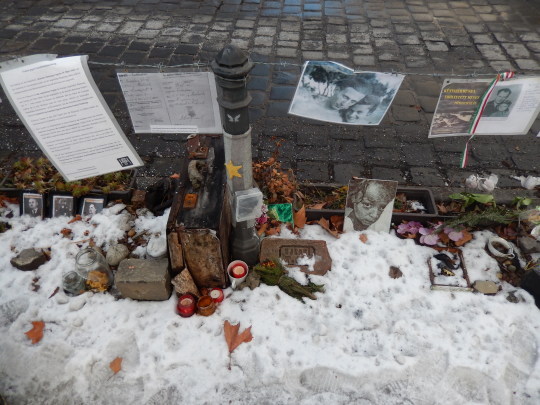
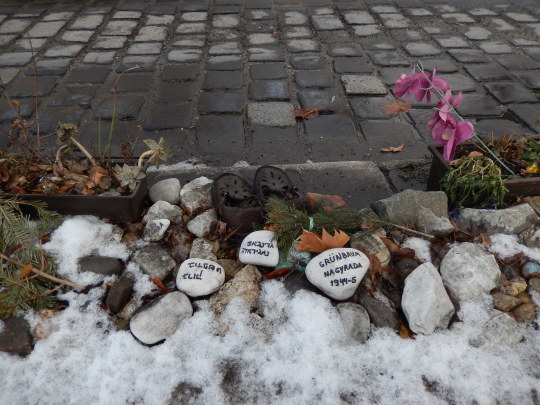
Ever since its hasty construction, protesters have been adamantly demanding the memorial’s removal. The resulting counter-memorial, which faces the colonnaded tympanum on the opposite side of a narrow road, reveals the link missing from the composition. Photocopies of Hungarian
anti-Jewish laws preceding the German occupation, as well as images and stories of people perished in concentration camps have been placed along the curb. In addition, pebbles, tiny rocks with names and an assortment of objects, primarily candles, flowers, shoes and suitcases have been placed at the “living memorial,” as its creators call it. As a bottom-up initiative, it is indeed alive: it undergoes constant change exposed to heat, rain, and snow.

image
image

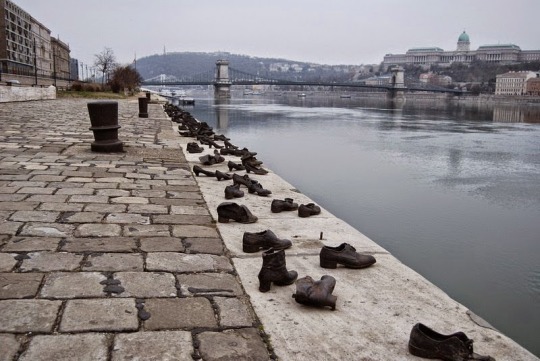
The rocks are integral to Jewish funereal culture, but what role do the shoes and suitcases play in this cacophony of new and disintegrating objects? Although they are obviously not relics from the 1940s, they still appear uncannily familiar. They are props that invoke (as intertextual references) other memorial sites. The shoes recall a nearby memorial dedicated to Jews who had been shot into the Danube by Hungarian Nazis in the closing months of the war. In that memorial the absence of murdered victims is conveyed by rows of bronze shoes along the river.

image

The living memorial at Freedom Square also recalls of the stacks of shoes, suitcases, and glasses and other objects confiscated from deported Jews as exhibited, for instance, in the Auschwitz concentration camp. If these personal belongings bear the imprint of their murdered owners, the props that mimic them at the living memorial at Freedom Square invoke them as intertexts, thus constituting a corrective to the “alternative facts” propagated by the official memorial to the German occupation of Hungary. The civil movement organized around the living memorial has morphed into an ongoing protest with a strong online presence. As the removal of the tympanum with Gabriel and the eagle is not on the government’s agenda, it is safe to say that the living memorial is there to stay for a while—something to seek out if you’re in Budapest.

The United States of Dystopia

by Edwin van Meerkerk

French
philosopher Jean Baudrillard once described America as Europe’s ‘future
catastrophe
’.
With the election of Donald Trump, this description aptly describes the feeling
of many Europeans, especially where new elections are due and populist
candidates appear strong in the polls. Baudrillard is known for his
introduction of the notion of the simulacrum,
the sign without reference, as emblematic for the postmodern society. In this
‘hyperreal’ world, there is no reality, only images. With a president elect who
oftentimes seems to exist mainly in and through his twitter account
@realdonaldtrump​,
the hyperreal seems to acquire a new momentum.

image

The slogan
that won Trump’s election more than anything was his assertion that he would
‘make America great again’. This expression is a direct, albeit most likely
unconscious, quotation from J.G. Ballard’s 1981 novel Hello America, in which a future president of the United States
uses the very same line. Ballard (1930-2009), whose work is
often typified as science fiction, but is better described in Margaret Atwood’s term
‘speculative fiction’, has had a love-hate relationship with America throughout
his life. His fascination with American technology (especially cars) and
celebrity cult, went hand in hand with his rejection of American politics and
media.

In Hello America, the protagonist, Wayne,
is on a quest to find his father. After a soul-searching journey through a
future America, which has turned into an uninhabitable desert due to climate
change, he ends up in Las Vegas, the only remaining city. The United States
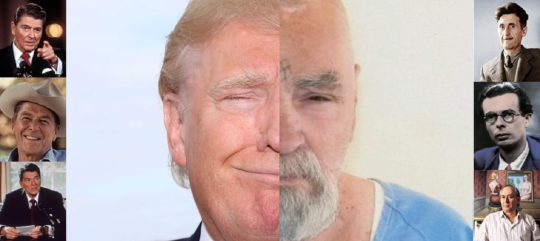
have become the embodiment of the simulacrum: an artificial reality. Here, he
meets the new president, Charles Manson:

‘I was very
impressed by Manson. For all his weirdness, he has the old Yankee virtues. He
wants to see America great again
, and becoming president is little more than
the decoration on the cake.’

Manson, an
obvious reference to the assassin and cult leader still serving a life time
sentence
,
is a superstitious and narcissist man, who, in Wayne’s words ‘has every right
to call himself the forty-fifth President.’ (Hello America, p.140) – the number seems prophetic. Manson is
convinced that Europe is trying to break his ascent to power: ‘I see it waking
now like an old dog, smelling us here and trying to get its snout into this new
America I’ve built.’ As a response, Manson starts bombing cities on the eastern
coast of America, to create an impenetrable nuclear wasteland. Wayne naively believes
everything Manson says, despite the numerous warnings he is given.

Finally, Wayne meets
his father, the cliché mad scientist dr. Fleming, who spends most of his time building robot avatars of previous
presidents, as well as a fleet of solar power aircraft. Dr. Fleming, unlike his son Wayne,
does not believe in America any longer, wondering

‘what exactly we signify by
the term “America”. It’s an emotive symbol, Wayne, went out of
fashion in the 1980s and 1990s, somehow lost its appeal…’

America as an
emotive symbol, American power residing in Las Vegas, Charles Manson as its
president, all of whose predecessors are mere robots: it may seem a harmless joke, but
the stakes become real when Manson aims the last of the nuclear missiles at
himself, seeking to destroy his own capital. Making America ‘great again’ for him
means to utterly destroy it.

J.G.
Ballard’s view on American politics has always been quite unambiguous. This was
never as acutely expressed as in his pamphlet ‘Why I want to Fuck Ronald Reagan
(1967, also included in The Atrocity
Exhibition
, 1970),
the immediate cause for his American publisher to withdraw Ballard’s manuscripts from
distribution, and the reason why Hello
America
wasn’t published in the US until years after its initial publication date.
The pamphlet is Ballard’s reaction to Reagan’s election campaign as governor of
California in 1967. In this campaign, Reagan widely used television
advertisements and other visual campaign strategies, all of which showed a
stark contrast between the image of a friendly and benevolent candidate and the
conservative programme with which Reagan ran for office.

It seems to
be more than ironical that the next political candidate to revolutionize the use of modern media, in
this case Twitter, in a campaign that overturns the order of fact and image, is
destined to become the real 45th
president of the United States. His name is not Charles Manson, even though he,
too, claims to want to ‘make America great again’.

Photo:
collage of portraits (Reagan, Trump, Manson, Orwell, Huxley, Ballard) by author from public domain.
J.G.
Ballard ([1981] 1985) Hello America.
London: Triad/Panther.

A Thousand Times No

Creativity and resistance

By Judith
Naeff

For the
occasion of the Prince Claus Award Ceremony on December 15, Lebanese born Egyptian
artist, scholar and activist Bahia Shehab visits the Netherlands. I have the
privilege to receive her with a group of students at Leiden University this
week.

image

Bahia
Shehab is specialized in Arabic calligraphy and typography, both historical and
contemporary, and has developed a Graphic Design major and the University of
Cairo. She currently heads this department and continues to teach there. In her
2010 art work A Thousand Times No she collected a large number of samples
of the word “no” – in Arabic “لا” – in Arabic calligraphy, which also
led to a publication that meticulously documented each sample with information
about the original context and the date of the inscription. In 2011, large
scale protests erupted in Cairo, following the uprising in Tunisia. Shehab took
to the streets and used stencils to spray the various NOs she had collected on
the city’s walls. “No to military rule.” “No to a new Pharaoh.” “No to beating
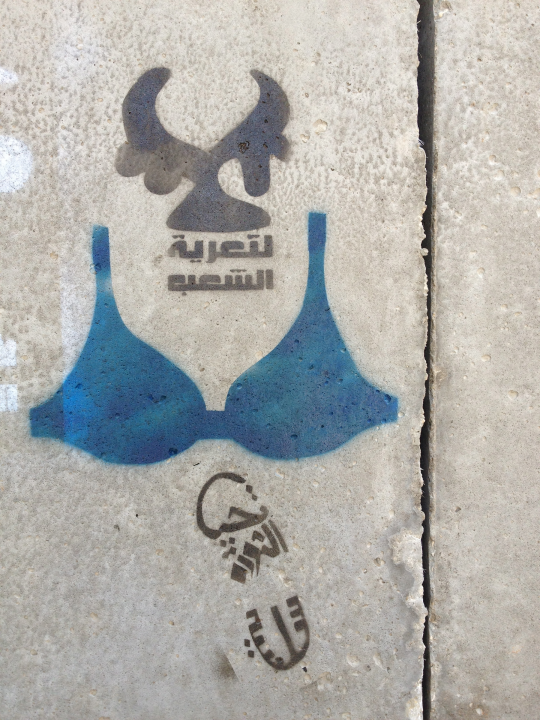
women.” One of her stencils shows a blue bra referring to the footage of a
woman who was ripped of her abaya (traditional black robe and veil) by
military police revealing her blue bra. The military police proceeded to drag the
woman along the street and stamped on her bare belly with their boots. The
footage went viral under the name “blue bra girl.” Shehab’s stencil reads “No
to stripping the people.” The footprint is itself a piece of calligraphy too, reading
“Long live the peaceful revolution.” You can watch her TED talk about these
projects here.

The
masterclass that I organize around her visit forms the incentive to reflect on
the role of artistic and creative practices in the context of political dissent.
To stick with the context of the Arab spring, there has been a tendency in both
academic and popular literature to understand revolutionary arts as “weapons”
in the struggle against repressive regimes and disenfranchisement. For example,
the BBC has decided to use for its item on the creator of a children’s magazine
the heading: “Syrian woman using ‘art as weapon’” (19 March 2016). Likewise, the
scholar, activist and journalist Donatella Della Ratta wrote in 2011: “It may
seem like a strange time to talk about music and films in Syria, but artists, armed
with a renewed creative mindset, are taking an active role in the struggle
against the Syrian regime and the violent crackdown it has launched” (“Creative resistance challenges
Syria’s regime
Aljazeera
25 December 2011, my emphasis).

If arts can
indeed function like a weapon, what is its target and how does it attack? Egypt
today suffers under a violently repressive and humiliating new dictatorship;
Libya, Yemen and Syria have spiralled down into full blown war; only Tunisia
managed to move into a new but highly precarious democratic order. Images and
texts cannot remove a regime nor can they protect bodies from bullets and
bombs. Yet, looking at Shehab’s blue bra stencil, I am still touched by the
revolutionary spirit of Egypt in 2011. When I watch the finger puppet show Top Goon, I still feel elevated by the wittiness with which it mocks Bashar
al-Assad. When I watch the videos of Abounaddara I feel
enlightened by their portrayal of human dignity and compassion amidst the
unspeakable violence and suffering in contemporary Syria. These works
continue to radiate a powerful embrace of life against the odds and despite the
desperation and exasperation of the present. I want to argue that claiming a
voice against suffocating repression, and advocating life in the face of death
asks for a vocabulary that defies war and militarism.

There is a
long tradition of thinkers who have tried to give meaning to forms of
resistance that do not seek direct confrontation with the authorities. Michel
de Certeau, for example, pitted the concept of “strategies” against “tactics”
(1984: xix). If the former refer to administrative, policing and military
actions to control and discipline the population, the latter refer to everyday
practices with which individuals appropriate, reclaim and at times subvert the
paths laid out by a ruling system. Olifantenpaadjes constitute a benign but eloquent example of such everyday civil
disobedience. In the context of the Middle East, Asef Bayat long before the
Arab uprisings erupted, pointed towards what he called “the quiet encroachment
of the ordinary” (2010: 14-15) meaning the “non-collective but prolonged direct
action by individuals and families to acquire [the] basic necessities of their
lives (land for shelter, urban collective consumption, informal jobs, business
opportunities and public space) in a quiet and unassuming illegal fashion” (2010:
45). In other words, the prolonged survival tactics of large swathes of the
urban dispossessed has been transforming the urban environment, and society in
general, in sometimes subversive ways, without any concrete political agenda or
pivotal leadership.

De Certeau’s
“tactics” and Bayat’s “art of presence” hence both conceptualize creative forms
of resistance that do not seek direct confrontation. Yet, their
inauspiciousness does not allow for an inclusion of revolutionary graffiti,
banners and posters, or satire in theatre, television and cartoons, or rallying
music, rap or chanting in the streets. Are these not precisely meant to carve
out a presence that is to be heard, seen and felt; that disrupts the routines
of everyday life, rather than uses these routines as a cover? Helle Malmvig
when reviewing creative practices in the Syrian context, instead proposes the
Foucauldian concept of counter-conduct. Counter-conduct, she maintains, is
never directly targeting sovereignty. Rather, it is characterized by performing
behaviour and imagining ways of being that refuse to conform to hegemonic forms
of conduct. It is therefore also risky, in the sense that it disrupts the norms
and exposes the subject as “other”. For example, Abounaddara’s refusal
to clearly distinguish between victim and perpetrator, right side and wrong, is
a form of counter-conduct in the context of military sectarianism in
contemporary Syria.

Finally, in
order to understand how counter-conduct finds its place in larger patterns of
resistance, I would like to turn Marwan Kraidy. In his latest book, The
Naked Blogger of Cairo
, he distinguishes between radical and gradual modes
of what he calls “creative insurgency.” The radical type occurs in outbursts,
violent and spectacular in their life-threatening open challenge to the
sovereignty of the ruler. The gradual mode “is distinctive in the incremental
and cumulative ways it chips away at power” and largely coincides with
Malmvig’s understanding of counter-conduct (2016: 18). Kraidy’s crucial insight
is that the two modes entwine. “They fuel and shape, prod and pull each other.
Gradual rebellion expands prerevolutionary dissent […] [and] sporadic radical
actions fuel waves of gradual infractions that reverberate widely, setting
grounds for the next radical gauntlet” (ibid.). Even if speaking about arts and
culture in terms of weaponry fails to do justice to the affirmation of life
they perform, they still function in tandem with violent forms of confrontation
in complex and unequal ways.

With these
insights, I look forward to hear Shehab discuss her work – then and now. I am
particularly curious to learn how she looks back on the exhilarating
revolutionary period from the perspective of a bleak present. What role does she
see for herself and others like her in the current situation in Egypt and the
Arab world at large? If you want to find out, check the
announcement and send in your motivation before Monday 12 December
. The deadline has already, but if
there is still space, I am sure we can accommodate you.

Image

courtesy from the artist.

Bayat, Asef
(2010) Life as Politics: How Ordinary People Change the Middle East.
Amsterdam: Amsterdam University Press.
De Certeau,
Michel (1984) The Practice of Everyday Life. Trans.
Steven Rendall. Berkeley: University of California Press.
Kraidy,
Marwan (2016) The Naked Blogger of Cairo: Creative Insurgency in the Arab
World
. Cambridge, MA: Harvard University Press.
Malmvig, Helle
(2016) “Eyes Wide Shut: Power and Creative Visual Counter-Conducts in the
Battle for Syria, 2011–2014.” Global Society 30:2, 258-278.