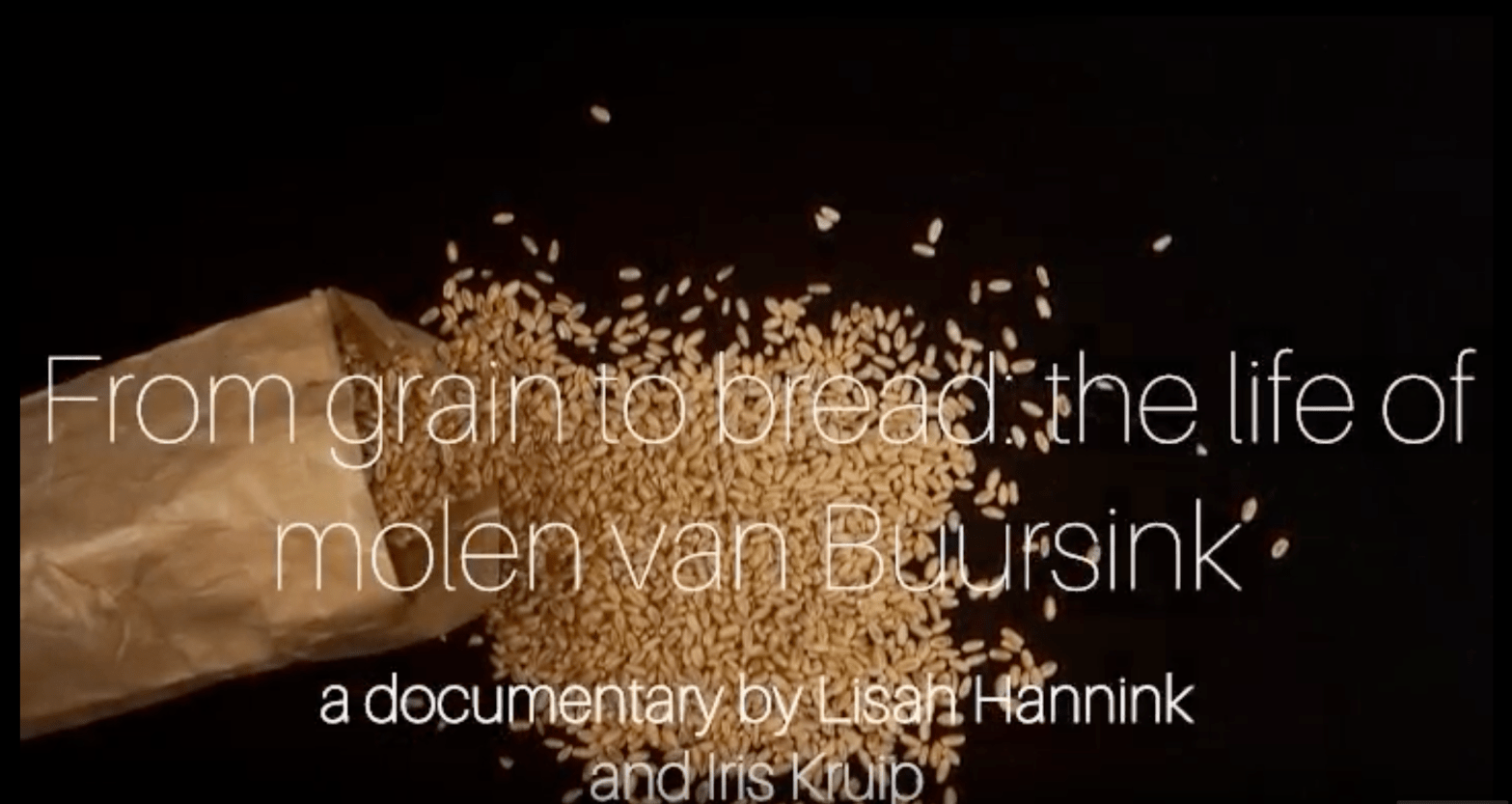
Documentary: From Grain to Bread: the Life of Molen van Buursink

A documentary by Lisah Hannik and Iris Kruip

From Grain to Bread was created as part of the course Material Culture, taught by Liedeke Plate in the BA Arts & Culture Studies at Radboud University.

Artist Statement

Our documentary explores how the transformation of grain into bread reflects broader changes in Dutch culture and community. Bread has long connected people to the land and to each other. While the basic process of turning grain into bread has remained materially similar for thousands of years, the context in which this transformation takes place has shifted from local windmills and communal production to industrialized, outsourced systems that often obscure their material and social origins.

To understand what this shift means, we focused on the Molen van Buursink in Markelo, a functioning 19th-century windmill that once formed the center of local grain processing and still operates today as a heritage monument. By visually following the grain’s transformation, from seed to flour to bread, we sought to capture how material processes shape, and are shaped by, human life. Filming at the mill allowed us to approach material
culture through sensory ethnography (Pink 2010). We were listening to the creaking wood, watching how the mill was operated, and observing how visitors can engage with this historical site.

The project draws on Arjun Appadurai’s and Igor Kopytoff’s idea of the social life and cultural biography of things (1986), Tim Ingold’s notion of making as correspondence between humans and materials (2013), and Jane Bennett’s understanding of vibrant matter (2010). Together, these frameworks guided our exploration of how bread and grain possess their own forms of agency and meaning within human and ecological systems.

Ultimately, our documentary argues that mills like Molen van Buursink are more than relics of the past. They are living mediators between people, materials, and landscape. By revisiting the material life of grain, we invite viewers to reflect on how re-engaging with local practices might restore a sense of connection between food, community, and environment.

Works Cited

Appadurai, Arjun, editor. The Social Life of Things: Commodities in Cultural Perspective. 1st ed., Cambridge University Press, 1986. https://doi.org/10.1017/CBO9780511819582.

Bennett, Jane. Vibrant Matter: A Political Ecology of Things. With Project Muse, Duke University Press, 2010.

Ingold, Tim. Making: Anthropology, Archaeology, Art and Architecture. Routledge, Taylor & Francis Group, 2013, https://doi.org/10.4324/9780203559055.

Kopytoff Igor. The cultural biography of things: commoditization as process. In: Appadurai A, ed. The Social Life of Things: Commodities in Cultural Perspective. Cambridge University Press; 1986, pp. 64-92.

Pink, Sarah. Doing Sensory Ethnography. SAGE, 2013.

Documentary: Het Heet Thee

By Talin de Jeu, Miriam Stuefer and Holly van Zoggel

Het Heet Thee originated from a shared interest in tea, gender, and the intersections of the two. With this documentary, we aim to dissect how mythologies surrounding tea and femininity are created and kept alive. By shooting images of the tea habits of ourselves and the people surrounding us, by filming artworks and china, and by collecting additional photographic footage from local archives and movie scenes, we search for intersecting and contradicting aspects of the personal, political and historical.

The documentary roughly follows the making process of tea: starting with ingredients, how they are grown and harvested, moving to the making of tea and the china it is consumed from, followed by the social aspects of drinking tea, and lastly its dregs. The focus on our own hands, shot on handheld phone cameras, emphasises our closeness to the subject but also the situatedness of our narrative. These images are intertwined with different types of archival material. This way, we wanted to underline the vast history and the physical and cultural contexts that all boil down into a single cup of tea. The images in the first chapter show people –  predominantly women – working on tea plantations. Even though tea is strongly connected to femininity, the power still lies with men, as  they are the ones judging the tea’s quality. We visualised this dichotomy between femininity and masculinity in our tea-culture with the two humorously named teas Decollethee and Theetosteron.

Although we do question the myths through our documentary, the style and nature of the film is subtler than if we had used a voiceover to explain our ideas. We chose this approach because we did not want to teach the viewer how gender(roles) and tea are intertwined. Instead, the documentary is a search for the parallels that constitute the myth, formalized in a way similar to the way myths circulate in our society: with subtlety but ever-present in its details.

The documentary Het Heet Thee was created in the BA course Moving Documentaries.

Documentary: Banden met Barrels

By Fenne van Beek, Jildou de Jong, Niko Oussoren, and Puck Gregoor

We, Fenne van Beek, Jildou de Jong, Niko Oussoren, and Puck Gregoor, are excited to present to you our short documentary, Banden met Barrels. It is a documentary created for the second-year course ‘Moving Documentaries’ as part of our bachelor’s program in Art and Cultural Studies at Radboud University. As four Dutch students, we wanted to shed light on bicycles, particularly student bicycles. Because where would the average student actually be without their bike? It may seem like a simple, ordinary object, and it is, but the bicycle is also a significant cultural phenomenon whose importance we often overlook. Bicycles are essential in Dutch student life for their practicality and reliability, despite their worn-out appearance. As will become evident in this documentary, the student bicycle can serve as a starting point for many conversations and two-wheeled journeys. We hope Banden met Barrels sparks nostalgia and prompts audiences to pause and appreciate the humble bicycle as more than just a mode of transportation, but as a symbol of freedom, community, and adventure.

The documentary Banden met Barrels was created in the BA course Moving Documentaries.

Documentary: Knuffels

By Rosa Floris, Lotte Lammers, Marta Ora, Laury van de Ven and Tim Wiesner

In Dutch, the word ‘knuffels’ holds a charming dual meaning, referring to both plush toys and hugs, and thus embodying a sense of comfort and care in a single term. Etymologically rooted in ‘knuffen’, meaning to bump or shove, the term ‘knuffels’ connotes a form of affection that entails both a gentle embrace and a playful nudge, driving home the idea of a push-and-pull, perpetually dynamic bond. This bond is at the center of our documentary, Knuffels, and explored through various interviews with Arts and Culture students of Radboud University. Knuffels pertains to the ambiguity of affection towards plush toys, and attempts to formulate an answer to the question: how do individuals attribute meaning to plushies within the context of ownership, and what psychological, emotional, and symbolic significance do these objects hold for their owners?

Knuffels aims to show truths; the audience is shown small aspects of the documentary’s construction, but not enough to betray the true extent of our involvement or to problematize the notion of truth. Instead, these few elements of construction work to disarm suspicion in the viewer and therefore aid in framing the contents of the documentary as truthful. The presentation of several voices, which at times contradict each other, serves this purpose. Subsequently, we have chosen to make fabric the common denominator in all shots and scenes, which vitalizes a soft aesthetic that fits, frames and harmonizes these oftentimes nostalgic sentiments expressed in the interviews.

As for the documentary in its entirety, the viewer could consider the footage a tapestry that we have carefully woven in collaboration with the interviewees, and from which we later cut and sewed together different pieces to make our final product – the visuals do not fabricate, the fabrics merely visualise. As a result, Knuffels quite literally embraces a storytelling predicated on multiplicity, be it in terms of lived experiences, perspectives, or the very essence of affection itself.

The documentary Knuffels was created in the BA course Moving Documentaries.

Documentary: Borrel

We are the makers of the short documentary ‘Borrel’ – Emily Hölz and Riikka Toropainen, Bachelor students at Radboud University from Germany and Finland. In 2021, we both came to the Netherlands for our studies and experienced many cultural differences when trying to settle in. Thus, when we had the chance to make our own documentary, in the second-year course ‘Moving Documentaries,’ we wanted to approach a topic that was familiar both to us and many like us. Thereby, our aim was to feel more at home, and integrated into the Dutch culture and lifestyle, whereby we hope to evoke this also in other internationals, who might feel lost in a city far away from home. Lastly, we hope that this documentary is interesting to Dutch people too, who might be curious about how internationals interact with and reinterpret their personal Culture and Pride.