
Preface to the Radboud Creative Industries Journal

Creative industries as a field and as an academic discipline has taken a pivotal turn in the last decades. The study of creative industries celebrates the intersection of multiple areas ranging from music, craft, fashion, technology, tourism, to placemaking, to name a few. Interestingly, these form only the tip of the iceberg.

Creative industries as an area was originally conceived towards revenue generation, creating employment and overall economic revitalization. However, the more we understand the creative industries, the closer we reach towards valuing them beyond simply an economic revitalization model. Creative industries serve as a great example to call attention to nuances that every researcher can individually bring- for instance, the questions of indigenous communities and technology is a fascinating example of how two diverse worlds can intersect. Understanding creative industries through its various players, processes and points of view can uncover various interesting facets therein. Thus, by focusing on creativity along with various intersections such as culture, diaspora, mobilities, gender and so on, the application of creativity and creative industries can be endless.

This was my first observation as students of MA Creative Industries Core Course discussed various topics that only kept broadening the scope of the subject and in-class discussions. This in-house e-journal, The Radboud Creative Industries Journal, brings together the articles of students of a Masters level course at Radboud University Nijmegen, the Netherlands (LET-ACWME0000 core course in creative industries). Students conceptualized interesting questions for discussion that were unique to their positionality, adopting a critical cultural studies perspective. The articles that resulted from these conversations in class, and a double blinded peer-review exercise are presented in this e-journal.

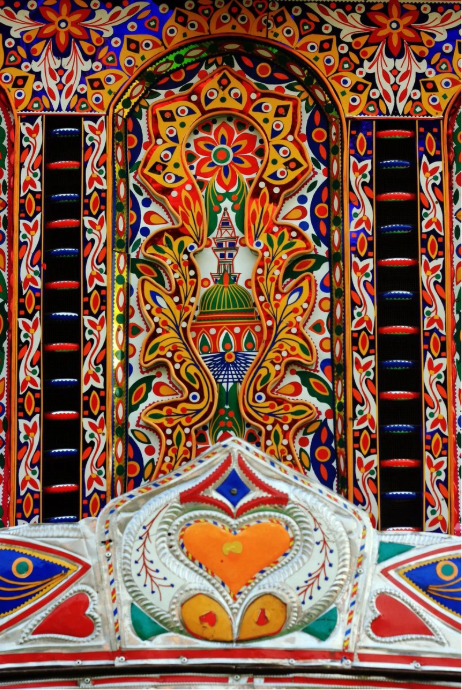
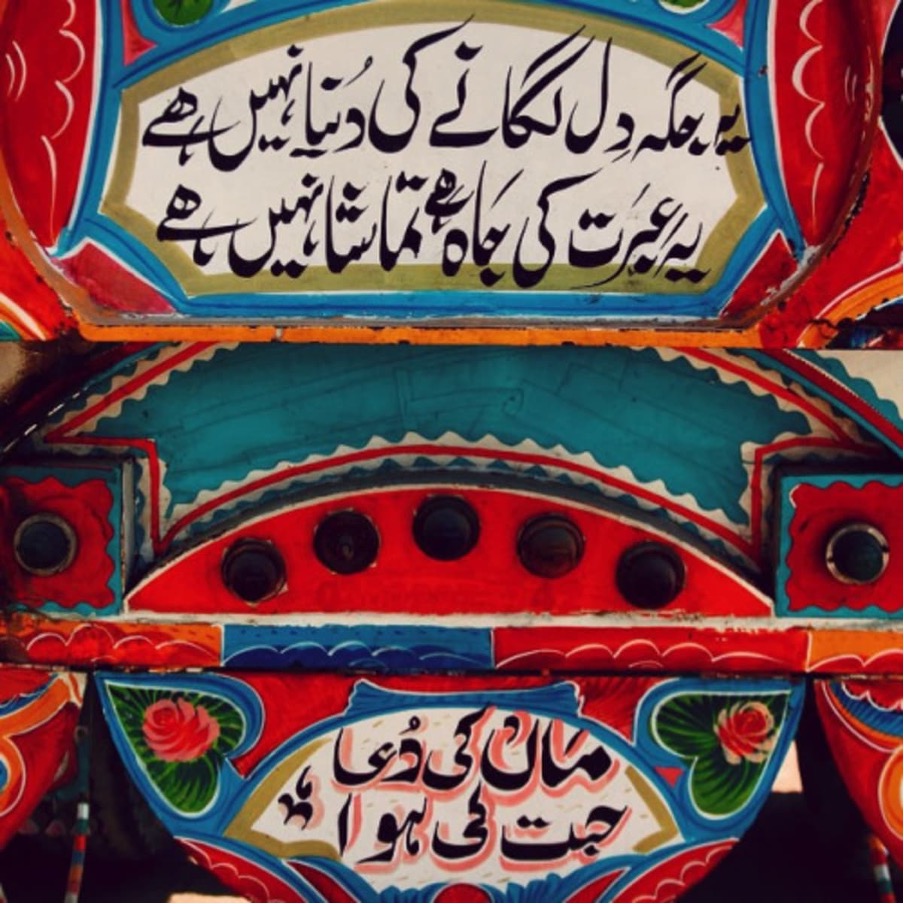
The angle of this e-journal celebrates creative industries from a global perspective. In this edition, we explore diverse topics ranging from youth participation in the creative industries in Ghana to Pakistani truck art’s cultural relevance, from the evolution of socially committed art, to understanding the role of platforms such as TikTok or Vinted in contemporary societies. Taking relevant strides towards social relevance of creative industries, this edition touches upon AI and storytelling in museums, and also activism in the music industry underpinning Bandcamp Gaza fundraisers as a case study.

This e-journal came into being with limited resources and no funding, but with the pure intent of making enriching creative industries conversations that take place in classroom more accessible to a wider audience. This idea resulted in this collection of essays. We are grateful for the support of Culture Weekly for housing this initiative and we hope this e-journal sees many more years of collaborative efforts to add depth and richness to creative industries in general. I particularly want to thank MA students Merel Visser and Julia Leijzer for their enthusiasm in supporting this e-journal with their great editorial assistance. We hope you enjoy reading along!

Apoorva Nanjangud      Merel Visser                      Julia Leijzer

Editor                                Editorial Assistant         Editorial Assistant

Nijmegen,

April 2025

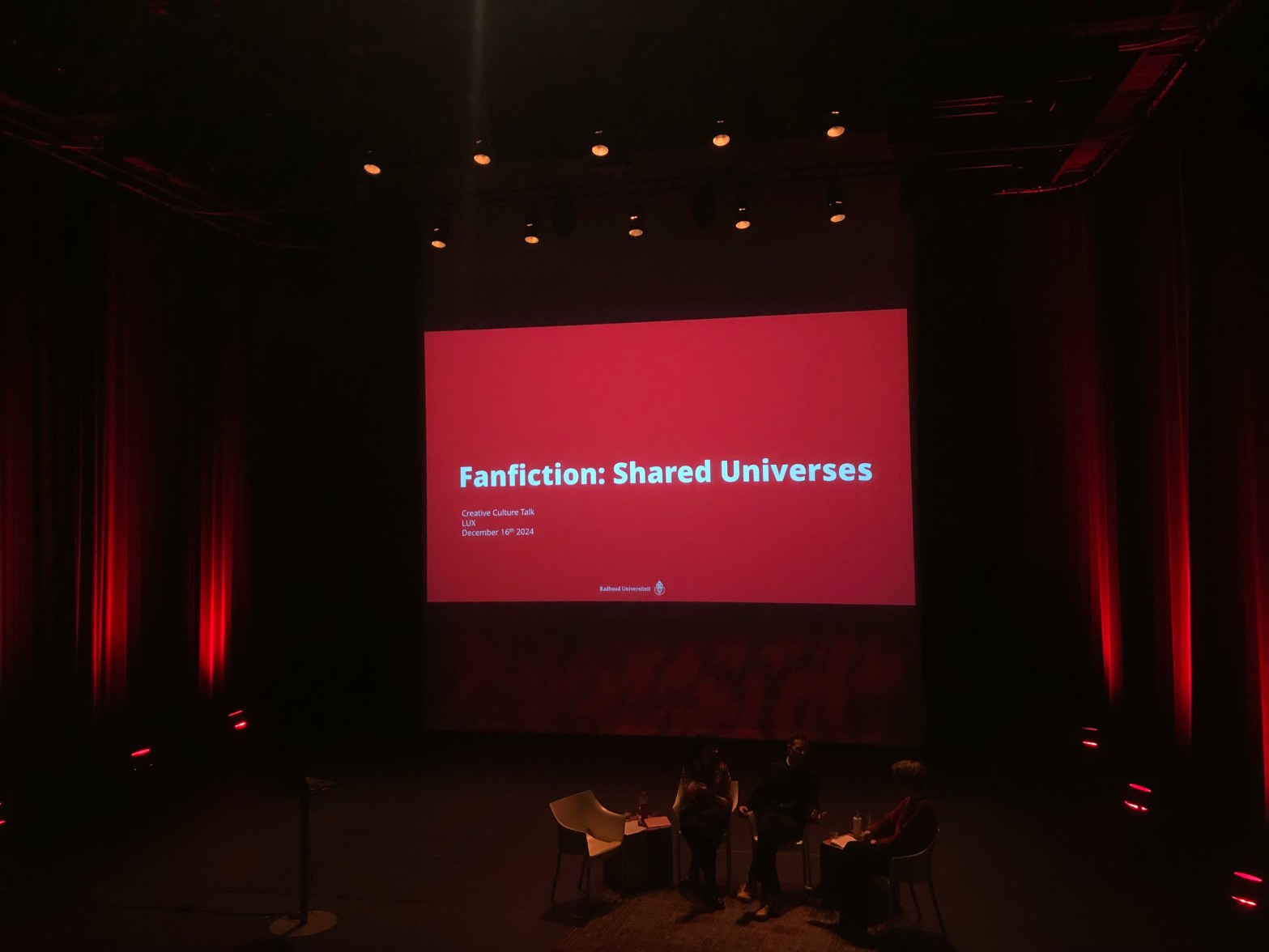
Fanfiction: Shared Universes

By Julia Neugarten and Rūta Tidriķe

PhD-candidate Julia Neugarten and third-year BA student Rūta Tidriķe look back on the Creative Culture Talk they organized last year at film theatre LUX, titled Fanfiction: Shared Universes. The evening included presentations and discussion with two guest speakers: Nicolle Lamerichs, a senior lecturer and team lead at Creative Business, HU University of Applied Sciences in Utrecht, and Roderick Leeuwenhart, a writer of science fiction and winner of the prestigious Harland Award for speculative fiction.

“Raise your hand if you have ever read fanfiction.”

Some of the people at LUX looked around uncertainly, but others raised their hands with confidence. After a few moments, more than half of the audience had their hands up.

“Now raise your hand if you have ever written fanfiction.”

More than half of the hands went down.

None of this was surprising. Apart from the fact that fanfiction-afficionados are probably more likely to attend an event about fanfiction than other people, the largest English-language fanfiction-website today has over 8 million users.1 Fanfiction is a huge and ever-growing online phenomenon – you probably know people who read and write it, especially if you’re under 30 years old.

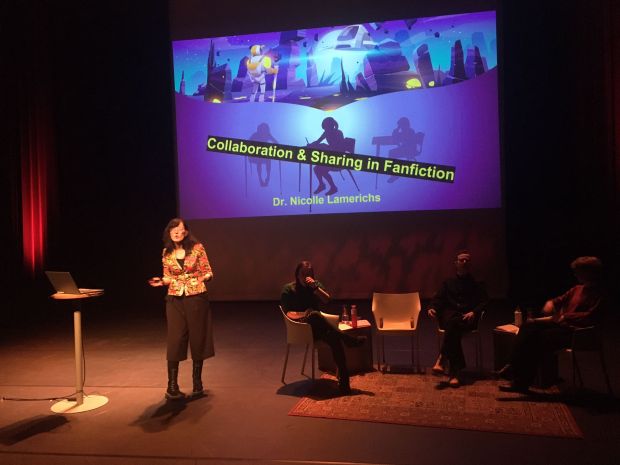
To tell us more about fanfiction and the fan culture it emerges from, Dr. Nicolle Lamerichs kicked off the evening with a presentation. She explained that fans are typically emotionally invested audiences. Fans are often active in communities – which they call fandoms. Finally, fans are often creative. They express their emotional attachment to popular culture through creations such as art, costumes, and fanfiction.

Picture by Aliisa Råmark

Fanfiction often explores alternate interpretations or elements of a storyworld from popular culture. It is often written in close collaboration with the rest of the fan community – the so-called fanon (fan-canon) is constantly changing and developing. And, lastly, fanfiction is often transformative – while some fanfiction endlessly produces more of a certain popular thing, fans also use it to get more from beloved stories – more representation, more nuanced storylines, more answers to their questions, more emotional fulfillment.2 Fanfiction’s capacity for transformation can encompass the exploration of commonly underrepresented identities, but it can also mean trying out different plot scenarios or changing the fundamental ideological underpinnings of a story.

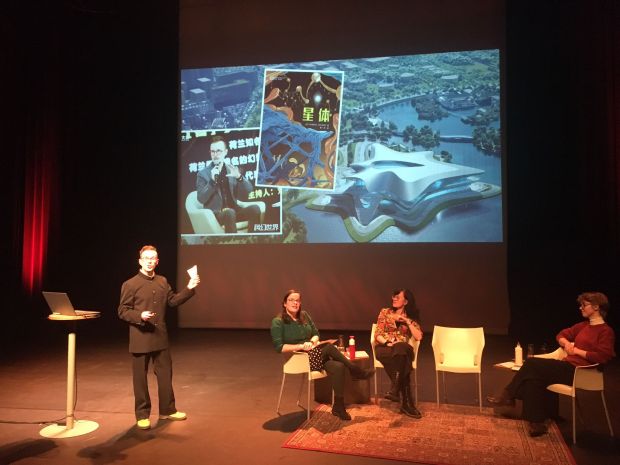
We were then introduced to the work of Dutch science fiction writer Roderick Leeuwenhart. Roderick also surveyed the similarities between fanfiction and science fiction. For example, both types of stories share a preoccupation with hypothetical scenarios, with asking ‘what if?’ Roderick also reflected on his experience contributing to De Zwijgende Aarde (The Silent Earth), a series of science fiction novels by different authors that are all situated in the same narrative universe. This collaborative mode of authorship is not unlike the process of fanfiction production.

Picture by Aliisa Råmark

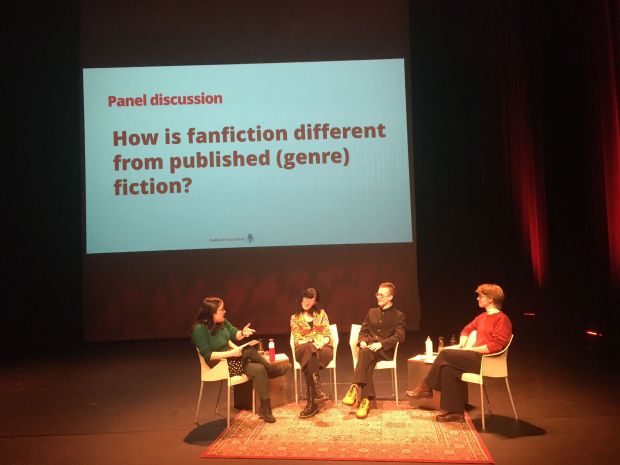
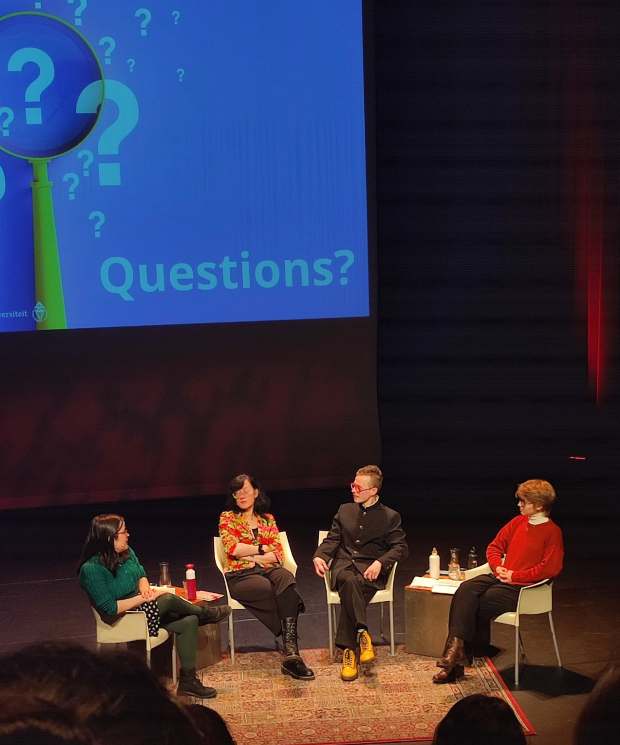
In the panel discussion that followed, we discussed the differences and similarities between fanfiction and published fiction, including differing modes of production and distribution, differences in content, and different reading experiences for audiences. Here, Rūta made an interesting observation: in their life, fanfiction-reading has a very different role from reading published fiction or other types of texts. Indeed, to them there is a certain comfort and ease that comes with reading fanfiction as the characters and/or the worlds they inhabit are already well known. This is different to starting a new original fiction book or series, where the reader must learn and familiarize themselves with the new story world. Ultimately, for them, reading fanfiction comes with a certain level of comfortable familiarity.

Picture by Ida Bassenge

Roderick then read his short story Bacteriophages for us, about a futuristic medical treatment that had some unexpected side-effects. The story, we reflected, was speculative in regard to some culturally dominant ideas about medicine and the human body. Through humor and defamiliarization, it let us think through these topics. We discussed the distinction proposed by Francesca Coppa, that science fiction tends to be speculative about (story)worlds, whereas fanfiction tends to be speculative about characters instead.3 These distinct types of writing may thus lend themselves to different types of speculations.

What are these different types of speculation? When are they useful? When do they fall short? We talked about the possibility that fanfiction, like some science fiction, could be politically powerful by allowing people to imagine, and therefore strive for, a different, better world. We also discussed some of the ways that fan culture can be reactionary rather than idealistic. In the end, real-world political viewpoints can limit the transformative possibilities of (fan)fiction.

So where will fanfiction go in the future? During discussions, we agreed that in recent years, especially when people were forced to spend time inside during the pandemic, there was a noticeable influx of new people in fandom communities, who were previously unfamiliar with how these spaces worked. This shift brought up old discussions and spurred new ones, especially as new practices emerged.

Picture by Trine Linke

Online fan communities that revolve around fanfiction seem to just keep growing, and technological developments like AI are also making new kinds of online fan-activity possible, such as interactive fan experiences with AI chatbots. Although these developments may also mean a tendency for fan culture to become more focused on profit, we hope that fandoms can maintain their curious, critical, and sometimes silly sides as well.

The evening was produced in collaboration with Karlijn Scheffers of LUX and with the assistance of Sofia Dovianus, a student-assistant at the Radboud. The Creative Culture Talk was made possible by Helleke van den Braber, formerly of Radboud University’s Art and Culture Studies and now affiliated with Utrecht University. Header image by Ida Bassenge.

Footnotes

  1. This site is Archive of Our Own: https://archiveofourown.org/, consulted March 27th 2025. ↩︎
  2. This distinction between more of and more from originates from The Democratic Genre: Fan Fiction in a Literary Context, by Sheenagh Pugh (2005). ↩︎
  3. Coppa, Francesca, editor. The Fanfiction Reader: Folk Tales for the Digital Age. University of Michigan Press, 2017. ↩︎

Elmer bezoekt huizenhoge hoogtes in Platland

Dit stuk is geschreven door Jill Moser in het kader van het vak Kunstkritiek

Door middel van een allesinnemende, sensorische reis neemt Elmer haar publiek mee om al rappend, stampend en dansend in haar Platland-clubtour benauwende constructen af te breken om hun vervolgens de mogelijkheid te bieden vanuit muzikale hoop weer iets op te bouwen.

De frontvrouw van het voorprogramma Maria Iskariot vouwt zich uit de foetushouding vanuit waar ze eerder machtig en grollend zong voordat de bandleden hun halfuur durende set besluiten en ze het podium verlaten. Vooraan in het publiek hervormt een enkele bubbel aan onhandig tegen elkaar opspringende mensen zich tot keurig gevormde, braaf wachtende rijen en terwijl de laatste klanken nagalmen in de kleine zaal van De Effenaar zoek ik schuifelend door de menigte een plek.

Eenmaal net-niet-achteraan staande zie ik over een gevarieerd landschap van mensen het decor van de act waarop we allemaal wachten vlug opgebouwd worden. Op het podium verschijnen verschillende lagen aan kartonnen kunstwerken in het halfdonker voordat Elmerde planken beklimt.

Elmer, alter-ego van Merel Pauw, is een Nederlands rapper, muzikant, producent, theatermaker en acteur. De artiest debuteerde in 2021 met de obscene hit Je Vader en verwierf daarmee al snel een bescheiden (internet)succes. Sindsdien bracht ze drie EP’s en een dubbele single uit en trad ze op verschillende vooraanstaande poppodia en festivals op. In 2024 werd Elmers debuutalbum platland uitgebracht waarop afgelopen najaar een clubtour door Nederland en België volgde.

Op beats van drumcomputers met doorgaans dreunende, soms swingende bassen, die doen denken aan genres als electrofunk en miami bass, rapt Elmer provocerende doch kwetsbare teksten. In haar muziek en met het gebruik van haar alter-ego (dat geïnspireerd lijkt door eerder belichaamde alter-ego’s als David Bowies Ziggy Stardust en Eminems Slim Shady) lijkt Merel Pauw te willen spelen en breken met heersende verwachtingen van en structuren rondom het zijn van een mens, een vrouw en het zijn van een vrouwelijk artiest.

In de inmiddels volledig donkere zaal verschijnt Elmer, gedrapeerd in een grote zwarte cape en tovenaarshoed, samen met dansers Semna Segal en Sjaid Foncé, op het podium. De setlist wordt afgetrapt met de doordringende riff, diepe bas en strakke raps van Sorry waardoor Elmer met haar kundigheid en toewijding vanaf moment één haar publiek laat dansen, springen, rappen en gillen – of op z’n minst met hun hoofden op de maat van de muziek laat knikken.

Na een denderend applaus circuleert Elmers aansporende boodschap ‘Laten we vanavond vieren dat we allemaal rare losers zijn!’ luid en duidelijk door de zaal voordat ze continueert met het muzikaal aanstekelijke nummer Ik Weiger, dat tekstueel scherpe kritiek levert op de heersende gendernormen en de daaruit volgende beperkingen in genderuiting. Het handjevol mensen dat eerder nog niet danste lijkt Elmer in dit nummer wel mee te krijgen en terwijl ook ik mijn lichaam meebeweeg op de muziek kan ik het niet laten mezelf af te vragen of Merel Pauw gendertheorieën van Butler zou hebben gelezen. Het nummer komt tot een einde door het herhaaldelijk uitkrijten van ‘Ik weiger!’ en het zicht van een aantal jonge mensen die dit uit volle borst meeschreeuwen ontroert me; voelend dat het voor hen veel meer betekent dan een simpele declaratieve zin.

De machtige kreten doven uit en Elmer trekt de grote zwarte cape en tovenaarshoed waarmee ze op het podium verscheen uit. Onder de cape verschijnt een donkerblauw schort over witte onderkleding en onder de tovenaarshoed verschijnt een witte hul: een kostuum dat veel wegheeft van traditionele Volendamse klederdracht. Gedurende deze onthulling horen we het eerste nummer intro van Elmers nieuwe album waarin we in door een klein koor onheilspellende versregels als ‘Kijk dat landschap / Wat een vakmanschap / Wie bedacht dat / Rechte lijnen / Schuine daken / En de weides / Zijn net lakens’ over Nederland worden toegezongen. Het nu sterker verlichte decor laat in het midden een groots, cartoonachtig, kartonnen draaiorgel zien.

In haar debuutalbum platland onderzoekt Elmer haar ingewikkelde relatie met het land waarin ze werd geboren en opgroeide. Daarmee lijkt de artiest met dit album ook automatisch een onderzoek naar de relatie met haarzelf te doorwerken. Met de overwinning van Wilders en de PVV was Elmer in eigen woorden ‘zo boos dat [ze] dit album moest maken’. De tien nummers van platland zijn zowel een ode aan en een afbranding van Nederland, als een bevraging van waarom we Nederland zo verdedigen en afsnauwen.

Terwijl de eerste tonen van het nummer platland al luid klinken stelt de alleskunstenaar haar publiek voor ‘een kringverjaardag te maken!’, ‘met kaasblokjes of zo!’ en enkele seconden later zie ik vooraan een mensenmenigte hun best doen een circlepitte maken. Moeite wordt beloond, want terwijl de dreunende bas en de door Elmer strak gerapte regels ‘Stamp dit land plat / Dit land is plat / Nat de grond / Land is plat / Wereld rond / Dit land is plat / Van karton / Pak het vast / Draai het om’ in de zaal doorklinken ontstaat in een bubbel van mensen vooraan de meest chaotische maar gezelligste kringverjaardag die ik heb gezien. Naast dat dit nummer een geniale live-ervaring is, zit het inhoudelijk ook goed in elkaar. De doffe (en soms incomplete) grammaticale structuur van de versregels ondersteunt de constatering van ‘het vlakke land’. Een constatering die uiteraard niet alleen het fysieke landschap beschrijft, maar ook als vehikel wordt gebruikt voor de doorgaans afgestompte mentaliteit van Nederland(ers). Tegelijkertijd communiceert de liedtekst door het noemen van karton hier ook met de performance, die veel gebruikmaakt van een kartonnen decor en attributen.

Voor het nummer Politiek Statement deelt Elmer het publiek op in twee delen: een linkerhelft, die ze vraagt tijdens aangewezen regels in het nummer ‘Ja’ te schreeuwen, en een rechterhelft, die ze vraagt ‘Nee’ te schreeuwen. In de tekst wordt gespeeld met kritiek op de toenemende maatschappelijke polarisatie en terwijl de verdeelde menigte op de muziek luidkeels ‘Nee’ en ‘Ja’ naar elkaar schreeuwen weerspiegelt de publieksparticipatie dit. Er verschijnt een glimlach op mijn gezicht terwijl ik me voorstel dat Wagner wellicht wel trots zou zijn op Elmers show, die nu al dicht in de buurt komt van een allesintegrerend gesamtkunstwerk.

Al dansend, brekend, zingend, rappend, grinnikend en lachend, sommigen jankend, verstrijkt de reis door Elmers Platland. Ze nam ons allemaal mee, hangend aan haar lippen, in een van begin tot eind in alles doordachte en met enthousiaste toewijding opgevoerde show. Als publiek verdwenen we in de belevenis van een landschap van krachtige muziek en even krachtige teksten, geniaal decor en kostuums, prachtige lichtshows en daadkrachtige dans. In hoogtes en in dalen maakte Elmer van haar concert een kunstwerk dat allesbehalve plat was.

Music for mental health… it’s BRAT

By Just Celebrities: Sjoerd Baas, Ana Cabrian, Julia Leijzer, Rik Pastoor and Aimée Walkate

Yeah, I don’t know if you like me

Sometimes I think you might hate me

Sometimes I think I might hate you

Maybe you just wanna be me

– Charli XCX in Girl, so confusing featuring Lorde

Meet Charlotte Emma Aitchison; a singer- songwriter from Great-Britain. You probably know her by her stage name Charli XCX. A name drawing from her MSN Messenger-phase, which she used when she was younger and still out of the limelight. Charli first gained attention in the early 2010s and has since become a key figure in modern pop. After several albums, with popular songs like “I love it”, “Speed Drive” and “Apple”, 2024 has seen her being transported into the mainstream as a big artist and global public figure.

She (co)writes most of her own songs wherein she handles subjects like hedonism and love. Musically, her style has been perceived as dark wave, witch house, gothic pop, synth pop, pop punk, avant-pop, although she states that she does “not identify with music genres.”1 Instead, in each of her album-cycles, she is known to adopt a different aesthetic altogether. Most recently, the world became acquainted with BRAT; the bright green in-your-face vibe of the summer.

It’s BRAT?

With the release of the BRAT album, on the 7th of June 2024, Charli XCX concluded months’ worth of build-up and anticipation for one of her most ambitious projects to date. However, this moment right at the start of the summer marked only the beginning of much bigger hype. Not only did the songs of the album – which topped charts around the world – garner massive appeal, but BRAT became a way of life.2 In line with the hedonistic attitude that Charli XCX professed on earlier work, the singer now delved further into the introspective aspects that come with her fame and party girl-attitude. Being a brat is about being a complex character; you can admit your flaws and recognize what makes you human, but you can also do whatever you want, however you want it.

Central to the appeal of BRAT is its relatability. Throughout her lyrics, Charli XCX shares insights into her emotional state-of-mind, often coming across as vulnerable, but always in control and empowering. She preaches partying, simultaneously as a way of escapism and embracing self-doubt. One of the central themes on BRATis Charli’s complicated relationship with other women. She sings about “perfect” girls and questions her friendship with other pop artists, most notably New Zealand singer and contemporary, Lorde.

It’s so confusing sometimes to be a girl

Roughly two-thirds into BRAT, Charli delves headfirst into a comparison of herself with one of her contemporaries, specifically, someone who she has always been compared with throughout her career. This sparked debates among fans, and eventually agreement, on who Charli was talking about.

People say we’re alike

They say we’ve got the same hair

We talk about making music

But I don’t know if it’s honest

Can’t tell if you wanna see me

Falling over and failing

And you can’t tell what you’re feeling

I think I know how you feel

Because of their synchronous rise through the ranks of the international pop music scene, around the early 2010s, Charli XCX and Lorde have always been subject of comparisons. From something as seemingly innocent as their style of hairdo, to more serious judgements on musical style and aesthetics, both artists could not escape the forced associations with the other. Central to the song is the anxiety and social stress that comes along for artists when the media forces them in competition with their peers.

Then the remix of the song came out. A near-identical version of the song, but with an added verse in which Lorde reacts to Charli XCX. This provided the invested fandom with a much-needed discourse on the insecurities both females shared towards each other. Hence the title “Girl, so confusing” which underlines the way both artists struggle to come to terms with how they should relate to each other in light of the media and their careers.

Charli on Mental Health

Charli XCX has been publicly open about her mental health struggles. She has spoken openly about experiencing anxiety, stress, and the pressures that come with being in the music industry. She does this in the lyrics of her songs, but also via social media and interviews.

Much like the conversational struggle with Lorde on “Girl, so confusing”, the insecurity Charli XCX experiences in regard to other women is reflected through the song “Sympathy is a knife”. She opens up about her feelings when she sings about a woman who triggers feelings of doubt and insecurity in herself. The sentence “This one girl taps my insecurities, don’t know if it’s real or if I’m spiraling” emphasizes this.

The theme of the song is about the internal struggle of constantly comparing oneself to other women. The lyrics of the song give an exploration of Charli’s own feelings, the words explore the complex feelings of self-perception, insecurity, and the impact of seeking validation from others.

Cause I couldn’t even be her if I tried
I’m opposite, I’m on the other side
I feel all these feelings I can’t control
Oh no, don’t know why
All this sympathy is just a knife
Why I can’t even grit my teeth and lie?
I feel all these feelings I can’t control
Oh no, don’t know

The metaphor of sympathy being a knife suggests that seeking validation from others can sometimes backfire, deepening emotional wounds. In trying to gain empathy, Charli XCX sings about ending up feeling more vulnerable, as the sympathy can worsen their pain.

For many fans, Charli XCX’s openness about her mental health struggles is perceived as inspiring. Reactions from fans seeing a pop artist opening up about her emotional well-being helped them feel less alone in their own mental health.

Meet Ella Marija Yellich-O’Connor, a singer from New-Zealand, who is better known under her stage name Lorde. This reflects her fascination with royalty and aristocracy.  Her music style has been described as indie-pop and alt-pop.

Lorde

Similarly to Charli XCX, Lorde also opened up about her mental health. In 2023 Lorde wrote a letter to fans in which she talks about her loneliness and heartbreak. “I eat chocolate to try and manipulate the endorphins, bring back the sweet happiness of Easter morning. I sit in the time machine and wait for it to move, but it hasn’t been invented yet.”3

These mental health struggles are also apparent in the song “Liability”. “Liability” is a song from Lorde’s second album (Melodrama). In this second album, she shifts from the collective “we” of her first album (Pure Heroin) to a more personal “I” perspective. In an interview with Vogue, Lorde explained how the first album was more about her and her peers, while the second album was more about her personal experience.4

I’m a liability

In the song “Liability”, Lorde talks about how she feels like a burden to the people around her.

 The truth is I am a toy that people enjoy
 ‘Til all of the tricks don’t work anymore
 And then they are bored of m
e

In these lyrics, for instance, she mentions how she is afraid that people are going to find out they would rather not spend so much time with her.5

Lorde explained in an interview with 60 minutes Australia how the song “Liability” surprised her: “it really appealed to a lot of young people […] people say to me: that’s exactly how I felt during high school […] even though I am in this quite specific situation myself, other young people can relate to what it is that I’m feeling”.

Mental Health, Consciousness-Raising and Feminist Standpoint Theory

Music and mental health have been proven to positively affect one another. Some people with mental illness can have trouble expressing themselves with words. Thus, music is used in therapy to help the patients express their emotions and create a relaxed mental state.6 It is even used by psychiatrists for treating people with depression.7 On the other hand, music can be used to improve one’s mental state outside of therapy as well. Just listening to music everyday reduces stress and anxiety. Research by psychiatrist Lavinia Rebecchini shows that listening to music decreases the levels of, among other things, stress hormone and adrenaline.8 She even argues that due to these decreased levels of stress and adrenaline, the immune system might improve. This ties in with the Sustainable Development Goal number three: Good Health and Well-Being, as mental health is an important part, if not the most important part, of good health and wellbeing.

Moreover, the artists themselves also play a major role in helping with mental health. They can reduce stigma by singing or talking about their own mental health issues. When artists discuss mental health, they can increase knowledge of symptoms, treatments and services.9 Lyrics that discuss mental health issues can help the individual create more self-awareness and physical/psychological relaxation.10 However, not every celebrity is equally impactful. There are three different kinds of celebrities: the traditional celebrity, the social media celebrity and the microcelebrity.11 Originally, microcelebrities were most impactful in reducing stigma, because they are regional celebrities, and their fans have a personal connection to them. Therefore, traditional celebrities, like Lorde and Charli XCX, were least relatable to the fans, as they are not connected to every-day life anymore. This has changed since the invention of social media, as all celebrities can easily have direct connections to their fans, creating this relationship between the fans and the celebrity.12 Social media has given traditional celebrities a way to talk directly to their fans about mental health, which reduces the stigma surrounding mental health issues.13

Furthermore, music itself is an important vehicle for social change and songs can be used as platforms through which certain messages can be spread to a wider audience. In other words, music can be used as a tool for consciousness-raising. This refers to works that are created in a way that will draw people’s attention to a certain social issue and increase their understanding of it, as well as how the issue has an impact on their personal life.14 This understanding will then hopefully encourage people to contribute to solving the issue. As mentioned above, one such problem is the stigma surrounding the concept of mental health. Consciousness-raising songs can serve as a way of raising awareness about mental health issues by addressing topics of emotional well-being, such as anxiety, depression or any other mental health related concerns. As a consequence, these songs can help normalize conversations about mental health and reduce the stigma around it, as well as potentially motivate individuals to look for help. Therefore, consciousness-raising songs can challenge societal norms and advocate for social change, in this case, how mental health is perceived and treated. Celebrities, such as Charli XCX or Lorde, that use their music to speak up about their personal experiences with mental health struggles, can increase knowledge and help change the public perception of mental health.

What is more, the aforementioned case studies of artists Charli XCX and Lorde exemplify feminist standpoint theory. This is used with the purpose of placing women’s stories and experiences at the center of the research.15 To elaborate, feminist standpoint theory wishes to identify and challenge cultural values and power dynamics that contribute to the subordination of particular groups, specifically women, as well as highlighting the distinct knowledge that can be obtained from a female perspective.16 Individuals indicate a standpoint when they portray and are critical of the power relations that are present in a society, as well as the consequences of those power relations for members of different groups.17 Lorde’s song “Liability”and Charli XCX’s album BRAT reflect marginalized perspectives, namely those of women, and challenge dominant structures surrounding emotional vulnerability, self-worth and other mental health struggles. Both of these artists use personal emotional well-being experiences to critique societal expectations and power structures that surround femininity, emotional expression and mental health. By shedding light on the experiences of the marginalized group, these songs can capture the attention of listeners that share similar struggles, consequently creating a space in which awareness can be brought to conversations about how mental health is perceived by a broader social system.


Footnotes

  1. Charli XCX, “I do not identify with music genres”, Twitter, tweet, published at 22-07-2022, 20:43. https://x.com/charli_xcx/status/1286008932377350144. ↩︎
  2. “BRAT, by Charli XCX”, Official Charts, accessed October 27, 2024https://www.officialcharts.com/albums/charli-xcx-brat-0/. ↩︎
  3. Lorde, “How I’ve Been; Revised”, Tumblr, email, September 20, 2023, https://lordeemailarchive.tumblr.com/. ↩︎
  4. Lorde, “73 Questions with Lorde | Vogue”, Vogue July 27, 2021, video, 12:51, at 2:20, https://www.youtube.com/watch?v=MSRBV9udKi8&t=234s. ↩︎
  5. Lorde, “Extra Minutes | Lorde Opens Up on the Meaning of her Hit Song “Liability””, 60 Minutes Australia, video, 3:10, at 0:40, https://www.youtube.com/watch?v=M70iz2UjQyI. ↩︎
  6. L. Rebeshi, “Music, Mental Health, and Immunity”, Brain, Behavior, and Immunity – Health vol. 18, no. 1 (2018): 1-6, at 2, doi: https://doi.org/10.1016/j.bbih.2021.100374. ↩︎
  7. Ibid. ↩︎
  8. Ibid., 3. ↩︎
  9. P. C. Gronholm and G. Thornicroft, “Impact of Celebrity Disclosure on Mental Health-Related Stigma”, Epidemiology and Psychiatric Science vol. 31, no. 62 (2022): 1-5, at 2. ↩︎
  10. C. Stephensen and F. Baker, “Music Therapy and Mental Health Recovery: What is the Evidence?”, in: P. Nielsen, R. King and F. Baker, Creative Arts in Counceling and Mental Health (Thousand Oakes, SAGE: 2016): 95-107, at 97. ↩︎
  11. Ibid., 3. ↩︎
  12. Ibid. ↩︎
  13. Ibid., 4 ↩︎
  14. A. Trier-Bieniek and A. Pullum, “From Lady Gaga to Consciousness Rap: The Impact of Music on Gender and Social Activism”, in: A. Trier-Bieniek et.al. (eds.), Gender & Pop Culture (Leiden: Sense Publicity, 2014): 81-102, at 85. ↩︎
  15. Ibid., 88. ↩︎
  16. J. T. Wood, “Feminist Standpoint Theory”, Encyclopedia of Communication Theory (Thousand Oakes: SAGE, 2009): 397-399, at 397.  ↩︎
  17. Ibid., 398.  ↩︎

Bibliography

“BRAT, by Charli XCX”, Official Charts, accessed October 27, 2024https://www.officialcharts.com/albums/charli-xcx-brat-0/.

Charli XCX, “I do not identify with music genres”, Twitter, tweet, published at 22-07-2022, 20:43. https://x.com/charli_xcx/status/1286008932377350144.

Gronholm, P. C.,  and G. Thornicroft, “Impact of Celebrity Disclosure on Mental Health-Related Stigma”, Epidemiology and Psychiatric Science vol. 31, no. 62 (2022): 1-5.

Lorde, “73 Questions with Lorde | Vogue”, Vogue July 27, 2021, video, 12:51, at 2:20, https://www.youtube.com/watch?v=MSRBV9udKi8&t=234s.

Lorde, “How I’ve Been; Revised”, Tumblr, email, September 20, 2023, https://lordeemailarchive.tumblr.com/.

Lorde, “Extra Minutes | Lorde Opens Up on the Meaning of her Hit Song “Liability’’”, 60 Minutes Australia, video, 3:10, at 0:40, https://www.youtube.com/watch?v=M70iz2UjQyI.

Rebeshi, L., “Music, Mental Health, and Immunity”, Brain, Behavior, and Immunity – Health vol. 18, no. 1 (2018): 1-6, at 2, doi: https://doi.org/10.1016/j.bbih.2021.100374.

Stephensen, S.,  and F. Baker, “Music Therapy and Mental Health Recovery: What is the Evidence?”, in: P. Nielsen, R. King and F. Baker, Creative Arts in Counceling and Mental Health (Thousand Oakes, SAGE: 2016): 95-107.

Trier-Bieniek, A.,  and A. Pullum, “From Lady Gaga to Consciousness Rap: The Impact of Music on Gender and Social Activism”, in: A. Trier-Bieniek et.al. (eds.), Gender & Pop Culture (Leiden: Sense Publicity, 2014): 81-102.

Wood, J. T., “Feminist Standpoint Theory”, Encyclopedia of Communication Theory (Thousand Oakes: SAGE, 2009): 397-399.

Confronting Gender Inequality in the Music Industry: Reflections on the personal approach to research

By Farijn Janssen, Eline Klaessens, Sofieke de Loos and Zsófia Szigetvari

After a day of putting up and handing out pamphlets, our group of young academics – lovingly named “The Gender Groupies (Don’t Be Sexist!)” – were absolutely ecstatic. We had designed these pamphlets to spark conversation about gender inequality in the music industry. We were filled with many emotions: determination, joy and a certain pensiveness…or perhaps reflectiveness. We hadn’t expected many responses or insights from the strangers we had approached to discuss our topic, because it can be intimidating to talk to students about societal issues and we didn’t want to disturb anyone’s peaceful day. However, to our surprise, a receptionist, a festival organiser, a barman and one of his regulars in a cafe took the topic seriously and were enthusiastic to talk about it with us, sparking interesting discussions. Trying to create change in the face of a systemic issue like gender inequality in the music industry, we were starting to see how a personal approach affected others.

This year’s rise of women at the top of pop music shows artists like Chappell Roan, Sabrina Carpenter and Charli XCX establishing themselves in the Billboard Hot 100 all summer long. Alongside this, this decade’s climb from 20.2% women in the Billboard 100 Year-End Charts in 2020 to 35% in 2023 shows a clear increase in the representation of women in the position of music artist. While the on-stage presence of women is more present, this isn’t the case for women “off-stage”, in the studio: producers and songwriters. The USC Annenberg Inclusion Initiative, an organisation that studies diversity, inclusion, and representation in entertainment and media industries, published their research regarding gender inequality in the recording studio. They found that as of 2022, there still were 3.5 men present in the industry for every woman. When it comes to their specific professions, women made up 30% of artists, 14% of songwriters, 3.4% of producers, and comprised 15.2% of Grammy nominees (Smith et al).1 Even though more women have been entering the music industry over the years, these numbers show that men still make up the large majority of the workforce.

If you’re thinking “this must be better in the Dutch music industry”, you’re going to be disappointed. Researchers Pauwke Berkers, Eefje Smeulders, and Michaël Berghman found that women only made up 13% of BumaStemra members, a Dutch collective society for songwriters, composers, and music producers. In the case of Sena, an organisation concerned with collecting rights for performing artists, the percentage of female members was at 19% (Berkers et al. 28).2 In the live music industry, women are more likely to hold positions in hospitality and marketing, compared to programming, directing and tech work in the Netherlands, according to the Cultuur Monitor, which creates an overview of the most important figures in the Dutch creative sector (Swartjes).3 It’s evident that the Dutch music industry, too, is male dominated.

We started to wonder how our research could actually change something in music, realising we had limited time and resources to do so. After listening to Ani diFranco’s feminist rendition of “Which Side Are You On?” and reading Adrienne Trier-Bieniek & Amanda Pullum’s chapter in Gender & Pop Culture, we thought about consciousness-raising and the role of personal narrative in social movements. Trier-Bieniek and Pullum emphasise that consciousness-raising as a feminist tool for change came from 1970s activism, describing the term as follows:

work done to draw people’s attention to a social problem, increase their understanding of it including how it personally impacts them, and hopefully motivate them to help solve the problem. (85)4

Feminist researchers using feminist standpoint theory have the same perspective. We read the work of Ratna Huirem, Kathiresan Lognathan and Priyanka Patowari, who wrote on feminist standpoint theory in the Journal of Social Work Education and Practice last year. We found it fascinating that this method focuses on centering the experiences of women, mainly by treating women and the testimonies of women more as subjects, rather than objects of study. Feminist researchers often befriend those who partake in their research. They do this in order to give them the safety and freedom to speak openly about their experiences living in the patriarchy. They also encourage their participants to come up with their own suggestions on how to move forward (48-50).5 This approach felt intuitive to us as we reached out to a group of friendly acquaintances we knew working in the industry to carry out a survey of their experiences. This would eventually prompt us to design the pamphlets we mentioned earlier in this blog. We decided to ask them how their gender affected the way they were treated within the industry and asked them to offer advice to those who aspire to follow in their footsteps. Our approach was friendly. We were sending them individual, often personally tailored emails. While we didn’t have the time to delve too deep, we remained understanding of our participants’ individual circumstances, and sent emails to update them on our process long after the surveys had been filled out. We’re even sending them this blog!

We decided to go into the city with the pamphlets made from the responses of the survey to talk to people working at creative places. We were told that our effort to raise consciousness about societal issues is an effective way to achieve change on a greater scale. This further encouraged us to visit as many places as possible. This was our attempt to take our personal approach to institutions, visiting the public library, the Lindenberg Theatre, the Festivalhuis and Cafe De Opstand, among others. Even though we stayed in Nijmegen and only spoke to specific bars and institutions who were already helping women gain visibility and equality, our initiative was still appreciated. We were still able to share our newly-acquired insights and connect them to the general, wide-spread problem. The personal stories that we printed out on our pamphlets resonated with the broader audience (especially with women), who understood the importance of our intervention and wanted to expand our possibilities to raise awareness.

We were offered the opportunity to organise a workshop in the theatre, specifically for women who are already making music (both backstage and onstage). We thought that it would be a great opportunity to present our research to those who should take part in it. There, they could even add to our research project. By creating a safe environment, where women can share their stories without being questioned or judged, it can strengthen the sense of community in them. We would like to empower them with knowledge from our research and advice from those who came before them. This way, they can break away from the stereotypes, – about things like female technicians – and embrace their skills.

It’s sad to see that many talented young girls would rather not pursue a career in music, because they don’t see themselves in those positions. We know that our topic triggers difficult feelings about societal issues of gender, but it’s important to have these discussions in the public sphere. It seems only fitting to us that music should become the vehicle to empower marginalised people, because of how deeply it’s intertwined with social movements.

After our own findings, we looked into Playing for Change: Music and Musicians in the Service of Social Movements by Rosenthal and Flacks to enlighten ourselves on how these personal approaches to music can lead to social change. This work analyses the dynamic role that music plays in social movements, and how music can, intentionally or not, inspire social change. Rosenthal and Flacks argue that music can serve as a tool for mobilisation and as a form of expression to build group identity. Music and social action have always been interconnected; however, the effectiveness of music as a revolutionary tool has often been debated, and the authors of this book argue in favour of its effectiveness. They support this idea by explaining that there is a democratisation of music in movements, which allows anyone to create and adapt songs to reflect their own experiences — a form of grassroots activism. This highlights the importance of looking at individual experiences related to music.  Ultimately, music can play a crucial role in shaping and supporting a social call for action due to its emotional resonance and its ability to share values and goals.

When music and activism are combined, they can fight for social change. Rosenthal and Flacks argue that music is not just a reflection of society, but it can also impact social life.  So, we need to look at the people who are creating the music and if they are representing the people listening. They quote, “Art is not a mirror held up to reality, but a hammer with which to shape it” (Brecht qtd. in Rosenthal and Flacks 13).6 This leads us to our question of how changes in the music industry can affect human action in the case of gender inequality. The relationship between music and society is dialectical, as it can help to “create, sustain, and alter social reality as well as reflect it” (14).  For example, music can be used to maintain values of patriotism, as its ideals are often expressed in songs routinely taught in schools, performed at rituals and celebrated in traditions. This makes sense, if most writers and producers are men. Music can therefore be used to affirm loyalty and guide the behaviour of members of established institutions. Because of this, music can reinforce the hierarchy inherent to a social structure (15). Thus, music can serve to both maintain and disrupt a society and is therefore an essential part of social life. So who is making our music?

“Musicking” is the act of participating in musical experiences in some way (Rosenthal and Flacks 30). This participation can be seen as a political activity as it reflects existing practices. According to C. Wright Mills, political music engenders the “sociological imagination,” which helps listeners to see the social roots in songs, which otherwise might have seemed like individual stories of problems. In this way, music reinforces a collective and structural arrangement of power dynamics (30). This means that music has the potential to change society, as it not only reflects social structures but also contributes to identity expression. It holds power, and through grassroots movements and personal experiences, music can guide us in addressing gender inequality. Thus, to make a change, we need to start at a grassroots level, to make the music industry more female-oriented. So, the way music is made by musicians and experienced by listeners can create a new social order where women are more included in the music scene.

Our personal approach to research has made us feel differently about our function as researchers, as we were much closer to our “subjects” than we had ever been, also considering the feelings of those affected by what we write. We also had to be activistic in our approach. We weren’t just looking on, analysing this phenomenon from afar, but in the middle of it. The result was not just a growing passion on our part, but also on the part of those affected by and able to affect change with us.

Footnotes

  1. Smith, Stacy L., et al. “Inclusion in the Recording Studio? Gender and Race/Ethnicity of Artists, Songwriters & Producers across 1,100 Popular Songs from 2012 to 2022.” Annenberg Inclusion Initiative, 2023, assets.uscannenberg.org/docs/aii-inclusion-recording-studio-jan2023.pdf. ↩︎
  2. Berkers, Pauwke, et al. “Music Creators and Gender Inequality in the Dutch Music Sector.” Tijdschrift Voor Genderstudies, vol. 22, no. 1, May 2019, pp. 27–44. https://doi.org/10.5117/tvgn2019.1.003.berk. ↩︎
  3. Swartjes, Britt. “Domein Muziek: 2. Trends en Ontwikkelingen.” Cultuur Monitor, 11 April 2024, https://www.cultuurmonitor.nl/domein/muziek/. ↩︎
  4. Trier-Bieniek, Adrienne and Amanda Pullum. “From Lady Gaga to Consciousness Rap: The Impact of Music on Gender and Social Activism.” Gender & Pop Culture, Sense Publishers, 2014, pp. 81–102. ↩︎
  5. Huirem, Ratna et al. “Feminist Standpoint Theory and Its Importance in Feminist Research.” Journal of Social Work Education and Practice, vol. 5, no. 2, 2023, pp. 46-55. ↩︎
  6. Rosenthal, Rob and Richard Flacks. “An Introduction to the Music-Movement Link”, Playing for Change: Music and Musicians in the Service of Social Movements. London, Routledge, 2011, pp. 1-36. ↩︎

A review of social commitment in 20th century art and its commodification under Capitalism

By Zahra Abdi

Introduction
At the start of the 20th century, the impact of war, economic crises, colonial competition, and skepticism about progress led many artists to move away from content-driven art and embrace formalism, sparking the rise of modern art. By the 1920s, however, avant-garde artists renewed their interest in socially engaged art, which is essential in addressing the era’s socio-political challenges (Scheunemann, 2005; Clark, 1997). In the 1920s and 1930s, artists addressed issues like poverty, housing, war, executions, and workers’ strikes. However, as the economy improved and the art market grew, the question of art’s autonomy led to a divide between art and life (Roberts, 2014). Modern art, with its formalist focus, dominated the art world until the postmodern era. In postmodernism, art shifted back to social discourse. After 1960 in France, a rebellion against consumerism sparked critical art, and by the 1980s, figurative painting became a platform for addressing social issues. Social movements, feminism, and themes of gender, race, and identity then became central to cultural studies and artistic works (Smythe, 2015).


This research aims to answer the key question of how the discourse of socially committed art evolved within Western art during the 20th century, shaped by historical developments. It also seeks how this art is commodified in a capitalist society. The objective of this research is to examine how socially committed art—as a tool for resistance and social critique—has evolved in its expression and purpose, and to analyze how capitalist systems transform this critical art into consumable products, often stripping away its oppositional potential. To address this, the research adopts a descriptive-analytical method, beginning with a review of the trajectory of socially committed art during two first decades of the 20th century, extending through the rest of the century and into postmodernism, then applying Theodor Adorno and Horkheimer’s theory of the Culture Industry to explore how capitalism affects art and culture.


Socially committed art in the first two decades of the 20th century
To fully grasp 20th-century art and the development of modernism, it is essential to contextualize them within the broader political, social, and technological changes of the time1 (Berlin, 1997). At the beginning of the century, many Europeans and Americans were imbued with an optimistic belief in societal progress, driven by the expansion of democracy, capitalism, innovation, and technology (Marx & Mazlish, 1996). However, the competitive nature of colonialism and capitalism introduced deep instability within Europe and its political allies, ultimately leading to widespread skepticism regarding the notion of progress. The concept of progress posits that history unfolds as a continuous process of improvement, with all societies contributing to a collective evolutionary trajectory. According to this framework, if one perceives history as a definitive path toward advancement, Western civilization becomes positioned as the apex of this developmental pathway (Castoriadis & Murphy, 1985). Hegel, in his metaphysical narrative, proposed that the driving force of history lies in the birth and evolution of ideological maturity. He argued that this ideological shift occurs when a new idea emerges within the confines of an established one, eventually superseding it. In his philosophy of history, Hegel maintained that any reflective individual analyzing historical events must accept that suffering is an integral part of progress, thus embedding the concept of colonialism within the broader framework of historical advancement (McLangy, 2024).


In the latter half of the 19th century, the notion of an organic society diminished, and conflict came to be seen as the foundation of life in industrialized Western society. This view was reflected by Marx and Engels in the early Communist Manifesto, which can be seen as a seminal modernist statement advocating a radical break from the past. Modernist writers and artists were influenced by this perspective, striving to depict the alienation of urban life. The shift toward abstraction in avant-garde art is also interpreted as a reflection of this social alienation2 (Childs, 2017). The incorporation of Marxist ideas into 20th-century art, prior to the Russian Revolution, led to the creation of movements like Futurism and Constructivism, where machine played a central role. This often led to the development of abstract expressions. These artists created a significant break from traditional art forms, embracing avant-garde techniques to merge industry and production with art. By defamiliarizing common processes, they aimed to elevate critical cultural awareness (Versari, 2009). In addition to philosophical influences, the rise of avant-garde art movements was closely tied to the events surrounding World War I (Cárcel, 2023). The outbreak of the war in 1914 drastically altered global dynamics. Prior to the conflict, collaboration among European artists was widely accepted, but the war’s onset and divergent views on it caused these relationships to collapse, ushering in a new phase of European art. During this period, many artists, either voluntarily or due to obligation, joined the front lines, with some subsequently glorifying war while others strongly opposed it (Becker, 2020). It seems that the glorification of war by avant-garde artists stemmed more from their anti-bourgeois stance than from any commitment to patriotism. This avant-garde viewpoint aimed to destruction of all systems influenced by the bourgeoisie. Among European avant-garde groups, the Italian Futurists, led by Filippo Tommaso Marinetti, were the most captivated by war (Storchi, 2015).

The first Futurist manifesto, issued by Marinetti in 1908, declared that only by becoming free of the stinking gangrene of… “professors, archaeologists, touring guides, and antique dealers” only by burning libraries and flooding museums, could Italy save itself. The new world of speed and technology required a new language of forms derived not from the past but from the future. A second manifesto declared that by denying its past could art correspond to the intellectual needs of our time. Tradition was reactionary, Modernism alone was revolutionary and progressive (Gablik, 2004).


These artists displayed a fragmented chaos that represented the 20th century—a century that was increasingly and technologically undergoing transformation (Salter, 2010). For the Futurists, war was viewed as an inspiring, progressive, and even beautiful phenomenon. However, this fascination was not universally shared among artists; for some, enthusiasm was replaced by profound hatred. In France, André Breton, who would later lead the Surrealist movement, expressed his reluctance toward the glorification of war, while artists such as Marcel Duchamp distanced themselves by leaving their homeland (Re, 2004). By mid-1915, the violence, suffering, and perceived futility of the war compelled many pro-war artists to reevaluate their positions. They sought to use their art to denounce and critique the war. In post-World War I Europe, the anxiety stemming from the conflict prompted some artists to memorialize the victims, not to celebrate military heroism, but to condemn the political underpinnings of war and the prevailing culture of forgetting (Cork, 1995).


Amid World War I (1916), the Dada movement emerged with its revolutionary critique of war and bourgeois society, followed by Surrealism in 1924, which embraced an anti-war stance (Rubin, 1968). By the 1920s, the postwar generation of Dadaists had grown increasingly skeptical of society’s mercenary nature. The catastrophic consequences of the war had shattered any remaining faith in a rational and peaceful future. In their view, a civilization that tolerated such atrocities was unworthy of art’s consolations, having lost its legitimacy. Consequently, the public was confronted with meaningless, aggressively absurd object (Gablik, 2004). Avant-garde modernism emerged as an artistic movement protesting the existing social order while seeking individual freedom. The war’s catastrophic effects shattered faith in progress and disillusioned artists with past ideologies, leading them to embrace absurdity. Dadaist and Surrealist artists aimed to dismantle established patterns, yet the disharmony and fragmentation of their works mirrored individuals’ loss of control and societal harmony (Childs, 2017). This loss of centrality once again led artists to reconsider the relationship between art and society from a new perspective.


Socially committed art from 1920 to postmodernism
In the late 19th century and early 20th century, the presence of humans, either as a source of evil or as an oppressed and threatened identity, became increasingly prominent in artworks3 (Wosk, 1986).

Even though the social thought and function of art around the 1880s gradually gave way to a phase of avant-gardism, which remained influential until about 19204, but during that period, the intensification of art’s autonomy through the aesthetic movement facilitated the avant-garde’s recognition of the inherent lack of social impact in autonomous art. As a logical consequence, there emerged a concerted effort to reintegrate art into the domain of social action. The fundamental transformation that arose from the transition from aestheticism to the avant-garde movement was rooted in art’s awareness of its role within bourgeois society—or, more precisely, its comprehension of its own social standing. Avant-garde artists believed that the integration of art into life was possible, provided they created unfinished works that remained open to audience reactions. This approach began its activities in 1920s5, when streets replaced galleries as venues for artistic expression, emphasizing the connection between life and art more than ever before (Burger, 1984). Alongside radical movements, the resurgence of realism in post-war European painting cannot be overlooked. The psychological impact of the war fostered a revival of realism, as artists, driven by a heightened sense of responsibility, became more attuned to their social and human obligations, seeking to contribute to the betterment of society (Lucie-Smith, 2020).


The formation of social realism in the 1920s and 1930s was inspired by the belief that art could serve as a weapon to combat the exploitation of workers under capitalism and halt the rise of international fascism (Whitfield, 2022). The painful experience of war drove German artists such as Max Beckmann and Käthe Kollwitz to create works with themes of war, suffering, and grief. However, while Kollwitz’s work can be considered part of social realism, Max Beckmann is associated with Neue Sachlichkeit. The ‘New Objectivity’ movement, which emerged in the 1920s, was an artistic response to the war and the political and social upheaval of the Weimar Republic, often characterized by a critical, detached, and sometimes satirical portrayal of contemporary life and politics in Germany (Pound, 2018). In addition to European art, American art during this period exemplified the return of art to social action. The Harlem Renaissance, which unfolded between the end of World War I and the mid-1930s, marked significant cultural, social, and artistic transformations in Harlem. Although initially driven by a literary movement led by writers and poets, this period gradually attracted artists, photographers, and musicians, establishing Harlem as a cultural hub. The Harlem Renaissance revitalized Black pride and contributed to changing perceptions of African Americans and their roles within the cultural framework of the United States (Stephens, 2006). According to Art Hazelwood, citing Gorky6, despite the significant socio-political movement in the art world, the powerful political art of the 1930s was sidelined. During this time, elitism reemerged with the economic recovery and the decline of the Great Depression. Many curators, gallery owners, and artists participated in this pronounced shift away from political art, which had previously symbolized solidarity among artists in the 1930s. Economic improvement, evolving artistic practices, the revitalized commercial art market, fatigue from political engagement, and a sense of futility surrounding political art were all noted as reasons for the decline of political art (Hazelwood, 2017).


The return of art to social commitment: Postmodernism
Postmodernism presents both opportunities for the resurgence and expansion of cultural politics and the risk of its neutralization. A significant focus of postmodern aesthetic theory is the rejection of the modernist distinction between art and other social activities. It seeks to reclaim the suppressed political dimensions inherent in aesthetic and cultural practices. As culture permeates all areas of life, there is a growing aestheticization of social, political, and economic spheres (Connor , 1989). The resurgence of political and social consciousness, along with the re-engagement of art in political discourse, was most prominently visible in France. In 1960s France, a rebellion against consumerist society emerged at a time when art was often seen merely as entertainment. This upheaval provided a renewed platform for critical art. Although abstract painting dominated the artistic landscape and gained significant traction in educational institutions, the resistance to mainstream art forms led artists to incorporate everyday objects, including discarded materials, into their work. This shift positioned them as commentators on social movements, reflecting broader critiques of contemporary culture (Foster, et al., 2005).


With the ongoing production of socially themed artworks, a new vitality emerged in painting from the early 1980s. This revival followed the marked isolation and unprecedented withdrawal that the medium had experienced during the 1960s and 1970s in response to innovative experiments beyond the traditional canvas framework. Notably, this renewed energy in painting was expressed not through abstraction, but primarily through figurative art (Cork, 2002). During this period, it is noteworthy that Marxist and socialist interpretations of art, which gained significant influence after World War I, contributed to the emergence of a movement known as the social history of art by the mid-20th century. This movement emphasized the reciprocal relationship between society and art. Over time, Marxist art history evolved into social art history, integrating with competing methodologies such as feminism, psychoanalysis, and studies of gender and race. This shift resulted in a diverse and interdisciplinary body of work, often referred to as “modern art history. Simultaneously, approaches associated with “cultural studies” increasingly gained prominence within the realm of sociological art studies (Doy, 1998). Alongside the expansion of social art studies, a wave of global artistic events emerged, spotlighting artists of diverse nationalities, ethnicities, and cultures who had been overlooked for years. Moreover, the rise of multiculturalism coincided with the end of the Cold War, exemplified by two exhibitions that challenged the institutional dominance of white artists in Paris and London (Stallabrass , 2006).


One of these two exhibitions was “Magicians of the Earth7” at the Georges Pompidou Center. This event was pivotal in decentralizing the main cultural and artistic hubs of the world and distributing art across international centers. Selecting half of the works from Asian and African countries, aimed to present a more global discourse on art, integrating local characteristics while fostering dialogue within a broader international context. During this time, new artistic movements with social objectives emerged. Conceptual and thematic art, which gained prominence in the late 20th century, transformed aesthetic perceptions and accompanied art with a form of aggressive ethics. However, the radical advancement of new artistic expressions faced significant resistance both within and beyond the art world, prompting many artists to redefine art in a figurative space. During this period, there was a widespread effort to address social issues, focusing on inequalities related to class, race, gender, and ethnicity, especially for those facing discrimination, violence, exploitation, or invisibility. What was once a marginal issue in the modern era became central in postmodernism. The emphasis shifted towards exposing both overt and hidden forms of discrimination, reshaping social images becoming a dominant approach in contemporary art.


Commodification of socially committed art
Adorno and Horkheimer’s theory of the Culture Industry indicates how cultural products, initially created for expression and intellectual development, are commodified and mass-produced for capitalist markets (Horkheimer & Adorno, 2012). Culture and capitalism have been deeply intertwined since the Industrial Revolution, leading to the separation of culture from everyday life. This separation resulted in an undemocratic culture, where art and culture became commodities (Childs, 2017). Commodification refers to the process through which symbolic forms—cultural products with significant intellectual, aesthetic, or emotional content—are produced, distributed, and consumed as commodities within capitalist systems (Scott, 2011). These products, which may serve as tools for entertainment, communication, or social positioning, are transformed into goods for profit within market exchanges which is one of the main concerns of culture industry theory (Scott, 2011; Horkheimer & Adorno, 2012). In the context of art, commodification refers to the process by which creativity, or any form of expression is transformed into a marketable product, valued primarily for its potential to generate profit, rather than for its intrinsic or affective qualities (Anonymous, 2017). The profit derived from exclusive control over unique, non-replicable resources—such as a work of art— is referred to as monopoly rent, which can extract value from it by capitalizing on its uniqueness as discussed by Harvey (2001). Capitalism seeks to appropriate local differences, cultural variations, and aesthetic meanings to generate monopoly rents leading to the commodification of cultural products, often at the expense of their original authenticity and political meaning. Walter Benjamin and Theodor Adorno argue that art has the power to disrupt capitalist ideologies as it serves as a bearer of truth by revealing hidden social and historical truths often obscured by dominant power structures. However, they stress that art’s autonomy—its ability to remain independent of market or political pressures—is fragile. Autonomous art retains its critical edge, but when absorbed by the creative industries and commodified, it risks losing this independence and its capacity for critique (Lijster, 2017). Art can also criticize capitalism and its effects, offering a platform for resistance. Malik (2008) argues that the art market uses critique as a moral justification to appear distinct from overtly commercial practices, yet both primary and secondary markets ultimately reinforce capitalist accumulation. The values of “artist critique”—creativity, autonomy, and resistance to commodification—have been co-opted by neoliberal management. These values, once used to challenge capitalism, are now integrated into its operations, making critique part of the system and weakening its oppositional power (Chiapello, 2004).


The paradox of socially committed art lies in the fact that, while it seeks to challenge and critique the very systems of oppression and commodification inherent in capitalism, it is not immune to the forces of commodification itself. Activist art, a form of socially and politically engaged art that aims to provoke change by raising awareness about injustices, encouraging dialogue, and mobilizing communities for social action (Gupta, 2021; Himada, 2014), is the prime example of this contradiction. This form of art transcends mere aesthetic appeal, using emotion (affect) and strategy (effect) to foster a deeper understanding of systemic issues and catalyze social transformation (Gupta, 2021; Sholette, 1998). Although activist art challenge societal norms, criticize power structures, and address issues such as racism, gender inequality, environmental degradation, and human rights violations (Hackney, 2016), yet, like much creative productions, it often finds itself co-opted by the same market forces it critiques. As Lippard (1984) notes activist art can act as a Trojan horse, appearing within the structures of the art world but containing subversive messages aimed at disrupting power structures. However, when this form of art is commodified, its critical edge can be dulled, turning a tool for resistance into a marketable product for public consumption. The commodification of art, especially within the context of public spaces or cultural institutions, raises questions about the authenticity of its message and the ability of such works to maintain their political impact. Street art as a type of activist art, once a form of urban resistance and critique, has also been co-opted into the very capitalist frameworks. This transformation of public art into a tool for urban branding reflects the idea of co-optation in a broader trend of “creative city” paradigms (Pavoni, 2019), where this aesthetics are incorporated into mainstream advertising, tourist attraction, and increasing property values. What began as a form of cultural opposition to the urban decay and marginalization has been turned into a commercial product that facilitates gentrification processes while maintaining structural inequalities by excluding residents from decision-making and alienating them(Raposo, 2023; Ian Ross, et al., 2020).


On the other hand, the sense of alienation felt by people or communities in this system, resulting from commodification, can lead to resentment and opposition toward the capitalist system. This aligns with Adorno’s concept of negative dialectics, where alienation creates the possibility for resistance, even within systems of oppression (Sherman, 2016). Besides, considering capitalism needs cultural differences and their uniqueness to generate monopoly rents and maintain the illusion of authenticity, this can create openings for resistance. Alternative forms of cultural production and political organization are another form of resistance to commodification. Socialist movements and other radical political forces can use culture as a tool for opposition, reclaiming creativity and authenticity from capitalist exploitation. By focusing on collective empowerment and redirecting cultural production toward social and communal values rather than profit, these movements can challenge the dominance of capitalism while preserving cultural uniqueness (Harvey, 2001). Serafini believes community-centered art practices as resistance for this commodification. She draws on Herbert Read’s essay “To Hell with Culture” (1941), where Read critiques how capitalist systems commodify art and hinder the democratization of culture. She argues by engaging people in radical politics and social change rather than institutions through community centered art we can maintain art’s autonomy and preserve its critical potential outside the constraints of institutionalization and market pressures (Serafini, 2015). Adorno’s concept of autonomy in art, which emphasizes its separation from market logic, can be also seen here as another model for preserving the integrity of socially committed art. Read advocates for a radical shift towards a democratic model of cultural production. He argues that under capitalism, art is produced primarily for profit, leading to an elitist and undemocratic culture that is disconnected from the everyday lives of people. To counter this, it should be a system where all production is for use, not for profit, with an emphasis on function and fulfillment as the defining qualities of art, rather than its marketability. He calls for the collective ownership and control of the means of production, including artistic industries, ensuring that cultural output serves the common good rather than capitalist interests. Furthermore, Read envisions a society where art is fully integrated into everyday life, breaking down the separation between culture and work that was caused by the Industrial Revolution. In this model, artists are no longer isolated as unique geniuses but are part of a collective workforce, contributing to the democratic and functional culture that serves society as a whole (Child, 2015).


In conclusion, the commodification of socially committed art under capitalism poses a paradox: while this art form seeks to challenge and critique oppressive systems, it often becomes absorbed into the very market forces it opposes. As critical art is transformed into consumable products, its oppositional potential is frequently diluted, turning acts of resistance into marketable commodities. However, opportunities for resistance remain, as artists and communities continue to explore alternative models of cultural production that preserve the integrity of socially engaged art and challenge its commodification within capitalist frameworks.

References:

  • Anonymous, A. A., 2017. Political art without words: Art’s threat of emergence, and its capture within signification and commodification. Ephemera, 17(4), pp. 877-894.
  • Becker, A., 2020. 1913, between peace and war. In: . E. Rentzou & A. Benhaïm, eds. 1913: The year of French modernism. Manchester: Manchester University Press , pp. 174-192, https://doi.org/10.7765/9781526145031.00019.
  • Berlin, I., 1997. The proper study of mankind : an anthology of essays. 1st ed. London: Pimlico.
  • Berlin, I., 2018. The Pursuit of the Ideal. [Online] Available at: https://isaiah-berlin.wolfson.ox.ac.uk/sites/default/files/2018-09/Bib.196%20-%20Pursuit%20of%20the%20Ideal%20by%20Isaiah%20Berlin_1.pdf [Accessed 1 October 2024].
  • Burger, P., 1984. Theory of the avant-garde, Translation from the German by Michael Shaw. 1st ed. Manchester: Manchester University Press.
  • Cárcel, J. a. r., 2023. World War I as a Cause of Ephemeral Hope in the Artistic Avant-Gardes. Society, 61(1), pp. 1-11.
  • Castoriadis, C. & Murphy, J., 1985. Reflections on ‘rationality’ and ‘development’. Basil Blackwell, 4(4).
  • Chiapello, E., 2004. Evolution and Co-optation The ‘Artist Critique’ of Management and Capitalism. Third Text, 18(6), pp. 585-594.
  • Child, D., 2015. To Hell with (the contemporary commodification of) Culture!. Anarchist Studies, 23(2).
  • Childs, P., 2017. Modernism. 3rd ed. London: Routledge.
  • Clark, T., 1997. Art and Propaganda in the twentieth century, the political image in the age of mass culture. 1st ed. London: The Everyman Art Library.
  • Connor , S., 1989. Postmodernist Culture: An Introduction to Theories of the Contemporary. 2nd ed. Oxford: Basil Blackwell.
  • Cork, R., 1995. A Bitter Truth: Avant-Garde Art and the Great War. Art Journal, 54(3), pp. 98-101.
  • Cork, R., 2002. New spirit, new sculpture, new money : art in the 1980s. 1st ed. London: Yale University Press.
  • Doy, G., 1998. Materializing Art History. 1st ed. Oxford: Berg.
  • Foster, H., Krauss, R., Bois, Y.-A. & Buchloh, B. H. D., 2005. Art Since 1900 Modernism · Antimodernism · Postmodernism. 1st ed. London: Thames & Hudson.
  • Gablik, S., 2004. Has Modernism Failed. 2nd ed. London: Thames & Hudson.
  • GAIE, Ș., 2021. The Radical Avant- Garde and the Obsession for a New Beginning. Papers in art and humanities, 1(1), pp. 44-55, https://doi.org/10.52885/pah.v1i1.44.
  • Gupta, J., 2021. ART ACTIVISM: NOT JUST VISUAL APPEAL BUT A CATALYST FOR SOCIAL CHANGE. International Journal of Advanced Research(IJAR), 9(08), pp. 1021-1046, DOI: 10.21474/IJAR01/13356.
  • Hackney, L. D., 2016. ACTIVIST ART VS. PUBLIC PERFORMANCES AS SOURCES OF ACTIVISM FOR BLACK. Johannesburg: Wits University.
  • Harvey, D., 2001. The Art of Rent: Globalization, Monopoly and the Commodification of Culture. In: D. Harvey, ed. Spaces of Capital: Towards a Critical Geography . Oxford: Routledge, pp. 394-411.
  • Hazelwood, A., 2017. Art, Artists and Activism– 1930s to Today. [Online] Available at: https://www.artbusiness.com/art-artist-activism-protest-history-demonstration.html [Accessed 30 September 2024].
  • Himada, N., 2014. Activist Passion: Art, Philosophy, and the Political. Quebec: Concordia University.
  • Horkheimer, M. & Adorno, T. W., 2012. The Culture Industry: Enlightenment as Mass Deception. In: K. B. Anderson, ed. Karl Marx. London: Routledge, p. Chapter 22.
  • Ian Ross, J., Lennon, J. F. & Kramer, R., 2020. Moving beyond Banksy and Fairey: Interrogating the co-optation and commodification of modern graffiti and street art. Visual Inquiry: Learning & Teaching Art, 9(1&2), pp. 5-23, https://doi.org/10.1386/vi_00007_2.
  • Lijster, T., 2017. Benjamin and Adorno on Art and Art Criticism. 1st ed. Amsterdam: Amsterdam University Press.
  • Lippard, L. R., 1984. Trojan Horses: Activist Art and Power. In: B. Wallis, ed. Art after modernism : rethinking representation. Boston: New Museum of Contemporary Art, pp. 341-358.
  • Lucie-Smith, E., 2020. Movements in Art Since 1945. 2nd ed. London: Thames & Hudson.
  • Lynton, N., 1980. The story of modern art. 1st ed. Oxford : Phaidon.
  • Malik, S., 2008. Critique as alibi: moral differentiation in the art market. Journal of Visual Art Practice, 7(3), pp. 283-295, DOI: 10.1386/jvap.7.3.283_1.
  • Marx , L. & Mazlish, B., 1996. Progress: Fact or Illusion. 1st ed. Michigan: The University of Michigan Press.
  • McLangy, M., 2024. Stanford Encyclopedia of Philosophy. [Online] Available at: https://plato.stanford.edu/entries/progress/ [Accessed 30 September 2024].
  • Pavoni, A., 2019. Speculating on (the) urban (of) art: (un)siting street art in the age of neoliberal urbanisation. Horizontes Antropológicos, Volume 55, pp. 51-88, https://journals.openedition.org/horizontes/3692.
  • Pound, C., 2018. Artsy. [Online] Available at: https://www.artsy.net/article/artsy-editorial-new-objectivity-artists-
  • exposed-decadence-hypocrisy-german-society [Accessed 1 October 2024].
  • Raposo, O. R., 2023. Street Art Commodification and (An)aesthetic Policies on the Outskirts of Lisbon. Contemporary Ethnography, 52(2), pp. 163-191, ps://doi.org/10.1177/08912416221079863.
  • Roberts, J., 2014. Revolutionary Pathos, Negation & the Suspensive Avant Garde. In: M. J. Léger, ed. The Idea of the Avant Garde And What It Means Today. 1st ed. Manchester: Manchester University Press, pp. 138-145.
  • Rubin, W. S., 1968. Dada, Surrealism, and their heritage. 1st ed. New York: The Museum of Modern Art.
  • Salter, C., 2010. Entangled: Technology and the Transformation. 1st ed. Massachusetts: MIT Press.
  • Scheunemann, D., 2005. Theorising the Avant-Garde. In: K. Beekman, ed. AVANT GARDE CRITICAL STUDIES. Amsterdam: Rodopi, pp. 15-48.
  • Scott, A. J., 2011. Capitalism, cities, and the production of symbolic forms. Wiley, 26(1), pp. 11-23.
  • Serafini, P., 2015. Beyond the Institution: Community-Centred Art Activism Against the Commodification of Culture. Anarchist Studies, 23(2), pp. 68-88.
  • Sherman, D., 2016. Adorno’s Negative Dialectics: Adorno’s Negative Dialectics. Philosophy Compass, 11(7), pp. 353-363, DOI:10.1111/phc3.12328.
  • Sholette, G., 1998. News from nowhere: Activist art and after. Third Text, 13(45), pp. 45-62, DOI: 10.1080/09528829808576764.
  • Singsen, D., 2020. The Historical Avant-Garde from 1830 to 1939: l’art pour l’art, blague, and Gesamtkunstwerk. [Online] Available at: https://doi.org/10.26597/mod.0154 [Accessed 1 October 2024].
  • Smythe, L., 2015. Modernism Post-postmodernism: Art in the Era of Light Modernity. Modernism/Modernity, 22(2), pp. 365-379, DOI:10.1353/mod.2015.0033.
  • Stallabrass , J., 2006. Contemporary Art: A Very Short Introduction. 1st ed. Oxford: Oxford University Press.
  • Stephens, J. L., 2006. The Harlem Renaissance and the New Negro Movement. In: B. Murphy, ed. The Cambridge Companion to American Women Playwrights. Cambridge: Cambridge University Press, pp. 98-117.
  • Storchi, S., 2015. Ardengo Soffici’s “Rete mediterranea”: The Aesthetics and Politics of Post-war Modernism. Annali d’Italianistica, Volume 33, pp. 321-340 , https://www.jstor.org/stable/43894808.
  • Versari, M. E., 2009. Futurist Machine Art, Constructivism and the Modernity of Mechanization. In: G. Brghaus, ed. Cover Futurism and the Technological Imagination. Netherlands: Avant-Garde Critical Studies, Volume: 24, pp. 149-175.
  • Whitfield, T., 2022. whitfieldcollection. [Online] Available at: https://whitfieldcollection.com.au/blogs/bulletin/social-realism-new-masses-diego-rivera?srsltid=AfmBOori1Tltu9j3FM_qPvTn_jpR31OdUzGjN_hLir2OoxvTbyRP2lab [Accessed 1 October 2024].
  • Wosk, J. H., 1986. The Impact of Technology on the Human Image in Art. Leonardo, 19(2), pp. 145-152, https://doi.org/10.2307/1578279

Footnotes

  1. In his article The Pursuit of the Ideal, Berlin identifies two significant factors in shaping the history of humanity in the 20th century: the active influence of science and technology, and the profound ideological upheavals that emerged. Events such as the Russian Revolution and its aftermath, totalitarian regimes (both left and right), surges of nationalism, racism, religious fanaticism, etc (Berlin, 2018) ↩︎
  2. Lynton describes modern art as if “there was no design, no composition, and no way for the viewer to know what to admire, let alone what to think about. It seemingly lacked any content (Lynton, 1980). ↩︎
  3. At the end of the 19th century, in the works of artists such as James Ensor (1860–1949), Edvard Munch (1863–1944), and Toulouse-Lautrec (1864–1901), there was no longer any trace of the tranquility and brightness found in classical works or the vibrancy of life depicted in realism. Instead, there are faces of distorted humanity, beings devoid of identity, and purely anguished visages; these faces symbolize the sickly and pessimistic spirit of suffering and corrupted humanity. ↩︎
  4. The avant-garde timeline should extend back to the 1830s, tracing its roots to l’art pour l’art. This shift highlights that the avant-garde was not only a rejection but also a continuation of l’art pour l’art (Singsen, 2020). ↩︎
  5. It is also known as radical avant-garde (GAIE, 2021). ↩︎
  6. Arshile Gorky, poor art for poor people ↩︎
  7. Magiciens de la Terre, a contemporary art exhibit from 18 May to 14 August 1989. ↩︎

The Sound of Resistance: How Music and Acoustemology Can Amplify the Impact of Student Protests

By R.L. Benjamins · S. Gahramanlı · M.M. Ho · K. Perjési · S.G. Pol

Following the assassination of Martin Luther King Jr, James Brown’s Say It Outloud (I’m Black and I’m Proud) became a hit. Peter Gabriel’s Biko brought the story of Steve Biko (an anti-apartheid activist from South Africa) to millions in the West. Shervin Hajipour’s Baraye became the song of Iranian women’s struggle against the Iranian regime. These are three examples of instances in which music brought communities together and delivered unnoticed stories to millions. As Rosenthal explains in his work, Playing for Change: Music and Musicians in the Service of Social Movements, “songs are democratic” since almost anyone can create a melody and songs are uniquely portable. He explains that we carry a database of songs associated with memories and emotions. It is hard to say the same thing for other art forms. While not everyone is a fervent reader, and not everyone might like paintings, everybody engages with music in one way or another.

Listening to music is arguably the most accessible form of engaging with art, more accessible than reading. Thus, it is no wonder that social movements end up adopting songs. Music defies language barriers and resonates with diverse audiences, allowing people on one side of the world to sympathise with the struggles of those in other parts of the world. With the help of music, emotions behind the motives of a social movement become apparent, and the message is delivered in a more accessible format. Moreover, the integration of music into social movements serves branding purposes. Once a song becomes associated with a purpose, people will reminisce about this movement once this song plays. For instance, in the Netherlands, student protests usually involve loud music and chanting to disrupt the peace in public spaces and express their message in this way. However, with acoustemology and a planned form of the use of music, the goals of student protests may be more effectively realised. By employing the language of music as a tool, these protests can achieve a more significant following and appeal to more people. In light of the recent protests against budget cuts in higher education, we want to explain why.

A way to look at this is through acoustemology, a term created by anthropologist Steven Feld, which combines “acoustics” (the study of sound) with “epistemology” (the study of knowledge). This concept suggests that sound is more than just something we hear; it’s a powerful way to “know” and experience the world. Feld’s work, particularly with the Kaluli people of Papua New Guinea, showed that sounds held deep meanings for them. Bird calls, for example, were thought of as the voices of ancestors, weaving family, memory, and identity directly into the environment. In this way, sounds became a way to feel connected to both place and community, making sound a way of understanding the world.

In the context of protests, acoustemology offers a unique lens to understand how sounds—such as chants, music, and even the rhythm of footsteps—shape the atmosphere, participation, and overall purpose of an event. In protests, sound is a powerful tool to forge unity, assert identity, and build a sense of presence and solidarity. For instance, when groups chant, sing, or clap in rhythm, they express themselves individually and create a collective voice. This shared sonic environment amplifies the protest’s impact, making it feel more substantial, unified, and bold than if participants were to stand in silence.

The three critical components of acoustemology that we can actively examine for its insights and effectiveness are the space, the participants, where the protest activities occur, and the sounds generated during them. The usage of spaces can depend on a specific meaning held by that place concerning the protest, allow sounds to amplify better, or allow participants to interact with it.

A recent study by Hei Ting Wong on the acoustemology of Hong Kong in protest highlights how specific sounds can evoke shared histories and cultural understanding within the same cultural system. In Wong’s analysis, she suggests that understanding protestors’ demographics and cultural backgrounds can help identify which sounds will resonate most effectively. The sounds within a protest’s acoustemology carry significance, regardless of individual preferences, because they are accessible, circulated, and—most importantly—widely understood within that context. According to Wong, sound can reveal an “unseen space” of human experience, offering an alternative way to experience and interpret spaces. Acoustemology thus helps us explore how sound can alter or even challenge spatial order. It allows us to see how spaces are reclaimed through music and sound and how these elements establish meaningful connections between people and the space around them.

By focusing on the interaction between sound, space, and participants, acoustemology enables us to analyse protests through their soundscapes—the collection of sounds in places. This approach reveals how different sounds—chants, drums, or intentional silences—transform a location into a symbolic space of resistance. For example, in Hong Kong’s Anti-Extradition Law protests, the song “Glory to Hong Kong” was sung in public places, turning everyday spaces like shopping malls into sites of solidarity and defiance. As this song filled public squares, transportation hubs, and streets, these spaces became part of the movement, resonating with participants’ shared purpose and identity.

Using acoustemology to study student protests, we gain insight into how sound creates a sense of belonging and presence. For example, a protest where students chant in unison strengthens the participants’ understanding of unity and communicates a message to anyone listening. This effect can draw in bystanders, attract media attention, and make the message of the protest resonate more deeply with people who might not otherwise engage. In this way, sounds create a ripple effect, where those who hear it feel connected to the movement, even if they aren’t physically present. By carefully selecting sounds representing their goals or emotions, protesters can create a more memorable and impactful event. This makes acoustemology a valuable framework for understanding and enhancing the effectiveness of protests.

Drawing on Bill Osgerby’s subcultural theory, which suggests that music shapes group identity and reclaims spaces for marginalised voices, music can help protesters, including students and faculty of higher education, turn familiar spaces—streets, squares, and university entrances—into resonant sites of protest. By choosing acoustically favourable areas that carry sound further, students can create high-impact moments where chants and music take on a new, amplified quality. This performative reclaiming of public space isn’t just about volume; it’s about turning these spaces into meaningful places of solidarity.

Acoustemology can also be used to recognise the impact of music and sounds on the people participating. Analysing acoustemology can give us more insight into the practical relationship of sound and music with society. This is what Christian Spencer-Espinosa describes in Music and Social Change: Reflections on the Relationship between Sound and Society. He believes that because of music, a shared value and participative ethos can be communicated, and every individual’s contribution is part of the performance’s success. Therefore, understanding the participatory aspect of acoustemology is crucial for a protest or political movement to succeed. Acoustemology sees sounds as obtaining knowledge. It conveys a form of knowledge that leans toward a particular way of living, its embodied nature offering a powerful tool for increasing protest impact by shaping participants’ collective identity.

Music as a performance can invigorate a protest, making it feel dynamic and alive, capturing the attention of participants and onlookers alike. Coordinated chants, live music, and rhythmic elements like clapping and drumming transform the protest into an immersive experience that feels like a collective act of resistance. As Spencer-Espinosa explains, music naturally fosters inclusivity, allowing each individual to contribute equally, which is essential for building a unified front. Students can use synchronised chants and rhythms at the education funds protest in Utrecht to create a cohesive, powerful sound that embodies their shared stance against funding cuts. This collective sonic identity does more than amplify the protest’s message – it visually and audibly conveys solidarity, creating a powerful display that engages bystanders and draws them into the movement. When a crowd unites in rhythm, their message of solidarity becomes nearly impossible to ignore, sending a clear, resounding call for change.

In addition to this collective experience, the creative process of crafting music for the protest brings a DIY spirit that enhances a sense of ownership and individual expression within the movement. By encouraging students to contribute to chants, rhythms, or even anthems, the protest takes on a collaborative, grassroots quality where every participant’s input shapes the unique soundscape. Using accessible instruments like drums, tambourines, or even everyday objects, participants can join in without needing formal musical training. This DIY approach empowers students to contribute to the protest’s auditory identity actively, turning their voices and sounds into a communal force that is distinct, organic, and memorable. Together, these elements—the shared experience of rhythm and the personalised DIY contributions—create an inclusive, resonant protest environment, reinforcing the students’ unified call for accessible, well-funded education.

Rosenthal explains that songs are unique in how they attach to our memories and emotions, becoming almost like mental shortcuts that instantly bring back specific feelings or experiences when we hear them. Taking this, we can argue that a big speech might not be the most effective method in reminiscing a cause when attending a protest, but a chant or protest song will be more easily remembered. Creating an original anthem, specifically for the protest, is an approach that builds unity while tapping into Rosenthal’s concept of music as a “database of linked emotions.” This concept suggests that music connects us to memories and emotions, making it a lasting symbol of a cause. By crafting a song that reflects the frustration or aspirations of students facing funding cuts, the protest can create an emotional anchor for participants. A custom anthem with meaningful lyrics becomes something students carry with them emotionally, resonating long after the protest ends. Sharing the song beforehand so students can learn it reinforces a sense of shared purpose and solidarity when sung together at the protest.

To conclude, acoustemology can be essential in organising and contributing to protests. The sonic experience can be powerful to the participants and people outside the movement and create a sense of belonging. Chanting in an open or closed space could make a significant difference in the effects of the protest. In addition, it can act as an inclusive and accessible tool, maximising participation opportunities, which is crucial within social movements and the achievement of change.

The proposed bill that protested by students and faculty affects the quality of education and has long-term consequences for every individual in the Netherlands. Innovation and creativity, which the same government wants to encourage, may be in danger. We urge you, students, colleagues and readers, to stand up for what you think is right and go against what you believe is unjust. To realise every voice matters and can bring change. To instrumentalise your voice and body to make sounds, create melodies and sing out loud to achieve positive social change. 

Music is an art form that reflects reality and affects the listener. But in music and acoustemology also resides power, and this power is in our hands, in our voice, and in our body. As more people muster their courage, more hands and bodies come together to stand together. The louder our presence, the more space we can reclaim.  So, the individual chooses to participate and contribute to the greater movement. The individual’s power is to unify and engage with others to guarantee success. Above all, every individual has the right to express and protect their voice; through music, we make that voice resonate.                                   

The budget cut protest discussed in this blogpost, which was to take place on November 14, 2024, was cancelled due to security concerns. An alternate protest was organised in The Hague on November 25th. Additionally, unions are currently discussing the possibility of a strike.

Sources:

Osgerby, Bill. “Subcultures, Popular Music and Social Change: Theories, Issues, and Debates.” In Subcultures, Popular Music and Social Change, edited by The Subcultures Network, 1-48.Newcastle: Cambridge Scholars Publishing, 2014.

Rosenthal, Rob and Richard Flacks. “An Introduction to the Music-Movement Link.” Playing for Change: Music and Musicians in the Service of Social Movements, 1-36. London: Routledge, 2011.

Rice, Tom. “Acoustemology.” In The International Encyclopedia of Anthropology 1, no. 1, 2018: 1-7. https://doi.org/10.1002/9781118924396.wbiea2000

Spencer-Espinosa, Christian. “Music and Social Change. Reflections on the Relationship between Sound and Society.” International Review of the Aesthetics and Sociology of Music 53, no. 1, 2022: 57–76. https://www.jstor.org/stable/48689101.

Wong, Hei Ting. “The Acoustemology of Hong Kong in Protest: A Sonic Understanding of the Anti-Extradition Law Amendment Bill Movement.” Continuum, September, 2024: 1–18. doi:10.1080/10304312.2024.2401832.

Protests:

Student protest against high study costs in 2018: https://www.aob.nl/actueel/artikelen/driehonderd-demonstranten-tegen-hoge-studiekosten/

2024 protest against budget cuts in higher education: https://www.aob.nl/actueel/campagne/kabinetsloopthogeronderwijs/

How Can Popular Music Change the World?

In this post, Prof. Dr. Melanie Schiller introduces Culture Weekly’s special section on Popular Music and Social Change

Music is more than just entertainment—it’s a powerful way to reflect and shape society. From civil rights anthems to protest songs against wars, music has carried the struggles, dreams, and demands of generations. It can amplify the voices of marginalized communities and bring people together to fight for causes like gender equality and environmental justice.

Over the years, songs like “We Shall Overcome” became symbols of the Civil Rights Movement, while punk rock pushed back against authority in the 1970s. Today, hip-hop tackles issues like systemic racism, and artists use their platforms to address urgent challenges like climate change. Music connects people through shared emotions and inspires them to act, leaving a lasting impact on culture and society.

Understanding this connection means looking at not just the songs but also their historical and cultural backgrounds. By exploring the role of music in social movements, we see how melodies and lyrics become tools for resistance, unity, and hope—proof that the right song at the right time can drive real change.

As part of the course Popular Music and Social Change in the master’s program Creative Industries, students took this idea further by creating real-world projects linking popular music to the United Nations’ Sustainable Development Goals (SDGs). Each group chose an SDG—like reducing inequality or promoting education—and designed a musical intervention for their local community. Projects included social media campaigns about the environmental impact of fast fashion inspired by Taylor Swift fandom, interactive playlists to discourage smoking, and educational leaflets highlighting gender inequality in the music industry.

Through these creative efforts, the students explored a big question: How can music save the world? Their projects showed how music can inspire progress, spark conversation, and bring us closer to solving global challenges.

Vrouw Slaat Hond

Door Saskia Kroonenberg

Woensdagochtend. Treinreis richting Nijmegen. Bij Utrecht stappen ze op. Een vrouw van middelbare leeftijd, een jongen, een hond. “Geen aandacht geven!” maant ze de jongen. “Anders denkt hij dat hij belangrijk is.” Dat is hij blijkbaar niet. “Hou op! Niet zo vervelend zijn,” roept ze naar het arme dier dat er allemaal ook niks aan kan doen. Ongemakkelijk zit de hond tussen haar benen. Hij mag niet naar links kijken, niet naar rechts kijken, als hij opkijkt krijgt hij een mep, als hij omlaag kijkt een ruk aan zijn halsband. En maar schelden. Hij is ook maar een hond.

Het doet me denken aan een plaatje dat ik tijdens mijn studie psychologie tegenkwam, van een man die wordt uitgescholden door zijn werkgever. Thuisgekomen scheldt hij daarop zijn vrouw uit, die tegen het kind uitvalt, die tegen de kat begint te krijsen. Zo reageren we agressie op de volgende (onderliggende) trede in de sociale hiërarchie af. Wie onderaan staat krijgt de meeste klappen, in dit geval een (kat of) hond. En waar moet die het laten? Zou die vals geworden zijn en ook enkel weten hoe van zich af te bijten? Of zou die maar depressief in zijn mandje gaan liggen tot het ophoudt? En hoeveel agressie heeft die vrouw te verduren gehad? Van wie? Waar begint het en waar houdt het op?

Ik kijk naar buiten. Een drinkwaterbedrijf prijst sterke dijken en schoon water aan. O ja, ons drinkwater. Daar blijkt steeds meer PFAS en andere rommel in te zitten, lees ik in het nieuws. We drinken continu forever chemicals en andere troep, de hele dag, een creditcard per week, zeggen ze. Het is overal, in ons voedsel, in de lucht die we inademen, in onze ongeboren baby’s. We kunnen niet ontkomen. Dit ís niet houdbaar, dit kán niet goed gaan, het gaat niet zo. Ik sluit mijn ogen. De wereld voelt de laatste tijd zwaar, gebukt onder ontelbare vormen van geweld. Plastic, genocide, een vrouw, een hond. Ik voel me machteloos en huil naar het landschap. Ik weet niet waar het ophoudt.

Wat is mijn rol in dit alles? Wat doe ik?

Ik ben onderweg naar een werkgroep Academische Vaardigheden. Het vormt de basis van het academische werk van de studenten. Het is een belangrijk vak, waarin we nadenken over wat een tekst wetenschappelijk maakt, hoe we weten of een bron betrouwbaar is of niet, en hoe we een academische stijl kunnen toepassen in schrift en woord. Het is belangrijk, ja, maar het voelt tegelijkertijd nogal futiel. Wat maken punten en komma’s eigenlijk uit? Enkele of dubbele aanhalingstekens, schuingedrukt of Hoofdletter, punt, puntkomma, who cares? Ik vermoed dat mijn studenten wel grotere zorgen hebben dan de uitlijning van een word-document. Zoveel problemen in de wereld en wij zetten een punt op een i.  

En toch, het maakt uit. We lijken steeds meer in een cultuur te leven waarin we er maar gewoon op los mogen slaan als ons iets niet zint. Een grote bek en niet zo moeilijk doen, is het motto. Gewoon afreageren op de volgende in de hiërarchie. Lekker beuken op een hond. Misschien is nauwkeurigheid en accuraat werken met taal juist extra belangrijk, als geweldloos tegenwicht.

De vrouw stapt uit, en met haar de jongen en de hond. Ik kom aan in Nijmegen en bereid me voor op mijn les. Wat kan ik mijn studenten meegeven? Hoe beleven zij dit alles?

Wat ik hoop is dat we er op de universiteit in slagen om niet onze eigen frustraties en pijn op anderen uit te leven. Dat wij ze, zoals Freud het noemde, kunnen sublimeren; dus ze om kunnen zetten in kunst(-analyses), in het collectief organiseren van bijvoorbeeld een protest, en in andere vormen die bijdragen in plaats van afbreuk doen. Dat we agressie kunnen gebruiken voor iets anders, in ons eigen kleine kunnen, gewapend met vaardigheid in komma’s, punten, puntkomma’s, en i’s. Onze macht als geesteswetenschappers is beperkt, maar wat we doen, kunnen we goed doen, zo volledig mogelijk en volgens de academische standaarden die we in de loop der jaren hebben ontwikkeld. Omdat het zo hoort, zo hebben we het afgesproken, het is iets. Het geweld houdt niet op, maar wij zetten door.

Afbeelding: “Anger Transference” Richard Sargent 1954

The same moon shines on both of us

Anna P.H. Geurts

On my recent journey to Suriname, I have been thinking something that I have thought many times before, every time I am separated from a loved one. I see the moon and I am comforted by the fact that, however far away the other person, the same moon shines on both of us. And I am not the only one with this thought. As an historian of travel, I come across it again and again.

This is the thought: However many miles are between us, and however many hours of travel, however many obstacles – sometimes even the bend of the globe prevents us from seeing one another – we are nonetheless united by a single glance at the moon in the sky. We only need to look up and we see the same, very real, physical thing, at the same time.

I am not the first to think this. In my work, I come across many historical travellers with similar experiences. In 1877, German lady’s maid Auguste Schlüter travelled with her British employers to Ireland.

It is Sunday night, the moon sends her silvery light across the ocean, and carries me far away, home to my dear ones and to my dear Hawarden home, and to another spot on earth which I need not name, for Thou knowest all my thoughts.1

In Ireland, the moon reminded Schlüter of her loved ones in Germany and Britain, and of a mysterious unnamed person – her lover? So, what I am finding in my work about nineteenth-century Europeans is that, because the moon was visible from very different locations at same time, it made travellers feel connected to their (other) homes and their beloved. The moon took away the distance for a moment. Sometimes, this was followed immediately by a sense of even greater distance because of the contrast between the moon that seemed so close as to be touchable, and the loved one who was both out of sight and out of touch.

Now, as an historian, I am trained to focus on historical and cultural differences. I am asked to describe how people in the nineteenth century were different from ourselves, for example. But sometimes, I cannot help but espy similarities. Between myself and someone in the nineteenth
century. Or someone in a vastly different time and place.

This same moon hangs over Fu-chou.
Alone, she’ll lean out her window to watch it.2

So begins one of the famous melancholy poems by Tu Fu about travel, migration and separation. Tu Fu was a Tang-dynasty poet living thirteen centuries ago in what is now central China. In his poem, he describes two protagonists united by the same moon, but yet watching it alone.

It looks like this magical property of the moon to annihilate distances – and then to emphasise them – has been felt across the globe and across the millennia.

These examples are about the moon. I have found travel writing in which the sun accomplishes the same, particularly at special events such as a solar eclipse. And other travellers who talk about the stars. More down-to-earth phenomena also did the same for many: long rivers, for example, and the ocean.

Rivers and the ocean did this in a slightly different way from the moon. Not by enabling distant ones to see one relatively small point at the same time, but by offering the vastness and connectedness of one body of water to both individuals at the same time. The Atlantic Ocean, the Indian Ocean and the Pacific Ocean connected one coast to a completely different one. And so, in the mid-nineteenth-century, the Russian writer Ivan Goncharov was on the island of Madeira in the Atlantic Ocean and seems to have felt connected to Russia through the Madeiran flowers he threw into the water and that might in theory reach Russia.3

Dare I propose that we are dealing with the same experience in every one of these instances?

And dare I propose also, therefore, that the moon brings together Tu Fu, Auguste Schlüter, and myself?

Immediately we have to admit that the story is not that neat. In Suriname, I sadly missed the opportunity of looking at the moon when it was full and when I knew certain people far away would also be looking at it. The rainy season covered up the moon. A week or so later, I saw a vivid bright waning moon. The same moon as was visible at the other side of the world, yes, but also a different one. While in Europe, my waning moon is balancing on its point. In Suriname, I see a calmly lying moon. In the same way, Tu Fu’s moon, Schlüter’s, and mine will have looked slightly different, because of our different positions on earth. What is more, our moons will have looked different because the moon has aged. The craters and seas on its surface may be a little worse for wear now compared to more than a thousand years ago, and there’s certainly been more human impact in recent years. My point is that the idea that we are looking at the same thing is perhaps a little bit of an illusion. But an influential and comforting illusion nonetheless.

In my recent book Travel and Space in Nineteenth-Century Europe, I discuss travellers’ attachments to home. In a related article, I outline different forms of what it means to feel distance.

More by Anna P.H. Geurts on Historian at large.

  1. Auguste Schlüter, A Lady’s Maid in Downing Street, ed. Mabel Duncan (London: Fisher Unwin, 1922), p. 17. ↩︎
  2. This translation is by Sam Hamill, in Endless River: Li Po and Tu Fu: A Friendship in Poetry (New York and Tokyo: Weatherhill, 1993). p. 37. ↩︎
  3. Ivan Aleksandrovich Goncharov, The Frigate Pallada, trans. Klaus Goetze (New York: St. Martin’s Press, 1987), p. 86. ↩︎