
By Constanza Lobos
This piece was created for the course Moving Documentaries, taught by László Munteán, Marileen La Haije and Jeroen Boom
A few days ago, my grandmother would have turned 83, but she passed away last August in the early hours of a cold morning. We used to have this tradition of celebrating together since our birthdays were two days apart: her on June 18th and mine on the 20th. Now those recollections from the past have been tainted by grief, yet bearing this remembrance, as painful as it might feel, helps me to not forget, which makes me wonder: Why do we keep trying to hold onto our memories if they stir pain? Is feeling pain a way to help us remember? The act of embodying our memories is depicted in Maite Alberdi’s latest documentary The Eternal Memory (Chile, 2023) as she unfolds the love story of a Chilean couple challenged by the husband’s Alzheimer’s disease (fig. 1).
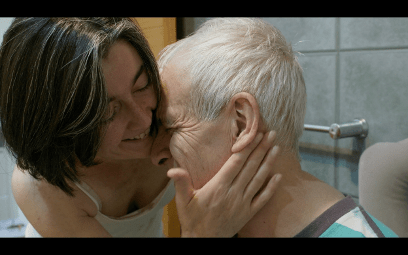
Fig. 1 Paulina shaves with care the face of Augusto.
I will discuss Alberdi’s work as case study to explore the film’s treatment of language to conjure memories, while relying on Nichol’s typology of cinematic modes, such as performative and observational, to further analyse the documentary. Moreover, I will use as lens the book Grammar of Fantasy written by Gianni Rodari in 1973, following his teachings on using words to unearth memory. Finally, I propose an interplay of keywords from the film and my personal experience as a way to draw parallels and create connections through memory, language, and grief.
The Eternal Memory opens with a couple who have been together for 25 years, in the intimacy of their bedroom. On one side of the bed, Augusto Góngora, renowned journalist that dedicated his life to remind the Chilean public of the human rights violations that unfolded after the country’s 1973 coup d’état, lays down as he looks up to his wife. She, Paulina Urrutia, actress, politician and Chile’s first female minister of culture, sits beside her husband as she tenderly looks back at him:
AUGUSTO. And who are you?
PAULINA. Who am I?AUGUSTO. Yes.
PAULINA. I’m Pauli.
AUGUSTO. Pauli?PAULINA. Yes,
PAULINA. Nice to meet you.PAULINA. You are Augusto Góngora.
AUGUSTO. Yes.
PAULINA. Now I’m going to surprise you. I am a person who has come here to help you remember.AUGUSTO. For me to remember.
PAULINA. Yes, for you to remember who Augusto Góngora was.
(The Eternal Memory 00:01:10–58)
The film portrays how Paulina copes with Augusto’s Alzheimer’s disease during their everyday life as both fear the day, he no longer recognizes her. Their story is juxtaposed with archival footage from the beginning of their relationship, their working lives, placed in contrast with the landscape of Chile during the years of the dictatorship from 1973 till 1990.
This form of cinema imbued with intimate and vivid fragments recalls Nichol’s definition on performative and observational modes. The first is described as a type of form that foregrounds affect, embodied experience, in a tacit or implicit way by addressing us “emotionally and expressively rather than factually,” (149–52). The latter prioritizes to look at characters as they live their lives while placing the viewer on an active position to make inferences based on what can be observed; thus meaning is created out of what is seen, said, and done (133–56). The Eternal Memory relies heavily on Paulina and Augusto’s daily routines to show us their situated experience in navigating Alzheimer’s. The complexity of memories is captured by becoming more than just thoughts coloured by time and suffering, they instil a sense of witnessing something precious, like a treasure, thought to have been lost, and then found.
This sense of looking at the scattered reminisces of our past lives hoping that by some stroke of luck we can retrieve some lost gem, made me found solace in Gianni Rodari’s essay collection The Grammar of Fantasy. He taught children and teachers about a type of creative pedagogy focused on storytelling as a way reveal the liberating value of our words, our language. Moreover, he conveyed storytelling as a “system for organizing thought into imagination, the way grammar is a system for organizing words into ideas,” (Popova). Rodari described how any randomly chosen word, such as throwing a stone in a pond, can unearth our fields of memory by producing waves, evoking our senses, and create “meanings and dreams, in a movement that touches experience and memory,” (5). Following his work, I will select words from the film and my grieving experience to convey the interconnectedness that lies between language, memory, and loss.
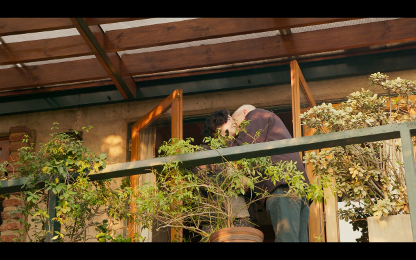
Fig. 2 Augusto hugs Paulina after telling her that this is not his home, but their home.
The first word I select from the documentary is “home”, since Paulina uses the word on different occasions to see if Augusto remembers that it is their home. Moreover, as I explore what “home” means, I find that the underlying question regarding the word comes from Paulina’s need to know if he is still able to remember that they built the place that has become their home (The Eternal Memory 00:20:25–59). The performative aspect of the films unveils the weight of the word “home”, not by appealing to linguistic expressions, but by showing the emotional impact of the fear behind losing a place that has become a site to bring back memories for Paulina and Augusto (Hakola 116).
To pick a word from my grieving experience after losing my grandmother, I asked a friend to come up with words from stories I have told them in the past. They randomly gave me the word “bed” and I let my mind wander. Thinking of “bed” makes me remember of our nights watching arthouse films or crime series together, of evenings spent reading books side by side before going to sleep. Sometimes I would wake up in the middle of the night and I would hear her breathing quietly. When she was slowly fading away it was in a different bed, in a different room, and I could not sleep by her side anymore. The word “bed” has become bittersweet yet still evokes memories and emotions.
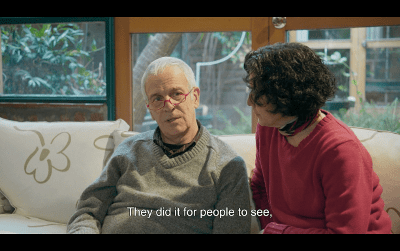
Fig. 3 Augusto tells Paulina how military forces killed his friend José Manuel Parada
To continue with this exercise, instead of a word I picked a name that belongs to one of Augusto’s late friends. In the scene, Paulina and Augusto are watching footage from the times of the dictatorship. She asks him if he remembers someone named José Manuel Parada:
AUGUSTO. Yes, of course. How could I not?
PAULINA. They slit his throat, remember?AUGUSTO. Yes, of course. They slit his throat just like that.
AUGUSTO. They did it for people to see, not for people to gossip about it.
AUGUSTO. They did it in front of a lot of young kids.
AUGUSTO. (Starts to cry) For fuck’s sake. (The Eternal Memory 00:25:49–00:29:02).
Augusto becomes overwhelmed with emotion after hearing the name of his friend which prompts him to retell the story of what happened. He embodies his memories even if they come to refresh the pain from the past. This example in the film reflects its observational nature as it pulls the viewer to connect with what is been shown; it creates a space of vulnerability not to be exploited but to be “expressed in an almost intangible, empathic moment,” (Grimshaw & Ravetz 552). Augusto represents the power of language to remove stale pain that has not yet withered away.
For the last word to connect with my grandmother, I received “flowers”. This word made me think of the bouquet I received for my birthday which has my favourite type of flowers: chrysanthemums. My grandmother used to have them in a pot with their vibrant red tones still fresh in my mind. I can still remember her taking care of them, or the words she would choose to speak to them because she believed that plants would feel better if we could address them as friends. Now whenever I go to a flower shop, I find myself looking for them as if my memory could burst into bloom.
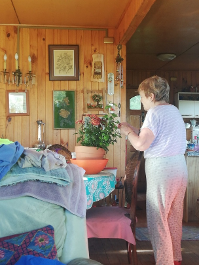
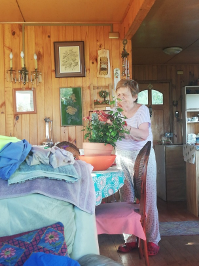
Fig. 4 My grandmother taking care of her red chrysanthemums.
Close to the end of The Eternal Memory, Paulina opens Chile: The Forbidden Memory a book that Augusto co-wrote to denounce the horrors of those years. She reads a dedication he wrote to her, and then the next scene changes into a recording of Augusto presenting the book back in 1989 (fig. 5):
Our book stars in June 1973 and ends in May 1983. It’s very important to us to reconstruct memory, not to be anchored in the past, because we think reconstructing memory is always an act that has a sense of future. It is always an attempt to know oneself, to know the problems, to know our weaknesses, overcome them and be able to generously face the future. It’s important to us to also say that is it not enough for memory reconstruction to be a merely rational act. Numbers and statistics are not enough. I think we Chileans also need to rebuild our emotional memory, because these have been such rough, traumatic years, so full of pain. We also need to get our emotions back, embrace pain, and work on our mourning (01:14:21–01:15:28)
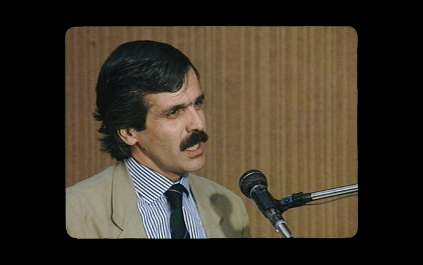
Fig. 5 Augusto Góngora presenting his book in 1989
To conclude this essay, I asked at the beginning: Why do we keep trying to hold onto our memories if they stir pain? Is feeling pain a way to help us remember? I believe that the most powerful memories are the ones that can still move us despite the ravages of time. Even if some might open our wounds, it reminds us that when we mourn, we encounter proof that we loved; that our grief has become love persevering through time.
Works Cited
Grimshaw, Anna, and Amanda Ravetz. “Rethinking Observational Cinema.” The Journal of the Royal Anthropological Institute, vol. 15, no. 3, 2009, pp. 538–56. JSTOR, http://www.jstor.org/stable/40541698.
Hakola, Outi. “Performative Documentaries: Life-Affirming Stories about Mortality.” Filming Death: End-of-Life Documentary Cinema, Edinburgh University Press, 2024, pp. 113–33. JSTOR, http://www.jstor.org/stable/10.3366/jj.9941215.9.
Popova, Maria. “The Grammar of Fantasy and the Fantastic Binomial: Beloved Italian Children’s Book Author Gianni Rodari on Creativity and the Key to Great Storytelling.” The Marginalian, 9 June 2025, www.themarginalian.org/2025/06/07/gianni-rodari-the-grammar-of-fantasy.
Rodari, Gianni. The Grammar of Fantasy: An Introduction to the Art of Inventing Stories. Translated by Jack Zipes, Enchanted Lion Books, 2025.
The Eternal Memory. Directed by Maite Alberdi, Micromundo / Fábula, 2023. Apple TV+, tv.apple.com/be/movie/the-eternal-memory/umc.cmc.4pobxr3411xcxtyg4zxsowci.


