By Seryal Hazal Mengüş & Maike Leerssen
Introduction: Sound as Social Action
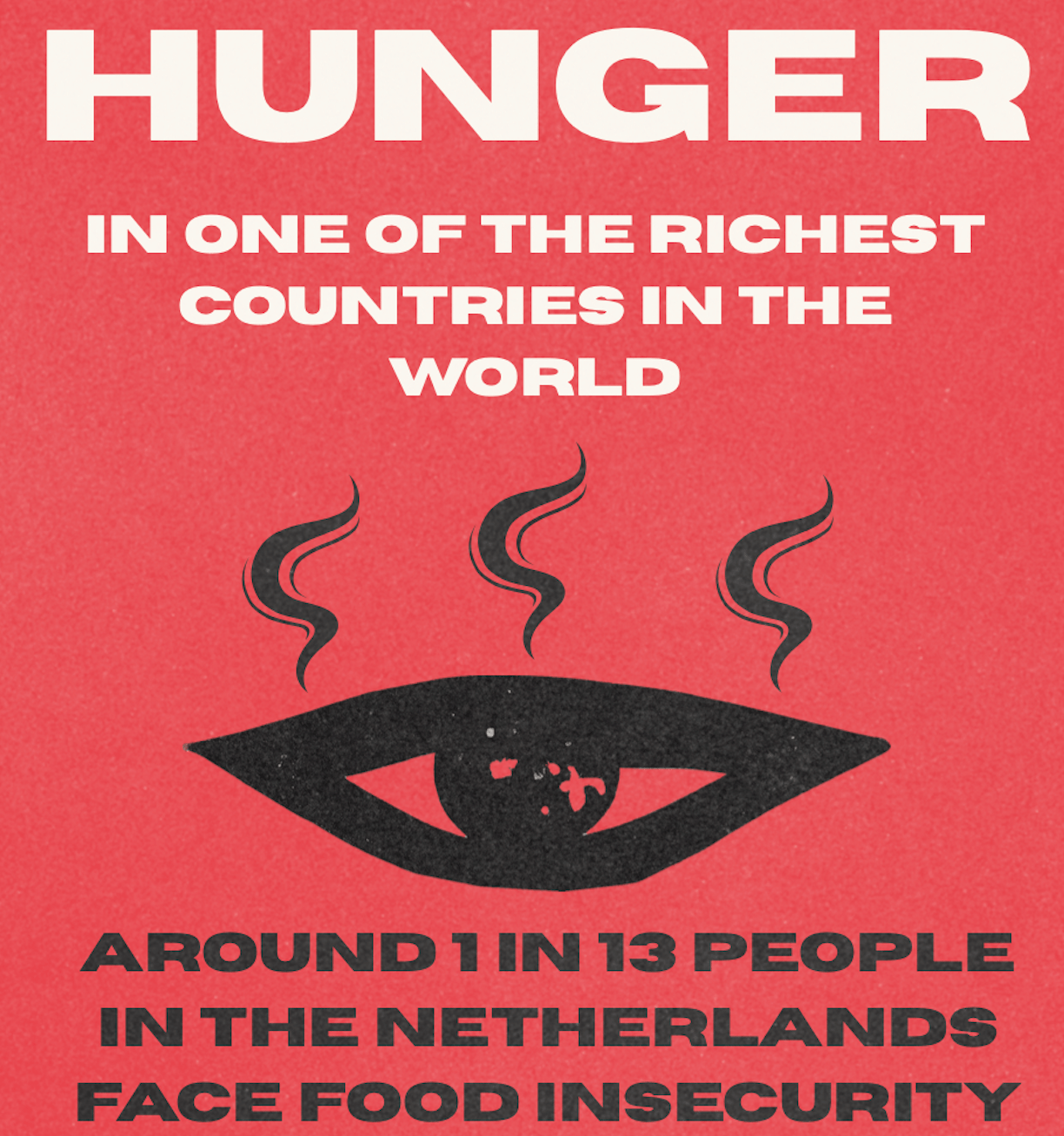
Can music feed people? It might sound figurative, poetic, or naïve, yet this question guided our intervention, The Food Bank Project, created for the course Popular Music and Social Change at Radboud University. While music is often seen as entertainment or expression, we wanted to see what happens when it becomes a tool for redistribution and care. Our project responded to Sustainable Development Goal 2: Zero Hunger, which aims to end hunger and ensure food security for all. In the Netherlands, a country known for wealth and abundance, one in thirteen people faces food insecurity (estimate based on available data from Voedselbanken Nederland & Kickstart.ai, 2024). The contradiction is striking: overflowing supermarkets next to overworked food banks. We wondered how music might intervene in this silence. Hence, The Food Bank Project set out to connect sound and solidarity. Through a concert, a flyer, and a digital toolkit, we sought to transform listening into action and audiences into allies. This post reflects on that experiment: how an artistic gesture became a meaningful act of social change, even if small.
The Performance: Music for Food Justice
Our idea was simple yet ambitious: a concert where the ticket would be a donation for the local food bank in Nijmegen. We wanted to merge cultural participation with redistribution, bridging symbolic and material impact. Initially, our team consisted of three members: DJ Morris, classical musician Maike, and cultural researcher Hazal. Each of us brought a different skill set: practical musicianship, aesthetic sensitivity, and theoretical framing. Together we envisioned an evening of hybrid performance where electronic beats and live instruments would coexist, while the audience would contribute food or small donations at the entrance. The collected items would be delivered to Voedselbank Nijmegen-Overbetuwe. However, as often happens with small activist initiatives, the fragility of the project quickly became visible.
Our plan depended on factors largely outside our control: the venue’s infrastructure, institutional permission, audience sign-ups, and marketing reach. When no one signed up, the venue cancelled the concert. Looking back, this was understandable: without much promotion, the right timing, or a local network, small projects like ours often find it hard to reach people. This also revealed how easily socially-engaged art can be constrained by infrastructures of visibility and logistics: publicity algorithms, event management systems, and time limits that rarely accommodate grassroots projects. On the other hand, Morris left the group. Yet rather than abandoning the idea, we reimagined its scope and audience. Maike decided to perform at her conservatoire, ArtEZ University of the Arts in Zwolle, during her regular Friday class. This shift became more than a logistical adjustment: it marked a conceptual evolution from public engagement to engagement with musicians, with peers who might one day become the next generation of artist-activists.
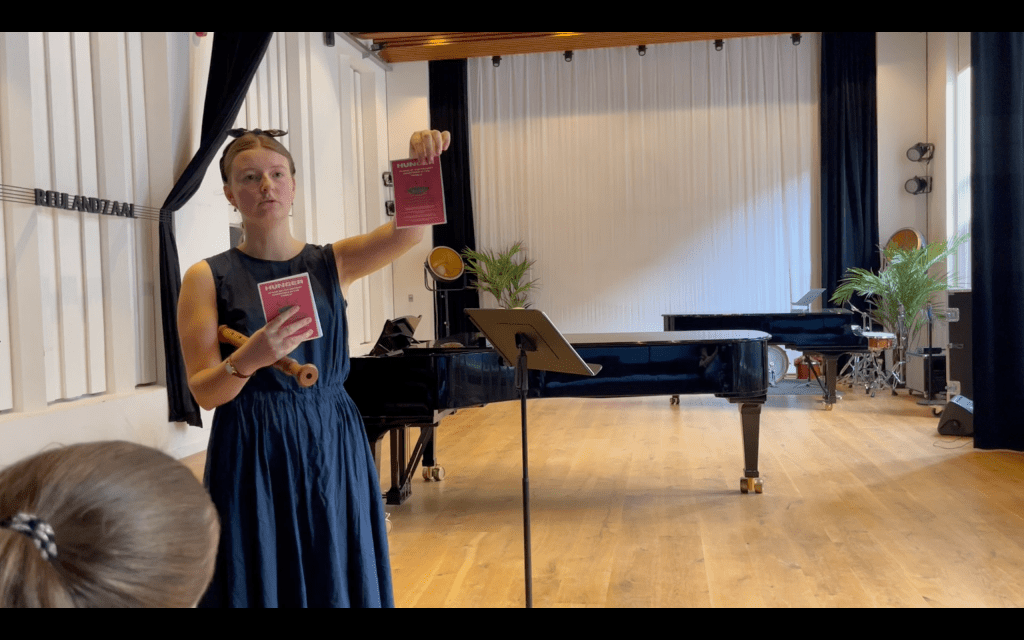
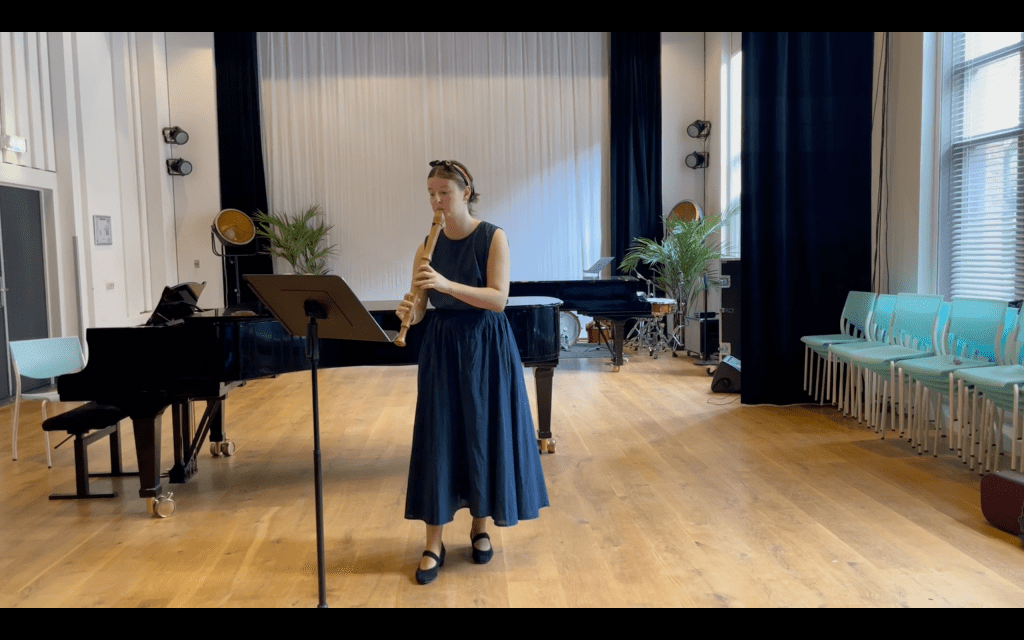
On 17 October 2025, Maike performed Laura by Jacob van Eyck, a 17th-century piece for tenor recorder chosen for its voice-like tone and introspective mood. Before playing, she introduced the issue of food insecurity and distributed the flyers designed by Hazal. Each flyer contained a QR code linking to our Toolkit for Music Activists, a digital guide on how to use music for social change and food justice, written by Hazal. During the performance, the low, resonant sound of the tenor recorder filled the classroom. Afterward, several classmates approached Maike to express appreciation, not only for the music but for the message. Sven (a classical piano student) noted that she explained the topic very well and that he liked the flyer’s design. The combination of performance and information seemed to land well with the group.
However, while the concert achieved its immediate goals (i.e., raising awareness and collecting donations) we could not fully assess its long-term impact. Maike did not have time during or after class to ask whether students actually engaged with the toolkit or planned to use it. This remains one of the project’s main limitations. On the other hand, those who showed interest might have been people who already cared about social issues. A broader distribution of the flyer and toolkit across the university could have created more diverse engagement. Yet this raised another challenge: resources. Printing is expensive, and arranging digital distribution requires technical skills and access we did not have at the time. These practical constraints reveal how even small- scale activist initiatives are shaped by invisible infrastructures of time, labour, and cost: issues that often determine whether ideas can reach beyond their immediate circles.
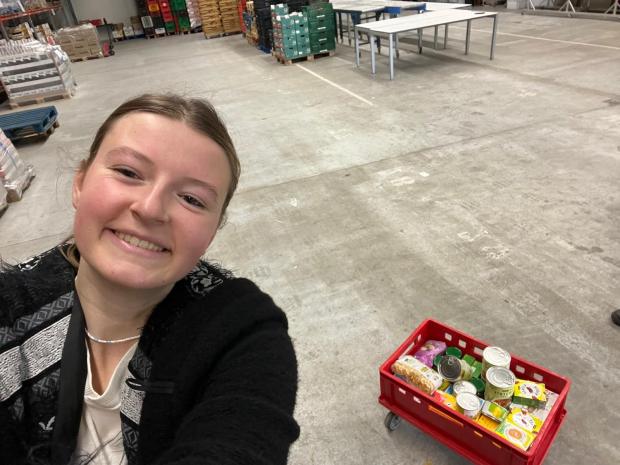
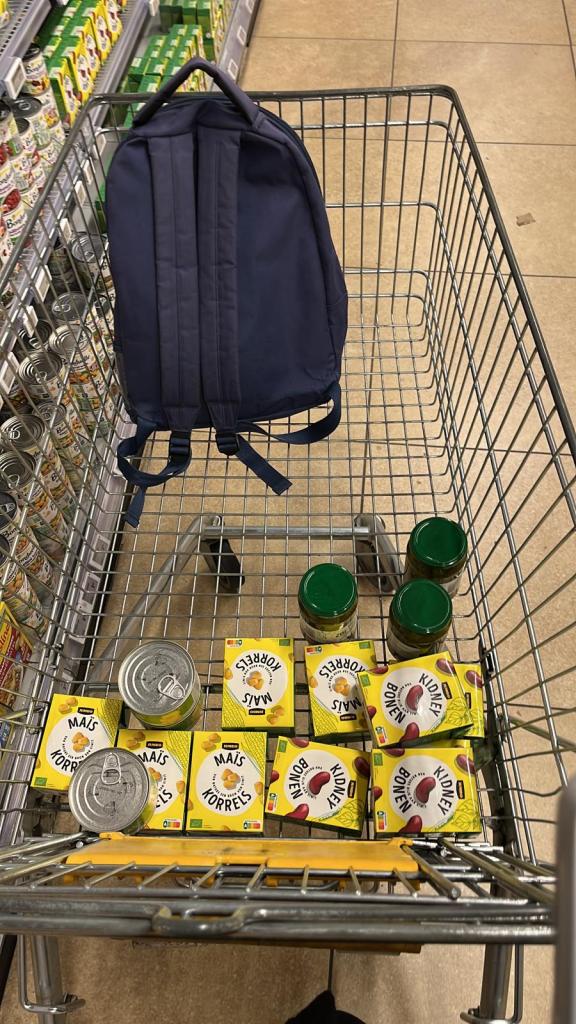
The performance included a digital donation link (Tikkie), through which classmates contributed money. In total we raised €80, which Maike used to buy groceries listed by the food bank (tea, coffee, beans, milk, canned vegetables, and other essentials). She transported three heavy bags of goods on her bicycle to the donation centre in Nijmegen. The volunteer who welcomed her was surprised and delighted. Inside the hall, surrounded by shelves of donated products from supermarkets and individuals, the scale of need became tangible. Through this process, we learned that activism is logistical as much as emotional. Planning, shopping, and cycling with heavy bags were as much part of the performance as the music itself. The project thus unfolded on multiple levels:
- Redistribution: tangible food donations reached local families.
- Awareness: students learned about food insecurity in a country often imagined as problem-free.
- Pedagogy: the flyer and toolkit offered musicians tools to continue such work.
In short, our intervention turned the conservatoire, a space usually reserved for artistic training, into a site of care, reflection, and social connection. The project reminded us that activism does not require scale or spectacle. It can happen through sincerity, persistence, and a willingness to act where you are.
Tools for Change: The Flyer and the Toolkit
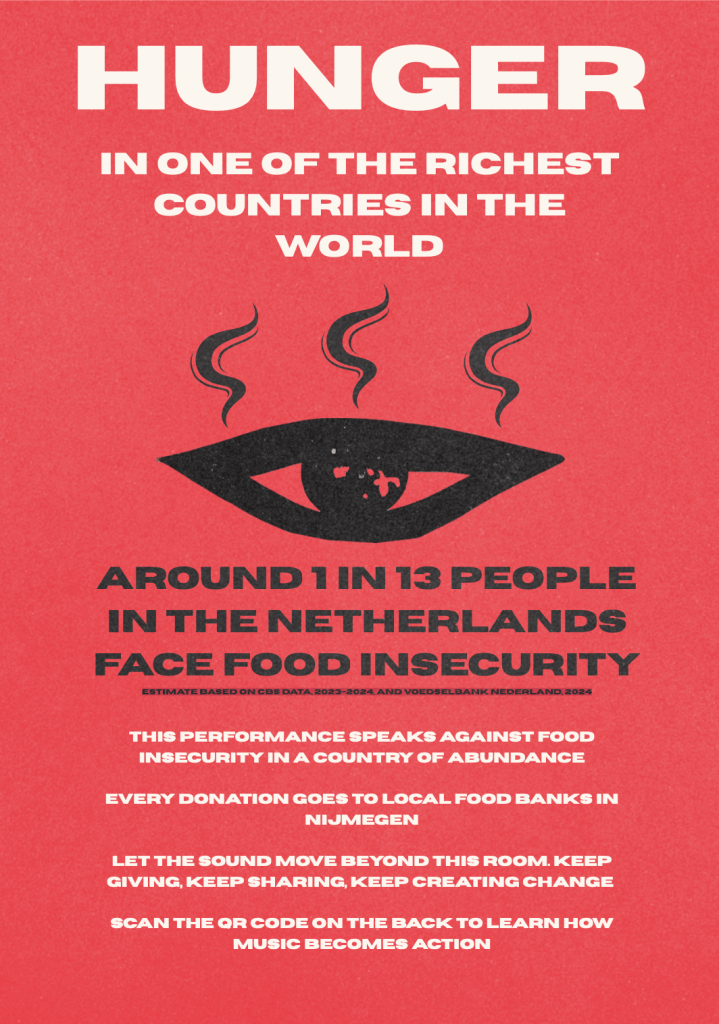
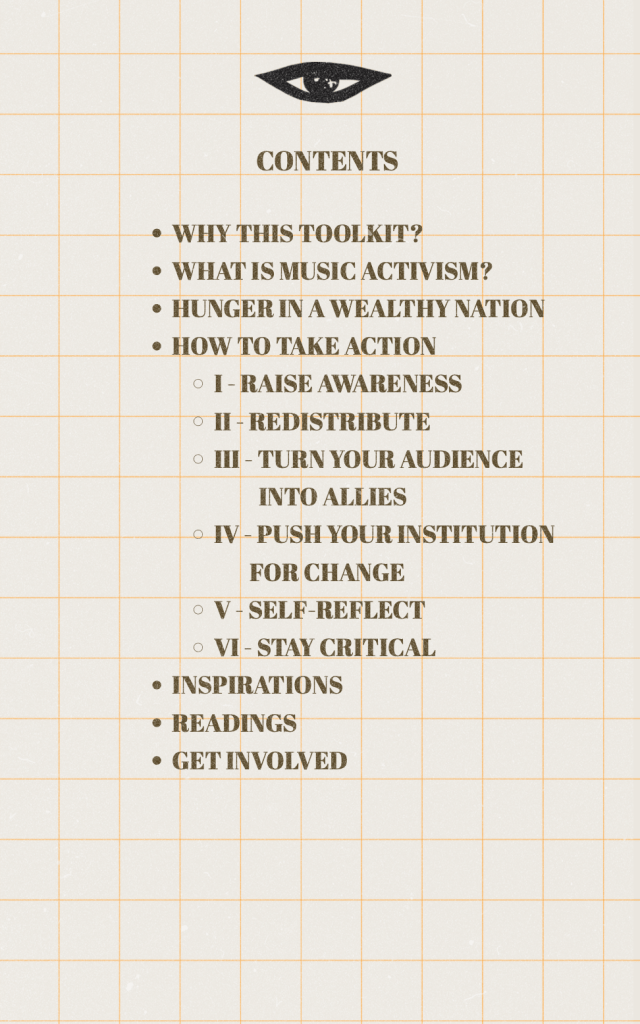
The flyer was both a visual anchor and a call to action. Its design juxtaposed statistics with a message: “Around 1 in 13 people in the Netherlands face food insecurity. […] Let the sound move beyond this room. Keep giving, keep sharing, keep creating change.” Printed on blank postcards, the flyer summarized the purpose of the concert, explained where donations would go, and linked, via QR code, to the digital Toolkit for Music Activists. The toolkit expanded on the flyer’s spirit, offering six concrete pathways for musicians who want to align their practice with social change:
- Raise Awareness: Use performances to share facts, tell stories, and inspire conversation.
- Redistribute: Turn gigs, rehearsals, or jam sessions into donation opportunities.
- Turn Your Audience into Allies: Use QR codes, playlists, and online sharing to sustain action.
- Push Your Institution for Change: Advocate for ethical food policies and zero-waste practices.
- Self-Reflect: Treat fairness and care within ensembles as part of activism.
- Stay Critical: Question charity models and aim for justice.
The toolkit also includes inspirations and readings, from Andrew Green & John Street’s “Music and Activism” to adrienne maree brown’s “Emergent Strategy.” It situates our small project within a global lineage of artists and movements that see music as both resistance and repair.
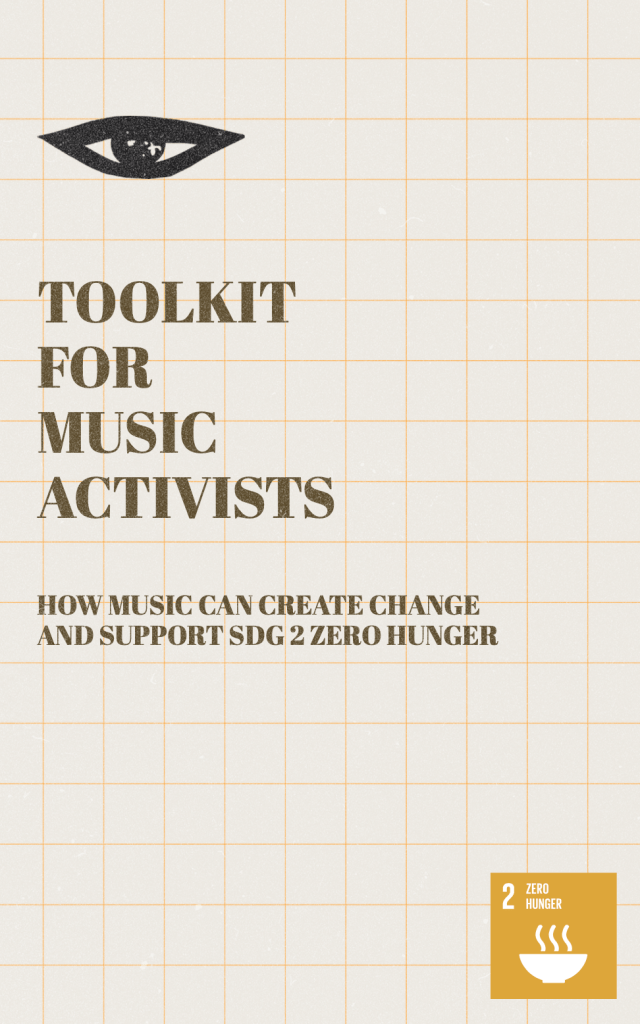
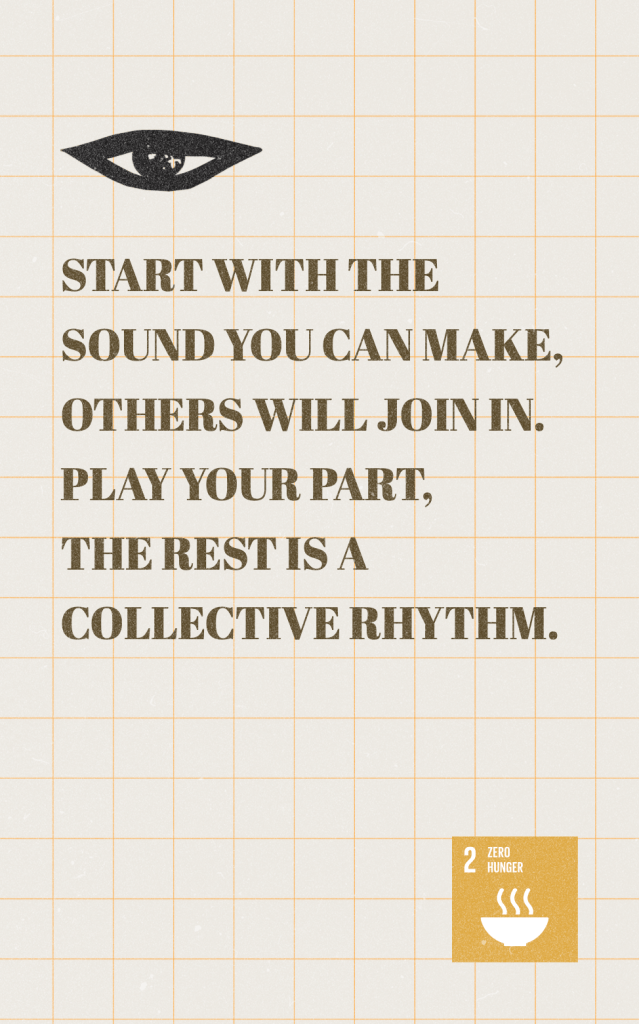
By distributing the flyer and the toolkit, our project aimed to extend beyond the classroom. Anyone who scanned the QR code could replicate or adapt the model. In this way, the intervention became pedagogical: not a single event but a portable framework for others to continue. As we wrote in the toolkit:
You don’t need a stage, funding, or fame to make an impact. Start with the sound you can make; others will join in. Play your part, the rest is a collective rhythm.
This replicability was key. Activism often depends on networks rather than numbers. If even one other student used the toolkit to organize a similar concert, the ripple would continue. Music, after all, travels easily and it invites participation.
Thinking Through Practice: Theory, Tension, and the Politics of Small Acts
Our collaboration brought together different forms of knowledge: Maike offered musical practice and logistical action; Hazal contributed research, visual design, and critical framing. Both of us crossed domains: discussing, revising, and shaping the project as it evolved. This process was not just a way to get things done; it reflected the project’s core: a blend of action and reflection, theory and practice. The Food Bank Project was rooted in action, but it also made us confront the political, ethical, and pedagogical choices behind even small interventions. We were not just raising money, we were asking how music might serve as both a tool and a model for social change. This section reflects on the theoretical ideas that helped us clarify our intentions, recognise tensions, and think more critically about the project’s possibilities and limits.
We aimed for outcomes that were both pragmatic and prefigurative, borrowing these terms from Green and Street (2018). Pragmatic politics refers to music used as a tool to achieve external goals, such as raising money, increasing awareness, or supporting a cause. In this sense, the performance and donations clearly served a pragmatic function. But we also saw the value of prefigurative politics, where artistic practice models the kind of social relations we want to create. The project’s form and atmosphere were shaped by care, collaboration, and material redistribution. In this way, we tried to embody the change we advocated rather than simply calling for it.
We created the flyer and digital Toolkit for Music Activists with the logic of participatory culture in mind, drawing on Leksmono and Maharani’s (2022) work on K-pop fan activism. Their study shows how fans mobilize shared interests and emotions into collective action using digital tools. Similarly, we designed our materials to be accessible, adaptable, and emotionally engaging. The QR code offered not just information but an open invitation, an entry point for others to act. Instead of merely delivering a message, we aimed to start conversations: among peers, within institutions, and through future adaptations of the toolkit. Our project, like the fan activism Leksmono and Maharani describe, used shared media practices to connect care with action.
At the same time, we were aware of the project’s limitations and not blind to the contradictions we were working within. As Gentilini (2013) argues, food banks in wealthy countries are not evidence of abundance but of systemic failure. They have become normalized as substitutes for structural support, patching over inequality with volunteer labour and temporary relief, and relying on charity to compensate for weakened welfare systems. In the Netherlands, as Janssen et al. (2022) show, food insecurity is shaped by structural issues like income inequality, migration status, and housing precarity. Our intervention provided temporary support while also raising questions, especially through the toolkit, about why such a system exists in the first place. However, while well-intentioned, it touched only the surface of these deeper dynamics.
This tension between charity and justice is one we kept returning to. As Smith-Carrier (2020) points out, charity responds to symptoms, while justice seeks to address root causes. Our project engaged with both. We knew our project would not “solve” hunger. But we hoped it could shift attention from temporary aid to collective responsibility. The flyer, toolkit, and performance were designed not to position us as helpers or to gain moral satisfaction, but to invite others into a shared process of awareness and action. Finally, we were aware of the emotional politics of food aid. Research by VanderHorst et al. (2014) highlights how food bank users often experience shame, dependency, and loss of dignity. This awareness shaped our tone and messaging: we avoided framing recipients as pitiful passive “beneficiaries” and instead emphasized mutual care. Redistribution, not rescue, was the frame.
In short, theory did not sit beside our project, it worked inside it. Concepts like participatory culture, pragmatic and prefigurative politics, and justice-based food activism helped us clarify both what we were doing and what we were not. The Food Bank Project was modest in scale, but it was also an invitation: to act, to reflect, and to remain accountable to the social contexts that shape both hunger and sound. It reminded us that good intentions are not enough, and that even small interventions must be critically examined. It was one gesture among many, but by combining practice with reflection, we hope it can resonate beyond its original moment.
Conclusion: Let the Sound Move Beyond This Room
What began as a class assignment became an experiment in sound as solidarity. Through one performance, a few flyers, and several bags of food, we explored how music can bridge art and action, emotion and ethics. The Food Bank Project demonstrated that even in modest forms, music can move resources, awaken empathy, and question inequality. It can transform institutions of learning into spaces of listening, reflection, and redistribution. In a time when crises often feel overwhelming, our experience offered a simple truth: social change doesn’t always start with policy or protest: it can begin with a note, a gesture, a shared rhythm.
Start with the sound you can make; others will join in. Play your part. The rest is a collective rhythm.
Access the full toolkit here.
References
Brown, A. M. (2017). Emergent strategy: Shaping change, changing worlds. AK Press. Gentilini, U. (2013). Banking on food: The state of food banks in high-income countries. IDS
Working Papers, 2013(415), 1–18. https://doi.org/10.1111/j.2040-0209.2013.00415.x
Green, A. & Street, J. (2018). Music and Activism. From prefigurative to pragmatic politics. In: G. Meikle (Ed.), The Routledge companion to media and activism (pp. 171-178). https://www.taylorfrancis.com/chapters/edit/10.4324/9781315475059-18/music-activism- andrew-green-john-street
Janssen, J. M. M., van der Velde, L., & Kiefte-de Jong, J. C. (2022). Food insecurity in Dutch disadvantaged neighbourhoods: A socio-ecological approach. Journal of Nutritional Science, 11, e48. https://doi.org/10.1017/jns.2022.48
Leksmono, D. L. D. & Maharani, T. P. (2022). K-Pop Fans, Climate Activism, and Participatory Culture in the New Media Era. Unitas. 95(3), 114-135. https://doi.org/10.31944/20229503.05
Smith-Carrier, T. (2020). Charity isn’t just, or always charitable: Exploring charitable and justice models of social support. Journal of Human Rights and Social Work, 5(3), 157–163. https://doi.org/10.1007/s41134-020-00132-2
Van der Horst, H., Pascucci, S., & Bol, W. (2014). The “dark side” of food banks? Exploring emotional responses of food bank receivers in the Netherlands. British Food Journal, 116(9), 1506–1520. https://doi.org/10.1108/BFJ-02-2014-0081
Voedselbanken Nederland & Kickstart.ai. (2024, April 30). Kickstart AI and Voedselbanken Nederland partner to combat food poverty. https://kickstart.ai/press/kickstartai-voedselbanken- nederlands-partner-to-combat-food-poverty

 Culture Weekly