Arts and Culture Studies, Radboud University Nijmegen
How Gen Z at Radboud University Perceive Gender (In)Equality: Music, Dialogue and Critical Awareness
By Anastasia Yuchynska and Dorota Kuncevič
Regarding the fifth Sustainable Development Goal, “to achieve gender equality and empower all women and girls,” there is still a systemic problem: women are underrepresented in leadership and decision-making positions, frequently encounter obstacles to decent work, experience salary disparities, and employment segregation. Universities play a key role in promoting social change and critical awareness. Higher education institutions are critical spaces for promoting gender equality, yet they continue to reproduce systemic gender inequalities. According to Rosa and Clavero (2021), universities are still unequal spaces, despite formal commitments to inclusion. Meanwhile, work at King’s College London shows that Gen Z holds the largest gender gap in attitudes: younger men and women diverge more sharply in their views on gender-equality than older cohorts. (Skinner & Gottfried, 2025). The European Institute for Gender Equality et al. (2022) recommend strengthening intersectional approaches, providing sustained funding, and integrating gender equality as a core institutional value rather than an administrative compliance task. Such findings illustrate the urgency of engaging Gen Z in participatory, dialogue-oriented formats around gender. Our intervention started with education, where institutions such as Radboud University may function as both a reflection and an outlet for change.
The question guiding our intervention was: How do Gen Z students of Radboud University, across different gender identities, perceive addressed gender (in)equality? We designed an intervention grounded in research. By collecting and visually displaying students’ responses, our goal was to open a participatory space on campus: one for dialogue, self-reflection and critical awareness of gender perceptions, using music as a medium for connection.
At Radboud, our intervention targeted students across genders, inviting them to respond to music, to one another, and to the mediated question of gender (in)equality. We took inspiration from Hess (2018) and her concept of musicking, where we approached music not only as an aesthetic expression but also as a political act. According to Hess, musicking involves all forms of engagement with music: performing, creating, producing, and listening. Hess further suggests that these acts are “sites for identity formation and meaning-making activities”. Musicking is also linked to identity politics as “a mode of organizing around shared identities as sites of oppression”. Hess highlights that identity politics is not just about personal identity but also about collective action. Through music, individuals can articulate their identities and play a significant role in building community. Inspired by this framework, we approached music not only as a form of entertainment but also as a political action.
Why “The Man”?
In practice, we chose the cultural product “The Man” by Taylor Swift as a case study. We chose to use Taylor Swift’s song because it highlights and critically reflects on the struggle faced by women, comparing them to what life would be like if “I was a man”. Swift’s song invites listeners to consider privileges and societal tendencies towards gender, while exposing the labor expected of women to achieve the same level of success:
“I’m so sick of running as fast as I can
Wondering if I’d get there quicker if I was a man”
(Swift, 2019)
According to Billboard’s Gil Kaufman, “The Man” is a pointed statement about “how much harder women need to work than men to get to the same finish line” (Kaufman, 2019). This framing allowed us to explore student’s reactions to the lyrics through the survey, where we aimed to collect lived experience and foster critical thinking about gender in their own environment.
Our goal was to create an accessible entry point to connect with students’ emotions and lived experiences. The song is culturally familiar, so it provides an accessible way to engage with complex issues surrounding gender. In addition, we wanted students to engage with other forms of media rather than just relying on academic articles when tackling complex issues. “The Man” is lyrically simple, catchy, rhythmically upbeat, and what’s more important, recognizable and memorable. It’s important to mention that we did not use any visual media, but analyzed the song’s lyrics and music.
Our Intervention
Our artistic intervention used Taylor Swift’s “The Man” as a catalyst for reflection on gender equality among Radboud University students. During lunch break at Radboud University, we went around the campus with 2 pairs of headphones and invited participants to listen to “The Man”, reflect on its message regarding gender in a pre-made Google Form and answer questions such as:
How does the song make you feel?
Can you relate to the experience expressed in the song?
Do you think this musical piece emphasizes the experience lived by you/the singer/other people?
Does participating in this conversation highlight for you the power of music when reflecting on the topic of gender inequality?
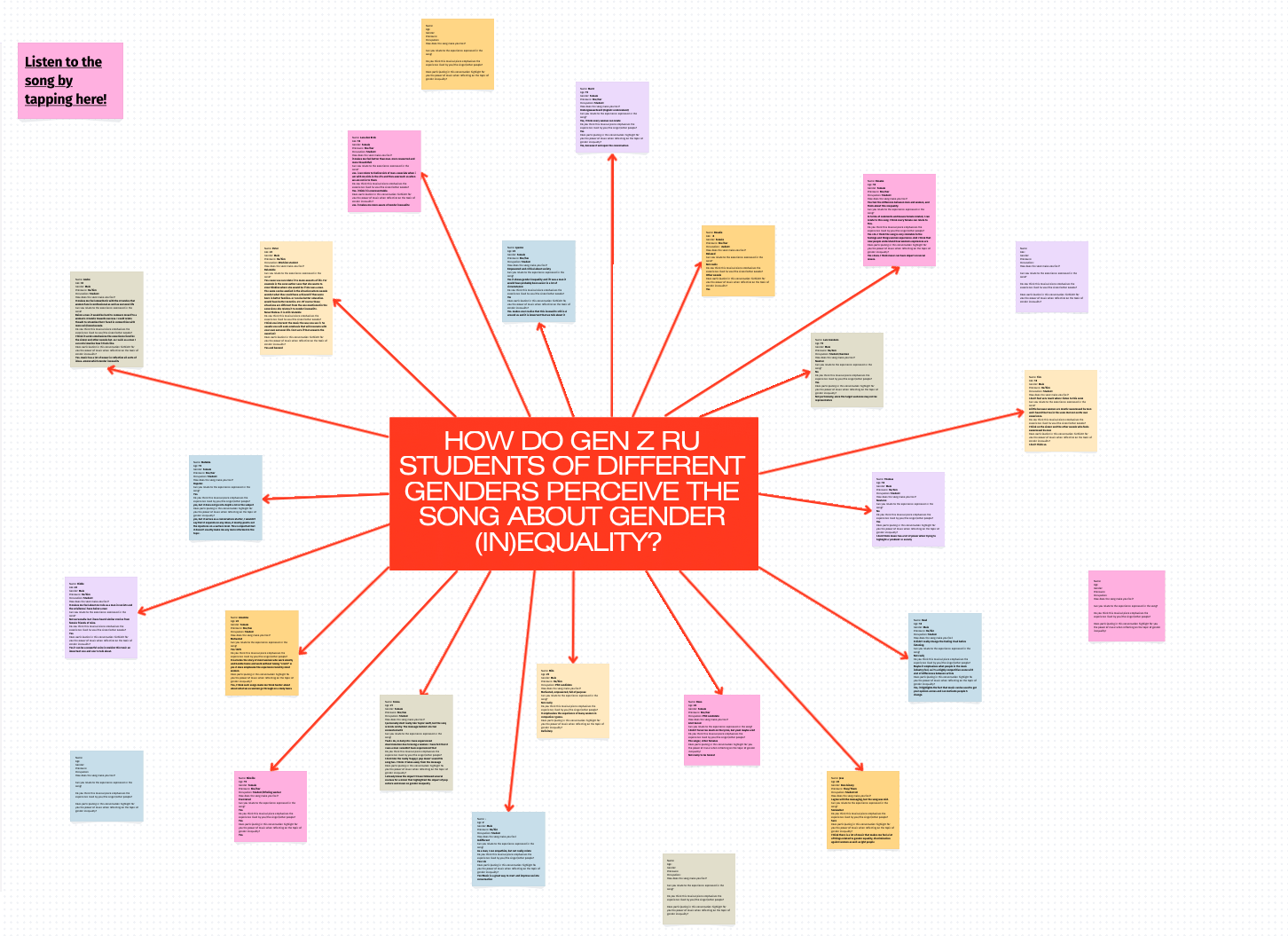
Their answers were collected and put on display, creating a “Web of (IN)equality” that mapped how gender is felt and experienced by different people. By inviting students to respond to our questions after listening to a song, we activated what Hess (2018) calls the political nature of music education, where music became a medium for amplifying marginalized voices. This approach aligns with her statement that “the personal is political,” particularly when addressing systemic inequalities. In our context, where research has shown that Generation Z holds increasingly diverse gender attitudes (Skinner & Gottfried, 2025), musicking offered a way for these tensions to surface. Since activist musicking creates space for challenging dominant narratives and building community, it is also a powerful tool for engaging students in discussions about gender inequality within the university.
To frame our intervention within a more detailed discourse, we draw on Rudy’s (2001) theory of radical and queer feminism, particularly her critique of additive identity politics. Additive identity politics is a model that assumes inclusivity can be achieved by simply “adding” marginalized identities to existing structures without challenging the norms that produce inequality. This model fails because the experiences and backgrounds of women are so diverse that meaningful conversation becomes difficult, which divides communities (p. 205). Rudy (2001) argues that this approach fails to account for the complexity of lived experience and the diversity of backgrounds. Instead, she calls for a queer theoretical approach, in which identity is understood as flexible and shaped by experience. For example, she explains that we cannot frame women’s liberation as an event involving “women only,” because doing so ignores the complexity of oppression and treats “women” as a fixed category in which everyone is the same (p. 209).
By creating our “Web of (IN)equality”, we demonstrate that gender is not a single story but rather many overlapping ones. The visual structure of the web itself reinforces this idea: at its center, the question “How do Gen Z RU students of different genders perceive the song about gender (in)equality?” radiates into a network of colorful notes. Every note represents an individual reflection, and together they form a constellation of perspectives that reveals how gender is felt, perceived, and interpreted through the lens of Taylor Swift’s “The Man.”
An analysis of the web shows several recurring themes. Many female participants wrote about frustration with double standards and a strong sense of recognition with the lyrics, some explicitly mentioning experiences of being underestimated or having to “prove themselves more.” One participant states that “it narrates the story of most women who work silently and handle home and work without taking credit”, while another stated “I think that every woman can relate to this”. These statements reflected a sense of validation, since the lyrics expressed frustration that often went unnoticed. Compared to male participants, female participants were more likely to identify with the frustration conveyed in the song. Male participants tended to express curiosity, reflective discomfort, or display carelessness, even though sometimes acknowledging that the song exposed forms of privilege they had not previously considered. Several responses were notably brief, occasionally limited to a single word or remark, with some participants stating that “It didn’t really change the feeling I had before listening”. Others, however, recognized its emotional impact, noting that: “It makes me feel empathetic with the struggles that women face in professional as well as personal life”. As a result of our intervention, we interviewed 20 people, 54.5% of whom were female, 40.9% male and 4.5% non-binary. In the end, 85% of participants mentioned that this intervention made them reflect on the issues they and/or others have/can experience and highlighted the importance of music in this process.
As previously mentioned, “The Man” was a deliberate and strategic choice. Rather than serving as an exploration of gender inequality, the song was intended to act as a conversation-starter that could open up space for reflection. It highlights everyday injustices in a way that is accessible. Some participants appeared to recognize this function, noting that while the song did not delve deeply into the complexities of gender dynamics, it pointed out surface-level issues and prompted them to think more critically about these issues. Some participants remarked that the song’s impact may be more about raising awareness than transforming perspectives. Nonetheless, these reflections highlight the power of music to spark dialogue and encourage individuals to reconsider their roles within broader societal structures. By using a familiar and culturally relevant piece of media, the intervention was able to bridge the gap between abstract concepts and lived experience, making difficult conversations more approachable and engaging.
Undoubtedly, this project also had its disadvantages. One limitation was superficial engagement. While many participants shared thoughtful reflections, others provided brief, less reflective answers such as “yes/no”, possibly due to time constraints or limited personal connection to the topic. This was specifically visible in the answers by men, who sometimes did not understand the topic or could not relate to the experience. Another drawback was the gender imbalance in participation, as a higher proportion of women than men took part and a small percentage of non-binary individuals were interviewed, which may have influenced the range of perspectives represented. Finally, the temporal, brief limitation of conducting the interviews during a single lunch break restricted the depth and continuity of engagement. It might have been a short moment of reflection which will not stick with our participants.
Reflection
By using music as an entry point, we created a less formal, but also important, place for critical reflection. Participants were part of meaning-making rather than only recipients of information. By doing this, the intervention contributes to the larger objective of SDG 5 – establishing gender equality. For Gen Z at Radboud, the question is not only what they think about gender (in)equality, but how they live it, feel it, and express it regardless of their gender category. We aimed to understand the emotional and social dimensions of these perceptions within the university setting. Using music as a reflective and participatory space, we invited students to share their responses and create a collective artwork that sparked dialogue and self-awareness. Therefore, our intervention moved beyond fixed categories and additive identity politics. Instead, it created space for students to express complex, personal views on gender through music. This is where music was a tool for connection, resistance, and reimagining equality.
It’s important to mention that through the process, we also became participants of the intervention. Doing this project allowed us to recognize how our own assumptions about gender and equality were challenged and reshaped through participants’ perspectives. We recognized that discussions of gender inequality often remain constrained to immediate participant groups, limiting both the diversity of perspectives and the potential impact of the dialogue. To address this, we’ve decided to broaden the scope of engagement beyond the initial participants.
We invite you to engage with the song The Man as a reflective prompt for examining personal experiences and perceptions of gender inequality. After listening, we encourage you to contribute your reflections by responding to the guiding question provided in the link below. By extending this activity beyond the initial intervention group, we aim to broaden the scope of dialogue and foster deeper, more impactful engagement with the objectives of SDG 5: Achieving Gender Equality. The web can be accessed through this link.
Works Cited
(2022). Gender equality in academia and research : GEAR tool step-by-step guide. Publications Office of the European Union. https://data.europa.eu/doi/10.2839/354799.
Hess, Juliet. “Singing Our Own Song: Navigating Identity Politics through Activism in Music.” Research Studies in Music Education, vol. 41, no. 1, 15 Oct. 2018, pp. 61–80, https://doi.org/10.1177/1321103×18773094
Rosa, Rodrigo, and Sara Clavero. “Gender Equality in Higher Education and Research.” Journal of Gender Studies, vol. 31, no. 1, 23 Dec. 2021, pp. 1–7,https://doi.org/10.1080/09589236.2022.2007446
Rudy, Kathy. “Radical Feminism, Lesbian Separatism, and Queer Theory.” Feminist Studies, vol. 27, no. 1, 2001, pp. 190–222,https://www.jstor.org/stable/3178457


 Culture Weekly