By Demi Storm
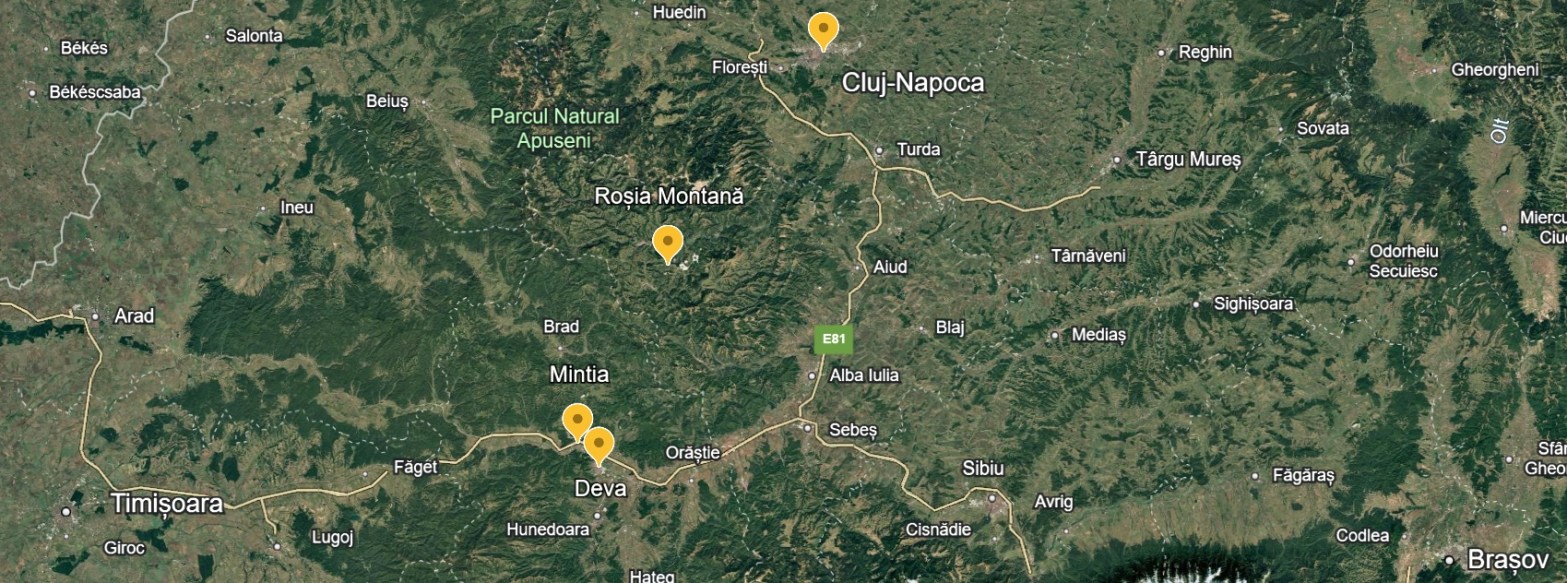
From the 24th of May until the 8th of June 2025, I was on my first ever research trip – which sounds very grownup. This trip to Romania was part of my PhD research on the experiences of space and time of mine- and quarry workers in Roman Dacia, using critical fabulation as a hermeneutic method. As I had never been to Romania before, the goal was to meet some people in the field, to visit Roșia Montană (where a Roman mining gallery can be entered), to go to as many museums as possible, and to see the votive altar that is central to my first case study in its context. To read (and write) about all my experiences of these two weeks would be too much, so in this blogpost I want to highlight only a few: the travel to Romania and the encounter with the votive altar.
Travelling to Romania
The travel to Romania took place over the course of three days. As I travelled by train, from Deventer, via Vienna and Budapest, to Cluj-Napoca, I saw the landscape change. On the first train in the direction of Osnabrück I wrote:
No more flat fields but a hilly landscape. Blue sky with some veil clouds. The green of the trees contrasting with the rusty rails. It looks different, it feels different but here too we find graffiti penises on walls.
A couple of naps, many tunnels, and twelve and a half hours later I arrived in Vienna for a short night.
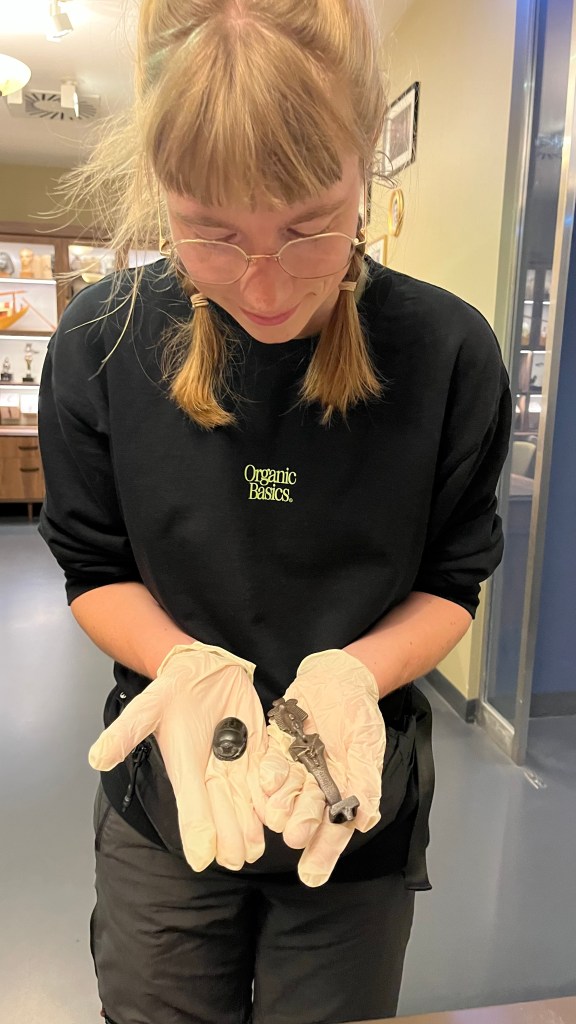
For the second day of travel, I would have loved to write that it was a beautiful trip, but I dozed off many times on the train. When I arrived in Budapest, I had a proper afternoon and evening in the city, which I spent walking around and visiting the Szépművészeti Múzeum (the museum of fine arts). There, I was lucky enough to be able to hold two Egyptian artefacts – a bronze figurine of Osiris and a scarab – in my own two hands, under the supervision of the most enthusiastic volunteer I have ever met.
The third day of travel was themed ‘time travel’. How, you’d wonder? If all goes well, we will cross the Hungarian Romanian border in the early afternoon. Then the time will shift by an hour. Pretty crazy, actually. Poof, an hour later than a second ago. Human choices and decisions. Modern time travel by train, I wrote down in my notebook while the train departed Budapest. But before crossing the border to Romania, I marvelled at the Hungarian landscape:
So many poppies in Hungary. Like red rivers. Vast greenery too; so many different shades of green. A farmer on a rusty brown tractor. Yellow meadows and purple flowers. Don’t forget the houses in the distance, the cars and churches. Hills, even further away. Here too, my favourite crows with a grey waistcoat. Birds of prey and swallows. A deer with a fawn. Bird species I don’t know. The train doesn’t go too fast either, which makes looking around easier.
Crossing the border at 12:48h was so lovely, not necessarily because of the changing time – my phone is still not quite up to speed on crossing national borders and thus time travel into the future. A quick flick of the plane mode on and off and then it’s 13:50h – but because I had arrived in the country of my destination, for me it felt like the research trip was now happening for real. I entered the context of my research and within four hours I would cross paths with Marcus Aurelius Arimo, who lived along the Mureș riverbanks some 1800 years ago – Arimo, for those wondering, is the person who dedicated the above-mentioned votive altar. Now Romania was not in satellite view anymore, it was three dimensional, even four, with the sounds, smells and sensations.
Visiting the Votive Altar
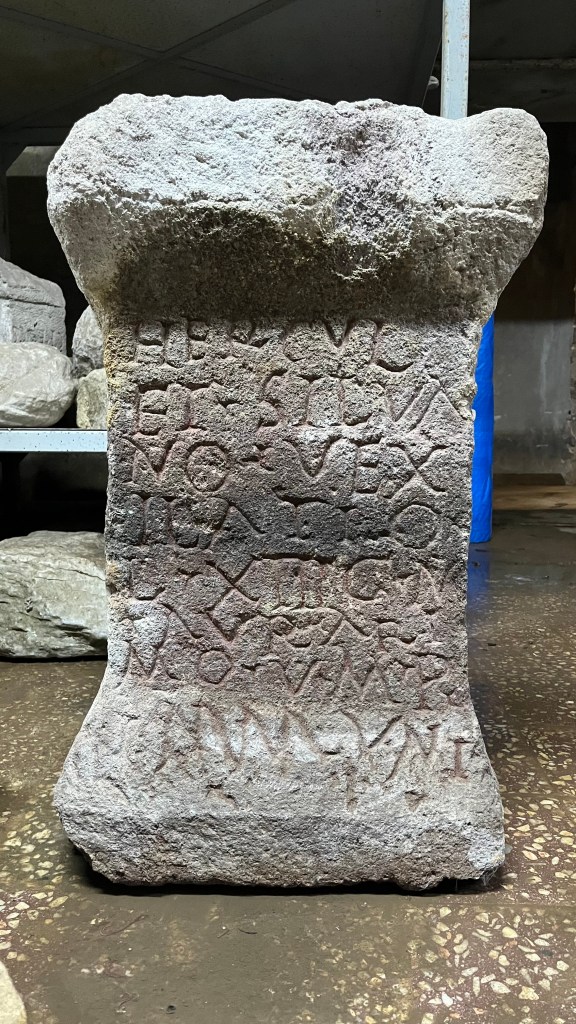
In the second week of my stay, I travelled from Cluj-Napoca to Deva, one of the places along the Mureș that is central to the case study. Here a votive altar was found by nineteenth century quarry workers. The altar was dedicated by Marcus Aurelius Arimo to the gods Hercules and Silvanus around 212-222 CE. Arimo was very likely involved with quarry work, as he was part of one of the special units of the Legio XIII Gemina that worked on extraction of natural resources and the construction of buildings, roads, etcetera. Today, the altar is stored in the depot of the Muzeul Civilizației Dacice și Romane (the Museum of Dacian and Roman Civilisation) and I was able to make an appointment with the museum to visit the depot on the 3rd of June.
I was so excited to be at the museum, that Tuesday morning. The depot is underground, so we – I was accompanied by two people of the museum – walked down the stairs, narrowed by a metal construction that ensured the mobility of the artefacts in and out of the depot and decorated with spiderwebs. I did not exactly know what to expect of the depot, but I had not foreseen the possibility of past floodings of the space. At some point in time the water stood at about 40 centimetres, which marked its hight on the artefacts. The floor still had some puddles of water and mud and was inhabited by many worms too. It was a dimly lit space, cool – contrasting with the bright sunny and warm weather outside – and in this space I was finally facing Arimo’s altar. That was magical. I had stared at one online photo of the altar many times and now I could see it in real life, experience its dimensions, read the inscription, take photos of every corner, touch it. This experience made me even more aware of the longevity of people’s choices and actions, the history of the artefacts themselves and the dynamics between past and present times, and that was wonderful.
To keep this piece around a thousand words, I will stop writing now. If you want to know more or have any questions: please contact me at demi.storm@ru.nl.

 Culture Weekly