By Farzana Shaheen
Abstract
Pakistani truck art, a vibrant tradition with roots in ancient culture, has evolved into a global symbol of cultural resilience. This paper explores how truck art maintains significance despite globalisation, balancing local traditions with international exposure. Through a theoretical framework grounded in post-colonial hybridity theory, the research examines truck art’s role as a symbol of cultural identity, a response to global influences, and a tool for resilience. Additionally, it highlights truck art’s educational power in raising awareness of socio-political issues.
Keywords: Pakistani truck art, Globalisation, Commodification, Cultural hybridity
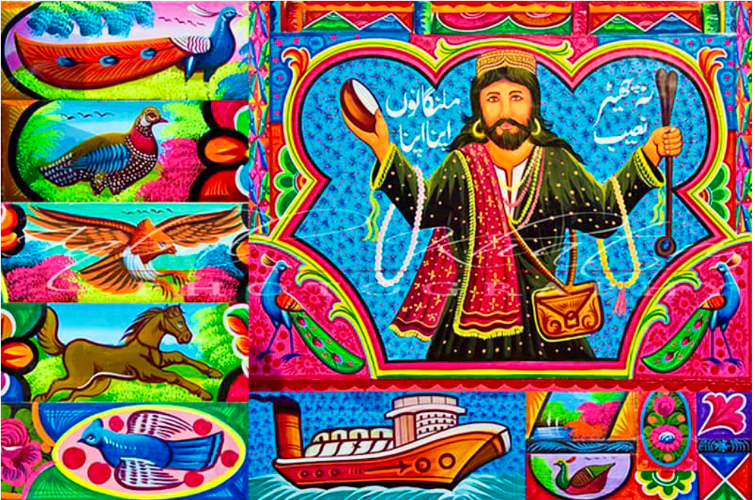
Header image: A collage of decorative truck art showing a Sufi saint, a horse, a ship, peacocks, an eagle and other birds. Source: FANN, 2022.
1. Introduction
Pakistan, a South Asian country known for its rich culture and ethnic diversity, is home to a unique, vibrant, and famous art form—truck art. This tradition of vehicle decoration, deeply rooted in history, is common in many countries, including the Philippines, India, Central and South America, and Afghanistan. However, Pakistani truck art is notable for its distinct style and ubiquitous presence, with practically all private and commercial trucks decorated in various ways (Elias, 2003; Stewart, 2018).
The practice of work of art on vehicles in Pakistan has a long and illustrious history, dating back to the Mughal rulers. They used to embellish their horse carriages with elaborate flower designs. Some argue that the origins of this folk art may be traced back to the ancient Indus civilisation (Rathnayake, 2022). Truck drivers began beautifying their vehicles with paintings and appealing poems, a practice that grew with the advent of Bedford trucks from England during British colonialism in the sub-continent (Ansari, 2024). After Pakistan’s independence in 1947, the truck industry became one of the biggest industries for transporting commodities (Ali, 2023). Today, truck art is more than decoration; it’s a complicated type of moving visual language and expressive communication. It explores religious, cultural, social, and folk topics, making it an effective visual narrative medium.
Pakistani truck art is called ‘art on the wheel’ or ‘moving art’ (Ansari, 2024; Ahmed, 2022; Ali,2023). This art originated from drivers from rural, low-income regions and is more than a form of expression. It is a powerful tool that portrays their traditions, emotions, and values.
This use of visual narrative bridges the gap between drivers and their communities, reflecting their natural surroundings and cultural heritage (Lefebvre, 1989). Artisans in this field typically inherit the skills from previous generations, resulting in a family tradition. Truck drivers and craftsmen call their trucks “newlywed brides.” At the same time, scholars use various terms such as “moving darbars (palaces)” and “moving billboards” owing to their elaborate decorations and sounds (Elia, 2003; Mackey, 2011; Sheikh, 2018). Elias (2003) covers Pakistan’s five regional truck design styles: three major (Punjabi, Swati, and Baluchi) and two amalgamations (Peshawari and Karachi). Each style features a unique design inspired by ethnic heritage and regional influences.
Pakistan’s truck decoration has reached a premier level and is evolving into a thriving industry that provides livelihoods for many people (Ali, 2023). It has gained worldwide attention through various collaborations and exhibitions, celebrating its cultural importance globally. For instance, it was showcased at the ‘2002 Smithsonian Folklife Festival’ and later used by ‘UNESCO’ to advocate for critical global causes (Smithsonian Institution, 2002; UNESCO, 2022). Despite these international influences, truck art has maintained its strong connection to its local roots. As Appadurai’s (1996) concept of cultural flows explains, this art form beautifully balances local traditions with global exposure, proving its resilience in the face of globalisation and commodification while continuing to stand as a proud symbol of cultural heritage.
2. Research Aim
This research aims to investigate how truck art embodies cultural resilience, fostering local culture and contributing to other local industries in the context of globalisation and commodification. Additionally, the paper critically analyses the challenges this art faces nationally and internationally.
3. Research Questions
- In what ways does Pakistani truck art reflect the resilience of local traditions and identities?
- How has Pakistani truck art maintained its cultural significance despite the pressures of globalisation and commodification?
4. Methodology
This paper uses a desk-based research method and the post-colonial theory of hybridity as a framework. Desk-based research is a method for gathering and analysing existing literature and secondary data sources to gather insights and contextualise findings (Fink, 2013; Bassot, 2018). Therefore, academic literature, articles, books, and blogs on truck art in general and Pakistan, in particular, have been accessed and reviewed to understand how this art symbolises cultural identity and resistance and to identify criticisms and alternative perspectives.
5. Theoretical Framework
The research adopts the post-colonial theory of cultural hybridity to understand how Pakistani truck art maintains its cultural distinctiveness by resisting dominant global cultural homogenisation. Key scholars in this field include Stuart Hall, Homi Bhabha, and Arjun Appadurai. They defined ‘cultural hybridity’ as the ‘continuous re-creation of culture’ (Stuart,1990), the combination and reinterpretation of cultural influences (Bhabha, 1994). According to Appadurai (1996), ‘cultures cannot be confined within today’s boundaries’ suggests that global interactions generate hybrid forms of cultural expression to form new identities and meanings.
Applying this theory to Pakistani truck art allows us to understand how it remains resilient amid the influence of global trends. Today, this folk art embodies colourful designs, patterns, motifs, and images blended with traditional themes, regional folklore, and modern influences. This flexible nature of truck art demonstrates cultural hybridity, developing new forms of mixing old and new, local and global, traditional and contemporary. This way, Pakistani truck art maintains its unique identity while continuously adapting to global shifts.
6. Literature Review
Truck art in South Asia grasped the attention of scholars at the end of the 20th century; various indigenous and international researchers contributed to this aspect of art in South Asia in general and Pakistan in particular. These will be discussed below in detail. The literature review deals with the history of truck art, its types and meanings, the social-political, cultural and religious influence of art, and its relationship with contemporary art and the fashion industry.
6.1. History of truck art meaning of images and symbols
The earliest works of truck art are done by French and German scholars, such as Jean-Charles Blanc (1976) ‘Afghan Trucks: Lastwagen Kunst in Afghanistan: Bilder, die fahren’, M. Centlivres-Demont (1976). ‘Les peintures sur camions en Afghanistan’ and Marie-Benedicte Dutrex’s (1978) work ‘La Peinture des camions en Afghanistan’. Due to the language barrier,
these writings could not be accessed and reviewed. However, Elias (2003: 188), in his article ‘On Wings of Diesel: Spiritual Space and Religious Imagination in Pakistani Truck Decoration,’ acknowledged Dutrex’s work as a systematic analysis of the motifs employed in truck design while criticising her work for making “serious errors in translating Pashto, Persian, and Urdu writing on trucks’ mentioning this flawed is due translation issues. Therefore, Dutrex’s work loses creditability in studying the meaning of truck art. In the same article, Elias also explores the tradition of truck decoration in Pakistan, focusing on the artistic styles, motifs, and underlying meanings. He examines how truck decorations transcend aesthetics and become a visual language reflecting Pakistani truck drivers’ religious beliefs, cultural values, and social identities.
Lefebvre (1989), in ‘The Decorative Truck as a Communicative Device’, provides deeper insights into the communicative aspects of truck art. He suggests truck art in Pakistan serves more than mere decoration; instead, it is a form of non-verbal communication that reflects both practical and symbolic purposes. Further expanding on this, Rich and Khan (1980), in ‘Bedford Painting in Pakistan: The Aesthetics and Organization of an Artisan Trade’, emphasise craftsmanship within an artisanal economic system. Based on these, in the article ‘Iconography in Pakistani Truck: A Cultural Appraisal’, Wajid Ali (2023) provides a more contemporary view, categorising truck art into different types and examining the popular. He highlights the impact of economic challenges on this art form.
6.2. The Socio-political, Cultural, and Religious Significance of Truck Art in Pakistan
Anna Schmid (2000), in the article ‘Truck Art as Area of Contest,’ illustrates that truck art is a medium for contesting religious, political, and cultural meanings, often resisting the dominating interpretations. The author analyses the construction and decoration of trucks, the interplay between drivers, painters, and the broader Pakistani audience, and the various motifs and inscriptions on the trucks. She explains truck art elements’ contribution to a complex and open-ended discourse that engages with societal values and beliefs, revealing the power of popular culture to challenge dominant narratives and foster individual expression.
Adding further on this, Elias’s (2005) second article, ‘Truck Decoration and Religious Identity: Material Culture and Social Function in Pakistan’, deeply dive into the relationship between truck art and religious identity, which reflects the deriver’s belief and influence of the Islamic
context. The author explores the visual elements that communicate a sense of community, religious beliefs, and cultural values. He draws attention to the evolution of truck decoration over time and the role of the Tabligh Jamaat (religious group) movement in shaping this unique artistic tradition. Eventually, the article emphasises that truck art as visual art goes beyond mere aesthetics, offering insights into Pakistani society’s beliefs, values and social dynamics.
Moreover, Sheikh’s (2018) “Impact of Truck Art, as Popular Culture on Pakistani Society” delves into the vibrant and often overlooked art form of truck decoration and argues that truck art transcends its aesthetic value and represents a rich tapestry of Pakistani culture, political and religious beliefs, and societal values. The observations, interviews with artists and truck owners, and her thoughtful analysis of recurring motifs and imagery showed that it is a powerful communication medium, a form of self-expression, and a reflection of Pakistani identity.
6.3. Truck Art in Contemporary Pakistan Culture
The only work that deals with Truck in the context of contemporary art is Nadia Ahmed’s (2022) ‘Pakistani Truck Art and its Shifts onto Modern Artefacts’, a thesis research project at Auckland University of Technology for her master’s studies. It mainly focuses on the artisan’s motivation in shifting art from heavy vehicles to modern artefacts and their impact on the meaning of their symbols and images as they are recontextualised in these new, often smaller and more personal, objects. The results showed that the artists’ motivation behind fusing contemporary art is to create awareness to promote Pakistan’s rich cultures and traditions globally and improve tourist experiences. Moreover, artisans are adapting Pakistani truck art to create functional objects that meet the modern demand for beauty and practicality. Artists’ satisfaction, decreased demand for work, their love for colours and, in some cases, heath constraints motivated artisans to shift to contemporary art. According to the author, this shift does not alter the meaning of the images.
6.4. The Fusion of Truck Art and the Fashion Industry
The intersection of truck art and the fashion industry has emerged as a fascinating study area. It showcases how this popular art is being reimagined and incorporated into contemporary local and international fashion while preserving its cultural identity.
In her academic paper, Fatima Malik (2018) advocates for preserving and integrating traditional Pakistani motifs and patterns in contemporary textile and fashion design. The article ‘Promoting Awareness about Traditional Motifs and Patterns of Pakistan in Truck Art through Textile and Fashion Design for the Local and Global Market’ draws attention to the adaptation of truck art into textile and fashion industries, locally and globally. By introducing truck art elements into contemporary fashion, the author aims to raise awareness of Pakistani heritage among local and global audiences. Thus, the country’s cultural identity will be promoted while the textile industry will foster economic growth. Correspondingly, Kazmi and Ghani-ur- Rahman (2021), in their article ‘The Evolution and Diffusion of Truck Art into Mainstream Culture Through the Fashion Industry’, illustrate the evaluation and diffusion of this folk art into mainstream cultures through its integration into the fashion industry. Prominent fashion designers and brands in Pakistan have commodified these unique motifs in the form of clothing, accessories, handbags and home decorations. For them, this is due to technological advancements and marketing evolution that have driven the commercialisation of truck art, integrating into various aspects of Pakistani culture. They examine the motivations behind designers’ and consumers’ adoption of truck art themes. This art form has not only been commodified but has also been used as a powerful tool for cultural expression and promotion. The research concludes that truck art has become an integral part of Pakistani cultural identity, reflecting the nation’s rich history, traditions, and artistic heritage.
Most of the literature about truck art deals with the art itself. In other words, many scholars focus on images, motifs, patterns, and meanings in socio-political, religious, and cultural domains. However, its resilience in the contemporary world, particularly in the context of globalisation and commodification, has not been discussed.
7. Argumentation & Analysis
7. 1. Truck Art as a Symbol of Cultural Identity
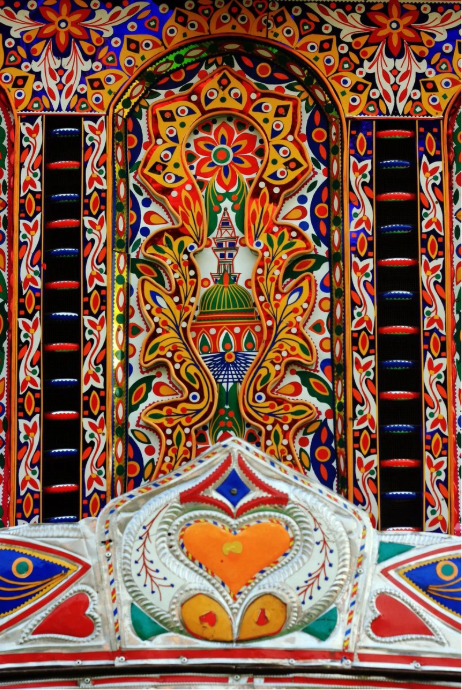
Truck art is a significant part of Pakistani aesthetics, mainly through the exclusive use of colours, intricate designs, and artistic craftsmanship. In addition to artistic expression, truck art is essential in visualising Pakistan’s diverse heritage and shared identity. Many academic works have highlighted the evolution of truck art as a “cultural flag carrier” (Kazmi and Ghani- ur-Rahman, 2021), which means it symbolises and promotes Pakistani culture both domestically and internationally. Inspired by environmental settings, it has become an integral part of daily life in Pakistan, reflecting cultural and national identity, local beliefs and traditions
in various forms (Kurt, 2008; Ansari, 2024). Elias’s (2005) analysis of truck art emphasises that sacred places, calligraphy, and mythical creatures create a ‘spiritual space’ for drivers and passengers, deeply connected to national culture and religious symbolism. This aspect of truck art is also supported by Ali (2023), who states that patterns, motifs, and colours are drawn from Indigenous traditions and beliefs. For example, the depiction of identity markers such as local flora and fauna, national heroes, as well as poetic and Quranic verses serve as a sign of blending the sacred with everyday life. Hence, this fusion of religious, cultural, and aesthetic aspects highlights the syncretic nature of Pakistani society, making truck art a dynamic representation of a unique identity.
7.2. Truck Art in the Context of Globalisation.
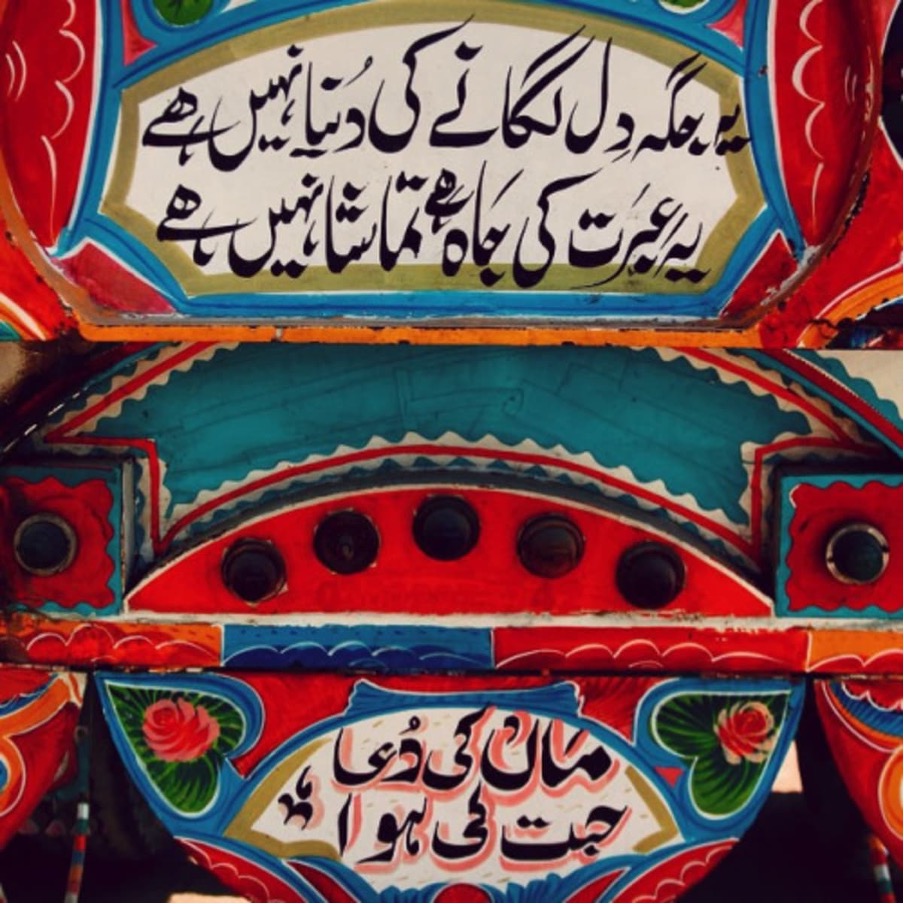
In today’s world, globalisation affects every aspect of human life through “both the compression of the world and the intensification of the consciousness of the world as a whole” (Robertson, 1992: 8). In the context of globalisation, Pakistani truck art has maintained its cultural significance. This art was born in the local context and is deeply rooted in the traditional values of the artists, making it able to thrive in today’s era—the use of various cultural symbols and motifs, such as peacocks, flowers, and animals (Elias, 2003; Ansari, 2024). These motifs hold cultural meanings and reflect local folklore, myths and legends. For example, the peacock symbolises paradise and spiritual immortality in Pakistani culture (Ahmed, 2022). Furthermore, the frequent use of poetic verses and phrases in the local language not only emphasises the significance of linguistic identity but also demonstrates a resistance to cultural homogenisation. While rooted in tradition, Pakistani truck art can also adapt to and incorporate elements of modernity, such as modern film characters and political and influential personalities such as Diana and Erdoğan. This blending of traditional and contemporary elements highlights the dynamic nature of Pakistani culture and its capacity to evolve while maintaining its core values and identities. Hence, Pakistani truck art is incomplete without the local traditions, myths, patterns and motifs. These elements of this art reflect a deep commitment to preserving local traditions and identities.
7.3. Truck Art Exemplifies as Cultural Resilience
Malik (2018) suggests that integrating truck art into fashion and textile designs helps truck artists’ livelihood and promotes awareness of cultural motifs in both local and global audiences. This means that despite the pressures of globalisation and commodification, truck art has adopted a hybridity of cultures by retaining distinctly local styles, motifs, and themes
rooted in Pakistan’s cultural context. This falls under Bhabha’s notion of hybridity (Bhaba, 1994), in which the truck exemplifies a hybrid cultural form that blends traditional and modern elements. Truck art emerged from the hybridity of cultures during colonisation when Bedford trucks were imported from England to India. This emergence of a “third space” (Bhaba, 1994) dominated the colonial authority. Lent (1995) also observed this and described trucks as a “reflection and manifestation of foreign and natural popular cultures” (Lent, 1995: 175).
In contemporary times, truck art in Pakistan is shaped by transforming foreign-manufactured vehicles into unique expressions of local identity through traditional colourful designs and intricate local patterns. This hybridity reflects the intersection of indigenous cultural symbols with foreign traditions and the formation of new identities and meanings, as discussed by Bhaba and Appadurai in their theories of cultural hybridity. Schmid (2000) noted this as truck artists adapting foreign landscapes and copying from postcards, depictions of Tarzan or Rambo, and national heroes, calling it a “seismographic” reaction to changes in modern times.
By infusing over 2.28 million privately owned trucks (Elias, 2005) with elaborate decorations, this practice celebrates regional aesthetics and fosters communal pride and belonging among drivers and communities. This exemplifies how local narratives can personalise global products, asserting individuality and challenging the homogenising forces of corporate conformity, thereby showcasing the resilience of cultural imperialism in an increasingly uniform global landscape. Truck art has survived for decades compared to other aspects of culture and art. Countries like Pakistan experience economic crises driven by multiple factors, leading to the extinction of various art practices due to insufficient support for their preservation and conservation. However, truck art emerges as a crucial means of resilience against these economic hardships, reinforcing community bonds and emphasising the significance of artistic expression beyond mere commercial interests. For instance, most trucks in Pakistan are fleet- owned, and drivers are often allowed to customise their vehicles at company expense, typically costing 125,000 to 400,000 rupees (Elias, 2003). This indicates that truck art is driven by more than just financial concerns.
7.4. Educating Through Art: Raising Awareness of Contemporary Issues
Stuart Hall (1990) and Bhabhba (1994) argue that culture is not static and is always continuously re-created through the interaction of various influences. Today, truck art conveys specific messages and values influenced by cultural hybridity and globalisation. Besides aesthetics, it also serves as an activist art by adopting a global trend to raise awareness about
local issues. For example, in specific campaigns such as documentary filmmaker Samar MinAllah Khan collaborated with truck artists by incorporating themes about critical topics such as sexual abuse, honour killing and domestic labour to create awareness among diverse communities using trucks as moving billboards (Rathnayake, 2022).
As Lefebvre (1989) mentioned, ‘the decorated Pakistani truck is an example of how an object is allocated a codified meaning and how this codification is ideologically structured’ (Lefebvre,1989: 218). In other words, truck art functions as a significant medium for expressing economic, national and political issues, advocating for women’s rights, promoting education, and reflecting Pakistan’s national heritage, thereby facilitating critical dialogues on social and cultural matters within the community, such as it carries images promoting polio vaccination and female education (Latif, 2015; Ali, 2023; UNESCO,2023 ). Furthermore, in collaboration with Berger Paints Pakistan, the contribution of truck art is worth noting. In 2019, an award-winning project was launched in which a small number of trucks carried portraits of missing children, as well as a phone number to call the Roshni Helpline (a Karachi-based nonprofit organisation dedicated to their recovery (Bloch, 2022; Saleem, 2022). Truck art is seen as a valuable educational resource internationally, exemplified by the Jingle Trucks Programme, founded by Kate Warren of Chattanooga’s Art. Through interactive art experiences, the Jingle Trucks Programme engages children in appreciating Pakistani truck art. It promotes connections and awareness in a multicultural context, illustrating the potential of such initiatives to cultivate a more inclusive educational environment (Wray, 2021).
8. Conclusion
Pakistani truck art stands as a testament to the resilience and adaptability of local traditions and identities. By incorporating local imagery, regional styles, traditional motifs, cultural symbols and narratives, it contributes to heritage preservation and reinforces a sense of shared identity in the face of global influences. Blending historical artistry with modern influences creates a visual language that celebrates Pakistan’s cultural heritage while engaging with contemporary issues. The feature of truck art to embrace change and reflect the evolving socio-cultural landscape continues to hold a significant place in the hearts and minds of the people. This folk art’s ability to develop and stay relevant in a globalised world ensures its continued significance as a powerful expression of Pakistani identity for generations.
9. Challenges and Recommendations
Despite maintaining its uniqueness, truck art can face the challenges of authenticity and originality in the future due to commercialisation. As Kazmi and Ghani-ur-Rahman (2021) highlighted, traditional motifs are reproduced and simplified for aesthetic purposes. This shift from truck art to commercialisation threatens specific patterns. For instance, the designs are often adapted to meet international tastes, which can marginalise or abandon traditional Islamic motifs, Urdu calligraphy, and regional folklore, which are the essence of Pakistani truck art. Moreover, this can also marginalise the real artists from the trucking community, often benefiting the elite class in the fashion industry.
In addition, some reasons enabled truck art to survive till today. First, the lack of modern technology and poor road infrastructure makes it difficult for new, advanced technology vehicles to travel. If, in future, things change and trucks like Tesla become more common, there is a real risk that this folk art could disappear. Second, the older generation is known for being passionate and skilful in truck art. The younger generation is also less engaged, and there are limited efforts in Pakistan to preserve this art form. Hence, to protect its future, policies are needed to support skill transmission, a truck art museum should be established, and efforts must be made to blend traditional art with modern technologies to keep it relevant.
Reference List
- Ahmed, N. (2022). Art on the Move: Pakistani Truck Art and its Shift onto Modern Artefacts. [online] Available at: https://openrepository.aut.ac.nz/server/api/core/bitstreams/9af66aca-2211-43f5-a29e- 79fdd0554692/content. (Accessed: 29.09.2024).
- Ansari, A. (2024). ‘Colorful images on Rear Panel’ (Truck Art) Truck Art in South Asia. Journal of Arts and Linguistics Studies, 2 (ISSN Print 2959-0957 ISSN Online 2959-0965), pp.1127–1142. (Accessed: 09.10.2024)
- Ali, W. (2023). Iconography in Pakistani Truck Art: a cultural appraisal. SSRN Electronic Journal. Available at https://doi.org/10.2139/ssrn.4636410. (Accessed on 29.09.2024)
- Ali, S. (2022). Truck Art: The Journey of Miscellanies Calligraphic art of Pakistan in South. [online] Academia.edu. Available at https://www.academia.edu/91173519/BY_SAJJAD_ALI_Truck_Art_The_journey_of_Miscellanies_Calligraphic_art_of_Pakistan_in_South [Accessed 10 Oct. 2024].
- Appadurai, A., 1996. Modernity at Large: Cultural Dimensions of Globalization. University of Minnesota Press. Available through University of Glasgow Library https://ebookcentral.proquest.com/lib/gla/detail.action?docID=310379 [Accessed on 2 Oct, 2024].
- Bhabha, H. K. (1994). The Location of Culture. London: Routledge.
- Bassot, B. (2018). Desk-Based Qualitative Research. Canterbury Christ Church University. Available at: https://ssrn.com/abstract=4636410. [Accessed 6 Oct. 2024]
- Bloch, H. (2022) ‘These eye-popping, hand-painted trucks rule Pakistan’s roads’, NPR, 5 February. Available at https://www.npr.org/2022/02/05/1078245678/these- eye-popping-hand-painted-trucks-rule-pakistans-roads [Accessed 4 Oct. 2024]
- Elias, J. J. (2003). On Wings of Diesel: Spiritual Space and Religious Imagination in Pakistani Truck Decoration. RES: Anthropology and Aesthetics, 43, 187–202. http://www.jstor.org/stable/20167598 available through the University of Glasgow (accessed: 20 Sept. 2024).
- Elias, J. (2005) ‘Truck Decoration and Religious Identity: Material Culture and Social Function in Pakistan,’ Material Religion, 1(1), pp. 48-71.
- FANN, B.A. (2022). Paskistani Truck Art & Ms Marvel. [online] Bayt Al Fann. Available at: https://www.baytalfann.com/post/paskistani-truck-art-ms-marvel [Accessed 6 Oct. 2024].
- Fatima Malik, A. (2018). Promoting Awareness about Traditional Motifs and Patterns of Pakistan in Truck Art through Textile and Fashion Design for the Local and Global Market. International Journal of Art and Art History, [online] 6(1), pp.40–45. doi: https://doi.org/10.15640/ijaah.v6n1a5. [Accessed 01 Oct. 2024]
- Fink, A. (2013). Conducting Research Literature Reviews. 4th ed. [online] SAGE Publications. Available at https://books.google.nl/books?id=Dg5zAwAAQBAJ&source=gbs_navlinks_s. [Accessed 29 Sept. 2024]
- Hall, S. (1990). Cultural Identity and Diaspora: Identity: Community, Culture, Difference. Londra: Lawrence and Wishart
- Kazi, S. (1998) Trucking Through Culture: The Branding of Transport in Pakistan. Karachi: Transport Studies Journal.
- Kazmi, S.M. and Rahman, G.-U.- (2021) From Folk to Popular: The Evolution and Diffusion of Truck Art in Pakistan into Mainstream Culture Through The Fashion Industry, Pakistan Journal of Social Research, 03(01), pp. 66–79. Available at https://doi.org/10.52567/pjsr.v3i01.188. [Accessed 4 Oct. 2024]
- Kurt, S. (2008) The Art of Truck Painting: A Historical Perspective. Lahore: Cultural Heritage Publications.
- Latif, A. (2015) Pakistan uses famous truck art to ramp up anti-polio efforts. Available at https://www.aa.com.tr/en/asia-pacific/pakistan-uses-famous-truck-art-to- ramp-up-anti-polio-efforts/2840963# [Accessed 23 Sept. 2024]
- Lefebvre, A. (1989). The decorative Truck as a Communicative Device. Semiotica 75 (3-4): 215-27. Available through University of Glasgow Library https://milngavie.cent.gla.ac.uk/idp/profile/SAML2/POST/SSO?execution=e1s2. [Accessed 1 Oct. 2024].
- Lent, J.A. (1995). Introduction. In JA Lent (Ed.), Asian popular culture (pp. 1-10). Colorado: Westview Press, Colorado.
- Mackey, R. (2011) ‘A Closer Look at Afghanistan’s “Jingle Trucks”,’ The New York Times, 22 December. Available at: https://thelede.blogs.nytimes.com/2011/12/22/a- closer-look-at-afghanistans-jingle-trucks/ (Accessed: 6 October 2024).
- Rathnayake, Z. (2022). Pakistan’s Trucks Are Vibrant, Bedazzled Works of Art. [online] Atlas Obscura. Available at: https://www.atlasobscura.com/articles/pakistan- truck-art-phool-patti. [Accessed 5 Oct. 2024]
- Rich, G.W. and Khan, S. (1980) ‘Bedford Painting in Pakistan: The Aesthetics and Organisation of an Artisan Trade’, Journal of American Folklore, 93, pp. 257-275.
- Robertson, R. (1992) Globalization: Social Theory and Global Culture. London: SAGE Publications.
- Saleem, M.H. (2022) ‘Truck art: A vibrant cultural expression in Pakistan’, ArtsHelp. Available at:https://www.artshelp.com/content/truck-art-empowers-female-rights-in- pakistan?ref=artshelp.com [Accessed 5 Oct. 2024]
- SARA (2023). Pakistan Truck Art. [online] HubPages. Available at: https://discover.hubpages.com/art/Pakistans-Truck-Art [Accessed 3 Oct. 2024].
- Schmid, A. (2000) ‘Truck Art as Arena of Contest’, Journal of Social Sciences, 4(4), pp. 235-241. doi: 10.1080/09718923.2000.11892273.
- Sheikh, S.Z. (2018). Impact of Truck Art as Popular Culture on Pakistani Society. International Journal of Multidisciplinary and Current Research, [online] 6(5). doi:https://doi.org/10.14741/ijmcr/v.6.5.10 .Available at http://ijmcr.com/wp- content/uploads/2018/10/Paper101061-1070.pdf [Accessed on 7 Oct.2024]
- Smithsonian Folklife Festival (2002). Available at https://festival.si.edu/past- program/2002. [Accessed 5 Oct. 2024]
- Stewart, J. (2018) Colorful ‘Jingle trucks’ rule the road in Pakistan. https://mymodernmet.com/pakistan-truck- art/#:~:text=A%20look%20at%20truck%20art%20cultural%20in%20Pakistan. [Accessed 5 Oct. 2024]
- Tuncer, F.F. (2023) ‘Discussing Globalisation and Cultural Hybridisation,’ Universal Journal of History and Culture, 5(2), pp. 85–103. Available through University of Glasgow Library https://dergipark.org.tr/en/download/article-file/3069054 [Accessed 7 Oct. 2024]
- UNESCO. (2023) Truck art: A vibrant advocacy for girls’ education in Kohistan. UNESCO. Available at:https://www.unesco.org [Accessed: 10 Oct. 2024]
- Wray, D., (2021): Pakistani art trucks on a bridge of culture, [online] https://www.aramcoworld.com/Articles/November-2021/Pakistani-Art-Trucks-on-a- Bridge-of-Culture. [Accessed: 8 Oct. 2024]

 Culture Weekly