
By Amber van Driel, student in Arts and Culture Studies
As an Arts and Culture Studies student, it is impossible to avoid the city of Paris. One of the ways we encounter it is through the words of Ernest Hemingway in his memoir A Moveable Feast. In one of our courses, we watched Woody Allen’s Midnight in Paris, which was based on the book. This interplay between the works inspired me to read the memoir, and I fell in love with it. When Frederik van Dam gave us the opportunity to create our own transmedial work in the new course Intertextuality and Intermediality, I had my eyes set on this story from the beginning. The result became the board game The Lost Generation.
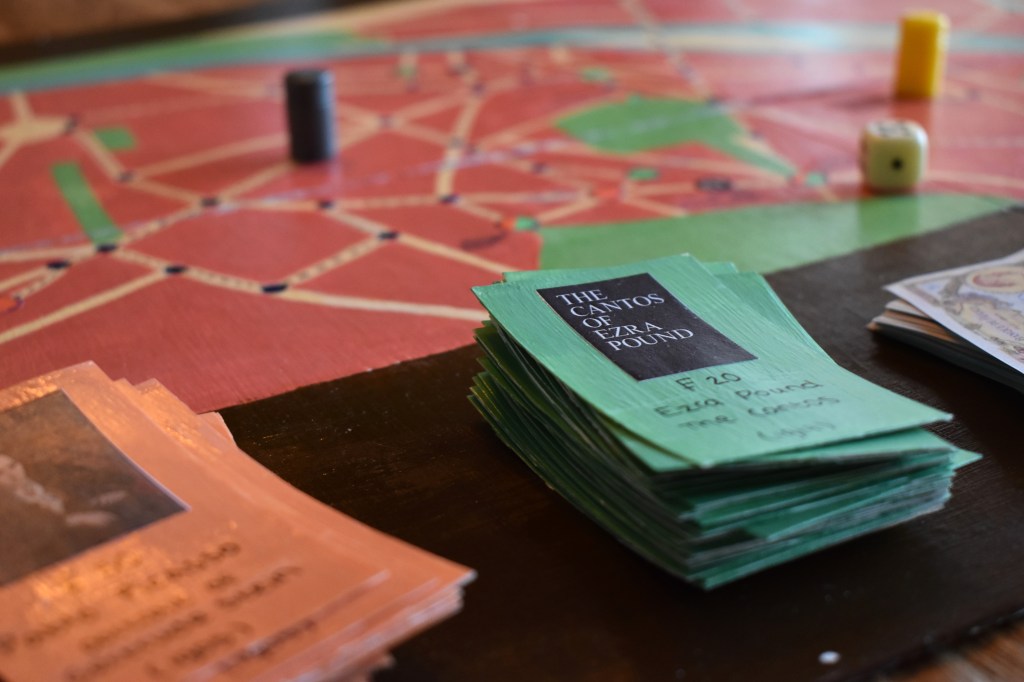
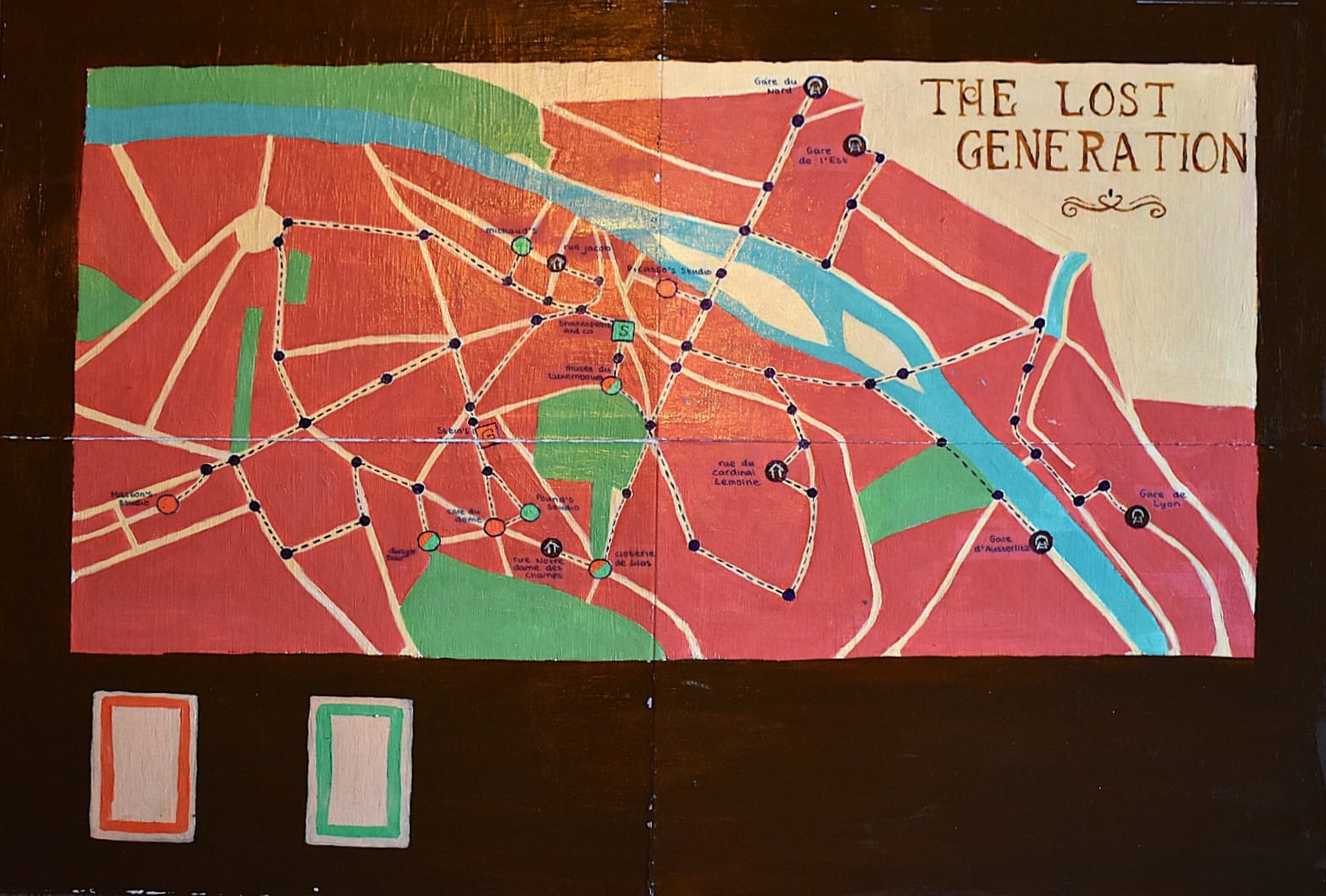
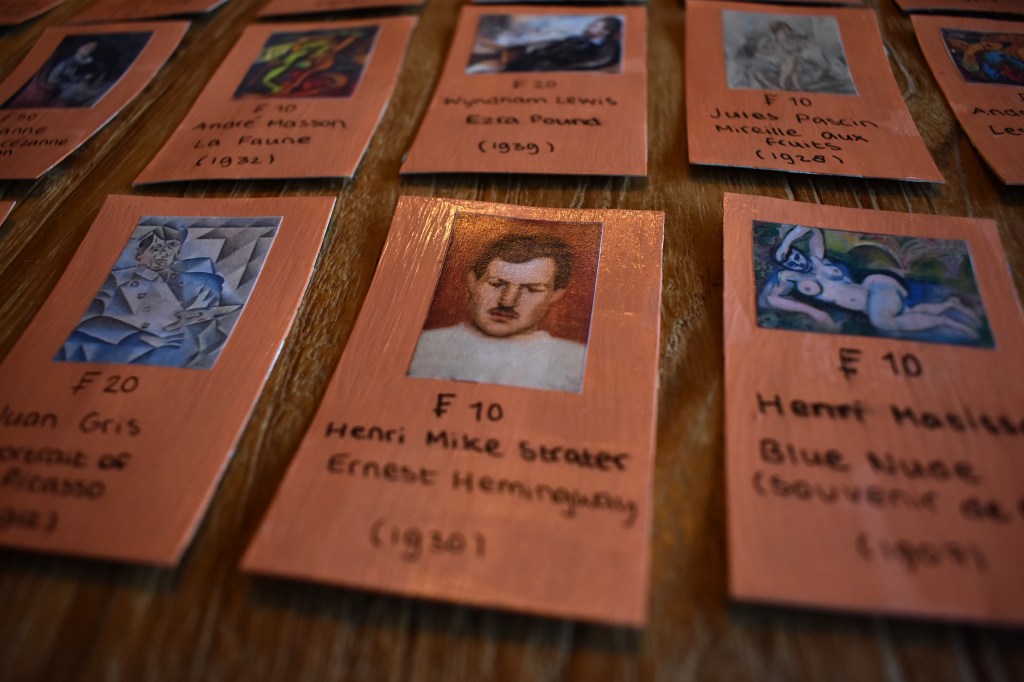
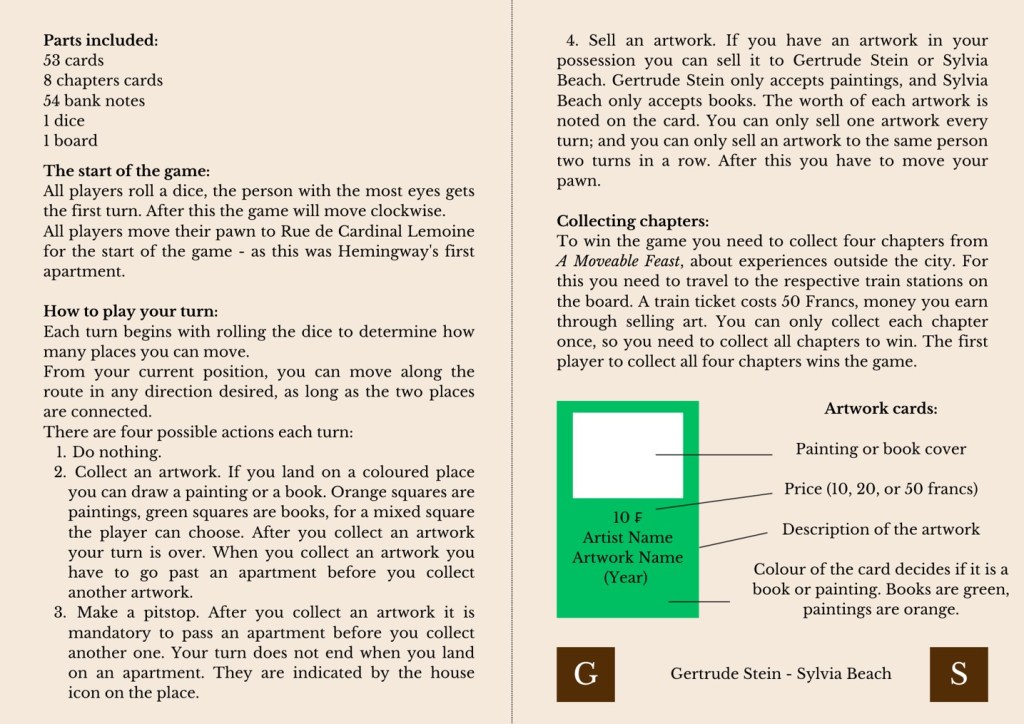
Essentially, the board game is an adaptation of Hemingway’s A Moveable Feast. The board game is an interdisciplinary work that engages with the source-text. To guide me in the process of adaptation, Linda Hutcheon’s theory proved very useful. The main theme, persistent in both the book and the game, is of course the characters – all real-life artists. The game is centred around interactions with these artists: the goal of The Lost Generation is to ‘write’ chapters of Hemingway’s memoir, while collecting the art of his friends. When landing on specific places on the board, players receive cards with artworks on them – either literature or paintings. The players can sell these artworks to Gertrude Stein and Sylvia Beach, to earn enough Francs to buy train tickets. Each train station corresponds with a chapter from A Moveable Feast. These connections are historically and geographically accurate.
Both Gertrude Stein and Sylvia Beach are often mentioned by Hemingway, and are perhaps some of the most influential ‘characters’ in the book. Because of this, and because I needed some feminine power in this male-dominated book, I centred most of the game around them.
Gertrude Stein was an American author and art collector who moved to Paris in the twentieth century. She is known for the famous salon she hosted in the city, which Hemingway frequently visited. This salon functioned as a meeting space, where many of the important modernist artist’s met each other. Players can thus sell all of their paintings to her, which differ in value.
Sylvia Beach, also an American, was a publisher who lived in Paris. Her bookstore Shakespeare and Company is quite famous, and was described by Hemingway in A Moveable Feast. He also wrote about Sylvia Beach’s publication of James Joyce’s Ulysses, which was a significant moment for the modernist literature field. It comes to no surprise, then, that players can sell works of literature to Sylvia Beach in the game.
I developed the process of the gameplay according to Roger Caillois’ game theory. He distinguishes four different types of games: Agôn, Alea, Mimicry, and Ilinx. These four types each describe a quality that a game can have, and naturally I wanted to incorporate as many as possible, to create ‘the ultimate game.’ Caillois describes Agôn as competition. It is important that there is a complete equality of opportunity for everyone, so the players’ talent becomes the deciding factor. In the case of board games, this talent is usually the strategy they choose. Alea is the element of chance. In board games this is often incorporated as dice rolling, with The Lost Generation being no exception. Additionally, the artwork-cards have different values and are drawn blindly, increasing the role of chance in the game. Caillois defines Mimicry as imitation. Essentially, Mimicry is a form of roleplaying: the player becomes a fictional character and behaves like them. I associate this with a sense of escapism. Woody Allen captured that escapism perfectly in Midnight in Paris: every generation longs for a different time (or even a different place). The entire board game is based around this desire, with some additional creative liberty. Ilinx refers to a feeling of vertigo. Interpreted literally, this is quite impossible to achieve within a board game. Though one could argue that a radically different perspective on a familiar work from history – A Moveable Feast – can cause disorientation as well. Three – possibly four – out of the four checkboxes ticked off should be the recipe to a perfect board game, right?
To me, the most important and most enjoyable part of the process was designing the board. Because of A Moveable Feast’s strong geographical quality, it felt obvious that the board should be some variation of a map. In the course we encountered narrative cartography through Marie-Laure-Ryan, who categorizes different kinds of intertextual maps. In the case of The Lost Generation, the map is an annotation of a real-world map, as an interpretation of the original text by Hemingway. In this part of the process I took some creative liberty – after some frustrating dead-ends – and used a map provided by Google Maps, of which I altered the scale slightly. Throughout the research, it surfaced that the majority of the book takes places in the Montparnasse neighbourhood, while all the train stations are located much farther away. So I altered the scale, and then ‘annotated’ this map with routes and locations.
Eventually, all this research resulted in a hand painted board game: The Lost Generation. The game is far from perfect, but that was not the point of this research. I learned so much about the process of creating a board game, and a lot about transmedial storytelling. It was fun to actively engage with the theory we encountered in the course, and to expand this fictional ‘franchise’ that I have come to love a little further.

 Culture Weekly