
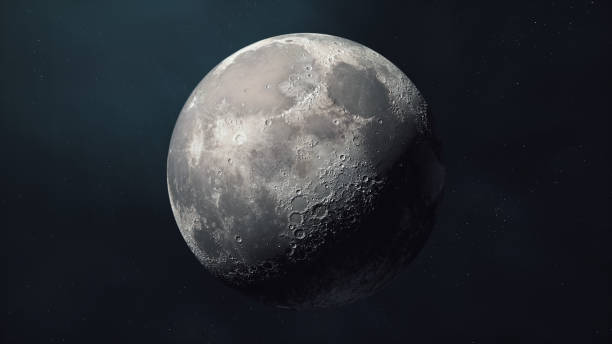
On my recent journey to Suriname, I have been thinking something that I have thought many times before, every time I am separated from a loved one. I see the moon and I am comforted by the fact that, however far away the other person, the same moon shines on both of us. And I am not the only one with this thought. As an historian of travel, I come across it again and again.
This is the thought: However many miles are between us, and however many hours of travel, however many obstacles – sometimes even the bend of the globe prevents us from seeing one another – we are nonetheless united by a single glance at the moon in the sky. We only need to look up and we see the same, very real, physical thing, at the same time.
I am not the first to think this. In my work, I come across many historical travellers with similar experiences. In 1877, German lady’s maid Auguste Schlüter travelled with her British employers to Ireland.
It is Sunday night, the moon sends her silvery light across the ocean, and carries me far away, home to my dear ones and to my dear Hawarden home, and to another spot on earth which I need not name, for Thou knowest all my thoughts.1
In Ireland, the moon reminded Schlüter of her loved ones in Germany and Britain, and of a mysterious unnamed person – her lover? So, what I am finding in my work about nineteenth-century Europeans is that, because the moon was visible from very different locations at same time, it made travellers feel connected to their (other) homes and their beloved. The moon took away the distance for a moment. Sometimes, this was followed immediately by a sense of even greater distance because of the contrast between the moon that seemed so close as to be touchable, and the loved one who was both out of sight and out of touch.
Now, as an historian, I am trained to focus on historical and cultural differences. I am asked to describe how people in the nineteenth century were different from ourselves, for example. But sometimes, I cannot help but espy similarities. Between myself and someone in the nineteenth
century. Or someone in a vastly different time and place.
This same moon hangs over Fu-chou.
Alone, she’ll lean out her window to watch it.2
So begins one of the famous melancholy poems by Tu Fu about travel, migration and separation. Tu Fu was a Tang-dynasty poet living thirteen centuries ago in what is now central China. In his poem, he describes two protagonists united by the same moon, but yet watching it alone.
It looks like this magical property of the moon to annihilate distances – and then to emphasise them – has been felt across the globe and across the millennia.
These examples are about the moon. I have found travel writing in which the sun accomplishes the same, particularly at special events such as a solar eclipse. And other travellers who talk about the stars. More down-to-earth phenomena also did the same for many: long rivers, for example, and the ocean.
Rivers and the ocean did this in a slightly different way from the moon. Not by enabling distant ones to see one relatively small point at the same time, but by offering the vastness and connectedness of one body of water to both individuals at the same time. The Atlantic Ocean, the Indian Ocean and the Pacific Ocean connected one coast to a completely different one. And so, in the mid-nineteenth-century, the Russian writer Ivan Goncharov was on the island of Madeira in the Atlantic Ocean and seems to have felt connected to Russia through the Madeiran flowers he threw into the water and that might in theory reach Russia.3
Dare I propose that we are dealing with the same experience in every one of these instances?
And dare I propose also, therefore, that the moon brings together Tu Fu, Auguste Schlüter, and myself?
Immediately we have to admit that the story is not that neat. In Suriname, I sadly missed the opportunity of looking at the moon when it was full and when I knew certain people far away would also be looking at it. The rainy season covered up the moon. A week or so later, I saw a vivid bright waning moon. The same moon as was visible at the other side of the world, yes, but also a different one. While in Europe, my waning moon is balancing on its point. In Suriname, I see a calmly lying moon. In the same way, Tu Fu’s moon, Schlüter’s, and mine will have looked slightly different, because of our different positions on earth. What is more, our moons will have looked different because the moon has aged. The craters and seas on its surface may be a little worse for wear now compared to more than a thousand years ago, and there’s certainly been more human impact in recent years. My point is that the idea that we are looking at the same thing is perhaps a little bit of an illusion. But an influential and comforting illusion nonetheless.
In my recent book Travel and Space in Nineteenth-Century Europe, I discuss travellers’ attachments to home. In a related article, I outline different forms of what it means to feel distance.
More by Anna P.H. Geurts on Historian at large.
- Auguste Schlüter, A Lady’s Maid in Downing Street, ed. Mabel Duncan (London: Fisher Unwin, 1922), p. 17. ↩︎
- This translation is by Sam Hamill, in Endless River: Li Po and Tu Fu: A Friendship in Poetry (New York and Tokyo: Weatherhill, 1993). p. 37. ↩︎
- Ivan Aleksandrovich Goncharov, The Frigate Pallada, trans. Klaus Goetze (New York: St. Martin’s Press, 1987), p. 86. ↩︎

 Culture Weekly