
By Aliisa Råmark
Recently, while attending a PhD writing retreat I connected with my peers about our hobbies outside of academia. I told my colleagues that in my free time I, of course, like to do bird watching. I was faced with curiosity and interest: “Oh really? Did you start it during Covid? It was a big trend back then.” Some friends also commented on it being a retired peoples’ hobby. I was utterly confused – doesn’t everyone casually birdwatch? What does it have to do with being old? Aren’t we all curious about identifying the species around us in the natural world? After receiving three bird books for my birthday, I am now in the acceptance phase of realising that maybe it’s a bit of a nerdy niche to birdwatch in your 20’s. But it’s one that I highly recommend.
I did not start bird watching during the pandemic. In fact, I was indoctrinated from a young age by my parents. Growing up in South-Eastern Finland, the forest is your backyard, quite literally. Our father would play us bird sound cassettes and test our knowledge on nature walks. Not only birds, but we were expected to learn how to identify mushrooms, plants, berries, species of trees – everything in the natural world around us. It was part of being one with and respecting nature, and also to learn what was safe to gather for eating.
However, I was only moderately enthusiastic about birds, until I moved abroad and realised how different the species were in other countries, even within Europe. The storks, grey herons and meerkoets that are so common in the Dutch landscapes were more of a rarity back home. And while most species are the same, they have different cycles. My internal clock was quite baffled hearing some birds singing in February in Nijmegen that mark the beginning of summer in Finland, or seeing the Egyptian geese with little goslings (yes, that’s geese babies) as early as April. Naturally, I reported all these Western European wonders back to my family in the arctic tundra.
On a more cultural level, this pastime is relatively young in its current form. Interest in birds was much more destructive up until 100 years ago. In the 18th and 19th century it was still common to kill and collect birds, as well as other wildlife, for studying their biology or merely displaying them in curiosity cabinets.1 The development of binoculars as well as advocacy of ornithologists Edmund Selous impacted the hobby. In his diary entry from 1898, Selous had an awakening when he displayed remorse for the past killing of birds and urged people to put down their guns, and observe the birds in their natural habitat instead.2 Several decades later, birdwatching was boosted during the Second World War following the 1940 publication of Watching Birds by James Fishers. Surprisingly, (as much as I tried to steer away from my research topic of Heritage on Nazi Persecution) birdwatching was also practised on German Prisoner of War Camps: for instance British PoWs led by John Buxton started their own ornithological society, tracking and illustrating birds and distributing weekly bulletins on the camp’s ‘nature news’.3 Birdwatching offered a welcome distraction to the prisoners, perhaps releasing stress, and a connection to the outside world during their entrapment.
Especially now, during the high intensity period of working on my PhD research, I find a lot of comfort in going out to Ooijpolder with my binoculars. It gives an incentive to go on a walk outdoors and quiets down my brain in the process. I enjoy pretending to be a 19th century ornithologist while studying the features of birds, trying to trace some elements of their dinosaur ancestors in their movements and sounds (if you have seen videos of the East-African shoebill, you know what I am talking about). I use Smart BirdID to note down the species I see and it gives me a cool sticker to my collection for each new bird – kind of like catching Pokémon, or creating a digital (and much more ethical) cabinet of curiosities.

A sticker collection of some of my identified birds on BirdID
Recently, I received news from my (bird-crazy) family that there is a rather rare osprey couple nesting on an island at our summer house. This was not a coincidence, but an effort of nature conservators who built a man-made nesting platform last autumn. Now our weekly phone calls go: “How are you doing? And how are the ospreys? Have their eggs hatched yet?” Things even took a dramatic turn resulting in a boat chase: as my stepfather saw a boat lingering around the nesting island he jumped onto his boat and chased down the unaware fishermen. I was not there, but I imagine it looked like something out of Baywatch. Once the fishers spotted him, they started drifting away with their boat, but he caught up and ordered them to turn off their motor. The frightened Russian fishers immediately offered their fishing licences. “I don’t care about your licences, but could you please let the ospreys nest in peace?” my stepfather pleaded. They took the hint and left for calmer waters. All was well again in the osprey paradise.

The famous nesting ospreys at our summer house in Torsansalo, Finland.
Regardless, if sitting still for hours with a pair of binoculars is a bit too hardcore for you, you can also sit still on the comfort of your couch for 51 minutes while watching Dancing with the Birds on Netflix or watch a live-camera stream of a bird’s nest. I simply encourage you to take a moment to appreciate the wonderful range of species and nature around us that we often take for granted.

A live camera capture of another osprey nesting in Saimaa lake region, Finland. (Source: WWF Suomi. Link: Sääksi – WWF:n Luontolive –https://wwf.fi/luontolive/saaksi/ WWF Suomi)
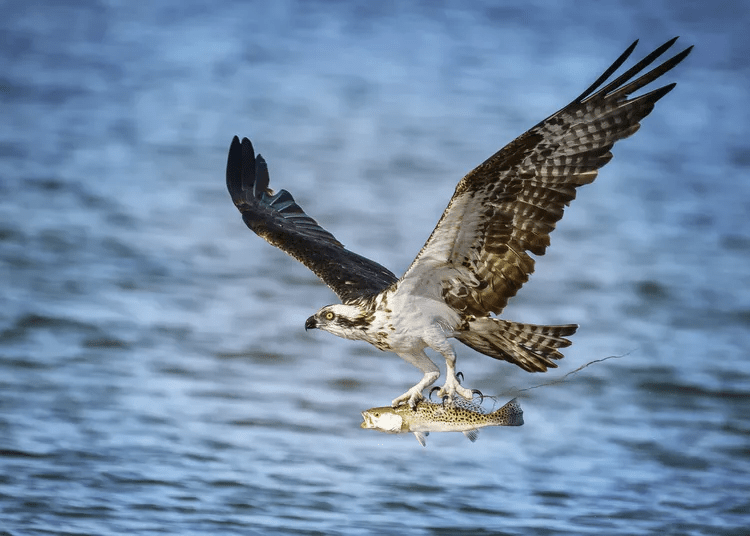
The header image for this piece is a hunting osprey. (Source: Vicki Jauron, Babylon and Beyond Photography / Getty Images)
Footnotes
- Birkhead, T. (2022). How Bird Collecting Evolved Into Bird Watching. Smithsonian Magazine. Available at: www.smithsonianmag.com/history/how-bird-collecting-evolved-into-bird-watching-180980506/-Watching ↩︎
- Ibid. ↩︎
- Williams, H. (2012). The bird men of Warburg PoW camp. BBC News. Available at: https://www.bbc.com/news/uk-scotland-north-east-orkney-shetland-20142709ews ; The Lady. (n.a.) The Bird Men PoWs. Available at: https://lady.co.uk/bird-men-pows ↩︎

 Culture Weekly