By Eva Mutsaers, Margherita Lillo, and Teodora Timicescu
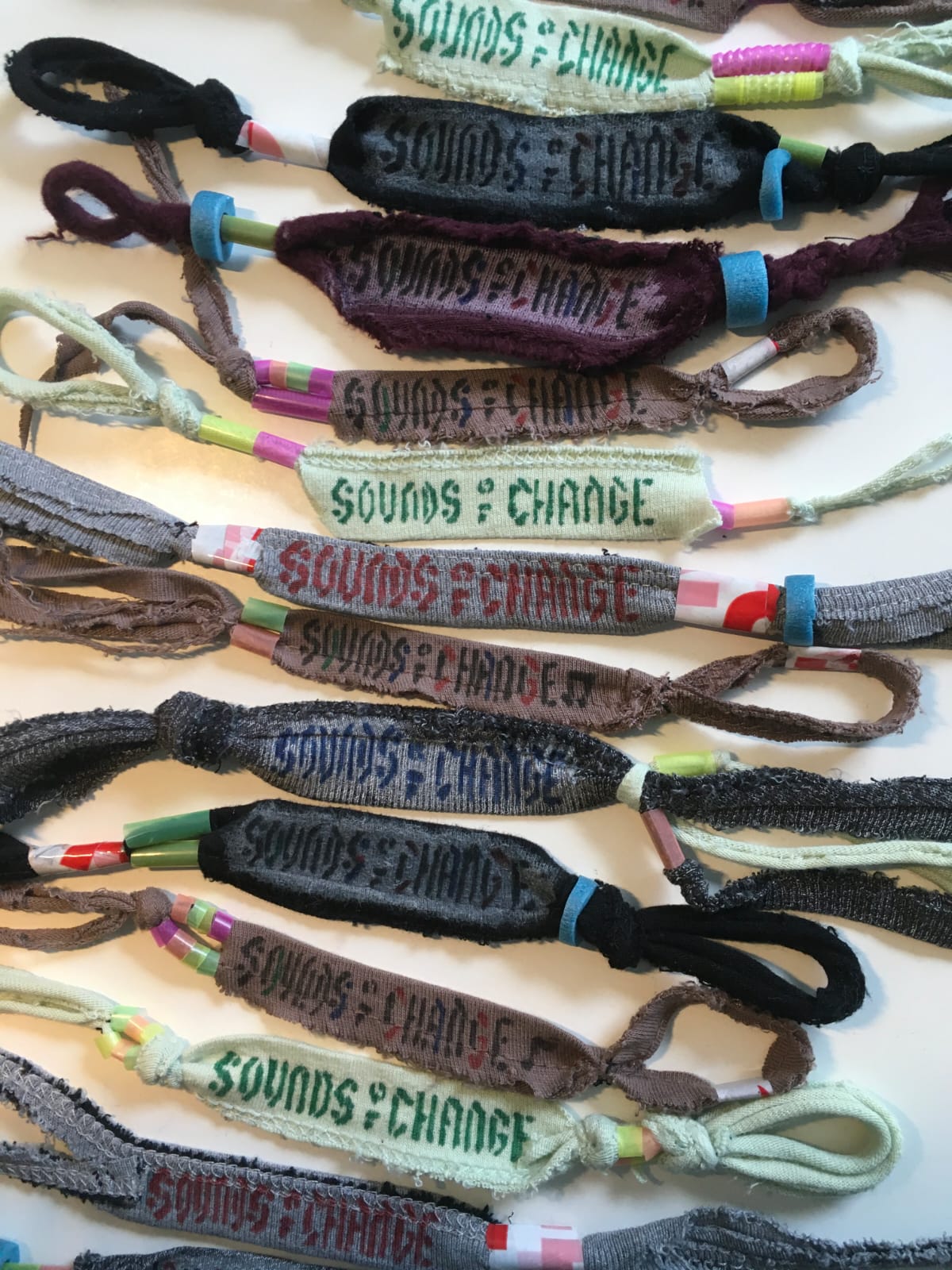
In community work, visibility is often a decisive factor for organizations to gain support and resources. However, despite their outstanding and meaningful work, many organizations are overshadowed by larger, more established institutions. The nonprofit organization Sounds of Change faces the same problem. When our group, Equal Voices, Equal Volume (EVEV), discovered this organization, we were surprised to see that few people were familiar with it. This is how our intervention was born: creating and distributing bracelets bearing Sounds of Change’s logo around Nijmegen, paired with a Linktree to the most important pages of the organization, to help them gain more visibility to help their target audience: refugees and minorities.
In recent years, the refugee crisis has become a pressing issue that has gained worldwide attention. Last year, the global refugee population reached 37.8 million, of which almost two-thirds came from Afghanistan, Syria, Ukraine, and Venezuela.1 This results in a global refugee density of 460 per 100.000 people, which is more than twice the number in 2015 and three times that of 2005. The refugee crisis, together with the rise of discrimination and unequal growth, is a current trend that contributes to inequality. To address this, it is important to provide extra support for vulnerable population groups and actively opposing rising discrimination. Sustainable Development Goal 10, by the United Nations, strives to reduce inequality within and among countries. Music can play a role in this. It can be a tool to develop skill, confidence and identity.2 This was the starting point for our intervention.
To address this inequality, we decided to work with Sounds of Change. Sounds of Change is a Dutch non-profit organization that, in their words, uses “the power of music to enable social change.”3 They work in refugee camps, (post)conflict areas, and marginalized communities to help people in these difficult situations and deal with their trauma and emotions by making music together.4 They focus on a prefigurative approach, making music with a group that focuses on sound and not so much on language. In this approach, music making becomes a political act, since it embodies and enacts ideal social relations, making social change possible.5 The music does not have to be complicated at all; they can make music with the simplest instruments and in simple ways, for example, using body percussion and boom whackers, which are colorful tubes in different sizes to make different sounds.6 They focus on giving the participants creativity and the chance to take control, which they are not able to do in their current state of life. Through music, they can share emotions, connections, a sense of belonging, or the feeling of being a team. In this way, Sounds of Change fits what Shapiro et al. state, that music can help develop confidence and identity. Sounds of Change is based in the Netherlands, but they work in different parts of the world, for example, Palestine (Gaza and West Bank), Ukraine, Syria, and Jordan (Sounds of Change, “Our Music Projects in the Middle East”).
Refugees often face mental health challenges due to cultural and geographical displacement and trauma experienced due to war and conflict, fleeing their country, and/or resettlement in a new place.7 They encounter both psychosocial and cultural problems, including culture shock, language barriers, racism, and social isolation. The stress and trauma these people have experienced lead to deep feelings of grief and loss caused by war, resulting in isolation and a longing for a lost home. Musical activities are an effective tool for addressing mental health problems. According to Marsh, making music can help develop “a sense of belonging and empowerment; forms of communication where verbal communication is limited; and to enhance stress relief, cultural maintenance, identity construction and integration within the host country” (ibid). Through different musical therapy strategies, trauma and difficult emotions can be experienced, expressed, and processed in a way that does not cause harm. For example, allowing for social synchrony through the feeling of being rhythmically and physically connected, which makes comfort and connection in social relations feasible.
In places of conflict, such as Gaza or Ukraine, healthcare is not easily accessible, and mental healthcare is needed, even when it is not discussed. Organizations such as Sounds of Change play an important role in providing music therapy for these people and helping them through these incredibly difficult times. To help Sounds of Change increase visibility and strengthen its supporter network in Nijmegen, we aimed to spread its message and inspire others in an engaging way. To bring our intervention to life, we decided to directly apply our skills and passion to the project, letting our excitement and admiration for Sounds of Change’s mission show through our involvement.
This approach felt similar to fan-based activism and participatory culture practices we studied in our Popular Music and Social Change course at Radboud University. While we recognized the difference between fandom centered on a musical product and supporting a non-profit that uses music for healing and inclusion, we still believed that framing our effort as ‘fan-based’ could help us connect more meaningfully with ourselves and our audience. From this perspective, we envisioned creating wearable bracelets to spread awareness about Sounds of Change and maintain the organization’s aesthetic identity. These bracelets can also foster an emotional connection through sharing—both the physical item and a shared desire for social change, especially regarding inequality in access to mental health care. To provide key information, most bracelets included a QR code linking to a Linktree with the organization’s website (and donation section), Instagram, and YouTube accounts.
Making the bracelets by hand allowed us to incorporate our creativity and values into our play, while also enriching the depth of our contribution. Using found materials for the bracelets added environmental considerations and gave them a do-it-yourself look, which we believe conveys resistance and empowerment by suggesting accessibility and genuine self-expression. In our approach, we chose a pragmatic form of activism focused on achieving specific goals: raising awareness and increasing visibility for Sounds of Change in Nijmegen. Like most pragmatic strategies, we used a practical tool—bracelets featuring the organization’s logo and key links—to help reach our objectives.
But what is participatory culture? Leskmono and Maharani8 referred to participatory culture as a vessel for community building through activism. In participatory culture, content and culture are created and shared by artists, consumers, users, audiences, and fans, allowing people from all over the world to connect through the Internet and social media. In this regard, our intervention can be seen as a participatory culture practice. Not only did the Linktree contain the Sounds of Change social media, namely the Instagram page and the YouTube channel, but the bracelets became a token, a symbol of support for the organization around Nijmegen. Our intervention gained more visibility for Sounds of Change, making people aware of the meaningful work the organization does, while it also created a small community around the organization in the city.9 Stemming from the members of EVEV, as we each have a bracelet, to the people we spoke to, and then to Stichting Gast, we managed to create a small network of people who know and support Sounds of Change in Nijmegen.
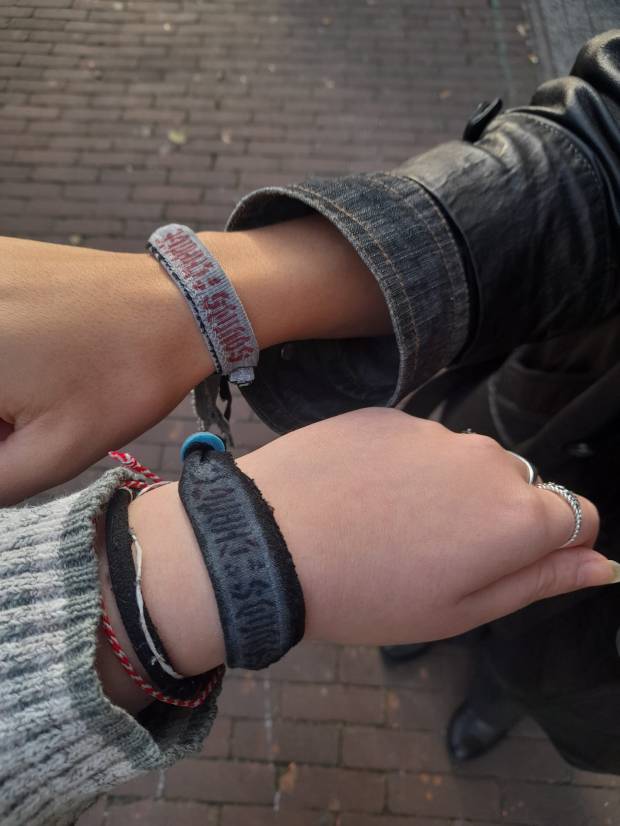
After receiving the approval from Sounds of Change, we decided to give away the 26 handmade bracelets in the city center of Nijmegen on a Saturday afternoon, after keeping one for each member of EVEV (three in total). We approached people in different parts of the city center by simply asking if they would like a bracelet and to learn more about our intervention. Although some of them rejected us almost instantly, as we expected, others did not mind stopping and chatting for a couple of minutes with us, while some even allowed us to take a picture of them tying the bracelets to each other’s wrists. We were pleased to receive such interesting responses, although many of the bracelets remained in our hands. As planned, we headed to one of Nijmegen’s socially engaged organizations to share our initiative with them.
Even before entering Stichting Gast – a local organization committed to providing various forms of help to undocumented immigrants, connected to the café De Klinker and the collectively and voluntarily run venue De Onderbroek – we met two of their volunteers just outside of the building. They happily accepted a bracelet each and allowed us to inform them about Sounds of Change and our intentions. They immediately suggested keeping some bracelets on-site and requested a poster to be displayed in their spaces. We quickly convened to leave some of the bracelets for them, and the next day we visited De Klinker to leave the remaining bracelets along with a larger poster. On this occasion, we also spoke with another volunteer who suggested letting Sounds of Change know that they are welcome in their spaces for potential future collaborations, as they have the capacity to host musical events at De Onderbroek.
This hybrid approach – approaching people on the streets while also informing existing local initiatives – left us very satisfied. Even if on a small scale and within our limited means, we felt that we successfully managed to meet Sounds of Change’s goals by engaging individuals who were not necessarily already involved in reducing social inequalities and connecting them to our local socially engaged community.
According to Rosenthal and Flacks,10 music is an important social factor. It can be the causal element or the one sustaining social movements. For them, music is a mirror of the world we live in, as it is perceived by the composers. This is why research11 shows that music is a great tool for working with trauma. From the exploration of personal feelings to serving as a tool of self-expression, both verbally and non-verbally, to even developing coping and relaxation skills, music has proven itself to be a steadfast tool. Therefore, we believe that organizations such as Sounds of Change, which actively work with and help people through music therapy, should gain more visibility and support. The opportunity to work with them and help them through an awareness campaign was one that all three of us cherished, found exciting and inspiring.
Supporting Sounds of Change through our bracelets has proven to us how simple, low-budget actions like ours can be meaningful in building a sense of community around shared values and sparking interest in future engagement. This experience strengthened our sense of belonging and empowerment as we found a lively community ready to learn, help, and collaborate with Sounds of Change through our personal contribution.
In this project, we shifted from being only researchers to also becoming activists and striving in both research and practice to reduce inequalities in and beyond the Netherlands. By experiencing the impact of our research in practice, we learned a lot about how to achieve social change. This meant stepping out of our comfort zone and addressing the challenges along the way. In the end, not only did we experience change through this process of becoming activists in practice, but we also helped strive towards change with the people we met along the way.
Footnotes
- United Nations. Goal 10 Progress and Info.sdgs.un.org/goals/goal10#progress_and_info. ↩︎
- Shapiro, Shain, et al. Your Guide to Music and the SDGs. 2021, playfair.act4sdgs.org/wp-content/uploads/2021/06/SDG_Music_Guide.pdf. ↩︎
- Sounds of Change. “Training Changemakers.” Sounds of Change, http://www.soundsofchange.org/what-we-do-1. ↩︎
- Sounds of Change. “Our Music Projects in the Middle East.” Sounds of Change, http://www.soundsofchange.org/projects. ↩︎
- Green, Andrew, and John Street. “Music and Activism.” Routledge eBooks, 2018, pp. 171–78. https://doi.org/10.4324/9781315475059-18. ↩︎
- Sounds of Change. “Sounds of Change Academy.” YouTube, 22 Nov. 2022, http://www.youtube.com/watch?v=CbfxNDmrGBw. ↩︎
- Marsh, Kathryn. “Creating Bridges: Music, Play and Well-being in the Lives of Refugee and Immigrant Children and Young People.” Music Education Research, vol. 19, no. 1, May 2016, pp. 60–73. https://doi.org/10.1080/14613808.2016.1189525. ↩︎
- Leksmono, Desideria Lumongga D. and Trisya Putri Maharani. “K-pop Fans, Climate Activism and Participatory Culture in the New Media Era.” Unitas, no. 3, vol. 95, pp. 114-135. doi.org/10.31944/20229503.05. ↩︎
- Jasper, James. “Emotions and Social Movements. Twenty Years of Theory and Research.” Annual Review of Sociology, vol.1 , no. 37, 2011, pp. 1-28, doi:10.1146/annurev-soc-081309-150015. ↩︎
- Rosenthal, Rob and Richard Flacks. “An Introduction to the Music-Movement Link,” Playing for Change: Music and Musicians in the Service of Social Movements, Routledge, pp. 1- 36. ↩︎
- Degmečić, Dunja, et al. “Music as Therapy / Glazba Kao Terapija.” International Review of the Aesthetics and Sociology of Music, vol. 36, no. 2, 2005, pp. 287–300. JSTOR, http://www.jstor.org/stable/30032173. Accessed 30 Oct. 2025. ↩︎

 Culture Weekly